
Does traditional WPC decking need sealing?
2026-11-06 17:22:36
No, classic composite decking does not need regular sealing. Everdur boards are a combination of wood fibre and HDPE plastic, and the plastic component already restricts water absorption. Uncapped boards, however, absorb moisture slowly. One research sponsored by USDA reveals decay-ready moisture in field boards within a year in a rainy environment. This tutorial explains why sealing is useful, when it doesn't work, and what to do instead. I created it for wholesalers, developers and refurbishment contractors who want to reduce callbacks and preserve profit. You'll obtain test data and a basic inspection procedure.
Everdur manufactures traditional composite decking on 50 manufacturing lines and delivers to 225 clients in over 60 countries. Looking for a traditional composite decking provider that will give you wood-fiber ratios and colour cards up front? Send your intended colours and volume to violet@wpcsupplier.com. We respond with samples, specifications and a quotation for a 100 SQM test order.SEND INQUIRY
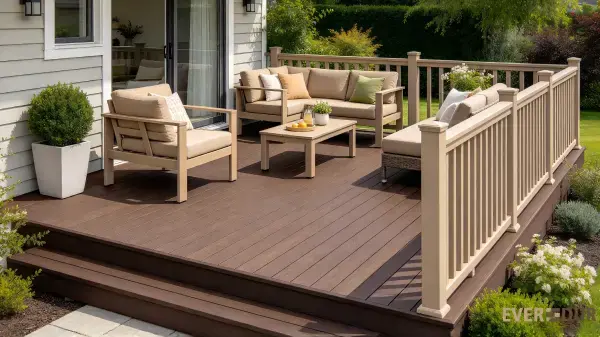

How Is Traditional WPC Decking Designed to Resist Moisture?
Traditional WPC decking (which I'll refer to as classic composite decking combines wood flour, HDPE (high density polyethylene) and additives into one homogenous board. Everdur's basic range contains up to 70% wood fibre with Grade A recycled HDPE. The heating and shaping process of extrusion, when the profile is formed, covers each wood particle with plastic. That layer slows the water down. It doesn't hold water all the way through.
How Does the HDPE Matrix Slow Water Uptake?
HDPE absorbs very little water, and creates a shell around each individual wood particle. Lab testing using industrial weathering procedures reveal low moisture levels. The wood is at around 5% moisture, much below the 25% to 30% required for decay fungus . That's why producers advertize composite as minimal maintenance. But that's just half of the narrative from the lab.
What Do Field Tests Add to the Lab Picture?
Field data changes the story. The same paper reports that large boards exposed for under 12 months in Hilo, Hawaii, reached moisture levels able to support fungal decay. Decay fungi fruited on untreated uncapped boards within roughly two to three years, and fungal threads grew 5 mm below the surface. Hilo is an extreme site. Its Scheffer climate index sits near 350, versus about 50 in Vancouver. Treat Hilo as a stress test, not a forecast for every market.SEND INQUIRY

What Makes Traditional WPC Decking Different from Sealed Wood?
Wood and composite break down differently and hence need different maintenance. The biggest error I see purchasers and installers make is mixing the two playbooks.
Why Does Wood Decking Need Sealing?
Wood expands, checks and warps when it dries and moistens again. The Building Advisor recommendation requires that decking in a roofed, properly protected area be treated with a water-repellent preservative or stain . Pressure-treated boards are no exception. Sealing is a common operation for wood. Ignore that and the boards collapse early.
What Does Classic Composite Skip?
Classic composite decking has no grain to splinter and no yearly coat to refresh. Everdur is produced in widths from 135 to 150 mm, thicknesses from 20 to 25 mm and lengths of 2,200, 2,900 or 3,600 mm. Surfaces might be embossed, brushed, sanded or wood-grain finish. The table below shows a comparison of three deck types on the sealing issue.
| Question | Wood decking | Classic (uncapped) composite | Capped composite |
|---|---|---|---|
| Routine sealing | Yes, regularly | Not recommended | Not needed |
| Takes a sealer or stain | Yes | Yes, but peels in about 18 months | Repels coatings |
| Main moisture risk | Whole board | Ends, edges, fastener zones | Cut ends, any uncapped face |
| Everdur warranty text | Not applicable | 5–10 years (website) | 15–20 years (co-extruded line) |
| Best fit | Budget wood look, with upkeep | Volume sales, dry to moderate climates | Pools, coastal, constantly wet areas |
Everdur's classic warranty reflects its website text (5–10 years); the 15–20 years applies to its co-extruded line. Confirm current terms by email.
What Does Sealing Cost Over Ten Years?
Try a basic model. A 100 SQM wood deck that is recoated once a year for ten years would use up 1,000 SQM of coating work. Development of 20,000 SQM of standard WPC decking requires 200,000 SQM. We assume a year over year interval. The actual period will vary depending on product and environment. But the trend explains why developers and homeowners are turning to composite. That bill is usually labour dominated, not material.SEND INQUIRY

Can Traditional WPC Decking Resist Rain Without Surface Sealant?
Yes. Ordinary rain doesn't call for a sealant on classic composite decking. The wood sits inside plastic, and the board dries between showers. Trouble starts only where water stays for weeks: poor drainage, blocked gaps, or constant ground contact. Fix those, and rain becomes a non-issue for most residential decks.
Why Do Some Classic Boards Perform Better Than Others?
Yes. Classic composite decking does not need to be sealed for normal rain. The wood is wrapped in plastic, the board drying between showers. Trouble only begins when water sits for weeks: poor drainage, closed gaps, or continual ground contact. Fix them and rain is not a problem for most home decks.
What Do Standards Test on a Deck Board?
Two boards might have the same name yet be quite different inside. Water uptake is affected by wood-fiber content, HDPE quality, recycled content, additives, and density. Data from the Forest Products Laboratory indicate the range: commercial uncapped boards from two manufacturers absorbed 26.2% and 30.9% under identical test . That disparity is an indicator of quality. Formulas, not simply costs, when comparing quotations.
How Can You Run a Quick Incoming Water Test?
Here's a field test I employ when comparing offers. Weigh a dry offcut of 300 mm. Place it cut end up in 10 mm of water for 24 hours. Wipe it and weigh it again. Find the % gain. Not a conventional procedure but if you use the same processes on each sample it ranks providers quickly. Take a photo of each result for your file.SEND INQUIRY

How Does Water Penetration Affect Uncapped WPC Decking?
Uncapped classic composite decking has wood fibre exposed on both sides. Water comes in slowly but it does come.
What Does the Moisture Data Show?
Uncapped samples absorbed 26.2% to 35.9% moisture, while capped samples absorbed 14.8% to 19.8%. The uncapped groups sat above the 25% decay line, and capped boards stayed below it. Capped boards did better, but they weren't immune. For classic composite decking, this means water will reach the wood given enough time and exposure.
Where Does Water Concentrate in a Board?
In the field samples, moisture gathered near board ends and edges. Edge moisture approached or passed 25% in some cases, with or without a cap. That pattern matters for installers. Cut ends, fastener zones, and the underside are the weak spots, not the top face that rain hits.
What Happens After Water Gets In?
Wet wood fibre in traditional WPC decking feeds mould, stains and finally rot fungus. Manufacturers added caps to address frequent complaints about mould stains on uncapped boards. Some manufacturers additionally include zinc borate, a fungicide, which is put in during production . Ask your provider whether its formula contains a biocide, and obtain the response in writing.SEND INQUIRY

Does Traditional WPC Decking Need Sealing in Humid Climates?
Classic composite decking is vulnerable in humid regions, but sealing is not the solution. Your markets in Southern Europe, the Middle East and Southeast Asia have got genuine heat and humidity. I would say the correct board grade and design improvements first, before any coating.
How Humid Is Too Humid for Uncapped Boards?
Take the Hilo figures as an upper limit. A Scheffer index around 350 indicates a severe deterioration environment and fungal growth appeared on Hilo boards within a few years. European markets are typically significantly lower. Coastal and tropical places will be closer to that stress therefore verify local statistics for each project. Match the board grade to the wettest part of job.
What Should You Do Instead of Sealing?
Make an exit for the water. Leave spaces as indicated in the installer's handbook, slant the frame for drainage and provide ventilation to the bottom. Clear gaps of leaves and debris every season. Keep planters on feet, not flat on boards. These actions are inexpensive, and they address the main problem: standing water.
What Do Wholesalers and Developers Gain From Design Fixes?
Fixes to design keep your reputation safe at little to no expense. Wholesalers that ship an install sheet with guidance on gap, slope and ventilation reduce needless complaints. A developer that included drainage in the frame plans avoids a post-handover shared cost argument. Both save money by not allowing water to sit, which is a typical root reason behind staining and swelling claims.
When Should You Upgrade to a Capped Board?
Upgrade from traditional composite decking to a capped board for pool, rooftop patios and any damp location. Everdur's co-extruded line wraps all six faces in a polymer shell and offers a 15- to 20-year guarantee. I think both lines provide a nice good-and-better ladder for the wholesalers. Wet zone customers increase without leaving your catalogue.SEND INQUIRY

Can Sealing Prevent Mold and Moisture Buildup in WPC Decking?
Sealing classic composite decking sounds logical, but the evidence is weak. Two sources give useful numbers. One is a retailer's long-term coating test from 2026. The other is the Forest Products Laboratory's end-sealing experiment.
Does Sealing the Cut Ends Help?
In the lab, researchers sealed cut edges of capped samples with dissolved ABS plastic, even on all sides. Sealing didn't prevent moisture uptake. Varying the sealed area didn't change absorption either. That result doesn't prove end sealing is useless in the field. It does mean you shouldn't expect a brush-on coat to make a cut end waterproof.
Why Do Coatings Peel Off Composite?
Ultra Decking tested a wax-based sealer on its uncapped boards. The sealer absorbed on day one and held for three months. At 18 months, it peeled and broke off in every case. The company blames the natural expansion and contraction of the board. A rigid film can't follow a board that moves.
What Actually Prevents Mold?
Cleaning, drainage, and ventilation do the work. A biocide in the formula adds protection from inside the board. A full cap protects further, because the cap keeps water away from the fiber. Sealing sits at the bottom of that list. It treats the symptom, and the coating itself becomes a new maintenance job.SEND INQUIRY

How Do Surface Coatings Change Traditional WPC Decking Performance?
Coatings change how classic composite decking looks, feels, and ages. Rarely do they improve how it performs. The same Ultra Decking test covered stain and paint, and the results line up.
What Happens When You Stain Composite?
The stain bonded well for a month. At three months, early peeling appeared. By 18 months, the stain peeled and flaked heavily. Staining gives a short-lived color refresh, then a patchy surface. For a wholesaler, that means a callback when the customer blames the board.
What Happens When You Paint Composite?
Paint took well on day one, even with a primer. At one month, dirt and dust clung to the painted surface. By 18 months, all the paint cracked, flaked, and peeled, with or without primer. The reviewer concluded that you can coat uncapped boards but shouldn't . I agree with that conclusion.
How Do Coatings Affect Warranty Claims?
A coating gives a supplier a variable to point to in a disagreement. Everdur's website says their traditional composite decking has coverage from 5 to 10 years. If sealing, staining or painting would affect claim processing, get it in writing from any source. Pass that response on to your own consumers on the packing or install sheet.SEND INQUIRY

When Should Traditional WPC Decking Be Sealed or Recoated?
Seldom and only with written justification. Routine yearly sealing, a wood-deck habit, doesn't apply to conventional composite decking. There are a few instances left and I'll go through them.
Which Cases Justify a Treatment?
Use a board only if the manufacturer's handbook suggests a specified product for a defined application. The most frequent example is cut-end therapy. Test any product on an offcut, and wait several weeks for weather to act before you use it. If a provider doesn't offer advice, that gap tells you something about the supplier.
How Should You Handle Field Cuts?
Every cut goes to the heart of standard WPC decking. Both capped and uncapped boards absorb moisture at cut ends, as shown in the USDA report. Use sharp blades to cut to length. Do not let cut ends stand in water. Ask your provider for written guidance on end-treatment. Then print that information on your installation document.
What Should You Do With Faded or Worn Boards?
Wash them first. A little soap and water and a gentle brush can clean up most dull-looking decks. Replace the boards if they have weakened or if the surface has worn through. Do not paint them . For remodelling, mention capped replacement as an upgrade option.SEND INQUIRY

How Can You Tell If Traditional WPC Decking Needs Protection?
Your traditional composite decking will tell you what it needs before it breaks. Learn four indications, check them twice a year and you'll detect issues when they're inexpensive to remedy.
Which Warning Signs Should You Check?
There are four indications I look for on every inspection:
- The patches reappear after cleaning and are dark or green.Scrub with soap and water, rinse and let to dry for two days. If the stain comes again in the same location, water is remaining there. Look beneath for obstructed airflow or standing water. Drainage is what creates most of these recurrent spots, so before you go for a remedy, fix the drainage.
- Flaring or swelling at the cut ends.Run your thumb down the end of each board, near walls, stairs and borders. A rising lip suggests water has entered the end. Record how many boards exhibit this sign and where they are sitting. A cluster generally indicates to one cause, such as a downpipe, sprinkler or low corner.
- Soft or chalky or rough areas on the surface.Gently poke a screwdriver tip into a suspicious area. It is readily marked by a poor board, but a good board will resist it. Take a picture of any soft spot with a penny for size. Early on change weakening boards since a failing part may impact neighbours and cost significantly more to fix.
- Areas that dry slowly after rain.Take a walk on deck an hour after you shower. Wet spots that still exist while the remainder has dried implies poor slope or closed gaps. Mark with tape and check again after your next clean. Persistent wet zones need a frame modification or capped board, not a coating.
On a standard deck, these four inspections take around fifteen minutes. They provide you a history that you may use to make a warranty claim. They inform you when to do something instead of guessing.
How Often Should You Inspect?
Inspect traditional WPC decking twice a year: once after the wet season and once before it starts. Add a check after any flood, heavy storm, or irrigation leak. For a commercial or multi-unit project, assign the task to a named person and keep dated photos. That record helps in any warranty discussion.SEND INQUIRY

What Is the Best Maintenance Strategy for Traditional WPC Decking?
The best strategy is a short routine that you repeat. Clean, drain, ventilate, inspect, and replace early. Nothing on that list involves a sealer. The details change slightly depending on whether you wholesale boards, build housing, or renovate old terraces.
What Does a Simple Cleaning Routine Look Like?
Sweep leaves and grit from the gaps. Wash with soap, water, and a soft brush. Rinse and let the deck dry. Do this two to four times a year, based on trees and shade nearby. Skip yearly sealing, staining, and painting. Everdur's spec sheet confirms that classic boards need no painting or finishing to look new.
How Do Wholesalers Protect Margin on Classic Boards?
Selling classic composite decking is a volume game, so one complaint can erase the margin on several sales. Ask your supplier for the wood-fiber and HDPE ratio, plus the recycled content, in writing. Lock your two or three main color numbers and request same-batch reorders. Everdur's MOQ is 100 SQM, so you can test before you scale. Ask about mixing colors inside that trial. Include a one-page care sheet in each pack.
How Do Developers Write Maintenance Into the Spec?
Developers who specify standard WPC decking care about lifecycle cost and who answers for defects. Put the cleaning routine, the inspection schedule, and a ban on coatings into the handover manual. Require batch records and test reports with each delivery, and split deliveries to match your site schedule. Confirm that the company you contract with is the factory that holds the certificates. Everdur lists ISO, FSC, CE, SGS, RoHS, REACH, Intertek, and ASTM credentials, and we share the documents on request.

How Do Renovation Contractors Use Classic Boards?
Renovation jobs run on tight budgets and short schedules. Boards of classic composite decking install on a joist frame with hidden clips, and installers cut them with standard woodworking tools. A frame lets you level an old concrete slab or worn timber platform without demolition. Pitch the maintenance savings to the owners' committee: no sealing, no painting, and a soap-and-water routine. Ask us about small-format options for repairs.
How Do You Spot Formula Cutting Before It Costs You?
Price pressure tempts some factories to raise the wood share or swap recycled grades. The result shows up months later as cracks, color drift, or swollen ends. Protect yourself with three steps. Ask for the formula ratio in writing. Run the 24-hour water test on every sample and on a random board from each delivery. Compare weights of equal lengths, because large changes can signal a changed recipe. Keep the results in one file.
How Do You Verify a Supplier Before the Trial Order?
Verify every claim about classic composite decking before you trust it, including ours. Everdur runs 50 WPC lines with an annual capacity of 30,000 tons and follows 5S on-site management. About 80% of output ships abroad to more than 60 countries, and over 100 of our 225 customers order actively. Chains such as Lidl, Hagebau, Hornbach, Hellweg, and Globus are among them. Ask for a video tour or an audit, and plan on two to five weeks from price list to trial order.SEND INQUIRY
Conclusion
Classic composite decking doesn't need routine sealing, and coatings tend to cause more trouble than they solve. The plastic matrix slows water, but uncapped boards still absorb moisture at ends and edges, especially in wet climates. Long-term tests show sealers, stains, and paint peeling within 18 months. Better habits work better: drainage, ventilation, cleaning, and early replacement. Choose capped boards for wet zones. With classic composite decking, your best protection is a clear spec, written guidance, and a supplier who answers questions.SEND INQUIRY

FAQ
Q: Does traditional WPC decking need sealing?
A: No. Routine sealing isn't needed, and it isn't recommended for uncapped composite. A retailer's test found that sealer, stain, and paint all peeled within 18 months. Focus on drainage, ventilation, and cleaning instead.
Q: Can I seal the cut ends of my boards?
A:: Only if your supplier recommends a named product. In a USDA-hosted lab study, even full end sealing with ABS plastic didn't prevent moisture uptake. Ask for written guidance, and test any product on an offcut before you use it.
Q: Will uncapped composite decking grow mold?
A: It can, when water stays on or inside the board. Mold staining was a common complaint on uncapped boards. Good drainage and regular cleaning reduce the risk, and a capped board reduces it further.
Q: Is classic composite decking safe in humid climates?
A: Yes, classic composite decking works in humid climates with good design. Keep the frame ventilated, let water drain, and clean the gaps. In constantly wet areas such as pool surrounds, choose a capped board. Ask for water absorption and UV reports before you commit.
Q: What warranty comes with Everdur's classic composite decking?
A: Everdur's website lists 5 to 10 years for classic composite. The co-extruded line carries 15 to 20 years. Request the full warranty text by email at violet@wpcsupplier.com, and ask whether coatings change claim handling.
Q: What are the MOQ and shipping terms?
A: The MOQ is 100 SQM. Ask us about mixing colors in a trial order. Boards ship FOB Shanghai or Ningbo. Please confirm current terms, stock lengths, and lead times by email, because schedules change with the season.

Request Classic Composite Decking Samples and a Mixed-Color Trial Quote
Everdur supplies classic composite decking to wholesalers, developers, and renovation contractors worldwide. If you want a classic composite decking supplier that shares formula ratios, color cards, and test documents upfront, send us your colors, lengths, and volume. We reply with a sample plan and a quote for a 100 SQM trial order.SEND INQUIRY
Email: violet@wpcsupplier.com.

References
1. American Wood Protection Association Proceedings, 2015. Mankowski, Manning & Slowik, “Durability of Capped Wood Plastic Composites.” USDA Forest Service Treesearch.
2. Ultra Decking, 2026. “Can You Paint, Seal, or Stain Composite Decking?” (retailer long-term coating test, published May 5, 2026).
3. Forest Products Journal, 2013. Ibach, Gnatowski & Sun, “Field and Laboratory Decay Evaluations of Wood–Plastic Composites.” USDA Forest Service Treesearch.
4. ASTM International, 2021. ASTM D7032-21, “Standard Specification for Establishing Performance Ratings for Wood-Plastic Composite and Plastic Lumber Deck Boards, Stair Treads, Guards, and Handrails.”
5. CEN via ILNAS, 2014. EN 15534-4, “Composites made from cellulose-based materials and thermoplastics: Specifications for decking profiles and tiles.”
6. Building Advisor, undated. “Decking” guidance on water-repellent preservatives and stains for wood decking.
About the Author
Violet is manage at Everdur, where she advises wholesalers, developers, and renovation contractors on classic composite decking specifications. Violet reviews cross-sections, test reports, and warranty terms with buyers in Central and Eastern Europe, Southern Europe, the Middle East, and Southeast Asia, and has 10 years of experience in wood-plastic composites.
Send Inquiry

Related Industry Knowledge
- Eco-Friendly WPC Decking vs Recycled Wood: Which Is More Sustainable?
- Weather Resistant Co-Extrusion WPC Cladding: Perfect for External Walls
- Wood Grain Custom WPC Decking: Custom Patterns for Your Style
- Wholesale Co-Extrusion WPC Cladding: Factory Price & Bulk Supply
- Low MOQ WPC Commercial Building Facades: Perfect for Small Commercial Projects
- WPC Composite Fencing for Residential Properties: Stylish & Secure
- Best WPC Cladding Designs for Villa and Luxury Residential Projects
- WPC Villa Fence with Wood Grain: Enhance Your Villa’s Aesthetics
- Top Composite Screen Fencing Manufacturers in 2026
- Co Extrusion WPC Decking vs Regular WPC: Which Saves You More Money?