_1777451497595.webp)
Top Composite Screen Fencing Manufacturers in 2026
Finding a reliable outdoor screening manufacturer has become more nuanced than simply comparing price lists. As more architects, contractors, and landscapers specify wood-plastic composite materials for outdoor projects, the range of suppliers has expanded considerably — and so has the variation in quality. This guide focuses on what genuinely matters when evaluating composite screen fencing manufacturers in 2026: material composition, production consistency, customization depth, and the certifications that verify performance claims rather than just decorate a brochure.
The outdoor living market in Europe and North America continues to shift toward low-maintenance, weather-resistant screening solutions. Homeowners want privacy without sacrificing airflow. Commercial clients need durable boundary treatments that hold up across seasons without repainting schedules. Composite screen fence panels answer both demands, combining recycled wood fiber and high-density polyethylene into profiles that resist moisture, UV degradation, and biological attack. Whether you're sourcing for a residential garden project, a hospitality terrace, or a landscape architecture scheme, the manufacturer you choose will shape the outcome more than the specification sheet alone.
What Should You Look for in a Composite Screen Fencing Manufacturer?
There's more to picking a manufacturer than just making sure they make profiles in the right size. Suppliers who consistently give results are different from those who cause buying problems months later in a number of ways.
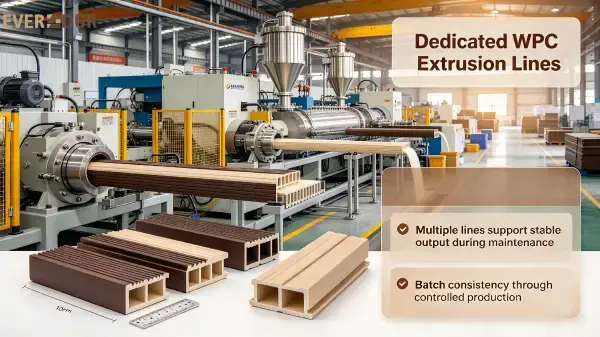
Production infrastructure is very important. A company with more than one extrusion line can keep the supply going even when one line needs maintenance. When suppliers only have a few machines, it can be hard for them to meet large or urgent orders on time. Look for businesses that can only extrude WPC. Avoid facilities that can switch between different types of plastic products.
Transparency in material sourcing is another useful signal. When you mix clean wood fiber with grade A recovered HDPE, you get a product that works the way you expect it to. When manufacturers can't be clear about the grades of their raw materials or use different types of post-consumer plastic, they make the end product less consistent. This can show up as differences in color, surface flaws, or changes in size after installation.
Depth of technical support is often what sets experienced manufacturers apart from newer ones. If a seller sells goods on more than one region, they will have dealt with harsh climates, strange installation rules, and different building codes. That experience turns into useful information when your project comes up with a unique problem.
During the sourcing phase, after-sales accountability is often forgotten. Directly inquire about the terms of the insurance, the replacement process, and the way that problems are recorded and dealt with. If a manufacturer is sure of the quality of their work, they will talk about these processes in an open way instead of using general quality assurance language.
Last but not least, think about the client base breadth. Suppliers who work with retailers in Europe, home builders in North America, and commercial projects in Asia have had to change how they control quality to meet the needs of these different markets. For manufacturing maturity, that breadth is a good measure.
Composite Screen Fencing Materials, Profiles, and Surface Options
What an outdoor screening panel is made of affects almost every aspect of its life, including how it ages, how it reacts to changes in temperature, and whether it keeps its look after years of being in the sun and rain.
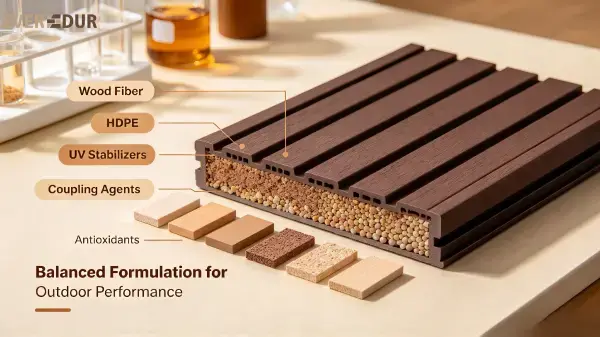
A lot of good outdoor composite panels are made with a core mix of wood powder, HDPE, and chemicals like UV protectors, binding agents, and antioxidants. The amount of wood fiber to polymer changes how dense something is and how it reacts to water. A higher wood content can make the natural look better, but the additives need to be carefully balanced to keep the wood from absorbing water. Well-made composites don't soak up a lot of water, which is important in places where it rains a lot or freezes and thaws a lot.
With co-extrusion technology, a secure polymer cap is put on top of the composite core. This top layer protects the wood fibers inside from direct UV light and water, which makes the color last longer and the surface stay strong over time. Second-generation co-extruded profiles are a big improvement over older single-extrusion composites. This is especially true for outdoor screening uses where surface wear is obvious and bad for business.
Profile geometry is very different from one manufacturer to the next. The widths are usually between 90mm and 200mm, and the thicknesses are between 15mm and 30mm. Standard lengths of 1.8m and 2.2m work with most home and business frame systems, but special lengths can be made with enough notice. Cross-sections that are popular, like 140×25mm and 150×25mm, are almost always used in European building codes.
The final look is significantly affected by the choice of surface finish. Textures that are brushed give wood a straight grain look that works well with modern designs. The natural variations in sawn wood are reflected in deep stamping. Wood grain surfaces with different levels of tonal depth work well for projects that need to look like they are made of natural wood. A sanded finish has a smoother, cleaner look. Because each method affects color pigmentation in a different way, looking at samples in the right setting is still the most accurate way to judge them.
Reliable makers' color ranges usually include neutral grays, warm browns, and natural wood tones. For example, ash gray, teak, walnut, cedar, and stone gray are all patterns that are found in all market-leading ranges. In addition to standard color palettes, projects with specific design briefs can have colors matched to their exact needs.
How Do Composite Screen Fencing Manufacturers Handle Custom Designs?
Material Adaptation for Regional Climates
Outdoor products work in very different environments, such as a garden on the coast of Europe and a terrace in the American Southwest that gets a lot of sun. A good maker changes composite recipes instead of using a single formula for everything.
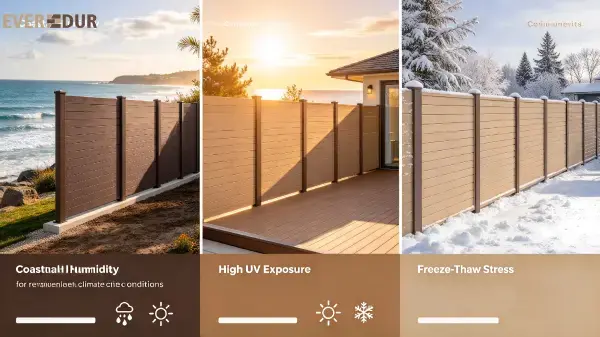
In coastal areas with a lot of humidity, the coupling agent chemistry that connects wood fiber to the polymer matrix needs to be tweaked so that it can withstand long-term contact to wetness. In places where UV light is very strong, stabilizer loading needs to be carefully calibrated to keep colors from chalking or shifting within reasonable time frames. Freeze-thaw stresses change the safety of dimensions in cold places. This is especially important for composite screen fence panels that are set in frames, where limited thermal movement can cause structural stress.
Manufacturers who can really adapt to climate change will ask you important questions about where your project will be built before they confirm a design. People who just say that their standard product "works everyplace" should be looked at more closely.
Color, Texture, and Profile Customization
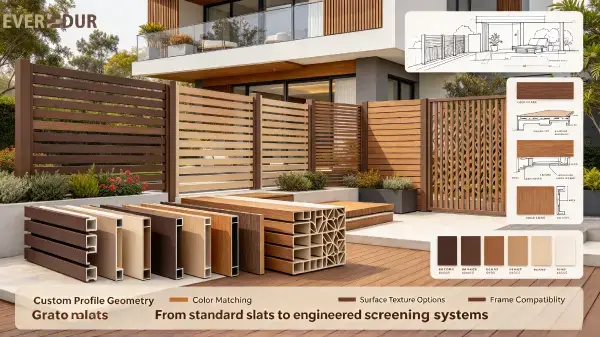
For architectural projects, custom color development usually starts with matching the color to a specific RAL or NCS reference. Samples are then made and approved by the client before full production runs begin. This process takes longer, but it lets screening displays fit in perfectly with the building around them instead of using a standard color scheme.
Customizing surface textures lets you be more creative. With custom tooling, you can make slatted panels with certain reveal widths, walls with artistic cutout designs, or groups of profiles of different widths. Frame compatibility is also very important. For example, if you want composite panels to fit into aluminum or steel post systems, you need to work with the frame provider to set the right size limits.
Special Profile Engineering
Custom profiles need more than just color and texture. They also need new extrusion dies that are machined to the exact cross-section. Because this is a big investment, manufacturers usually need a minimum order quantity to make it worth it. When it comes to bigger business or landscape architecture projects, custom designs let screening systems be built around the structure's needs instead of using stock items.
Customizing a profile also lets you change the length. When installing projects with consistent bay widths, non-standard lengths cut down on waste, which is important when choosing high-quality composite material for a large-scale project.
Composite Screen Fencing Production Capacity, Quality Control, and Certifications
Understanding Production Scale and Supply Reliability
The amount of work that a maker can do directly impacts their ability to meet deadlines for orders, make sure that batches are all the same, and handle extra work during busy project times. With 40 to 50 dedicated WPC extrusion lines, a facility can produce more than 1,500 containers a year, which is a big enough quantity to support both large business contracts and regular availability for smaller orders of WPC waterproof screen fencing.
Consistency from batch to batch rests on process controls being used throughout production, not just during final review. These controls should include dimensional standards, color matching, and surface quality. Facilities that have documented 5S workplace organization tend to have stricter rules for production, which leads to more consistent output.
Quality Control Processes That Actually Matter
Meaningful quality control in the production of composite decking and fencing includes checking the dimensions of raw materials while they are being made and testing final products against set acceptance standards. Accelerated weathering chambers test for UV resistance. Reliable makers use specific test lengths, like 2,000 hours of UV exposure with recorded color delta-E results, instead of making general claims about durability.
Testing for moisture absorption, density confirmation, flexural strength measurement, and surface hardness assessment all work together to give a good picture of how well a product works. When manufacturers write down these results and show them to potential buyers, it shows that they are confident in the quality of their products.
Certifications Worth Verifying
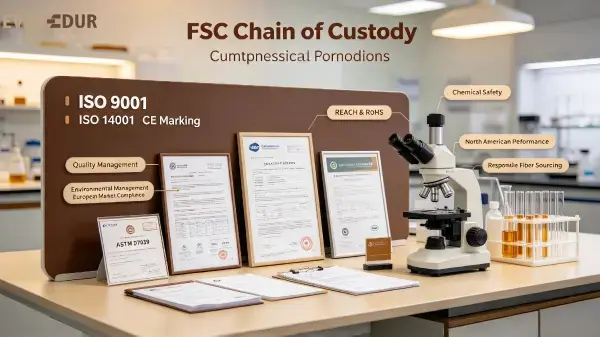
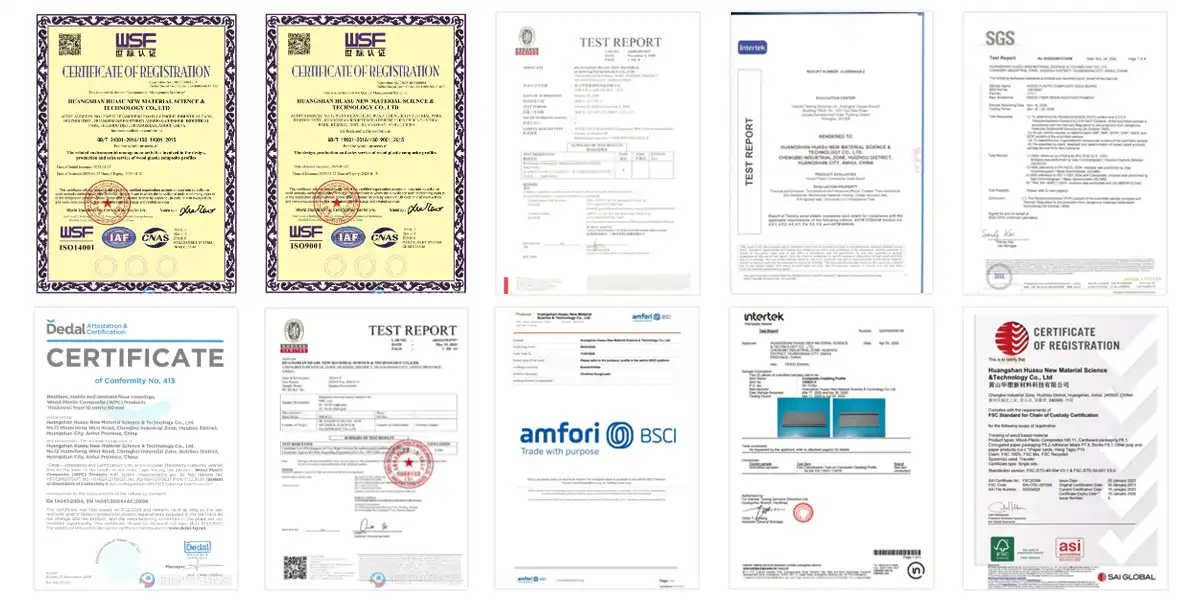
ISO 9001 for quality management systems, ISO 14001 for environmental management, FSC chain-of-custody certification for responsible fiber sourcing, CE marking for compliance with European market rules, REACH and RoHS for chemical safety in Europe, and ASTM D7039 for the North American market are all certifications that are relevant for composite outdoor screening panels. Each certification is an outside check of a certain claim; they are most useful when they can be checked through the organization that issued them instead of just being shown on a website.
Choosing a Composite Screen Fencing Manufacturer for Global Outdoor Projects
Evaluating Export Experience and Logistics Capability
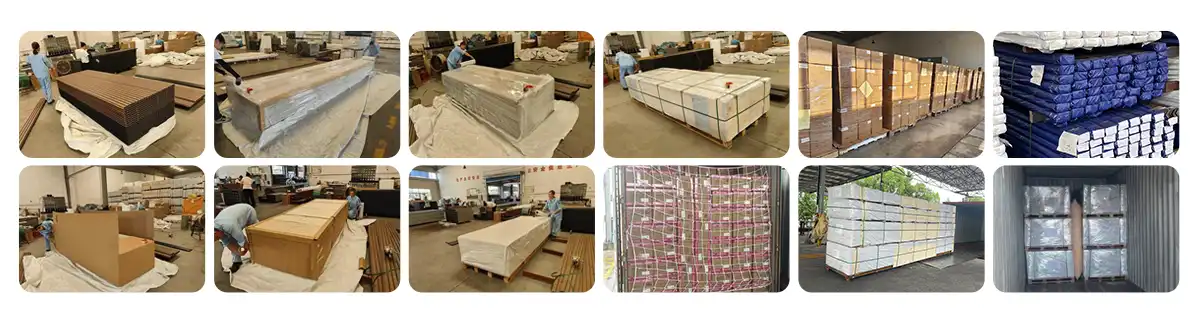
A company that has exported goods to more than one continent knows how to deal with the paperwork, logistics, and customs rules that cause delays for sellers with less experience. Real operational breadth is shown by active clients in Europe, North America, Asia, and Oceania. FOB prices from big ports like Shanghai and Ningbo, along with clear lead time promises and packaging standards that work with ocean freight, make it safer to buy things for foreign projects.
Long-Term Partnership Considerations
Outdoor material sellers become important partners long after the first sale. When installed projects need upkeep or extensions, having access to replacement stock, uniform colorway production over multiple years, and quick technical help become important. Manufacturers with 100 or more active long-term clients have shown that they are stable enough to work with others for more than one year.
Warranty terms should be carefully read. Solid co-extrusion profiles from well-known brands usually come with a 20-year warranty. This shows that the company is confident in the material's performance and makes it clear what to do if problems happen.
Aligning Manufacturer Capabilities with Project Requirements
A screening maker needs to be able to do different things for different types of projects. For a residential garden installation, esthetic choices and low MOQs are most important. For a big business terrace job to go smoothly, there needs to be a lot of supplies, consistent color mixing, and regular arrival times. For a landscape architecture plan with custom design elements to work, the manufacturer must be able to make the tools and be willing to work with the designer on the technical side.
Specification mismatches that cause problems during purchase or installation can be avoided by matching the manufacturer's capabilities to the type of project. It's easy to make things go much better by talking to suppliers about the project's scope, schedule, and performance standards before making a commitment.
Conclusion
In 2026, choosing a composite screen fence maker means looking at their production infrastructure, the quality of their materials, how much they can customize, and how trustworthy their certifications are, rather than just believing what they say. WPC waterproof screen fencing is now a well-established product category, including composite screen fencing. The companies that regularly give results are the ones that spend in process controls, formulations that work well in different climates, and open communication with clients. For outdoor projects in North America and Europe, these factors together decide if a screening installation works as planned over the time it was meant to.
FAQ
Q: What is the typical service life of outdoor composite screen fencing, and what affects it?
A: Composite screening panels from established manufacturers typically carry service life estimates of 10 to 25 years for outdoor use. The actual lifespan depends on the co-extrusion technology used, the quality of UV stabilizers in the formulation, local climate conditions, and installation method. Second-generation co-extruded profiles with a protective polymer cap generally outperform single-extrusion composites, particularly in high UV or high-humidity environments.
Q: Can composite screen fence panels be used for both privacy and decorative purposes outdoors?
A: Sure. The same profile may be used for simply utilitarian screening, e.g. for defining boundaries or concealing utility areas, or as part of a decorative architectural design, depending on the surface treatment, colour and panel arrangement used. Slatted patterns provide variable degrees of seclusion and air exchange . Solid screening patterns provide the most visible isolation . All composite screening materials are intended for outdoor installation only.
Q: What certifications should I verify when sourcing composite screening panels for a European or North American project?
A: The main regulatory criteria for European projects are CE marking, REACH compliance and RoHS certification. FSC accreditation involves ethical sourcing of fibre. ISO 9001 is the certification for quality management. ASTM D7039 is the performance standard for North American applications. The most reliable technique to check claims of conformity is to ask for the real certificate papers, not logos.
Partner with Everdur for Your Composite Screen Fencing Project
As a building company or fence builder, Everdur can help you with your project by providing consistent batch supplies and technical specs that fit your installation needs. Our goods meet the standards set by the EU (CE), ASTM D7039, and GB/T 24137. They also have environmental qualifications, such as Recycled Content certification and E0 environmental standard compliance. From FOB Shanghai and Ningbo, we can handle large orders with reliable lead times.
For wholesalers of building materials: We offer competitive bulk prices, flexible MOQs starting at 100 SQM, and free samples to approved buyers. Our range of composite screen fence comes in a wide range of colors and is subject to strict quality controls that protect your company's image with customers with composite screen fencing.
For resellers and end customers: Get free design advice and help with installation, plus access to all of our customization options, such as color matching, profile choice, and surface texture options that are perfect for your outdoor space.
Get in touch with our team to talk about the needs of your project. We are a committed manufacturer of composite screen fence with 16 years of experience and clients in more than 60 countries. This means we can help with projects of any size.
Get in touch with us at violet@wpcsupplier.com via email.
References
1. European Committee for Standardization. EN 15534: Composites Made from Cellulose-Based Materials and Thermoplastics (Wood-Polymer Composites). CEN, Brussels, 2014.
2. ASTM International. ASTM D7032: Standard Specification for Establishing Performance Ratings for Wood-Plastic Composite Deck Boards and Guardrail Systems. ASTM International, West Conshohocken, PA, 2023.
3. Forest Stewardship Council. FSC Chain of Custody Certification: Guidance for Suppliers and Manufacturers. FSC International, Bonn, 2022.
4. European Chemicals Agency. REACH Regulation (EC) No 1907/2006: Understanding Obligations for Importers and Manufacturers of Building Materials. ECHA, Helsinki, 2023.
5. Clemons, C.M. Wood-Plastic Composites in the United States: The Interfacing of Two Industries. Forest Products Journal, Vol. 52, No. 6, 2002, pp. 10–18.
6. Morrell, J.J. Wood-Plastic Composite Durability: A Review of Current Knowledge. Forest Products Laboratory, USDA Forest Service, Madison, WI, 2020.
7. International Organization for Standardization. ISO 14001:2015: Environmental Management Systems — Requirements with Guidance for Use. ISO, Geneva, 2015.
Send Inquiry
You may like