_1777451497595.webp)
WPC Cladding vs Vinyl Cladding: Which Is Better for Outdoor Use?
Architects, builders and property owners often compare WPC cladding vs vinyl cladding when selecting external wall materials. Both have a place in modern building, but are used for distinct requirements and behave differently in real outside settings. WPC cladding is constructed from a mix of wood fiber and recycled HDPE plastic. It gives the outer facade the warmth of genuine wood, along with strong weather protection and structural stability. Vinyl siding is a completely synthetic product made from PVC. Vinyl siding has been used widely for decades because it is affordable and easy to install. So which one is better for outdoors? It really depends on what you prioritize most, looks, longevity, maintenance requirements or budget. In this post, we’ll go into the fundamental distinctions among those elements based on material science and real-world installation experience, so that you may make an educated choice before investing in either option for your next outdoor endeavor.
What Makes WPC Cladding Different from Vinyl Cladding for Outdoor Use?
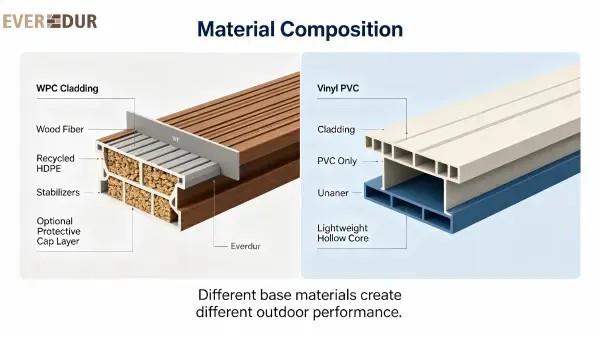
WPC cladding and vinyl cladding are distinct in that they are made from various base materials, and that makes a difference in how each one performs on an outside face.
WPC cladding (wood-plastic composite) is produced by an extrusion molding method which uses wood particles, Grade A recycled HDPE and chemical stabilizers. The result is a solid, stiff panel that mimics the feel and warmth of actual lumber, but resists the moisture absorption and decay that make real wood troublesome outside. Some WPC profiles are manufactured via a co-extrusion process where a protective polymer coating is added to the surface during manufacturing. This gives an extra layer of protection against surface abrasion, stains and UV deterioration.
Vinyl cladding is made completely of PVC (polyvinyl chloride). It contains no organic fibers. Lightweight, slick and available in a huge variety of factory colors. It does not absorb moisture (because it has no wood fiber) and does not encourage mold development from organic breakdown. But PVC has well-known issues with long term UV exposure – it will lose its color, become hard, and in certain environments, visibly bend as it gets hot.
The design of composite outside cladding also means that it is heavier per panel, with higher mass, which helps with acoustic insulation and gives a more solid sense on a building front. Vinyl is hollow and lighter, it may sound hollow when touched and may bend slightly between fastening places.
The organic texture of wood-plastic cladding is a popular option for projects with a natural esthetic such as residential villas, boutique hotels and modern commercial frontages. Vinyl may still be a viable solution for budget utility installations where esthetics don’t matter.
WPC Cladding Durability Against UV Exposure, Moisture and Temperature Changes
Outdoor construction materials are subject to a constant assault of UV radiation, rainfall, freeze-thaw cycles and temperature changes. How a cladding material manages each of these stresses impacts how long it will remain functional and appealing on a wall.
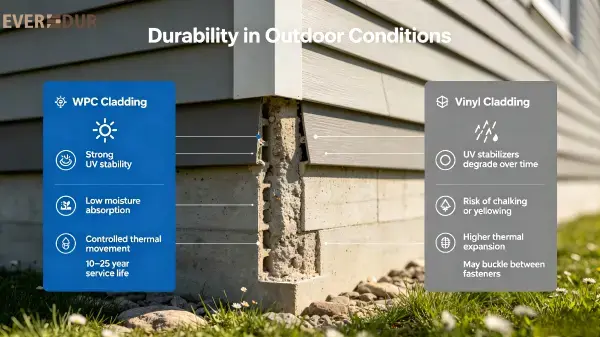
UV Exposure Co-extruded Composite Outdoor Cladding WPC panels with mineral enhanced surface layers show very little change in color after more than 2,000 hours of UV exposure testing. The colors are embedded throughout the cap layer, not just a surface coating, so they do not peel. Standard vinyl cladding is manufactured with UV stabilizers, however these additives wear off over time. Older vinyl panels tend to get chalky or yellowed after many years of being exposed to the sun in warmer areas.
Moisture resistance. WPC profiles are thick and the wood fibers in the composition are bonded with plastic binders, so they absorb relatively little moisture, compared to natural lumber. Vinyl naturally is non-porous and hence deals well with surface wetness. However, at panel joints and penetrations, moisture may occasionally track behind both materials if installation details are not properly handled. Proper ventilated facade design (with an air gap below the cladding) allows both materials to function better in rainy areas.
Temperature Changes: This is a point where vinyl cladding is often criticized. PVC has a relatively high coefficient of thermal expansion, thus it expands and contracts quite a bit throughout the cold winters and hot summers. This cycle induces minor buckling of panels and loosening of fasteners . It opens joints . WPC external exterior cladding also expands and contracts, but the wood-fiber matrix limits this movement, and stabilizers are added to modern formulas to reduce dimensional change. This difference is essential in locations with high seasonal temperature differences, such as northern Europe and northern United States.
Wood-plastic composite cladding has proven durable in the long term in many geographical locations with a recorded service life of 10-25 years depending on installation quality and environment.
How Does WPC Cladding Compare with Vinyl Cladding in Maintenance?
Cleaning and Surface Upkeep
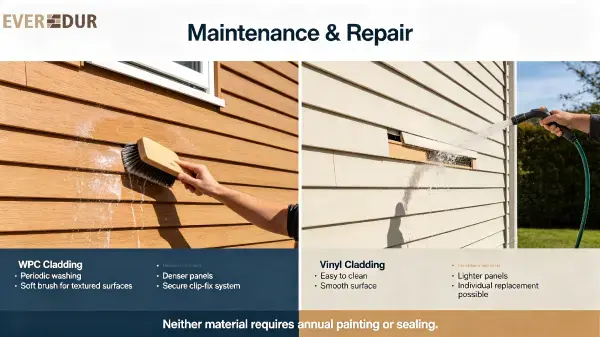
WPC and vinyl cladding don’t need yearly painting or sealing, which is an advantage over real wood. These materials need just routine care including periodic washing with water and mild detergent to remove dirt, algae or airborne deposits. It may be simpler to wipe off flat vinyl, but WPC panels with brushed or embossed textures will hold a bit more dirt on the surface, which is easily scraped off with a soft brush during the annual cleaning. Under normal use neither material needs sanding, re-staining or specialist coatings throughout its operational life.
Repair and Replacement
If panels are damaged, either from collision, extreme weather or an installation fault, the method of replacing them varies between the two materials. Vinyl panels are thinner and more flexible and occasionally may be popped out and changed separately without disrupting neighboring panels, which is nice. WPC panels are denser. They often include a hidden clip-fix system. So replacement takes more cautious handling. The result is a more secure, solid installation overall. With renowned producers that have reliable pigment compositions, color matching with WPC goods is usually more constant.
Long-Term Cost Consideration
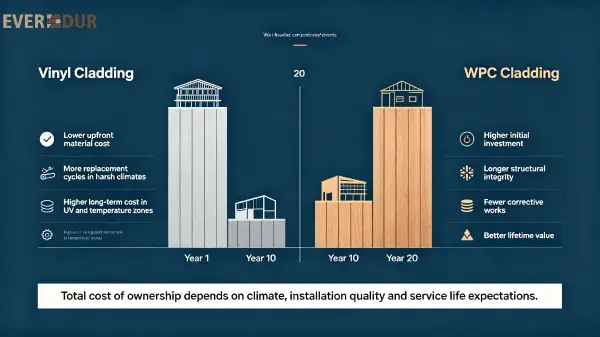
Vinyl cladding usually has a cheaper material cost upfront. However, when you add possible replacement cycles, especially in locations that stress PVC via UV and temperature cycling, the overall 20-year cost may close the difference significantly. Wood-plastic composite cladding tends to preserve its structural integrity and appearance for longer, reducing the frequency of corrective work and replacement expense during the lifespan of the structure.
WPC Cladding Wood-Grain Designs, Colors and Profiles for Exterior Facades
Surface Texture Options
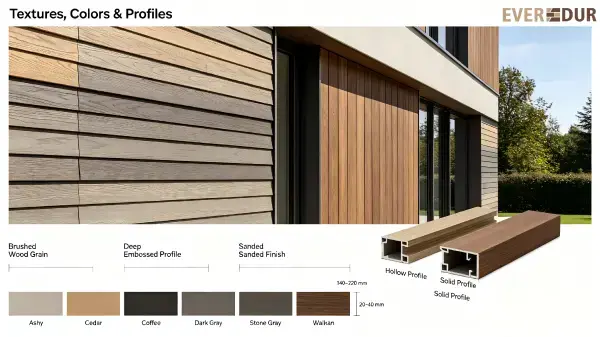
One of the practical advantages of the wood-plastic composite panels for external facades is the choice of surface treatments. Brushed textures seem like the linear grain of cut wood. Three dimensional shadow lines are created by deep embossed profiles which enhance the visual effect of a building elevation. Sanded finishes provide a more smooth, high-end look that works well with modern architecture. These surface possibilities are created as part of the extrusion process so the texture is structural not a thin applied coating that may peel off over time.
Color Range and Stability
Exterior composite wall cladding is often available in ash gray, cedar, coffee, dark gray, stone gray, teak, walnut, sandal wood and other colors. These range from warm realistic tones to chilly modern neutrals. We also provide custom color matching for larger projects that need a particular palette. In co-extruded profiles the pigments are buried in the cap layer and the color permanence over extended UV exposure is much superior than surface painted alternatives.
Profile Geometry and Installation Patterns
They are available in hollow and solid constructions, in widths from 140mm to 220mm and thicknesses from 20mm to 40mm. Lightweight hollow profiles are appropriate for ordinary residential and commercial facades. Additional stiffness for towering facades or installations in high wind areas. Solid profiles. Panels may be installed horizontally or vertically, or mixed to provide architectural contrast. In majority of the WPC outdoor facade cladding profiles, a concealed clip-fixing technique is employed to remove visible fasteners and create smooth façade lines – perfect for new and repair projects.
Which Is Better for Outdoor Projects: WPC Cladding or Vinyl Cladding?
For Residential Facades and Villas
For homeowners and residential developers looking for an exterior that reads natural, warm and premium, wood-plastic composite cladding is the most suitable material. The wood grain texture, color depth and dimensional stability provide a quality of facade that vinyl, regardless of finish, cannot nearly match. It also works well in the kind of climates typical to the home markets of Europe and North America.
For Commercial and Large-Scale Projects
Beyond appearance, commercial buildings, hotels, public infrastructure and multi-unit residential structures must take long-term performance, warranty coverage, certification compliance and supply consistency into account. Another major benefit of wood plastic composite exterior cladding is that it satisfies international certification criteria like CE, FSC, REACH, RoHS, ASTM and Intertek testing that are more and more specified in commercial procurement specifications all around Europe and North America.
For Budget-Sensitive or Utilitarian Applications
If money is tight and appearances aren't the issue, vinyl cladding is still a feasible alternative. PVC cladding may not be a priority but it works well on agricultural buildings, utility structures and low-rise commercial units. But the limitations of vinyl in esthetics and long-term performance become more apparent when the facade represents the public face of the structure.

Conclusion
WPC and vinyl cladding are both suitable for exterior building, but fit different goals. Vinyl has a reduced entrance cost and is simple to install. Composite exterior cladding is more efficient in providing esthetic quality, long term durability in various climates, low lifetime maintenance requirements, and wider certification compliance. For most residential, commercial and rehabilitation façade projects in European and North American markets, wood-plastic composite WPC Cladding offers greater value across the complete project lifespan.
FAQ
Q: Can WPC cladding be used in both hot and cold climates outdoors?
A: Yes. Wood-plastic composite cladding is formulated with stabilizers that moderate thermal expansion and contraction. It performs reliably across a wide range of climates, from humid coastal regions to areas with harsh winters, provided installation follows recommended guidelines for fixing and joint spacing.
Q: How long does WPC outdoor facade cladding typically last?
A: Under normal outdoor conditions and with proper installation, composite exterior cladding has a documented service life of 10 to 25 years. Co-extruded profiles with a protective cap layer tend to perform toward the upper end of that range, particularly in climates with strong UV exposure.
Q: Is WPC cladding suitable for renovation projects as well as new construction?
A: Absolutely. Wood-plastic composite wall cladding works well for both new builds and facade renovation projects. It can be fixed to steel or aluminum substructures and is compatible with ventilated facade systems, making it straightforward to apply over existing wall substrates during a retrofit.
Ready to Specify Exterior Cladding for Your Next Project? Talk to Everdur
Whether you are a construction firm managing a large commercial development, a fence contractor sourcing reliable exterior materials, a building materials wholesaler looking to expand your product range, or an end customer planning a residential renovation, Everdur has options built around your specific needs.
For construction firms and contractors: Request technical datasheets, certification documentation (EU CE, ASTM D7039, GB/T 24137), and project-specific material recommendations backed by 16 years of manufacturing experience.
For building materials wholesalers and resellers: Inquire about wholesale pricing structures, container-volume orders, and free sample sets to evaluate quality before committing.
For end customers: Ask about free design consultations and installation guidance to get your facade project started with confidence.
All Everdur products comply with EU CE, US ASTM D7039, and China GB/T 24137 standards, and carry environmental certifications including FSC, REACH, RoHS, and Recycled Content certification to E0 environmental standards.
As a professional WPC cladding manufacturer with over 1,500 containers of annual production capacity and active clients across 60+ countries, Everdur provides stable supply, strict quality control, and responsive support throughout your project.

Reach out directly to our team at violet@wpcsupplier.com to discuss your requirements.
References
1. Clemons, C. M. (2002). Wood-plastic composites in the United States: The interfacing of two industries. Forest Products Journal, 52(6), 10–18.
2. European Committee for Standardization. (2012). EN 15534: Composites made from cellulose-based materials and thermoplastics (usually called wood-polymer composites (WPC) or natural fibre composites (NFC)). CEN.
3. Stark, N. M., & Matuana, L. M. (2004). Surface chemistry changes of weathered HDPE/wood-flour composites studied by XPS and FTIR spectroscopy. Polymer Degradation and Stability, 86(1), 1–9.
4. American Society for Testing and Materials. (2011). ASTM D7031: Standard Guide for Evaluating Mechanical and Physical Properties of Wood-Plastic Composite Products. ASTM International.
5. Forest Stewardship Council. (2023). FSC International Standard: FSC Principles and Criteria for Forest Stewardship (FSC-STD-01-001 V5-2). FSC International Center.
6. Klyosov, A. A. (2007). Wood-Plastic Composites. John Wiley & Sons.
7. Caulfield, D. F., Clemons, C., & Rowell, R. M. (2005). Wood thermoplastic composites. In R. M. Rowell (Ed.), Handbook of Wood Chemistry and Wood Composites (pp. 365–378). CRC Press.
Send Inquiry
You may like