_1777451497595.webp)
WPC Decking Maintenance Tips: Keep Your Outdoor Deck Looking New for Years
Keeping your deck in great condition doesn’t take a hard procedure WPC decking is a blend of wood fiber and high-density polyethylene that is far more resistant to the elements than regular wood: rain, UV exposure, foot traffic and seasonal temperature variations. But even the most weather-resistant composite decking will benefit from some basic, regular care. A little attention over the seasons will go a long way to preserving the appearance and integrity of your boards. The regulations of care are basically the same whether your deck is tied to an apartment balcony, a private garden terrace or a rooftop urban area. Cleaning boards while the dirt is still fresh, removing stains before they set for easy removal, and controlling surface moisture helps color hold better. This book contains practical, evidence-based techniques for cleaning regimens, stain removal, mold avoidance, UV protection, and the long-term habits that make composite decking function consistently year after year. None of the options mentioned need the use of powerful chemicals that might damage the board surface or adjacent plants and most of these operations do not require particular equipment.

How Often Should You Clean WPC Decking for the Best Results?
How often you clean your composite deck counts more than how hard you clean it. Regular mild cleaning is always more effective – and less work – than a yearly heavy clean-up that tries to erase months of accumulated dirt.
A working rhythm would be: sweep or blow loose particles off the surface every one to two weeks, depending on surrounding vegetation and foot activity. Fallen leaves are worth clearing away quickly since they trap moisture against the board surface and may produce tannin stains which, over time, are more difficult to remove once dried. A stiff-bristled brush does the job, or a leaf blower.
A more thorough washing with mild soapy water is suggested every two or three months. Use a soft bristle deck brush brushing along the length of the boards not across them in the direction of the grain of the surface texture. This prevents grit from being worked into the embossed or brushed finish.
It's recommended taking a good look at each change of season, making sure that drainage spaces between boards are clean, searching for any indications of surface discolouration and verifying that fixings and clips are still securely installed. This evaluation takes place every six months and detects little problems before they become structural ones.
If you live in a region with a lot of trees, high humidity, or salty ocean air, you may want to do a little more often. The material itself is designed to be low-maintenance, but “low-maintenance” does not equal “no maintenance.” The best method to make sure your investment is protected is to stick to a modest routine.
WPC Decking Cleaning Methods for Dirt, Leaves and Everyday Stains
Most of your everyday cleaning requirements for Composite UV Resistant Decking may be satisfied with items already in your house. The objective is always to remove the impurity without abrading the surface of the board or driving moisture into the board structure.
A garden hose sweep and rinse is often all that's needed for normal dirt and dust. Do not use a high pressure washer since the concentrated pressure of the water might damage the surface finish, especially on brushed or embossed surfaces. If you must use a pressure washer, keep the pressure below 1500 psi and keep the wand with the fan tip nozzle at least 30 cm away from the surface of the deck.
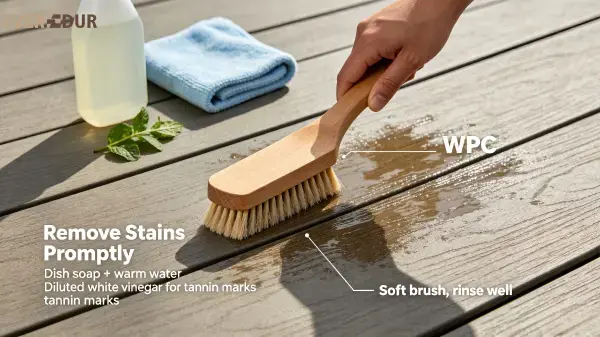
For organic stains such as leaves, berries or garden soil, a little dish soap in warm water works nicely. With a gentle brush, apply and gently massage the solution into the afflicted region. Rinse well after a few minutes. If the tannin markings are more stubborn, a diluted white vinegar solution (about one part vinegar to three parts water) is a good choice and does not need expert composite deck cleaners.
Grease stains from outside cooking or sun lotion are best treated promptly. 1. First blot up the excess to avoid spreading. Then squirt on some degreasing dish detergent and rub it in with a soft cloth. Rinse it off. The longer a grease mark remains, the deeper it will permeate into the surface pores of the composite material.
One thing to highlight is never to use bleach cleansers harsh scrubbers or solvent cleaners on composite boards. These may strip the surface coating, affect color uniformity and under some conditions destroy the structural integrity of the material. Whenever possible always choose for pH neutral or slightly alkaline cleaning chemicals.

How Can You Prevent Mold, Mildew and Moisture Buildup on WPC Decking?
Most of the problem with mold and mildew growing on outdoor decks is a moisture management problem. Co-extruded composite, UV resistant decking materials have a capped outer layer that prevents moisture absorption. However, situations at the surface such as water pooling or gathering of organic material might create the damp environment mold spores need to colonize.
Adequate drainage is the best preventative. Boards should be put with enough spacing (usually 5-8mm between boards) to for water to drain easily and not stand between planks. Helps with hollow-core board profiles when water runs through the structure instead of resting against it.
Scrape off any potted plant saucers that have standing water and that sit directly on the planks of the deck. If your balcony or patio design includes plants, employ raised pot supports so that air can circulate beneath.
A quick brushing off after long rainy spells to get water trapped in low places off the surface may help prevent the wet conditions mold enjoys. The drying process will take longer in shaded portions of the deck that are not in as much direct light. Treating two to three times a year with a moderate mold-inhibiting wash (diluted white vinegar or a product particularly approved for composite surfaces) offers further protection without damaging the board finish.

WPC Decking Care for UV Exposure, Color Stability and Outdoor Weather
UV exposure is one of the most important elements that will damage the long term look of any outdoor decking material. Composite boards constructed with excellent HDPE and UV-stabilizing chemicals provide far better color retention than untreated lumber, however some degree of deterioration is a normal property of any material exposed to direct sunshine over time.
The UV strength is higher in the south-facing or high altitude sites, thus the balcony WPC decking put in these places may exhibit modest lightening in color during the first few months of operation. This is a typical weathering process and not a flaw - the composite boards tend to stabilize and dependably keep their color after this first time. Products that are evaluated for over 2,000 hours under UV exposure standards (e.g., ASTM D7039 compliant tests) are designed to limit this impact.
To help preserve color stability, avoid leaving portions of the deck covered with rugs or furniture for long periods of uninterrupted time. This causes uneven weathering patterns, with covered portions maintaining their original tone and uncovered regions deteriorating regularly, resulting in noticeable color fluctuation while moving furniture. Occasionally moving furniture around, or removing carpets to clean them, helps the whole surface weather evenly.
Rubber feet are preferred over metal or hard plastic feet that might create scratches on the board surface under prolonged stress. Outdoor furniture is better. In extreme heat, light-colored composite boards remain cooler to the touch than darker hues—a useful point for barefoot usage on a summer balcony.
How Does Proper WPC Decking Maintenance Extend Its Service Life?
The quality of installation, climatic conditions, and how regularly the deck is maintained all contribute to a recorded service life of excellent composite decking between 10 and 25 years. That range isn’t random – it represents the genuine impact maintenance behaviors make over time.
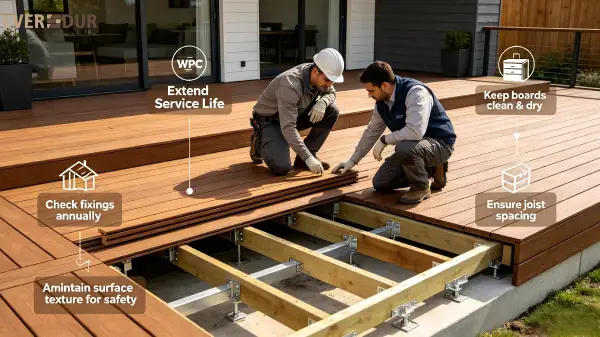
Clean and dry boards at the board-to-joist contact locations will undergo far less biological deterioration than boards left with organic matter trapped beneath. Appropriate joist spacing (often 300–400mm for most composite board profiles) and sub-frame ventilation are structural considerations that will pay benefits over the long run.
WPC decking that is evaluated each year for loose clips, minor movement of boards or evidence of corrosion of the sub frame may have little problems dealt with before they become bigger structural difficulties. This is especially important in coastal regions where salt laden air promotes corrosion of metal fittings – stainless steel or polymer clips are a good standard in these situations.
On the surface, the anti-slip performance of the surface is maintained by cleaning in the direction of the grain to retain the embossed or brushed texture of the board. A polished, slick deck surface may be slippery, especially when wet, so cleaning it regularly while maintaining the texture is a matter of safety and appearance.
All these behaviors, such as regular cleaning, moisture management, UV awareness, and structural inspections, are what help a composite deck go toward the higher end of its service life range rather than the lower.

Conclusion
Maintaining WPC Decking composite decking does not demand significant time or specialized equipment. A consistent routine — regular sweeping, prompt stain treatment, managed moisture, and periodic structural checks — is what keeps boards looking clean, performing safely, and holding their color through years of outdoor use. The material is designed for durability, and a modest maintenance habit is what allows that durability to fully express itself over the long term.
FAQ
Q: Can I use a pressure washer on my composite deck?
A: A pressure washer can be used carefully, but settings above 1,500 PSI risk eroding the surface texture of composite boards. Keep the nozzle at least 30cm from the surface and use a wide fan tip. A garden hose and brush is sufficient for most routine cleaning.
Q: Why has my composite decking changed color in the first few months?
A: A degree of initial weathering and subtle lightening is a normal characteristic of composite boards adjusting to outdoor UV exposure. Color typically stabilizes after this break-in period. Boards made with quality UV-stabilizing additives are formulated to hold their color reliably after this stage.
Q: How do I remove mold spots from my outdoor deck without damaging the surface?
A: A diluted white vinegar solution (one part vinegar to three parts water) applied with a soft brush and rinsed thoroughly is effective for surface mold. Avoid bleach-based products, which can affect color consistency and surface integrity on composite materials.
Get in Touch with Everdur — WPC Decking Manufacturer
For construction firms and contractors: Our technical team provides specification support, installation documentation, and sample boards for project tendering. We supply WPC Decking composite decking compliant with CE (EU), ASTM D7039 (US), and GB/T 24137 (China), alongside environmental certifications including FSC, REACH, RoHS, and Recycled Content certification meeting E0 environmental standards.
For building materials wholesalers and resellers: Exclusive wholesale pricing structures are available, along with free sample sets, OEM/ODM customization, and consistent annual capacity of 1,500+ containers to support reliable supply chain planning.
For end customers and homeowners: We offer free design consultation and installation guidance to help you choose the right board profile, color, and surface finish for your balcony, terrace, or garden space. Our team speaks to your project — not just the product.
Reach our team directly at violet@wpcsupplier.com to discuss your requirements. Whether you are sourcing for a single balcony renovation or a large-scale residential development, we are glad to help you find the right solution.
References
1. Clemons, C. M. (2002). Wood-plastic composites in the United States: The interfacing of two industries. Forest Products Journal, 52(6), 10–18.
2. American Society for Testing and Materials. ASTM D7032: Standard Specification for Establishing Performance Ratings for Wood-Plastic Composite Deck Boards and Guardrail Systems. ASTM International.
3. European Committee for Standardization. EN 15534: Composites made from cellulose-based materials and thermoplastics (usually called wood-polymer composites or natural fibre composites). CEN.
4. Klyosov, A. A. (2007). Wood-Plastic Composites. John Wiley & Sons.
5. Pilarski, J. M., & Matuana, L. M. (2005). Durability of wood flour-plastic composites exposed to accelerated freeze-thaw cycling. Journal of Applied Polymer Science, 100(1), 35–39.
6. Forest Stewardship Council. FSC Certification and Chain of Custody Standards. FSC International.
7. U.S. Environmental Protection Agency. Recycled Content Products and Procurement Guidelines. EPA Sustainable Marketplace Resources.
Send Inquiry
You may like