_1777451497595.webp)
Hollow WPC Decking Maintenance Tips: Keep It New for 10+ Years
Keeping your outdoor deck looking great year in and year out is less about luck and more about understanding what your material truly requires. Hollow WPC decking is constructed from a combination of wood fiber and recycled HDPE, designed to withstand outside conditions. However, just like any external surface exposed to rain, sun, and foot activity, it may benefit from regular, simple maintenance. The good news is that the maintenance routines for these composite boards are substantially lower than what conventional wood needs. No sanding. No staining. No re-sealing every season. What you do need is a good program of cleaning, drainage inspections and UV monitoring. It doesn’t matter whether your deck is built around a garden terrace, borders a pool area, or stretches over a residential balcony, the basics are the same. In this tutorial, we will go through practical, evidence-based procedures to ensure your composite boards remain structurally strong, look fresh, and are safe underfoot for 10 years or more. These maintenance insights also provide a realistic perspective on the long-term ownership experience if you are considering hollow composite boards for your next project.
How Should You Maintain Hollow WPC Decking for Long-Term Outdoor Use?
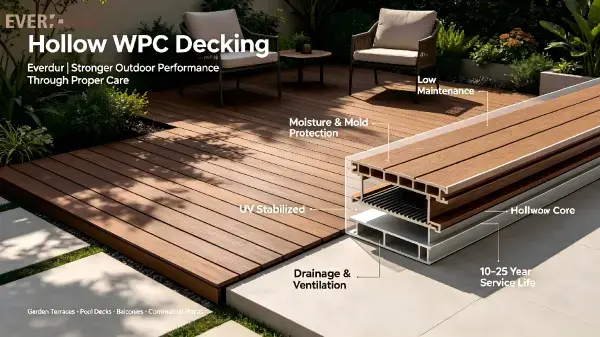
Long-term care of a composite deck is more about rhythm than hard work. The hollow-core construction of these boards helps to save weight and allows for internal ventilation, but the cavity design also tends to collect dirt, especially in the grooves and around fasteners, which requires constant maintenance.
A good rhythm to yearly maintenance would be: a full seasonal wash at the beginning of spring to get rid of the detritus of winter, a mid-year check for any movement or surface discoloration, and a short fall clear-out to stop leaf debris resting over winter. In most homes, a quick rinse every few weeks between these planned checkups is all that is needed.
One issue that many owners neglect is the gap spacing between boards. Those gaps are not there for esthetics , they have a practical purpose for drainage and thermal expansion . In heat composite materials expand a little, and they contrast in the cold. Boards might bend under temperature stress if the space is constricted by debris or incorrect installation. One of the easiest and most effective long-term care behaviors is to keep these pathways free.
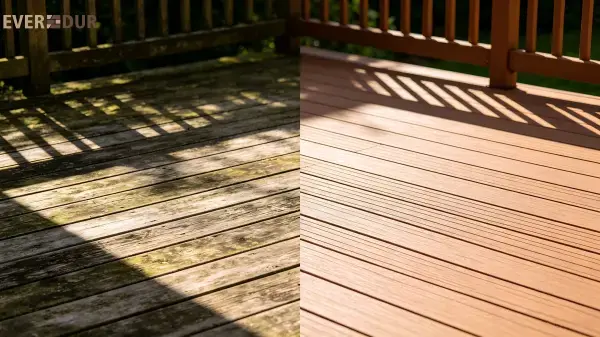
Hardware and substructure need frequent care, too. 2. Annually check joist connections, clips and fasteners for indications of corrosion or loosening. If the subframe fails, it may limit the effective service life of the whole deck system, even if the surface boards are still in great shape. In humid conditions, the use of aluminum or galvanized steel joists under composite boards is often advised.
And foot traffic patterns important too. regions of high usage (such as doors and around furniture anchor points) are more abrasive to surfaces than periphery regions. Chairs and tables include rubber foot pads to prevent localized wear of the surface but not compromise the structural integrity of the board.
Hollow WPC Decking Cleaning for Outdoor Dirt, Stains and Debris
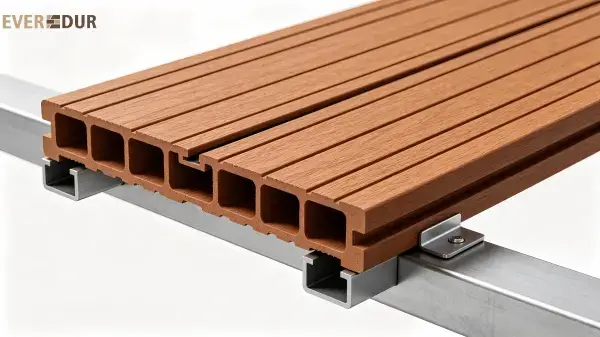
Outside, surfaces gather a predictable amount of contaminants: organic material like leaves and pollen, oil residue from cooking or manufacturing, mold spores encouraged by wet shadow, and general atmospheric filth. How you clean Hollow Composite Deck boards significantly changes according on what you are working with.
For surface filth and dust, a garden hose and a soft bristle brush would suffice. Always scrub with the grain or embossed texture of the board. Scrubbing against the grain will drive trash down into the grooves instead of pulling it out.
Organic stains from berries, leaves or bird droppings react nicely to a mild soap solution applied with a soft cloth or brush and a thorough rinsing. Do not leave any soapy residue on the surface as this might attract more dirt or form a slippery film when wet.
If you have an outdoor kitchen or grill area, you’ll probably have some oil and grease marks on your deck. Usually, they are treated with a diluted degreaser suited for composite surfaces applied with a cloth and rapidly washed. No stains are left. Oil stain, the longer it rests the deeper it sinks into the surface layer.
In instance, mold and algae may develop in darkened or poorly ventilated areas, and produce green or black spots. For mild instances, a solution of white vinegar and water (about 1:3 ratio) applied with a brush and left for a few minutes before washing works well. For long-lasting growth, use composite-safe cleaning chemicals with low concentrations of sodium hypochlorite. Check for compatibility with your board's surface finish before applying liberally.
Pressure washers may be used carefully. Pressure must be kept below 1500 PSI and the nozzle must be 20–30 cm away from the surface to prevent peeling surface texture or driving water into the interior hollow structure.

Protecting Hollow WPC Decking from Moisture, Mold and UV Exposure
One of the more subtle parts of caring for composite decking is moisture control. Though hollow composite deck boards are intended to repel water absorption, extended periods of sitting water, especially in shady spots, may stimulate the growth of mold and mildew on the surface.
While the material itself will not decay like lumber does, surface biological development is still conceivable when moisture and organic detritus mix. The best way to limit the danger of mold is to keep the deck surface free of damp leaves, to prevent furniture from leaving permanent wet footprints and to cut overhanging plants to enable sunshine and ventilation.
Almost every material used outside will fade with time and exposure to UV. For most quality hollow boards the color of the surface stabilizes over the first months of external exposure in the natural weathering process. With well-made boards with UV stabilized pigments, this process is greatly delayed – independent testing data shows that boards with proper levels of UV stabilizer exhibit little if any visible fading after 2,000 hours of UV exposure. For those in high-sun locations like southern Europe, California or Australia, using a composite-compatible UV protectant spray yearly may further prolong the life of the pigment.
Hollow WPC Decking Drainage, Ventilation and Installation Checks
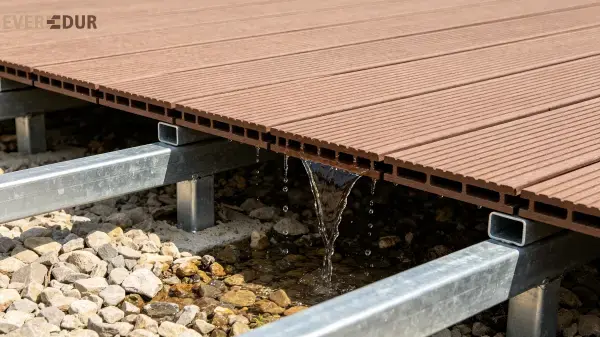
One of the major structural benefits of a hollow Hollow WPC Plank plank is its hollow form – it helps drain away moisture and at the same time decreases the weight of the board. But this design works only if the installation allows proper drainage and circulation under and between boards.
Make that the deck subframe is still level, and that none of the joists have moved or settled unevenly during the season. Uneven support means individual boards take uneven load and this might lead to surface deformation over the years. A spirit level and a visual inspection of the deck surface from a low angle will detect any mild warping early on.
Provide for unrestricted drainage of water off the deck perimeter. If planting beds, walls or concrete have been erected around the deck after it was installed, it may be that they are accidentally obstructing drainage routes. Moisture accumulation in the joist cavity is avoided by redirecting drainage away from the base of the subframe.
Good air circulation under the deck, which can normally be achieved by ensuring a minimum clearance of 50 mm between the underside of the joists and the ground, will help to keep the substructure dry. In certain instances this clearance is lowered in deck areas that are refurbished or rebuilt. It’s a good idea to check it frequently, particularly after landscape modifications, to keep the conditions the deck was initially placed to benefit from.
How Can Proper Care Extend Hollow WPC Decking Service Life?
The specified service life for quality hollow composite boards is usually between 10 to 25 years, depending on the product specification, environmental exposure and the consistency of maintenance. There’s a reason for that range: a well drained and frequently cleaned board, with no matter buildup, performs considerably better over time than one that is ignored.
With practical care, you don’t need to spend a lot of time. A medium-sized home deck may realistically expect to need around three to four hours of active care each year, spaced out among periodic inspections. The pay-off for that small effort is a deck that will maintain its structural integrity, surface appearance and slip-resistant qualities throughout its intended lifetime.
Field performance of composite decking installations in northern European climates, where freeze-thaw cycling and continuous rain are common, has documented that boards installed with correct joist spacing, adequate drainage clearance and periodic cleaning show no structural degradation after a decade of use. This is in agreement with dimensional stability data obtained in the laboratory on boards made under controlled extrusion settings.
The practical conclusion is simply this. Maintenance is not a matter of compensating for material deficiency. It’s about supporting the design the board was designed to give.
Conclusion
Hollow WPC Decking is built to handle outdoor conditions without demanding intensive upkeep. Regular cleaning, attention to drainage, seasonal hardware checks, and basic UV and mold management are all it takes to keep the surface looking well-maintained and the structure performing as intended. These habits are not complex — they are simply consistent. With the right routine, a well-installed composite deck can genuinely deliver a decade or more of reliable, attractive outdoor use.
FAQ
Q: How often should I clean my hollow composite deck boards?
A: A light rinse every few weeks keeps surface grime from accumulating. A deeper clean with a soft brush and mild detergent is recommended at the start of spring and after autumn leaf fall.
Q: Can I use a pressure washer on hollow composite boards?
A: Yes, with care. Keep pressure below 1500 PSI and hold the nozzle at least 20–30 cm from the surface to avoid damaging the texture or forcing water into the board's internal cavities.
Q: Will my composite deck boards fade in direct sunlight?
A: Some initial color shift during the first few months of outdoor exposure is normal as the board weathers. UV-stabilized boards are formulated to resist further fading — boards tested to 2,000+ hours of UV exposure typically show minimal perceptible color change after that initial phase.
Get in Touch with Durable — Hollow WPC Decking Manufacturer for Your Next Project
For Construction Firms and General Contractors: Receive detailed technical datasheets, project-specific dimensions, and volume pricing. Our production capacity exceeds 1,500 containers annually across 50+ extrusion lines, supporting both scheduled and fast-turnaround project timelines.
For Building Materials Wholesalers and Resellers: Competitive wholesale pricing structures, consistent lead times, and free sample boards are available to qualified partners. ODM and OEM programs support private-label requirements.
For End Customers and Homeowners: Free design consultation and installation guidance are available to help you specify the right board profile, color, and surface finish for your garden, balcony, or terrace project.
All hollow WPC decking products comply with EU CE certification, ASTM D7039 (US market standard), and China GB/T 24137. Environmental credentials include FSC, REACH, RoHS, and Recycled Content certification (Grade A recycled HDPE), with boards meeting E0 environmental standards for composite materials.
Reach our team directly at violet@wpcsupplier.com to discuss your project requirements, request samples, or explore custom specifications.
References
1. European Committee for Standardization. EN 15534: Wood-Polymer Composites (WPC) — Test Methods and Performance Requirements for Decking. CEN, Brussels.
2. American Society for Testing and Materials. ASTM D7032: Standard Specification for Establishing Performance Ratings for Wood-Plastic Composite Deck Boards and Guardrail Systems. ASTM International, West Conshohocken, PA.
3. Forest Stewardship Council. FSC Certification Standards for Chain of Custody and Recycled Content. FSC International, Bonn.
4. Clemons, Craig M. Wood-Plastic Composites in the United States: The Interfacing of Two Industries. Forest Products Journal, Vol. 52, No. 6, 2002.
5. Morrell, Jeffrey J., and Stark, Nicole M. Performance of Wood-Plastic Composite Decking After Outdoor Weathering. United States Department of Agriculture Forest Service, Forest Products Laboratory, 2006.
6.RoHS Compliance Directive (2011/65/EU). Restriction of Hazardous Substances in Electrical and Electronic Equipment — Application Scope and Testing Standards for Composite Materials. Official Journal of the European Union.

Send Inquiry
You may like