_1777451497595.webp)
2026 Brushed WPC Decking Trends: Stylish & Durable Options
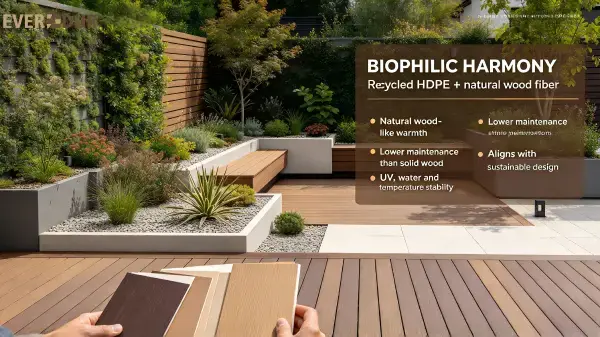
Outdoor living spaces are evolving rapidly, and brushed WPC decking sits at the center of that shift heading into 2026. Homeowners, architects, and contractors across Europe and North America are rethinking what outdoor surfaces can look and feel like — and the brushed finish has earned a firm place in those conversations. Unlike smooth composite surfaces, the brushed process gives the board face a fine, directed grain that makes it less likely to slip when it's wet and gives it a warmth that makes it look like real wood. The material, which is a mix of recycled HDPE and natural wood fiber, can withstand UV light, water, and changes in temperature throughout the year without needing the yearly maintenance that solid wood does. Over the past few years, brushed composite decking has grown up a lot. It went from being a niche choice to a standard feature on patios, decks, and platforms by pools in homes and hotels. This article goes over the styles, colors, textures, and uses that will be important in the category in 2026. It will help you plan your next outdoor project by showing you what to expect and what questions you should ask.
What Brushed WPC Decking Trends Are Defining Outdoor Design in 2026?
In 2026, outdoor design is being formed by a greater desire for surfaces that feel real instead of fake. This desire is moving specifiers toward shapes with depth that can be felt, and the brushed composite deck style does a good job of meeting that need. It's important to note that some routes cross.
The force that lasts the longest is biophilic harmony. Composite decking is being used by designers along with living walls, gravel beds, and native plants to make outdoor spaces that feel like they are part of the natural environment. A brushed grain makes that link stronger because the surface spreads light like real wood does, making it less harsh on the eyes without the upkeep that comes with wood.
Sustainability qualities are no longer just a marketing gimmick; they are now a real factor in buying something, especially in the EU market where rules for green buildings are getting stricter all the time. Materials with recycled content are being chosen during the design process instead of being added later to save money. These needs are easily met by composite boards made from recycled HDPE and wood fiber.
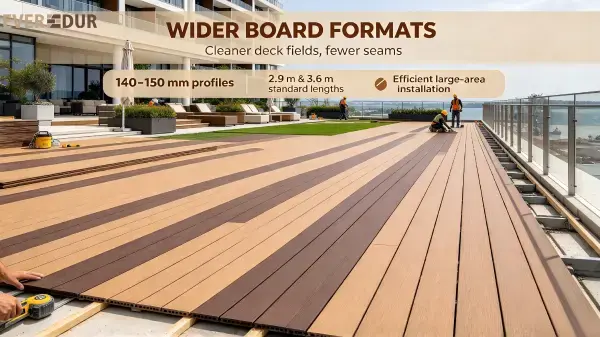
More and more people are choosing bigger board formats with wider profiles (140 mm to 150 mm). This is because they make the deck surface look cleaner and more open, which is more traditional in modern architecture. When paired with longer standard lengths of 2.9 m and 3.6 m, this format makes it easier for installers to run boards over large outdoor areas with fewer seams and cuts.
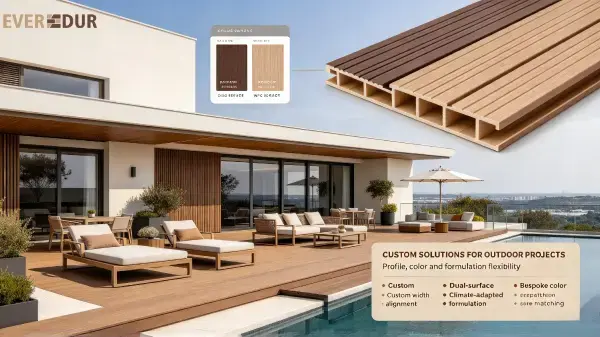
Another new standard is dual-surface boards. One side is brushed for use in homes or businesses, and the other side has a curved design for places that need to drain well, like around pools. Because of this, a single board can be used for more than one zone in the same project, which makes it easier for contractors to keep track of their inventory.
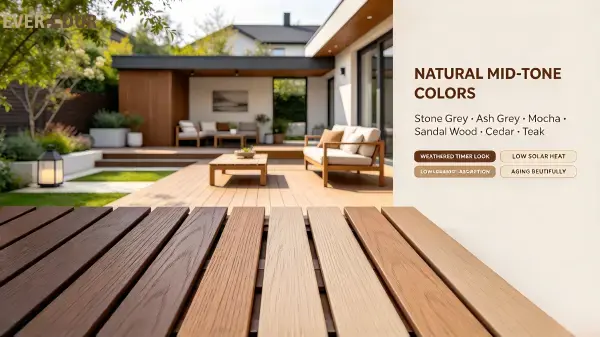
Lastly, the color palette is moving away from dark, high-contrast colors and toward natural, mid-range colors that look good with age and soak up less solar heat, which is important in warmer markets in the US and southern Europe.
Brushed WPC Decking Colors for Modern Outdoor Spaces
Color selection has become one of the most deliberate decisions in brushed WPC decking design, and the range available for composite boards in 2026 reflects a matured market. The dominant direction is toward tones that mirror weathered, aged timber rather than freshly cut wood — hues like Stone Grey, Ash Grey, and Mocha carry a quiet, settled quality that suits both contemporary architecture and more traditional garden settings.
Warm neutrals like Sandal Wood, Cedar, and Teak are still very popular because they go well with a lot of different types of exterior siding, such as rendered walls, brick, and natural stone. Along with that, these tones tend to look good in a variety of lighting situations, keeping their own style from daytime sun to evening ambient lighting.
On the cooler end of the color spectrum, Dark Gray and Gray look great on simple terraces where the deck is meant to blend in with the rest of the space, letting the furniture, plants, and architecture do the talking. Especially in Scandinavian and Northern European markets, this cautious approach works very well.
As people become more aware of thermal comfort, ivory and lighter tones are becoming popular again. It's important to have lighter surfaces on south-facing patios and swimming areas where people often walk barefoot because they receive less solar heat.
Custom color matching services go beyond the standard color palette and let project designers choose tones that perfectly match the outside of a building. This is especially important for commercial and hospitality projects that need to make sure that brand colors are used consistently on outdoor surfaces. Working with a company that can handle custom color runs gives specifiers a lot of freedom to be creative without having to wait as long for custom wood finishes.
Natural Textures and Finishes in Brushed WPC Decking
How the Brushed Finish Achieves Its Wood-Like Quality?
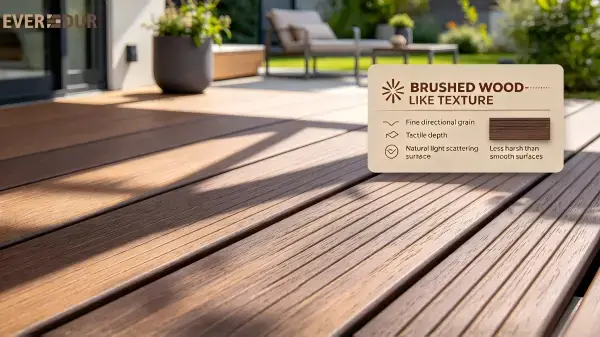
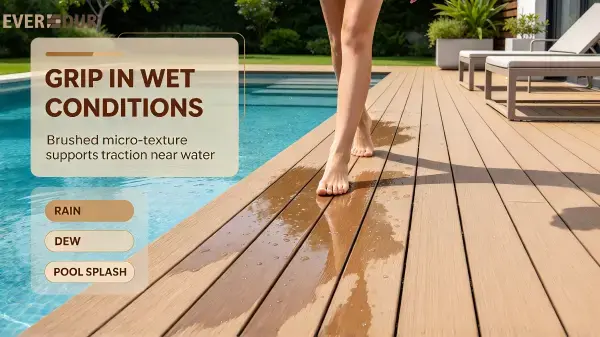
The brushed finish is produced by passing the extruded board surface through a mechanical process that raises the wood-fiber component slightly, creating a directional micro-texture. The result is a surface that scatters light in a way similar to natural grain, producing depth and warmth that smooth-faced boards cannot replicate. The texture is consistent along the board length, which matters for large installations where visual uniformity across dozens of boards is essential. Beyond aesthetics, the raised fiber texture provides meaningful grip improvement in wet conditions — a practical benefit for any outdoor surface exposed to rain or morning dew.
Comparing Brushed, Embossed, and Wood-Grain Surface Options
Each surface treatment serves a distinct purpose. Embossed finishes press a repeating pattern into the board face during extrusion, creating a defined texture that is consistent and durable but can sometimes read as overtly manufactured. Wood-grain finishes use deeper, more irregular patterning to simulate the growth rings and knots of specific timber species, producing a high-fidelity visual that works well in traditional design contexts. The brushed surface composite occupies a middle ground: less literal than wood-grain, less mechanical-looking than embossed, with a tactile quality that holds up well across contemporary and transitional design styles. Many specifiers combine a brushed face with a grooved underside to gain both aesthetic and functional flexibility from a single board profile.
Durability Characteristics of Textured Composite Surfaces
Textured surfaces on composite boards do more than just keep people from slipping. A brushed face's micro-relief spreads small surface stresses more widely than a perfectly smooth face. This can help prevent the fine surface cracking that can happen on composite boards after being exposed to UV light for a long time. One more thing to think about is color stability. A rough surface tends to hide slight fade better than a high-gloss smooth face, which reflects light in a way that makes color change stand out more. Several international test methods say that good composite boards keep their color well after being exposed to UV light for at least 2,000 hours.
Brushed WPC Decking for Contemporary Patios, Gardens, and Pool Areas
Residential Patios and Garden Terraces
The modern porch in a 2026 home is made to be used all year, not just for summer parties. That assumption puts real stress on things that are on the surface. When it freezes and thaws, which happens a lot in Northern Europe and the Upper Midwest, brushed composite decks doesn't crack or split like raw wood does. Dimensional stability across temperature ranges means that boards stay level and gaps stay the same as the seasons change. This is an important quality factor for people who want to build an outdoor living space that they will use for a long time. The low-maintenance appearance is also a big selling point for people who want to sell their home and want their yard to look nice without having to sand, oil, or reseal it every so often.
Poolside and High-Moisture Environments
Any outdoor area that is used near a pool has to be able to handle the most useful demands. The ability to not slip, keep water out, and stand up to pool poisons are all important. The brushed pattern makes the surface less slippery, even when it's wet, without having the rough grip of open-grooved profiles, which can trap dirt and need more work to clean. Waterproofing that is already built into high-quality composite boards stops them from absorbing water. This stops the warping and biological growth that shortens the life of natural wood in permanently damp conditions. Composite boards are a practical and esthetically pleasing choice for pool surrounds in commercial settings like hotel pools, wellness centers, and aquatic facilities. They are easy to clean and maintain and look the same over a large installation area.
Commercial Outdoor Spaces and Hospitality Projects
Hotels, restaurants, and public leisure facilities require surfaces that withstand sustained foot traffic without deteriorating visibly. The durability profile of brushed WPC decking material suits these environments well: consistent performance across a service life measured in decades rather than years, with cleaning limited to periodic washing rather than specialist treatment. Commercial specifiers also value supply reliability — the ability to source matching boards for future repairs or extensions from the same manufacturer, years after the original installation. Working with a manufacturer that maintains a stable production capacity and consistent color batches reduces the risk of visible mismatches during maintenance work.
Custom Brushed WPC Decking for Emerging Outdoor Design Trends
Material Adaptation for Climate-Specific Requirements
Standard composite board formulas work well in a lot of locations, but projects in very harsh climates need to have the materials changed. Installations near the coast that are exposed to high humidity and salt air may need formulations that are better at resisting moisture. Higher levels of UV protector are good for uses at high altitudes that are exposed to a lot of UV light. Areas with big differences in summer and winter temperatures put the most stress on the stability of dimensions. If you work with a maker that can change the wood fiber ratio, chemical package, and HDPE grade to fit your environment, the product you put will perform according to the manufacturer's specifications instead of the average.
Surface and Profile Customization for Architectural Projects
Architectural projects frequently carry design requirements that fall outside standard product catalogues. A facade-integrated deck might require a specific width to align with cladding module dimensions. A rooftop terrace might need a thinner profile to stay within a structural load budget. Custom profile dimensions, dual-surface configurations, and bespoke color matching are all services that allow a brushed WPC decking specification to meet project-specific requirements precisely rather than approximately. Surface customization can also extend to combining brushed and sanding treatments on the same board face, producing a layered texture that reads differently at varying distances — a detail that can elevate the material quality perception of a finished project.
ODM and OEM Services for Distributors and Contractors
Distributors, building materials wholesalers, and specialist contractors increasingly seek composite decking products that carry their own branding or meet specifications developed in-house. ODM services allow a partner to bring a design concept to production without establishing their own manufacturing capability. OEM arrangements allow established product designs to be manufactured to a partner's quality standards and labeled accordingly. Both models benefit from working with a manufacturer that holds relevant international certifications and operates documented quality management systems, since these provide the audit trail that downstream customers in regulated markets require.
Conclusion
The market wants surfaces that feel real and last a long time, and the brushed surface composite format gives them both. This is the direction that outdoor decking is going in for 2026. Trends in color favor naturals in the middle range and cool grays that look good with age. People who like different textures tend to like finishes that look warm and natural without needing as much care as real wood. Quality composite boards can be used in a wide range of places, from residential gardens and poolside platforms to commercial hospitality areas. Each of these uses has its own specific functional needs that must be met. Custom production services make these options even wider, so you can really choose a product that fits your project perfectly instead of making your project fit a product. If you are planning an outdoor place or looking for materials for a client, these trends can help you make choices that will last long after the current season is over.
FAQ
Q: How does the brushed surface on composite decking improve safety compared to smooth finishes?
A: The brushed treatment raises the wood-fiber component at the board surface slightly, creating a fine directional texture. This texture provides grip under wet conditions — rain, morning dew, or poolside splash — where a smooth surface becomes notably slippery. The improvement is meaningful without requiring the aggressive open-groove profiles that trap debris and complicate cleaning routines.
Q: What is the expected service life of brushed WPC decking in outdoor conditions?
A: Quality composite boards with a brushed finish typically carry service life estimates in the range of 10 to 25 years, depending on installation quality, climate conditions, and the specific material formulation. Boards made from Grade A recycled HDPE combined with natural wood fiber, produced under documented quality management processes, tend to perform toward the upper end of that range.
Q: Can brushed composite deck boards be used in both residential and commercial outdoor projects?
A: Yes. The material performs well across both contexts. Residential applications benefit from its low maintenance profile and natural aesthetic. Commercial applications — hotels, restaurants, public terraces — benefit from its resistance to sustained foot traffic, consistent appearance across large surface areas, and the supply reliability that comes from working with a manufacturer with stable production capacity. Profile and color customization options make it adaptable to the specific requirements of either project type.
Partner with Everdur for Your 2026 Brushed WPC Decking Projects
For Construction Firms and Architects: Everdur supports your project from material specification through delivery, with custom profile dimensions, climate-adapted formulations, and full technical documentation. Our products comply with EU CE certification, US ASTM D7039, and China GB/T 24137 standards, and carry environmental certifications including Recycled Content certification and E0 environmental standard — the audit trail your regulated-market projects require.
For Building Materials Wholesalers and Resellers: Explore exclusive wholesale pricing structures, consistent batch-to-batch color matching, and free sample arrangements to support your sales process. As an established brushed WPC decking manufacturer with over 50 production lines and annual capacity exceeding 30,000 tons, Everdur maintains the supply reliability that wholesale distribution channels depend on.
For Fence Contractors and Deck Installers: Receive technical installation guidance, flexible MOQ from 100 SQM, and access to a product range covering standard and custom specifications. Our certifications — ISO 9001, FSC, CE, SGS, REACH, INTERTEK — mean you are working with materials that meet the quality expectations of end clients in European and North American markets.
For End Customers: Receive free design consultation and installation guidance tailored to your outdoor space. Whether you are planning a garden terrace, poolside platform, or balcony, we help you select the right profile, color, and surface treatment for your specific conditions and aesthetic goals.
Ready to discuss your project? Contact our team directly at violet@wpcsupplier.com and share your requirements. We respond with specific product recommendations, sample availability, and pricing information relevant to your application.
References
1. European Committee for Standardization. EN 15534: Composites Made from Cellulose-Based Materials and Thermoplastics (Wood-Polymer Composites). CEN, Brussels.
2. ASTM International. ASTM D7032: Standard Specification for Establishing Performance Ratings for Wood-Plastic Composite Deck Boards and Guardrail Systems. ASTM International, West Conshohocken, PA.
3. Forest Stewardship Council. FSC Certification Standards for Chain of Custody and Recycled Content Claims. FSC International, Bonn.
4. Building Research Establishment (BRE). Good Practice Guide: Specifying Composite Decking for Outdoor Applications in Temperate and Mediterranean Climates. BRE Press, Watford.
5. European Outdoor Group. Outdoor Living Spaces Market Report: Material Preferences and Sustainability Drivers in European Residential Construction, 2024–2026. EOG Publications.
6. International Code Council. ICC 400: Standard on the Design and Construction of Log Structures, with Commentary on Composite Deck Material Compliance. ICC, Washington, DC.
7. Timber Research and Development Association (TRADA). Wood-Polymer Composites: Performance Data and Specification Guidance for Architects and Specifiers. TRADA Technology Ltd., High Wycombe.
Send Inquiry
You may like