_1777451497595.webp)
How to Choose High-Quality Co Extrusion WPC Decking for Your Garden
Choosing the proper decking for your yard is not only a case of choosing a color you like. There are so many composite alternatives out there now, so it takes a little bit of expertise to grasp what distinguishes a really durable outdoor board from a poor one. Co Extrusion WPC Decking, often known as wood-plastic composite decking, is made using a co-extrusion method. It has become a staple of contemporary outdoor living areas throughout Europe and North America, and for good cause. Unlike older-generation composites, the co-extruded boards are enclosed in a continuous polymer shell during manufacture. This means that the protective layer is fused directly to the composite core rather than being added later as a surface coating. It’s this structural distinction that gives it everything from moisture resistance to scratch performance to long-term color stability. Whether you are a homeowner updating a private garden, a contractor selecting materials for a villa terrace or a reseller buying reputable stock, understanding what to look for before you buy can save you time, money and stress. This guide will lead you through the major factors — cap layer quality, core composition, UV and moisture performance, size alternatives and installation concerns — so you can make an educated selection.
What Should You Look for in High-Quality Co Extrusion WPC Decking?
Quality in Smooth Co-extruded WPC co-extruded wood-plastic composite decking is not a single feature but a combination of material selection, manufacturing accuracy and structural design working together. As you begin to evaluate items, don’t only focus on the price but also consider a number of related elements.
The base is the material composition. Good boards are made from wood fiber or wood powder mixed with Grade A recycled HDPE (high-density polyethylene) and properly calibrated chemical additives that promote bonding, UV resistance and thermal stability. Lower quality items may include recovered mixed plastics or wood debris with significant moisture content, which will affect dimensional stability over time. Ask suppliers directly about the quality of HDPE and if they utilize virgin or recycled material. Reputable manufacturers will provide straightforward responses.
And consistency in manufacturing is very important as well. Co-extrusion is a technically difficult technique that involves careful temperature control and die calibration . An uneven extrusion causes boards to have varying cap thickness, hence weakening the shell’s protection in specific areas. That’s why production volume and years of expertise are meaningful indicators, not merely marketing points. A dependable manufacturer maintains strict tolerances throughout each manufacturing run.
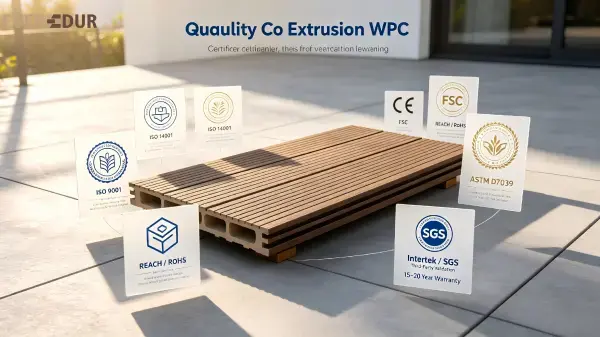
Certifications give you something real about quality standards”. Look for ISO 9001 (quality management), ISO 14001 (environmental management), CE labeling for European markets, FSC certification for responsible sourcing, and REACH or RoHS compliance that the products fulfill EU chemical safety regulations. ASTM D7039 is of interest to customers in the US. You’ll also find third-party certifications from organizations like Intertek or SGS that have independently validated these products, so you can feel even better about them.
Surface texture and uniformity of finish are realistic indications of the quality of the manufacture. Run your fingers over a few boards from the same batch. Brushed, embossed or wood-grain finishes should appear and feel homogeneous with no apparent seams, bare spots or color variations. These details show how good the binding was of the cap layer over the whole profile of the board.
Finally, inquire about the warranty. The producer, who believes in his product, gives real guaranties – from 15 years and more on hollow profiles, up to 20 years on solid profiles. If the warranty is short or unclear, that’s a red flag.
Checking the Cap Layer and Core Structure of Co Extrusion WPC Decking
The cap layer is undoubtedly the most important structural component in any co-extruded composite board and it does need serious consideration before you make a purchase.
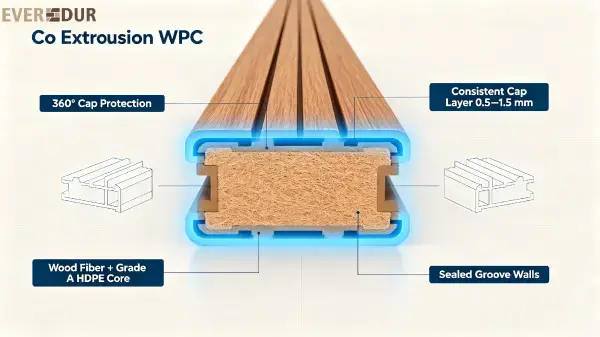
In a normal single-sided capping just the top surface of the board is covered with a polymer. This exposes the bottom face, cut edges and groove channels – the very places most likely to be accessed by damp, fungus and insects. All six sides of the board are enclosed in a 360-degree cap design which includes the bottom and the interior groove walls for concealed fastener placement. If moisture can’t access the composite core, there’s far less chance of swelling, warping and biological deterioration – even in salt-air coastal conditions or garden settings where the earth stays damp.
Look at a cross-section of the board if feasible. The cap layer should be a separate continuous shell of consistent thickness generally between 0.5 mm and 1.5 mm depending upon the product grade. A patchy, thin at the borders or inconsistently glued cap layer is a quality problem.
The composite core itself should have a balanced ratio of wood fiber to HDPE. An excess of wood in relation to the plastic binder might enhance water absorption at the micro level, while a lack of wood can compromise the board’s structural rigidity and natural tactile character. The plastic matrix of Grade A HDPE offers uniform density and durability, yielding scratch resistance and long-term structural integrity.
Also check the groove channels in the board profile. It is recommended to seal the inner walls of the inner grooves (including concealed fasteners) in a well-manufactured co-extruded product. It is easy to ignore but this feature does significant in reality – uncapped grooves are entry points for moisture penetration at the place of installation and this is one of the most prominent causes of premature degradation in composite decking.
When evaluating supplier paperwork, ask for material data sheets that include core density, cap layer thickness, and water absorption rates under established testing settings. This data is accessible to legitimate manufacturers.
Choosing Co Extrusion WPC Decking for UV and Moisture Resistance
And the two perennial enemies of outdoor decking are dampness and UV radiation. Whether a board stays appealing and structurally strong or fades and degrades prematurely depends upon how it is managed over years of exposure.
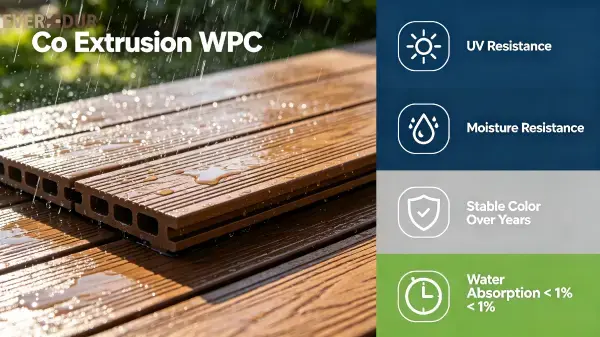
UV resistance in Durable Co-extruded WPC co-extruded composite boards is mainly attributed to the polymer cap layer which includes UV stabilizers, added during the extrusion process. A carefully designed cap layer may retain color stability during 2,000 or more hours of accelerated UV testing, which is equivalent to several years of actual outdoor exposure. Demand documented UV test results (preferably under ASTM G154 or ISO 4892 procedures) not just the word of the provider.
Moisture resistance is based on same principles. The smooth co-extruded WPC profile has a totally sealed outer shell which inhibits water absorption that causes swelling, cracking and mold. Practically speaking in the garden, this means the boards keep their size through rainy winters and dry summers with no movement to worry about from one season to the next as you get with untreated lumber. Full 360 degree capping is especially crucial in high humidity environments like poolside or gardens.
Request for independent test data from vendors on water absorption rates and dimensional change during wet/dry cycling. The products with water absorption less than 1% after 24 hours immersion testing means the cap layer is effectively sealed.
How to Choose Co Extrusion WPC Decking Sizes, Colors and Textures
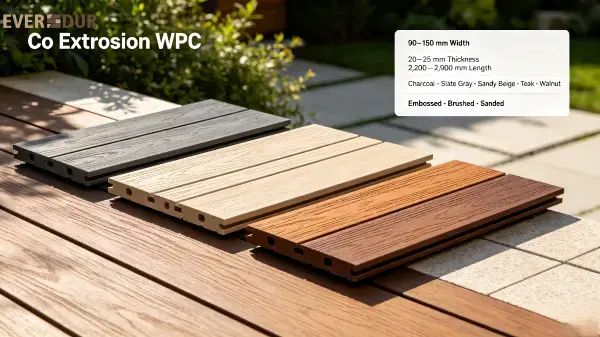
Getting the measurements correct makes a difference, both esthetically and structurally. The widths of the usual profiles are 90 to 150 mm and thickness is 20 to 25 mm. Common width for domestic garden decking is 138mm wide x 23mm thick, which gives a good scale of visual appearance and structural span performance. Wider boards offer a smoother visual line across a terrace, while thinner profiles are good for compact areas or accent borders.
For normal garden decking, lengths of 2,200 mm and 2,900 mm will cover most domestic spans without undue waste. Experienced manufacturers may provide custom lengths for projects with special span needs or unconventional garden layouts.
The choice of colors has increased enormously in recent years. Modern co-extruded boards come in charcoal, slate gray, sandy beige and dual tone effects including contrasting cap and core hues for extra visual depth, as well as traditional teak and walnut tones. The benefit of coloring built into the cap layer, instead of being put on as a surface stain, is that the color is permanent over weathering, and not bleached off from the surface.
Surface textures are used for both utilitarian and cosmetic objectives. The embossed wood-grain finishes look warm like genuine wood and they also feel warm to the touch. Brushed finishes provide a fresh and modern look with a little texture to enhance slide resistance when wet. Sanded finishes are smoother to the touch, making them a good choice for pool decks and other locations that are often used barefoot.
If you ask for samples, observe them in natural sunshine similar to that of your garden since artificial light may change the way you perceive both tone and texture.
Co Extrusion WPC Decking Installation for Gardens, Fences and Railings
The way you install your decking has a direct bearing on how it will function for years to come and even the best boards will perform poorly if done improperly. Composite co-extruded boards are intended for outdoor usage only and should never be utilized for inside purposes.
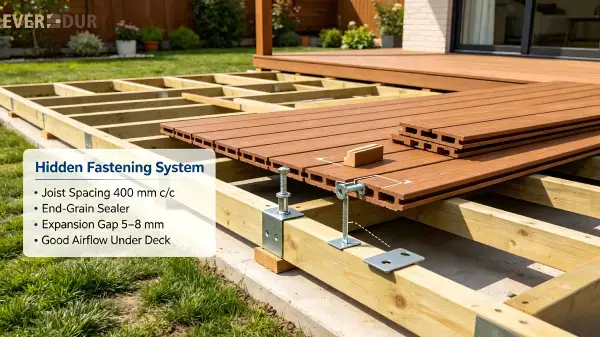
For co-extruded boards, the preferred installation technique is a hidden fastening system. The sealed grooves on either side of the board are clipped to and secured to the underlying joist structure. This method does away with surface screws and provides a clean, unbroken deck surface while preventing the attaching point from direct water exposure. In quality boards the groove walls are capped, thereby protecting the clip channels for the whole service life of the board.
Joist spacing should be as specified by the manufacturer, generally 400 mm center-to-center for ordinary residential installations, although tighter spacing is advised for high-traffic areas or boards set at a diagonal angle. Good air flow under the deck, with adequate joist height and perimeter clearance, will keep moisture from building up on the bottom of the boards.
Co-extruded profiles for garden fence and railing applications are cut and drilled using ordinary woodworking equipment. Circular saws, jigsaws and drill bits all work well. Seal cut ends using an appropriate end-grain sealer to maintain moisture protection at exposed cross-sections. This is especially crucial for fence posts and railing uprights that touch the ground or post bases.
Expansion spaces between ends of the boards — often 5 mm to 8 mm depending on the temperature range of your environment — allow for the little dimensional movement that happens between summer heat and winter cold. These distance suggestions mean boards won’t push against each other and buckle in the heat.

Conclusion
Choosing the right Co Extrusion WPC Decking composite boards for your garden comes down to understanding what you are buying beneath the surface. The cap layer, core material, UV stability, dimensional options, and installation method all connect to determine how the decking performs over years of outdoor exposure. Take time to review test data, request samples, check certifications, and ask direct questions of your supplier. A manufacturer who answers clearly and provides documented evidence of quality is generally one worth working with.
FAQ
Q: What is the practical difference between co-extruded WPC and standard composite decking?
A: Standard composite decking may have a cap applied to only the top surface, leaving edges and grooves exposed. Co-extruded boards bond a polymer shell across all surfaces during the manufacturing process itself, creating continuous protection rather than a surface layer that can separate or wear unevenly over time.
Q: How do I maintain co-extruded garden decking over the long term?
A: Routine cleaning with mild soap and water removes most dirt and organic material. A soft-bristle brush addresses stubborn marks. Unlike timber, co-extruded composite boards do not require annual staining, sealing, or painting, which reduces both maintenance effort and long-term ownership cost.
Q: Can co-extruded WPC boards be used for garden fencing and railings as well as decking?
A: Yes, co-extruded profiles are widely used for outdoor fencing, railing infill panels, and screen structures. They are designed exclusively for outdoor use and perform well in exposed conditions where moisture, UV radiation, and temperature fluctuation are ongoing factors.
Contact Everdur for Your Garden Decking Project
Whether you are specifying materials for a large development or refreshing a private garden space, Everdur has co-extruded composite decking options suited to your requirements.
For Construction Firms and Fence Contractors: Access project-based pricing, technical drawings, and bulk delivery scheduling. Our team supports specification-stage inquiries with material data sheets, installation guidance, and sample boards for on-site review.
For Building Materials Wholesalers and Resellers: Inquire about volume pricing structures, container-load arrangements, and private-label options under our ODM/OEM program. Samples are available to support your sales process before commitment.
For End Customers: Receive personalized color and size recommendations based on your garden layout, along with installation guidance to ensure your deck is built correctly from the start.
All Everdur products comply with ISO 9001 quality management standards, ISO 14001 environmental management requirements, EU CE marking regulations, ASTM D7039 testing for the US market, FSC responsible sourcing certification, and REACH and RoHS chemical safety requirements. Our materials incorporate Grade A recycled HDPE content and meet E0 environmental standards.
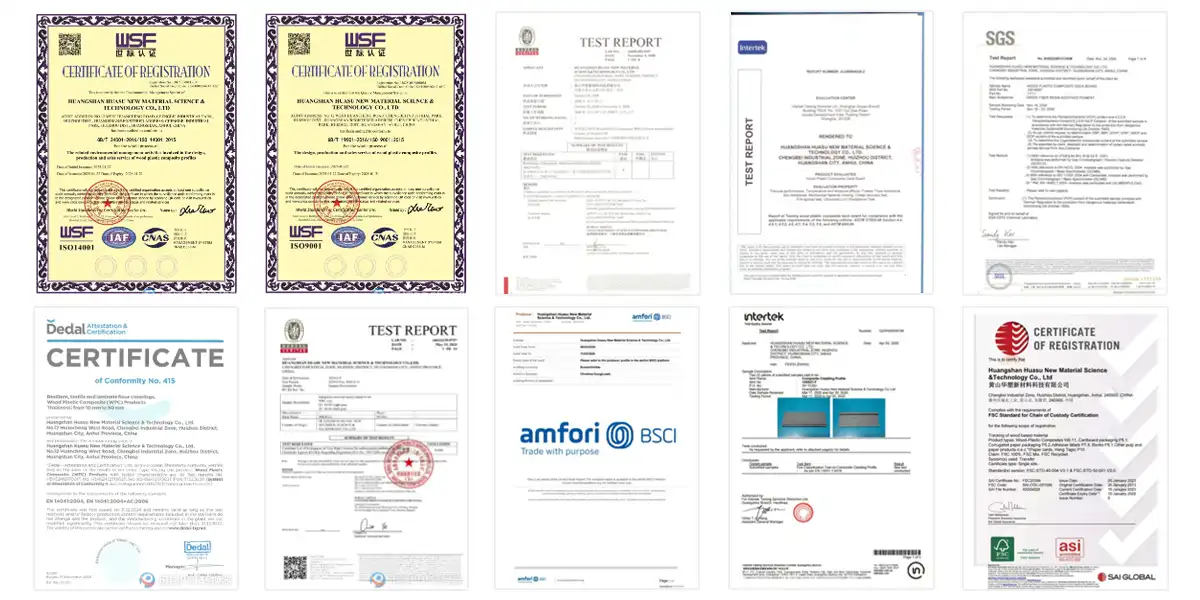
As a professional co extrusion WPC decking manufacturer, Everdur serves clients across more than 60 countries with an annual capacity exceeding 1,500 containers. Reach our team directly at violet@wpcsupplier.com to discuss your project requirements, request samples, or obtain a quotation.
References
1. Clemons, C. M. (2002). Wood-plastic composites in the United States: The interfacing of two industries. Forest Products Journal, 52(6), 10–18.
2. European Committee for Standardization. (2012). EN 15534: Composites made from cellulose-based materials and thermoplastics (usually called wood-polymer composites (WPC) or natural fibre composites (NFC)). CEN.
3. Stark, N. M., & Matuana, L. M. (2006). Influence of photostabilizers on wood flour–HDPE composites exposed to xenon-arc radiation with and without water spray. Polymer Degradation and Stability, 91(12), 3048–3056.
4. American Society for Testing and Materials. (2011). ASTM D7032: Standard specification for establishing performance ratings for wood-plastic composite deck boards and guardrail systems. ASTM International.
5. Klyosov, A. A. (2007). Wood-Plastic Composites. John Wiley & Sons.
6. Wolcott, M. P., & Englund, K. (1999). A technology review of wood-plastic composites. Proceedings of the 33rd International Particleboard/Composite Materials Symposium, Washington State University, Pullman, WA.
7. Forest Stewardship Council. (2023). FSC International Standard: FSC Principles and Criteria for Forest Stewardship (FSC-STD-01-001 V5-2). FSC International Center.
Send Inquiry
You may like