_1777451497595.webp)
Affordable WPC Decking Wholesale: Direct from Factory to Your Project
Quality outdoor decking material at scale doesn’t have to come with layers of wholesalers, uncertain lead times, or overpriced prices. WPC decking, or wood-plastic composite decking, is widely used in major outdoor projects in Europe and North America. Its advantages include weather resilience, minimal maintenance, and uniform look. Buying directly from a manufacturer also gives customers a better view of the standards of manufacturing, traceability of materials and the rationale behind price. This is massively important whether you are co-ordinating hundreds of square meters for a residential complex, commercial hospitality facility or municipal outdoor area. Factory-direct wholesale is not just about saving money, it is about creating a trustworthy supply relationship where criteria are fulfilled regularly, documentation is available, and lead times are predictable. Whether you’re a building materials wholesaler looking for a reliable private label source, a contractor overseeing a phased construction schedule, or an architect specifying materials for a complex outdoor environment, knowing how factory direct WPC decking procurement works — and what to look for — will help you make confident decisions.
Why Choose Factory-Direct WPC Decking for Wholesale Projects?
Wholesale procurement of outdoor composite decking through factory-direct channels removes a significant amount of operational uncertainty from your supply chain. When you work directly with a manufacturer, the pricing you receive reflects actual production costs rather than accumulated margin stacking from distributors and regional agents. That pricing transparency extends to customization: adjusting dimensions, surface textures, or color specifications becomes a conversation with the production team rather than a request that has to travel through multiple contact points before anyone can confirm feasibility.
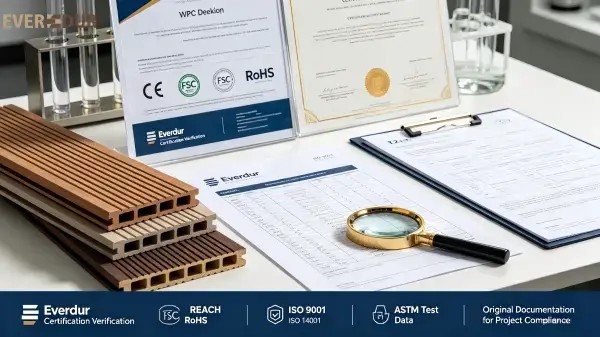
Beyond cost, factory-direct sourcing gives buyers direct access to production documentation. Certifications such as CE, FSC, REACH, and RoHS are issued to the manufacturer — when you source directly, you receive original documentation rather than secondary copies, which matters for project compliance reporting in European markets and for green building rating submissions in North America.
Manufacturers with established export experience also understand the documentation requirements for customs clearance, which reduces administrative friction on the buyer's side. Shipping terms, pallet configurations, and container loading plans can be discussed directly and adjusted based on your logistics setup.
There's also a practical quality assurance dimension. With factory-direct supply, you can request pre-shipment inspection arrangements, review quality control processes, and — in many cases — visit the facility. That level of access is simply not available through multi-tier distribution channels. For projects where material consistency across multiple deliveries is critical, having a direct production relationship provides meaningful security.
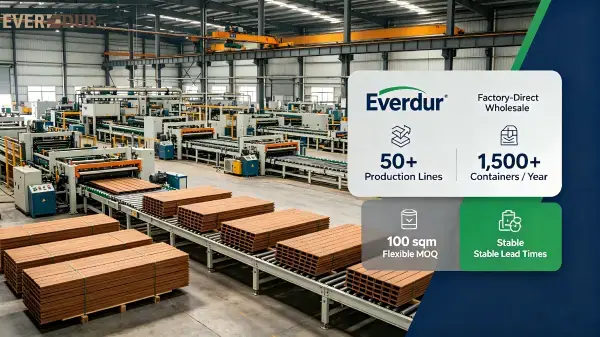
Manufacturers with 50 or more active production lines and an annual output exceeding 1,500 containers have the capacity to sustain large or phased projects without supply interruptions — a consideration that becomes critical when construction timelines are fixed.
WPC Decking Wholesale with Flexible MOQ and Stable Production Capacity
One of the practical barriers to factory-direct sourcing for smaller buyers or new partnerships is the minimum order quantity. A manufacturer that requires extremely high minimums from the outset can exclude legitimate buyers who are scaling up or testing a new product category. An MOQ starting at 100 square meters addresses that concern meaningfully — it allows distributors, contractors, and resellers to evaluate product quality and supplier reliability before committing to full container volumes.
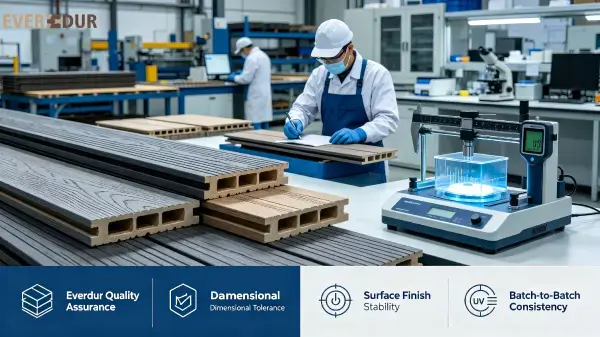
For larger buyers — construction firms managing multi-site developments, municipal procurement offices, or hotel groups — stable production capacity is the priority. A manufacturer operating 50+ production lines with structured 5S quality management can produce consistent volumes without quality drift between batches. Batch-to-batch consistency in color, dimensional tolerance, and surface finish is not incidental; it's a functional requirement when materials from different shipments need to integrate visually and structurally on the same project.
Equally important is the manufacturer's familiarity with international logistics. FOB terms from established ports — Shanghai and Ningbo, among the most active container ports globally — mean buyers benefit from competitive freight rates and reliable carrier networks. Lead time predictability, combined with flexible container loading options, allows procurement teams to align material delivery with construction schedules rather than adjusting schedules around material availability.
Manufacturers who have served 225+ clients across 60+ countries bring export process knowledge that translates into fewer surprises at the customs and documentation stage, particularly for buyers in regulated markets like the EU or the US.
How to Evaluate WPC Decking Quality for Bulk Outdoor Projects?
Material Composition and Core Integrity
The performance of any composite deck board over its service life depends substantially on what it's made of — and in what proportions. High-quality outdoor composite decking uses recycled Grade A HDPE combined with wood fiber and carefully selected chemical additives. The grade of HDPE matters: lower-grade recycled plastic can introduce inconsistencies in density and moisture absorption behavior, which affect long-term dimensional stability.
Core structure — hollow versus solid — has direct implications for application suitability. Hollow-core profiles reduce weight and material cost, making them appropriate for residential patios and rooftop installations where load requirements are moderate. Solid-core boards carry greater load capacity and are better suited to high-traffic commercial environments. Co-extrusion technology adds a protective polymer shell around the composite core, significantly improving resistance to surface staining, moisture ingress, and UV degradation — a relevant factor for waterfront or coastal installations.
Dimensional tolerance is another measurable quality indicator. Width, thickness, and length consistency across a production batch affects installation speed and visual outcome. Request batch-level dimensional data when evaluating suppliers.
Surface Finish and Slip Resistance
Surface finish is not purely aesthetic. For outdoor applications — particularly decking around pools, in areas subject to seasonal rainfall, or in commercial settings with high foot traffic — the coefficient of friction of the WPC Decking surface texture has safety implications. Brushed and embossed surfaces generally provide better wet slip resistance than smooth finishes.
WPC deck boards are available in multiple surface treatments: wood grain, brushed, sanded, and 3D embossing. Dual-surface options — where both faces of the board carry a finish — offer installation flexibility, particularly useful when boards are used in mixed orientations or for vertical cladding elements in the same project.
UV color stability is measured through accelerated weathering tests. Reputable manufacturers will provide data showing color delta values after 2,000+ hours of UV exposure testing. Requesting this data before placing a bulk order is a practical verification step rather than a formality.
Certification Verification and Test Reports
Material claims need documentation. Certifications relevant to European and North American markets include CE marking, FSC chain-of-custody certification, REACH compliance, and RoHS conformity. For structural performance benchmarking, ASTM test data — particularly related to flexural strength, moisture absorption, and thermal expansion — provides a basis for engineering review.
ISO 9001 certification indicates that the manufacturer operates a documented quality management system with auditable processes. ISO 14001 reflects environmental management standards in production. FSC certification confirms responsible sourcing of wood fiber content.
When reviewing certifications, verify that documents are current, issued to the manufacturing entity directly, and cover the specific product category you're procuring. Certificate numbers can be cross-referenced through issuing body databases.
Custom WPC Decking Sizes, Colors, Profiles and Surface Finishes
Dimensional Range and Structural Profiles
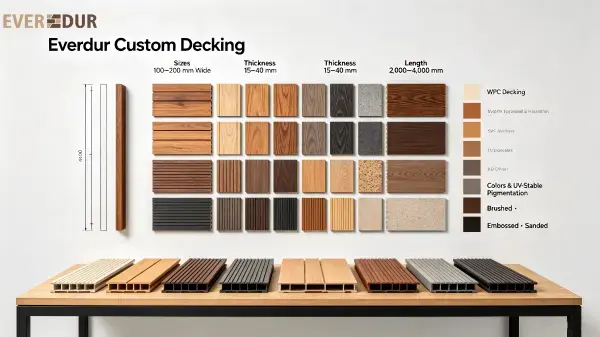
Custom WPC decking is available across a meaningful dimensional range: widths from 100 mm to 200 mm, thicknesses from 15 mm to 40 mm, and standard lengths spanning 2,000 mm to 4,000 mm. Popular commercial profiles — such as 138×23 mm, 145×25 mm, and 150×25 mm — are stocked regularly, while non-standard dimensions can be produced to specification for architectural projects with unusual spatial requirements.
Profile selection extends beyond outer dimensions. Groove patterns, edge profiles, and clip-channel configurations affect installation method compatibility. Projects using concealed clip systems require specific groove geometries on the board edge — a detail that needs to be confirmed at the specification stage rather than on-site.
Color Options and UV-Stable Pigmentation
Standard color offerings include Ash Grey, Cedar, Coffee, Copper Brown, Dark Grey, Ivory, Mocha, Sandal Wood, Stone Grey, Teak, Walnut, and Wood tones. These cover the predominant aesthetic preferences in European and North American residential and commercial markets.
For brand-specific projects or developments with a defined material palette, custom color matching is available. UV-stable pigmentation — integrated into the composite material rather than applied as a surface coating — maintains color fidelity across the service life of the board. This is particularly relevant for large-scale projects where visual uniformity across multiple phases or building facades is a design requirement.
Surface Texture Customization
Surface texture selection affects both the visual character and the tactile performance of the installed deck. Brushed finishes replicate the grain directionality of natural timber. Embossed and 3D-stamped surfaces introduce depth and shadow patterns that enhance visual interest from a distance. Sanded finishes offer a cleaner, more contemporary appearance with moderate slip resistance.
Dual-surface boards, finished on both faces, allow the same product to serve multiple functions within a project — decking on horizontal planes and cladding on vertical elements — reducing the number of SKUs a procurement team needs to manage.
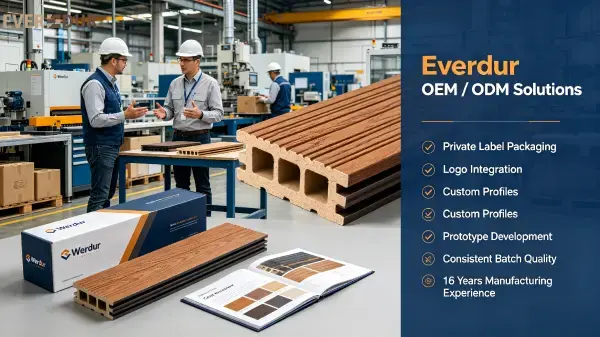
WPC Decking OEM and ODM Solutions for Large-Scale Project Supply
OEM: Your Brand, Proven Manufacturing
OEM arrangements allow distributors, resellers, and construction material companies to market WPC Decking products under their own brand identity without operating manufacturing infrastructure. The manufacturer handles production, quality control, and logistics; the buyer manages market positioning and customer relationships.
Practical OEM support includes private-label packaging design, logo integration on product surfaces or packaging materials, and consistent production runs that maintain brand-level quality standards. For buyers establishing or expanding a branded product range, OEM production from an experienced manufacturer with 16 years of continuous operation provides a stable production foundation.
Sample production and approval cycles allow buyers to verify product quality and appearance before committing to full production volumes, which is standard practice for responsible procurement.
ODM: New Products Built to Your Specification
ODM services go beyond branding an existing product. When a buyer has identified a market gap or has specific performance requirements that existing product lines don't address — a particular combination of board dimensions, surface characteristics, and structural profile — ODM development creates a genuinely differentiated product.
The development process moves from concept and technical specification through prototype production, testing, and refinement before transitioning to batch manufacturing. Manufacturers with active R&D capacity — evidenced by ongoing development of lighter, higher-strength composite formulations with reduced thermal expansion — are better positioned to translate buyer specifications into manufacturable products efficiently.
Technical support throughout the development cycle ensures that the product meets both the buyer's performance requirements and the manufacturer's production feasibility constraints.
Consistent Quality Across Large or Phased Orders
For large-scale supply arrangements — multi-site residential developments, hotel group rollouts, or municipal infrastructure programs — consistency across production batches is the governing quality requirement. A single facility producing with 50+ production lines under documented quality management provides a more reliable consistency baseline than a supplier consolidating production across multiple subcontracted facilities.
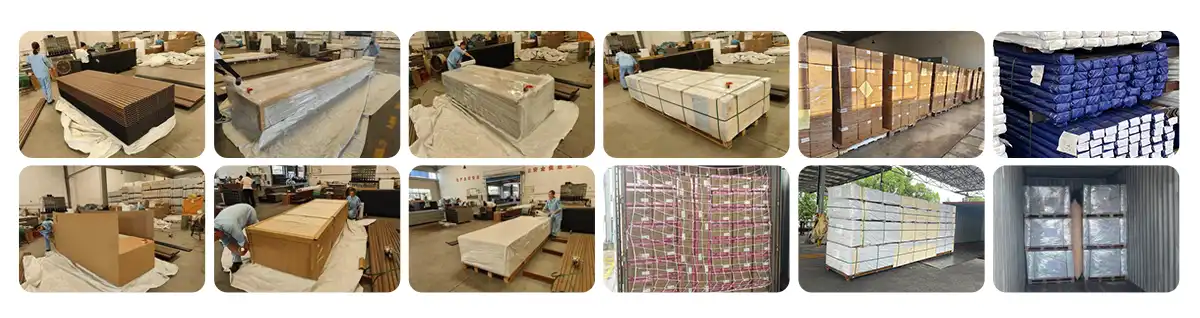
Packaging in PE film with wood pallet protection maintains product condition through container transit and warehousing. Structured 5S management on the production floor reduces process variation between shifts and between batches, which translates directly into dimensional and aesthetic consistency for the buyer.
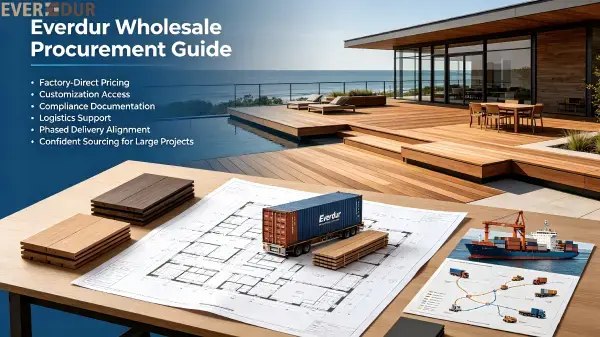
Conclusion
Factory-direct wholesale procurement of WPC Decking composite outdoor decking offers genuine advantages in cost transparency, customization access, documentation quality, and supply reliability — provided the manufacturer has the production scale, export experience, and quality management systems to support consistent delivery. Evaluating material composition, certification validity, and batch consistency before placing large orders is a practical investment in project outcomes. Whether your requirement is a standard profile in high volume or a fully specified custom product for a branded range, working directly with a capable manufacturer removes friction from the supply chain and puts decision-making authority where it belongs — with the buyer.
FAQ
Q: What is the minimum order quantity for wholesale composite decking?
A: The minimum order quantity starts at 100 square meters, which makes factory-direct sourcing accessible for contractors and distributors who are evaluating product quality or managing smaller initial project phases before scaling to full container volumes.
Q: How long does custom WPC deck board production take, and what lead times should I plan for?
A: Lead time varies based on order volume, customization complexity, and current production scheduling. Standard profiles in stocked colors typically move faster than fully custom specifications. Contacting the manufacturer directly with your project timeline allows for a realistic lead time confirmation early in the planning process.
Q: What certifications are available, and how do I obtain documentation for project compliance reporting?
A: Products are supported by CE, FSC, REACH, RoHS, ISO 9001, ISO 14001, ASTM, and Intertek certifications, among others. Original certification documents are provided directly by the manufacturer and can be supplied for project compliance submissions, green building rating applications, or customs clearance requirements in regulated markets.
Connect with a WPC Decking Manufacturer for Your Next Project
For construction firms and project developers: Request project-specific quotations, technical datasheets, and compliance documentation — including CE, ASTM, FSC, REACH, and RoHS certificates — aligned with your project specification requirements. Our capacity supports both large single-order volumes and phased multi-delivery supply schedules.
For building materials wholesalers and resellers: Exclusive wholesale pricing structures are available alongside free sample sets for product evaluation. OEM private-label arrangements are supported with consistent batch quality and custom packaging design. Our products meet EU CE standards, US ASTM D7039 benchmarks, and carry Recycled Content and E0 environmental credentials.
For architects and specifiers: Free specification consultation and surface sample libraries are available to support material selection. Custom WPC decking profiles, colors, and surface finishes can be matched to project design documents.
For end customers: Free design guidance and installation orientation support are available to help you specify the right product for your outdoor space.
Reach out directly to our WPC decking manufacturer team at violet@wpcsupplier.com to discuss your project requirements, request samples, or begin an OEM/ODM conversation. We respond to all substantive inquiries within one business day.
References
1. European Committee for Standardization. EN 15534: Composites Made from Cellulose-Based Materials and Thermoplastics (Wood-Polymer Composites). CEN, Brussels.
2. ASTM International. ASTM D7032: Standard Specification for Establishing Performance Ratings for Wood-Plastic Composite Deck Boards and Guardrail Systems. ASTM International, West Conshohocken, PA.
3. Forest Stewardship Council. FSC Chain of Custody Certification: Requirements for Forest Management and Wood Products. FSC International, Bonn.
4. European Chemicals Agency. REACH Regulation (EC) No 1907/2006: Registration, Evaluation, Authorisation and Restriction of Chemicals. ECHA, Helsinki.
5. International Organization for Standardization. ISO 9001:2015 — Quality Management Systems: Requirements. ISO, Geneva.
6. RoHS Directive 2011/65/EU. Restriction of Hazardous Substances in Electrical and Electronic Equipment. Official Journal of the European Union.
7. U.S. Green Building Council. LEED v4 Materials and Resources Credit: Building Product Disclosure and Optimization — Sourcing of Raw Materials. USGBC, Washington, D.C.

Send Inquiry
You may like