_1777451497595.webp)
Composite Screen Fencing: Privacy & Decorative Screen for 2026
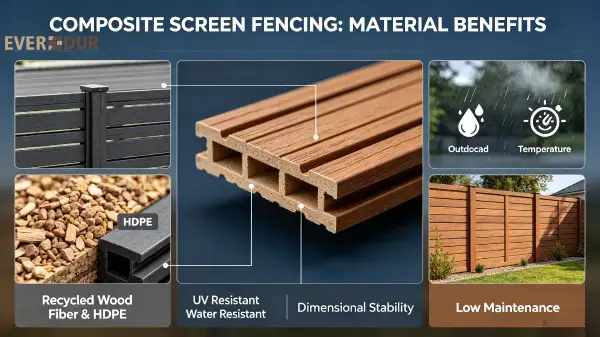
Outdoor living spaces are evolving rapidly, and composite screen fencing has become one of the most sought-after solutions for homeowners, architects, and landscape designers heading into 2026. Composite screen panels are different from standard wood or metal options because they are made of recycled wood fiber and high-density polyethylene (HDPE). This makes a material that is resistant to UV light, water, and changes in seasonal temperatures without needing to be maintained every year. You can choose from a wide range of profile widths, surface textures, and colors for this type of outdoor screening, making it perfect for enclosing a garden terrace, defining the edge of a commercial patio, or adding architectural detail to a modern building. Slatted composite panels are attractive for more than one reason: they add rhythm and shadow play to outdoor walls and yard boundaries, giving them visual depth that solid fence just can't match. As environmental rules get stricter in North America and Europe, specifiers and end users who want outdoor materials that show they care about the environment will like these panels because they are made of recycled materials. This guide talks about what's making people use composite screen panels in 2026, the different ways they can be designed, and how to choose the best one for your outdoor project.
What Makes Composite Screen Fencing a Key Outdoor Design Trend in 2026?
It's not a coincidence that composite privacy screen fencing and composite outdoor screens are becoming more popular in 2026. Several factors working together, including progress in material science, changing tastes in style, and stricter environmental purchasing standards, have made this type of product standard in landscaping and architecture.
In second-generation co-extrusion manufacturing, a protective polymer shell is put around the composite core during production. Compared to older single-layer extrusion methods, this structural approach makes the material more resistant to wear, staining, and water getting in. This makes a panel that stays the same color and size in a wide range of conditions, from the hot, humid summers in the Mediterranean to the cold winters in northern Europe.
In modern outdoor design, slatted or louvered screening is more popular than solid boundary walls because it looks better. With open-slat designs, natural light and air can flow through, making outdoor areas feel linked instead of closed off. This is especially important in cities, where outdoor spaces are limited and a sense of openness is important.
In order to be environmentally friendly, composite wood-plastic panels are made from Grade A recycled HDPE and recovered wood fiber. Architects and buying teams working with green building systems like BREEAM in the UK, HQE in France, or LEED in North America can get points and meet paperwork needs by choosing materials with certified recovered content.
Lastly, the fact that plastic slatted screens don't need much upkeep gets rid of a cost that comes up over time with wood fence. There is no need to paint, seal, or treat for rot—just clean it every so often to keep it looking good for a service life that can last anywhere from 10 to 25 years, based on the structure.
Composite Screen Fencing Styles for Privacy, Light, and Airflow
One of the best things about composite slatted screens is that they can meet many, sometimes conflicting, space needs at the same time. The same outdoor border can give you privacy from your neighbors' homes while still letting air flow through and giving you some views of trees or the sky.
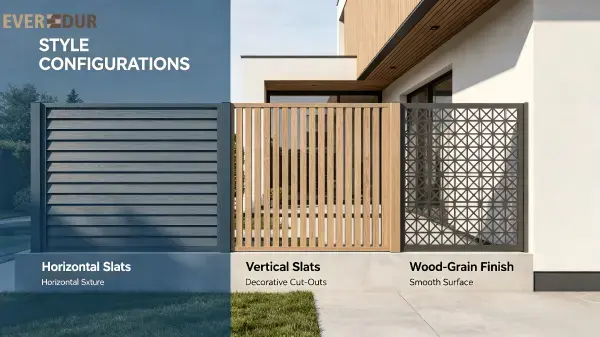
The main variable is the slat spacing. Narrower gaps between horizontal or vertical boards—usually made possible by wider profile widths between 138mm and 200mm—provide more privacy while keeping the open look that makes screening different from a solid wall. When you want to block wind, define a space, or add visual depth without significantly limiting light, wider gaps with narrower profiles (90mm to 120mm) work well.
Texture on the surface adds another level of style choice. The matte, rough feel of brushed surfaces goes well with modern minimalist designs. When the plants around you are the main focus of your attention, embossed wood-grain finishes look great. Smooth finishes that have been sanded work well on porches and steps, where the wall itself is more of an architectural feature than just something in the background.
Color selection for composite screen fencing has expanded considerably. Beyond standard tones like ash grey, charcoal, and teak, custom color matching is available for projects where the screening needs to integrate with an existing facade palette or interior color story carried outward. This degree of specification makes composite slatted panels a practical tool for interior designers and landscape architects working on cohesive residential or hospitality projects.
Panel orientation — horizontal versus vertical — carries its own spatial logic. Horizontal slats tend to elongate a boundary visually, making a garden feel wider. Vertical configurations draw the eye upward, which can make low-boundary walls feel more substantial or frame a view more deliberately.
How Can Composite Screen Fencing Enhance Modern Outdoor Architecture?
Contemporary outdoor architecture increasingly treats boundary elements as active design components rather than afterthoughts. Composite screen panels contribute to this shift in a number of concrete ways.
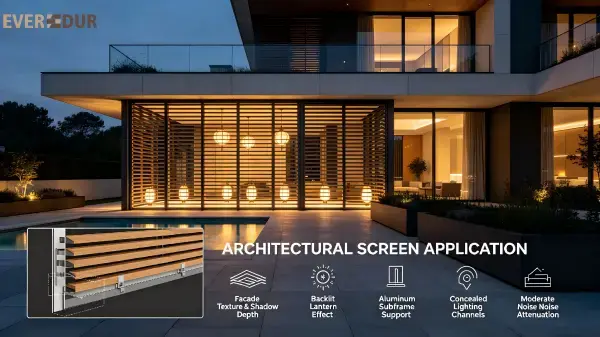
At the facade level, composite slatted panels installed as cladding or screening over structural frames introduce texture and shadow depth to exterior elevations that would otherwise read as flat surfaces. When backlit at night, the gaps between slats produce a lantern effect that animates outdoor walls after dark — a detail valued in hospitality and high-end residential projects.
Structurally, composite screen panels mount onto aluminum or steel subframes, which gives specifiers control over the installation depth and the opportunity to integrate concealed lighting channels, planting pockets, or irrigation infrastructure behind the screen face. This adaptability means the screening solution can be precisely coordinated with other architectural systems on site.
From an acoustic standpoint, composite screen boundaries provide a moderate degree of noise attenuation relative to open gardens, which is useful in urban residential contexts where traffic or commercial noise affects the quality of outdoor amenity spaces.
Durability is a practical architectural concern that is often underweighted at specification stage. Composite decorative screen fencing panels resist the expansion and contraction cycles that cause timber elements to split, cup, and loosen fixings over time. This dimensional stability means that the crisp geometric lines designed into a scheme are maintained through years of weather exposure rather than degrading into a distorted surface requiring remedial work.
Composite Screen Fencing for Gardens, Patios, Balconies, and Terraces
Composite slatted screens works well in a lot of different outdoor settings, but it's important to understand how each setting works in terms of space.
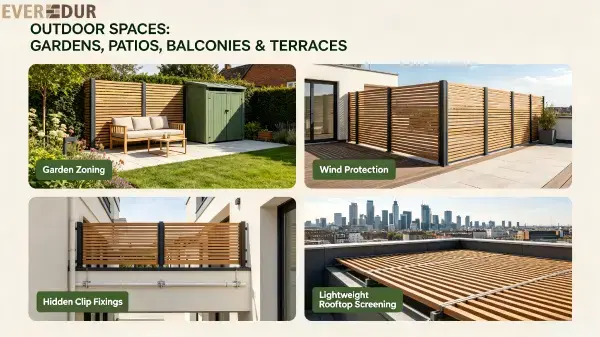
Most of the time, screening panels are used in residential gardens to make private seating areas within a larger garden boundary, to hide utility areas like bin stores or compost systems, or to define a vegetable garden or play area without blocking it off from the rest of the space. The partially see-through nature of slatted panels makes the garden look like a single space while also creating useful zones.
Screening protects privacy and keeps the wind out on porches and decks at ground level. Putting low-level screens on the side of a resting area that faces the wind can make it feel much warmer without making a completely enclosed microclimate. This is something that should be thought about for homes near the coast and yard platforms that are higher up in exposed areas of northern Europe.
When installing a balcony, you need to pay extra attention to how the structure is loaded and how it is fixed. When using composite panels to screen off a deck, they need to be paired with fixing hardware that is rated for the wind loads that will be present at that building's height and position. For balcony uses, the usual way to place panels is with aluminum support systems that use hidden clip fixings. This keeps the panel face clean and free of obvious screws.
Composite screening panels are a good alternative to metal mesh or glass balustrades for rooftop terraces, which are becoming more common in urban residential and commercial developments. The natural-tone finishes tone down the industrial feel that rooftops can have, and the low self-weight of composite panels lowers the dead load that they put on the roof structure.
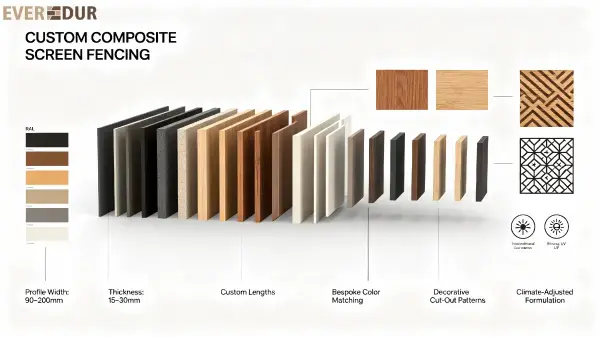
Custom Composite Screen Fencing for Contemporary Landscape Projects
Landscape architecture and high-specification residential projects frequently require screening solutions that go beyond catalog dimensions and standard color options. Custom composite screen fencing production addresses this through adjustable profile dimensions, bespoke color matching, and surface texture development.
Profile customization covers width (90mm to 200mm), thickness (15mm to 30mm), and length, with standard lengths at 1.8m and 2.2m and custom lengths available for projects with specific modular requirements. This means the panel dimensions can be coordinated with paving module sizes, facade grid lines, or interior joinery proportions carried into the outdoor space.
Material formulation can also be adjusted for regional climate conditions. Projects in high-humidity tropical climates benefit from composite mixes with enhanced moisture barrier properties. Installations in high-UV environments — southern Europe, parts of the Middle East, or high-altitude locations — can be specified with formulations and colorants that demonstrate minimal fading after 2,000 or more hours of UV exposure testing.
Color development for bespoke projects begins with the client's design intent — whether that's matching a RAL color specified on a facade, referencing a natural stone or timber tone found elsewhere in the project palette, or creating a panel color that doesn't appear in any standard range. This collaborative process requires lead time, and early engagement with the manufacturer during design development is the practical approach.
Decorative cut-out patterns within panels — geometric, botanical, or abstract — extend the application of composite outdoor screening into pure architectural ornament. These panels are used as gate infills, boundary features in public realm schemes, and decorative partitions in commercial hospitality settings where the screening contributes to brand identity as well as spatial function.
Conclusion
Composite screen fencing has earned its position as a practical and design-forward outdoor screening material heading into 2026. The combination of recycled-content composition, weather durability, low maintenance requirements, and genuine customization capability makes it a credible choice across a wide range of residential, commercial, and landscape architecture applications. Whether the priority is garden privacy, architectural texture, balcony wind screening, or decorative boundary detail, composite slatted panels offer a material solution grounded in verified performance rather than marketing claims.
FAQ
Q: How long does composite screen fencing last outdoors?
A: Service life ranges from 10 to 25 years depending on the structural configuration, installation quality, and local climate conditions. Second-generation co-extrusion panels, which feature an integrated protective polymer shell, generally perform toward the upper end of this range because the outer layer resists surface wear, moisture ingress, and UV-driven color shift more effectively than single-layer extruded composites.
Q: Is composite screen fencing suitable for coastal or high-humidity outdoor environments?
A: Yes. The HDPE component in composite panels is inherently resistant to moisture absorption, and the material does not rust, rot, or swell when exposed to salt air or high ambient humidity. For coastal projects, specifying panels with a co-extrusion construction adds an additional layer of protection at the panel surface. The material formulation can also be adjusted for projects in particularly demanding climatic conditions.
Q: Can composite screen fencing panels be cut to non-standard lengths on site?
A: Composite panels can be cut using standard woodworking tools — circular saws or mitre saws with fine-tooth blades. Cutting on site to fit non-standard dimensions is straightforward, though it does expose the core material at the cut end. Applying an appropriate end-cap or sealant to cut ends is recommended for installations in wet or humid outdoor conditions to maintain the panel's dimensional stability over time.
Get Composite Screen Fencing Samples and Pricing from Everdur
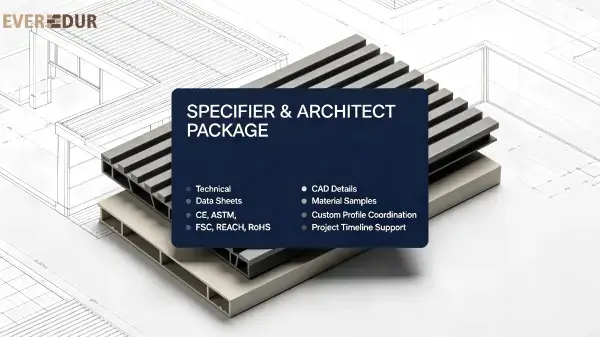
For Construction Firms and Architects: Receive technical data sheets, full certification documentation (CE, ASTM, FSC, REACH, RoHS), and CAD details for specification. We support design development with material samples and custom profile options coordinated to your project timeline.
For Fence Contractors and Installers: Access installation guides, compatible subframe specifications, and consistent supply backed by 50 WPC production lines and annual output exceeding 1,500 containers to 60+ countries.
For Building Materials Wholesalers and Resellers: Enquire about exclusive wholesale pricing, MOQ flexibility, and private-label options. Free samples are available to support your sales process.
For End Customers: Receive free design consultation and installation guidance tailored to your garden, terrace, or balcony project. Our team helps you select the right profile, color, and configuration before you commit to an order.
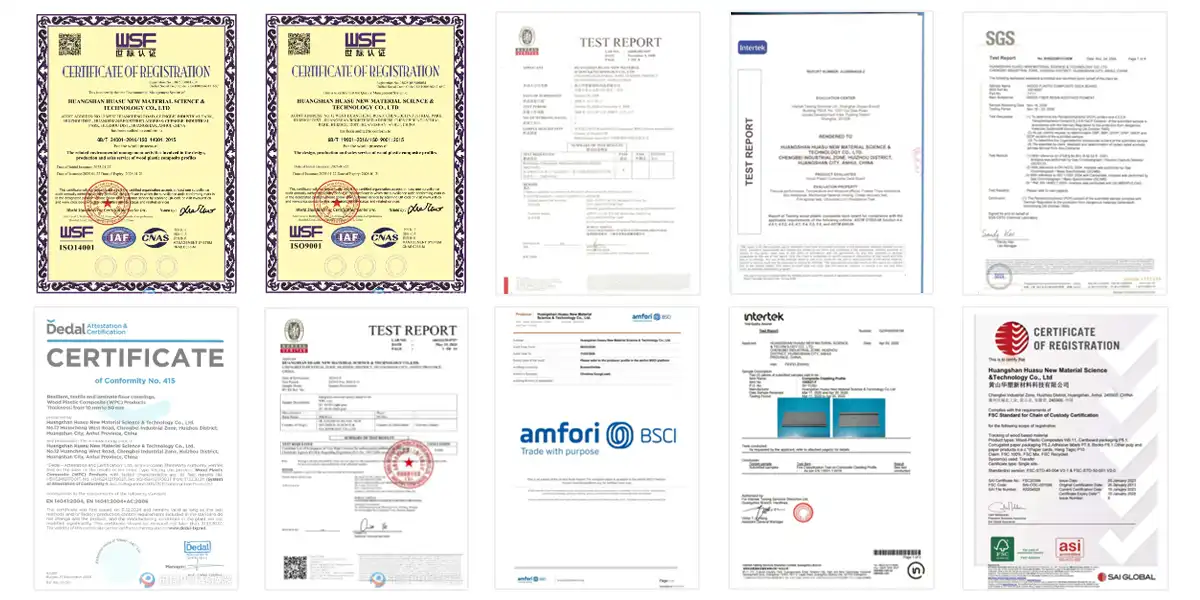
Everdur's composite screen fencing manufacturer credentials include ISO 9001 quality management, ISO 14001 environmental management, CE conformity for the European market, ASTM D7039 compliance for North American projects, FSC chain-of-custody certification, REACH and RoHS compliance, Recycled Content certification, and E0 environmental standard for formaldehyde emissions. All products are intended for outdoor installation only.
Reach our team directly at violet@wpcsupplier.com to request samples, discuss project requirements, or obtain a quotation.
References
1. European Committee for Standardization. EN 15534: Composites Made from Cellulose-Based Materials and Thermoplastics (Wood-Polymer Composites). Brussels: CEN, 2014.
2. ASTM International. ASTM D7032: Standard Specification for Establishing Performance Ratings for Wood-Plastic Composite Deck Boards and Guardrail Systems. West Conshohocken: ASTM International, 2021.
3. Forest Stewardship Council. FSC Chain of Custody Standard FSC-STD-40-004. Bonn: FSC International, 2019.
4. Klyosov, Anatole A. Wood-Plastic Composites. Hoboken: John Wiley & Sons, 2007.
5. Wolcott, Michael P., and Karl Englund. "A Technology Review of Wood-Plastic Composites." Proceedings of the 33rd International Particleboard/Composite Materials Symposium, Washington State University, 1999.
6. Clemons, Craig M. "Wood-Plastic Composites in the United States: The Interfacing of Two Industries." Forest Products Journal, vol. 52, no. 6, 2002, pp. 10–18.
7. Brydson, John A. Plastics Materials, 7th ed. Oxford: Butterworth-Heinemann, 1999.
Send Inquiry
You may like