_1777451497595.webp)
WPC Cladding: The Ultimate Solution for Durable and Stylish Building Exteriors
WPC cladding continues coming up to the top of the debate for building owners and architects about exterior materials that last over time without requiring continual upkeep. Wood Plastic Composite cladding is a mixture of recycled wood fiber and high-density polyethylene and offers an exterior wall covering that withstands the kind of damage that reduces the life of conventional timber. It will not split, rot or warp after a few seasons of rain and sun, unlike genuine wood. It has a real warmth and richness to it that pure plastic panels lack and looks great on both residential and business facades. Over the last decade, co-extrusion manufacturing processes have taken the performance of the material to the next level by creating a protective outer layer that makes today’s composite cladding boards significantly harder than their predecessors. This style of façade board provides an effective compromise between esthetic value and structural robustness whether you are completing a private home, renovating a shop storefront or choosing materials for a hotel project. In the sections following, I’ll guide you through precisely why that combination works, how the material stands up against real-world environmental stresses, and what to consider when choosing profiles for your unique project.
What Makes WPC Cladding a Durable Choice for Building Exteriors?
Durability in a façade material is not just a matter of hardness. It is about how the material reacts to the whole spectrum of pressures that a building outside endures during years of service.
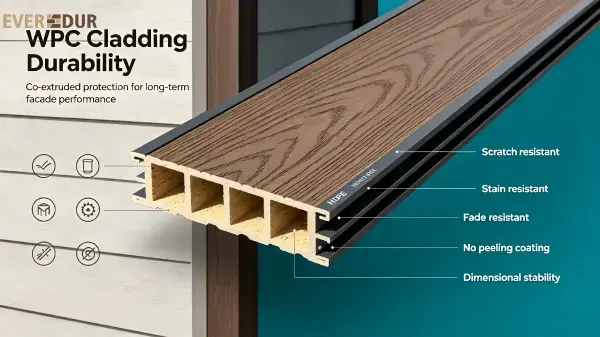
The strength of WPC cladding lies on the proportion and quality of its two major elements, wood powder and HDPE (high-density polyethylene). The wood fiber gives the stiffness and that familiar natural look . The HDPE ties everything together and creates a moisture barrier at the molecular scale . During the extrusion process, chemical additives such as UV stabilizers, antioxidants, and coupling agents are added to prevent the material from deteriorating when exposed to sunlight or oxidation over time.
The difference between current generation goods and earlier composite boards is the co-extrusion technique. When manufacturing, a thick, protective outer cap layer is concurrently created with the core. This top layer is what makes contemporary wall cladding boards resistant to scratches, staining and color loss on the surface. There is no coating placed later so it doesn’t peel or wear off like painted finishes may.
The structural integrity is also a function of how the material manages the dimensional stress. Natural wood expands and contracts a lot with moisture fluctuations which causes cracking at joints and around fasteners. Well-formulated composite boards maintain tighter tolerances across temperature and humidity cycles, which is very important in areas that swing between scorching summers and freezing winters – conditions widespread throughout Europe and North America.
As for the service life of external WPC cladding with co-extrusion construction from a life cycle perspective, it is generally 15 to 25 years, depending on the product grade and installation environment. That’s a big benefit over untreated wood, which might need replacement or major repairs within a decade when exposed.
WPC Cladding Protection Against UV, Moisture and Temperature Changes
Outdoor wall materials have three constant enemies: UV radiation, moisture penetration and thermal expansion. A façade board that can dependably do all three is really valuable in a broad variety of climates and project kinds.
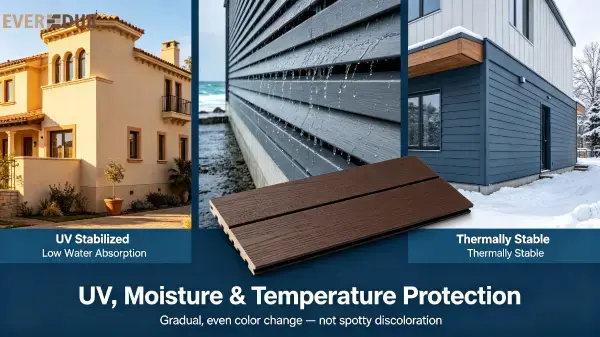
The main cause of color deterioration of outdoor textiles is UV light. UV stabilizers used in good grade composite boards considerably reduce the photodegradation process. Well-tested items will still be acceptable after 2,000 or more hours of UV exposure in accelerated testing (a norm used by a number of international testing organizations). That’s not to say no fading, ever, but it does imply the change is gradual and even, not spotty discoloration that plagues painted or stained surfaces.
The HDPE composition and the co-extruded cover provide moisture resistance. The water absorption rates of composite wall panels are far lower than those of untreated wood, so avoiding the swelling, warping and rot associated with repeated wet-dry cycles. notably in coastal sites or areas with high seasonal rainfall.
Thermal stability – the material’s capacity to keep its form across a wide range of temperatures — is a feature that gets less airtime but is equally significant. Composite cladding materials intended for use on the outside are designed to reduce linear expansion and contraction. If you install it properly, with sufficient space between the pieces, the movement that does occur will not buckle in a heat wave or crack in the cold.
How Does WPC Cladding Reduce Exterior Maintenance Requirements?
No Painting, Staining, or Sealing Needed
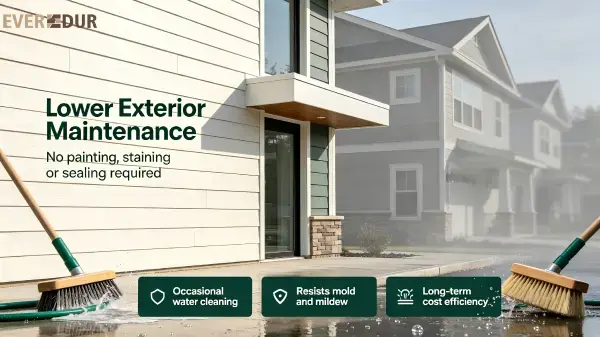
substantial continuing expenditures in repainting every few years, resealing joints and addressing rot or insect damage. Composite wall cladding cuts out a lot of that cycle. The color and texture are built into the material rather than put on top, so there’s no paint coat to maintain. A occasional cleaning with water and a light brush is generally enough to keep the surface looking acceptable. That decrease in maintenance is a real advantage for property managers with several properties, or homeowners who just want less to worry about.
Resistance to Mold, Mildew, and Insects
In humid circumstances or shady locations, wood facades are susceptible to biological development. Mold and mildew may grow on the surface and penetrate the substance over time. Insects, especially wood-borers, use timber for food and protection. The HDPE part prevents both from coming into contact with the composite boards. The material does not absorb moisture in a manner that supports mold colonies, and gives little nutritional benefit to boring insects. This is mainly important in woodland residential or humid coastal locations where biological activity is strong.
Long-Term Cost Efficiency
The initial outlay for premium composite facade planks is more expensive than plain wood. But during a 15- to 20-year life, the maintenance savings — no repainting, no pest treatment, no early replacement – tip the overall cost of ownership toward the composite. That long-term assessment has considerable weight for commercial buildings, where every time scaffolding goes up it costs money, or rental properties, where downtime for maintenance reduces income.
WPC Cladding Colors, Textures and Profiles for Modern Facade Design
Surface Finish Options
Surface treatments for exterior WPC cladding are available in a variety of options that influence the look and feel. Brushed finishes provide a gentle, directional feel that reads as sophisticated and modern. Embossed finishes fairly well reproduce the natural grain patterns of teak, walnut and cedar woods. Sanded finishes provide a smoother face to clean-lined contemporary architecture. The wood grain textures provide visual depth that you just can't get on a flat or single tone surface.
Color Range and Customization
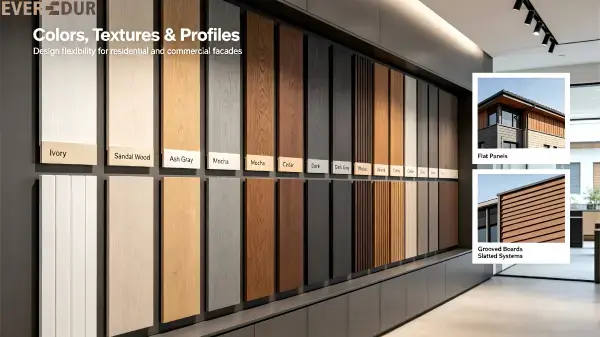
Composite wall panels are often available in standard color palettes from light natural colors such as ivory, sandal wood and ash gray to mid-tones such as mocha and cedar to deeper colors such as dark gray, walnut and coffee. For projects where typical alternatives are not consistent with the architectural palette, we provide bespoke color matching via manufacturers with ODM capability. This is especially beneficial in commercial applications when coordination with brand colors or existing building materials is required.
Profile Styles and Installation Systems
The visual rhythm of the final facade and its structural behavior are affected by profile choice. Flat panels provide a smooth, homogeneous surface. The grooved boards generate shadow patterns that provide visual appeal and also assist water drain away from the building face. Slatted systems provide depth and enable ventilated facade assembly improving the thermal and moisture performance of the building envelope. Hidden clip systems and hidden fasteners also have the added advantage of being rather common in professional installations since there are no visible fixings and thus a cleaner finish.
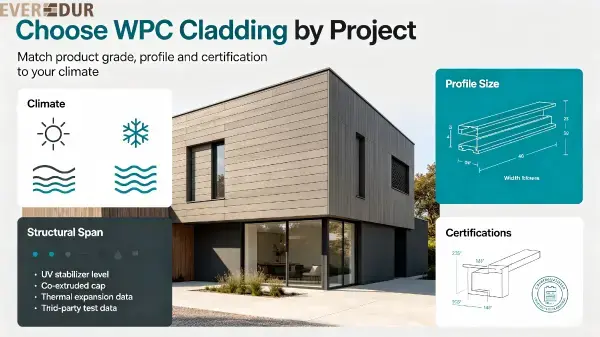
How to Choose WPC Cladding for Residential and Commercial Exteriors?
Match the Product Grade to the Climate
Not all composite façade materials behave the same under all situations. Projects in high UV conditions such as Southern Europe, the US Southwest or coastal Australia benefit especially from boards with higher UV stabilizer content and a completely enclosing co-extruded cap. For cold-climate projects in northern Europe or Canada, you require goods with validated low thermal expansion coefficients and moisture absorption rates. It’s appropriate to ask for third-party test data relative to your climatic zone before specifying any product.
Consider Profile Dimensions and Structural Requirements
The width and thickness requirements impact the apparent scale of the facade as well as the structural span between fastening points. Boards in the 100-120mm range are perceived as fine-grained and intricate. Wider 150-220mm profiles for a bolder, more solid appearance. The thickness of the board may also effect the span between joists since bigger boards can span greater distances between joists, which can lower the amount of substructure required. Problems in the installation phase may be avoided by coordinating profile dimensions with the structural engineer or installer early in the design process.
Verify Certifications Before Purchasing
In Europe and North America, material certification is not a choice for projects; it is a basic requirement for many specifiers and building standards. Composite cladding for European projects must be CE marked and conform with necessary EN requirements. FSC accreditation guaranties that the wood fiber content is supplied in a responsible manner. REACH and RoHS compliance is a chemical safety issue – crucial for both occupant health and regulatory compliance. ASTM test compliance is important for North American projects. "Normal" means they ask for proof of what they want ordered. Good manufacturers will have it on hand.
Conclusion
Composite facade cladding has moved well past the point of being a novelty alternative to timber. The combination of recycled material content, co-extrusion manufacturing, and verified resistance to UV, moisture, and temperature makes WPC Cladding a credible long-term choice for building exteriors in a wide range of climates. The reduction in maintenance obligations, the breadth of available colors and profiles, and the compatibility with modern hidden-fix installation systems make it practical for both residential and commercial applications. If you're evaluating facade options for an upcoming project, the durability, design flexibility, and lifecycle economics of WPC wall cladding are worth examining closely.
FAQ
Q: How long does WPC cladding typically last on a building exterior?
A: Service life depends on the product grade, climate exposure, and installation quality. Solid co-extruded boards are generally rated for 20 years; hollow co-extruded profiles typically carry 15-year expectations. Both figures assume correct installation and normal exposure conditions.
Q: Can composite cladding boards be painted or refinished?
A: They don't need to be, and in most cases manufacturers advise against it. The color is integral to the material. Applying paint on top creates a surface that will eventually peel and require ongoing maintenance — which defeats one of the primary advantages of the material.
Q: Is WPC wall cladding suitable for use in both hot and cold climates?
A: Yes, with the appropriate product specification. Quality composite boards are formulated to handle a broad temperature range. The key is verifying that the specific product has been tested for the thermal conditions of your project location, and that installation gap spacing follows the manufacturer's guidelines for your climate zone.
Get WPC Cladding for Your Next Exterior Project — Contact Everdur Today
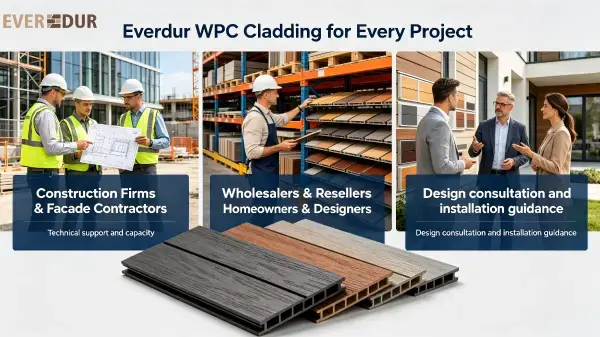
Whether you're a construction firm sourcing facade materials for a multi-building development, a building materials wholesaler looking for a reliable supply partner, or an end customer planning a villa or home renovation, Everdur has options structured for your situation.
For construction firms and facade contractors: We offer project-specific technical support, sample boards for specification approval, and stable production capacity — with more than 1,500 containers of annual output, we can support both mid-scale and large-scale project timelines.
For building materials wholesalers and resellers: We provide competitive wholesale pricing, consistent batch quality under ISO 9001 and ISO 14001 certified systems, and the flexibility to accommodate custom color and profile requirements through our ODM/OEM program.
For end customers: We offer free design consultation, color matching support, and installation guidance to help you get the facade result you're looking for without navigating the process alone. All Durable WPC cladding products comply with CE (EU), ASTM D7039 (US), and GB/T 24137 (China) standards. Environmental certifications include FSC (Forest Stewardship Council) for responsible wood fiber sourcing, REACH and RoHS compliance for chemical safety, and recycled content certification reflecting the use of Grade A recycled HDPE.
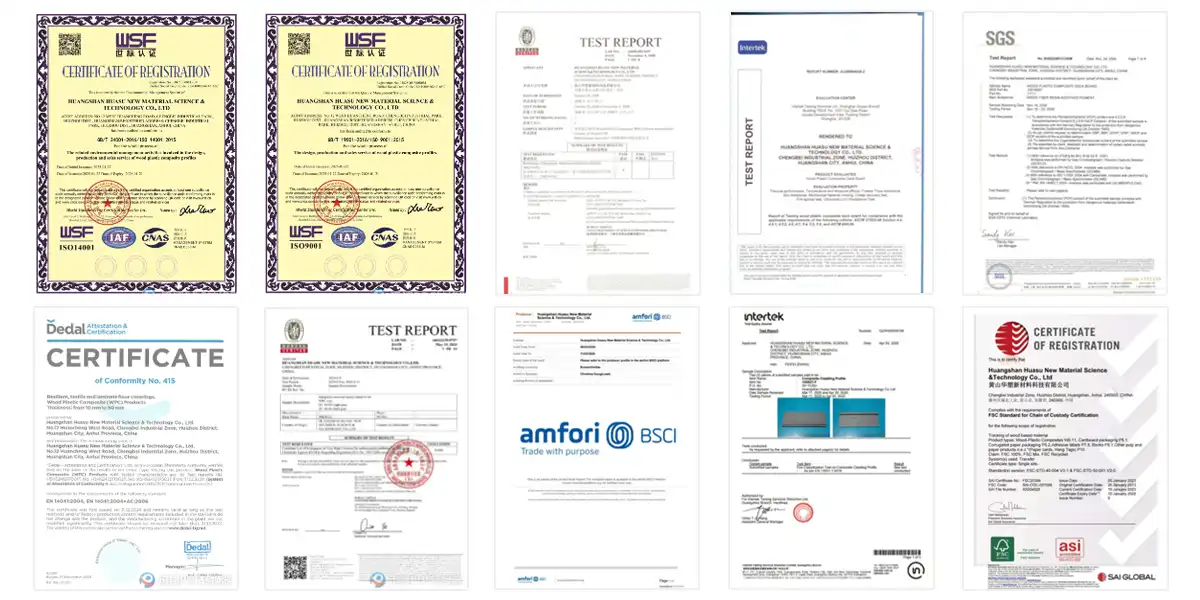
As a professional WPC cladding manufacturer with 16 years of production experience serving clients in 60+ countries, we take compliance and material transparency seriously. Send your project details or a sample request to our team: violet@wpcsupplier.com.
References
1. Clemons, C. M. (2002). Wood-plastic composites in the United States: The interfacing of two industries. Forest Products Journal, 52(6), 10–18.
2. Kazemi Najafi, S. (2013). Use of recycled plastics in wood plastic composites — A review. Waste Management, 33(9), 1898–1905.
3. European Committee for Standardization. (2012). EN 15534: Composites made from cellulose-based materials and thermoplastics (usually called wood-polymer composites (WPC) or natural fibre composites (NFC)). CEN.
4. Mankowski, M., & Morrell, J. J. (2000). Patterns of wood susceptibility to mold and decay fungi following exposure to a sewer environment. Wood and Fiber Science, 32(4), 405–414.
5. American Society for Testing and Materials. (2011). ASTM D7031: Standard guide for evaluating mechanical and physical properties of wood-plastic composite products. ASTM International.
6. Stark, N. M., & Matuana, L. M. (2006). Influence of photostabilizers on wood flour–HDPE composites exposed to xenon-arc radiation with and without water spray. Polymer Degradation and Stability, 91(12), 3048–3056.
7. Forest Stewardship Council. (2015). FSC Standard for Chain of Custody Certification (FSC-STD-40-004 V3-0). FSC International Center.

Send Inquiry
You may like