_1777451497595.webp)
Top Traditional WPC Decking Manufacturers for Quality Products
Finding the right manufacturer for traditional WPC decking takes more than a quick search. With outdoor decking projects representing significant investments for contractors, resellers, and property developers across Europe and America, selecting a supplier who delivers consistent quality, reliable capacity, and genuine technical support matters more than price alone. This guide walks through the practical criteria buyers use when evaluating composite decking manufacturers — from production capability and certification verification to customization options and long-term supply reliability. Whether you are sourcing classic wood-look deck panels for residential villas, garden terraces, or public landscape projects, the manufacturer behind the product shapes everything from installation experience to decades of outdoor performance. Understanding what separates a dependable supplier from an unreliable one helps you avoid costly mistakes and build sourcing relationships that hold up over time.
What Should You Look for in a Traditional WPC Decking Manufacturer?
The company you choose for composite decks will have long-lasting effects on the quality of your job, your relationships with clients, and your bottom line. Before you choose a supplier, you should carefully think about a number of practical factors.
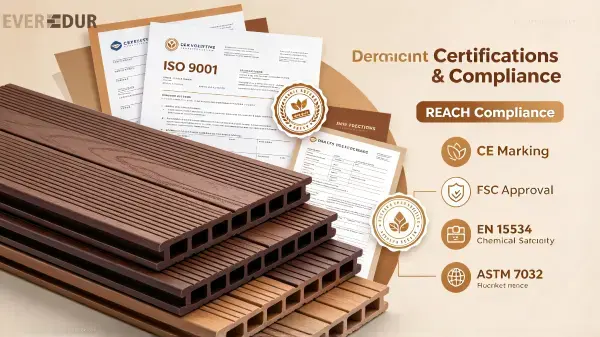
Certifications and following the rules are pretty close to the top of that list. A trustworthy manufacturer should have certificates that are known around the world for things like quality control, product safety, and environmental standards. Check for ISO 9001 for quality systems, CE marking for compliance with the European market, FSC approval for responsible buying of materials, and REACH compliance for chemical substance safety. These are not bonuses that you can choose not to have; they are basic needs for selling in North America and Europe.
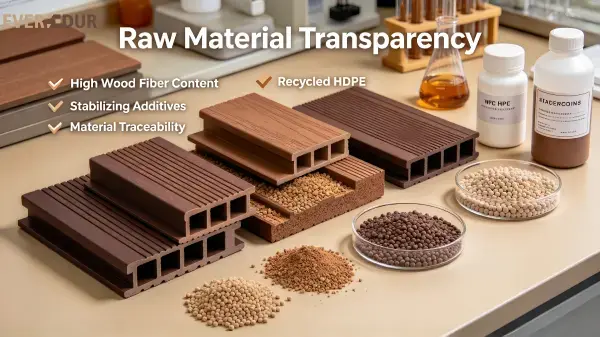
Another area that should be looked into is "raw material transparency." Manufacturers with a good reputation make it clear what goes into their boards. A well-made composite deck panel usually has a high percentage of wood fibers (60–70% or more), recycled HDPE, and chemicals that make it stable. If you ask about the HDPE grade, the amount of recycled material, and the types of additives, you can tell right away how seriously the seller takes the integrity of the product.
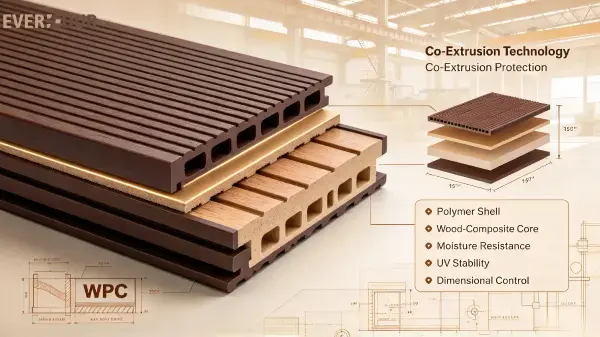
Most buyers don't realize how much production technology affects durability. When manufacturers use co-extrusion methods, they add a protective polymer layer around the core. These boards are usually better at resisting moisture, UV light, and being hard on the outside than single-extrusion options.
Quality of response and communication tells you a lot about how a supplier works on a large scale. If a manufacturer clearly answers technical questions, gives you detailed product documentation without being asked, and promptly follows up on samples, you can get an idea of how they will act when you need an urgent order or are worried about the quality of their work in the middle of a project.
Lastly, think about your geographical reach and export track record. Manufacturers who sell to customers on multiple continents have already figured out how to deal with complicated logistics, customs paperwork, and different compliance rules. That knowledge makes it easier for importers and project writers to work with people in other countries.
Traditional WPC Decking Manufacturing Capacity and Production Technology
Two real areas where makers differ are their production capacity and process technology. The quality of their products and the dependability of their supplies are directly affected by these differences.
A company with a lot of extrusion lines can keep up the same level of output for big orders without sacrificing accuracy in measurements or surface finish. This is very important for buyers who are working on multiple projects at once or who have to deal with regular demand spikes. Suppliers who don't have a lot of space may do a great job with a sample order but have a hard time when the order volume goes up with classic WPC deck panel.
Making new technologies is also very important. Co-extrusion processes have made a big difference in the quality of composite floor boards since single-extrusion processes were replaced. Co-extrusion creates a tough, weatherproof shell around the wood-composite core. This fixes problems with older boards that would sometimes absorb water and get stained on the outside. This way of building structures helps keep the sizes stable over time and changes in temperature, which is important for outdoor projects in places where the seasons change a lot.
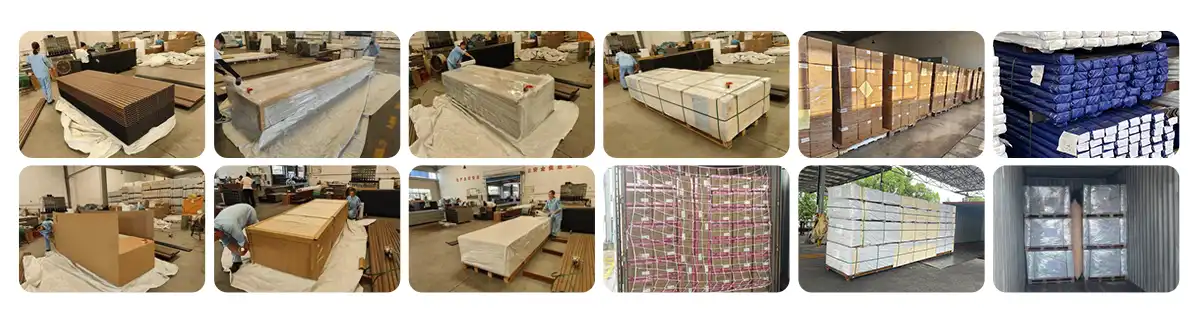
Using second-generation co-extrusion technology, Everdur runs more than 50 production lines that make about 30,000 tons of material every year. Products are sent to more than 60 countries on five continents to be bought by people like known store groups and project creators in the Americas and Europe. This wide range of supply experience shows how production systems are built around quality control and stability. These systems include 5S organization on-site and quality checks at each stage, from receiving raw materials to packaging them up at the end.
Also, it's important to remember that manufacturing innovation doesn't stop with the products that are already on the market. Composite profiles that are lighter, stronger structurally, and move less in temperature change are being worked on. This is an example of the kind of incremental improvement that serious manufacturers seek instead of seeing a current product as a finished answer.
How Can You Verify Traditional WPC Decking Quality and Consistency?
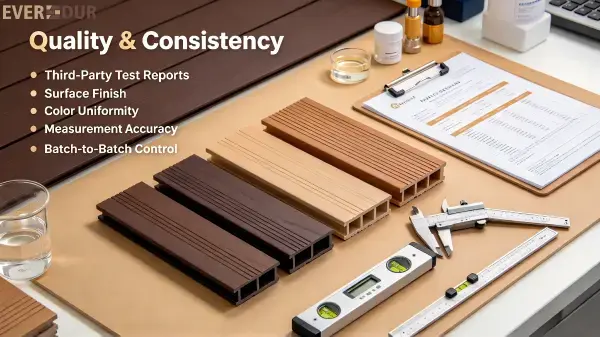
Checks begin before you even place an order. You can compare different sellers' products by getting official test reports from third-party labs that are recognized by the government. These reports should include information on UV resistance, moisture absorption, flexural strength, and slip resistance. Look for test standards that are well-known in the market you want to reach. For example, EN 15534 is a good standard for European composite board uses, and ASTM D7032 is a good standard for North American performance needs.
Physical samples are still necessary. A sample board shows the quality of the surface finish, the uniformity of the colors, the accuracy of the edges, and the density of the structure in a way that product photos just can't. Doing your own basic tests, like making sure the surface is level, checking the accuracy of the measurements, and feeling the board under your feet, adds a useful layer on top of the lab numbers.
Some makers have trouble keeping things the same from batch to batch. If you can, ask for samples from more than one production run, or talk to the sellers directly and ask them how they handle color and size differences between big orders. If the company has strong quality management systems, they should be able to answer that question with specifics instead of broad statements.
Traditional WPC Decking Samples, Customization, and Technical Support
It's simple to get a basic object from a catalog. What sets capable manufacturers apart is their ability to adapt, and they should be able to help buyers through this process by providing them with real technical information.
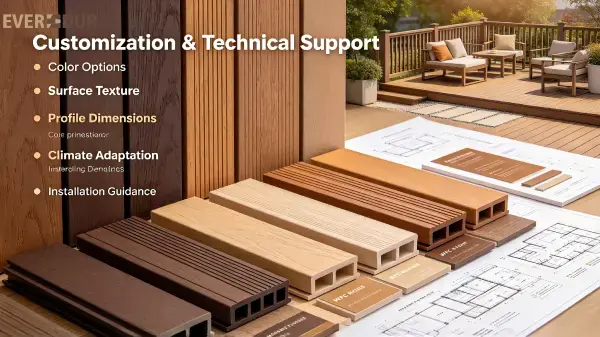
Some customization options to look into are changing colors outside of the standard range, changing the surface texture (such as brushed, embossed, wood grain, or sanded), changing the profile dimensions to meet specific structural needs, and changing the way the material is made to work in harsh climates. Working with a manufacturer who knows about material science instead of just having a set range of products makes a difference for project-specific uses, like a coastal piece that needs to be more resistant to salt or a public place that gets a lot of use and needs a harder surface.
The quality of technical support has a direct effect on how well installations go. On-site mistakes and callbacks are less likely to happen when there is clear information on fixing systems, frame spacing, expansion gaps, and load-bearing formulas. Manufacturers who have done a lot of exporting usually keep paperwork in a lot of different languages and installation standards.
Everdur lets you customize traditional decking boards in terms of color, surface texture, profile size, and material type. During the planning stages of procurement and installation, their team gives project-based technical advice.
Choosing a Traditional WPC Decking Manufacturer for Long-Term Supply
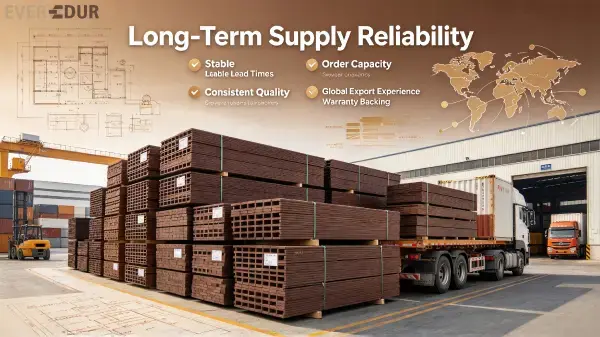
One successful order does not mean that there is a supply relationship. Long-term relationships depend on stable prices, expected wait times, consistent product quality across repeat sales, and easy contact when problems emerge.
When looking for a manufacturer to serve you on a regular basis, find out how they handle quality complaints, how they schedule their production, and what the minimum order numbers are for return orders. A supplier that has kept up busy client relationships with more than 100 accounts around the world has shown that they have the operating discipline and service standards to keep those relationships going.
European and American dealers and marketers count on reliable batch-to-batch uniformity to plan their inventory for classic WPC deck panels. Changes in color, size, or surface finish from one package to the next can cause problems with end customers and hurt brand trust. Buyers can better handle those risks when the companies they buy from have documented quality management systems and audit histories from a third party.
What we expect from the service life is also part of this conversation. Composite decks that can be used outside for 10 to 25 years means that users will have to make a long-term investment. Along with unit price, you should think about which maker is financially stable and has a past of production that will allow them to back up warranty claims and provide replacement boards years from now.
Conclusion
When looking for a traditional WPC decking manufacturer, you need to look at their certifications, production technology, quality control processes, ability to customize, and long-term supply reliability as a whole, not just one at a time. When manufacturers use open sourcing for materials, co-extrusion production technology, third-party certified quality, and quick technical support, they build a stronger base for outdoor decking projects in public, private, and commercial landscapes.
FAQ
Q.If a company makes standard WPC decking for the European and American markets, what approvals should they have?
A: To get into the European market, you need to have both CE marking and REACH compliance. FSC approval talks about where to get responsible wood fiber. ISO 9001 talks about systems for managing quality. For projects in North America, ASTM test approval gives useful performance standards. It is worth the time and effort to make sure that certificates are up-to-date and given by reputable organizations.
Q.What is the average length of time that standard composite decks lasts outside?
A: Service life depends on how the product is made, how well it is installed, and how much it is exposed to the weather. Co-extrusion composite floor boards that are well-made and used outside in homes and businesses usually last between 10 and 25 years. The main things that determine how long something lasts are its resistance to UV light, water, and changes in temperature.
Q.Can traditional WPC decking boards be changed to fit the needs of a certain project?
A: A lot of makers let you choose from different colors, surface designs, profile sizes, and material types. Talking to a manufacturer's technical team before production is often the best way to meet project-specific needs, like making something less likely to slip in wet areas or changing its temperature stability for harsh climates.
Ready to Source Traditional WPC Decking? Connect with Everdur
For firms that build things and plan projects: Get project-specific technical documentation, help with installation, and a steady supply of large quantities from a company that can do co-extrusion and has customers in both Europe and the Americas.
For Wholesalers and Resellers of Building Materials: To help your sales process, look into wholesale pricing, special color programs, and sample packs. Everdur's production ability ensures that all of your customers will always have what they need.
For Fence Contractors and Outdoor Specialists: Get full instructions on how to install the fixing system and feature details that are right for the way you put things.
For End Customers: Get help with design and suggestions for materials that are right for your outdoor space, climate, and style tastes.
All of Everdur's classic WPC decking meets the requirements of EU CE, ASTM D7039, and China GB/T 24137. The products are certified as having recycled content and meet E0 environmental standards. As a dedicated producer of traditional WPC decking, Everdur offers buyers in a wide range of markets both approved quality and reliable supply.
Email the Everdur team at violet@wpcsupplier.com to get in touch with them.
References
1. European Committee for Standardization. EN 15534: Composites Made from Cellulose-Based Materials and Thermoplastics (Wood-Polymer Composites or Natural Fibre-Polymer Composites). CEN, Brussels.
2. ASTM International. ASTM D7032: Standard Specification for Establishing Performance Ratings for Wood-Plastic Composite Deck Boards and Guardrail Systems. ASTM International, West Conshohocken, PA.
3. Forest Stewardship Council. FSC Certification Standards for Chain of Custody and Controlled Wood. FSC International, Bonn.
4. European Chemicals Agency. REACH Regulation (EC) No 1907/2006: Registration, Evaluation, Authorisation and Restriction of Chemicals. ECHA, Helsinki.
5. International Organization for Standardization. ISO 9001:2015 — Quality Management Systems: Requirements. ISO, Geneva.
6. Clemons, C.M. Wood-Plastic Composites in the United States: The Interfacing of Two Industries. Forest Products Journal, Vol. 52, No. 6.
7. Klyosov, A.A. Wood-Plastic Composites. John Wiley & Sons, Hoboken, NJ.
Send Inquiry
You may like