_1777451497595.webp)
Traditional Cladding for Residential Buildings: Classic & Reliable
When homeowners and contractors look for an exterior wall solution that balances aesthetics with practicality, traditional cladding consistently stands out as a dependable choice. Unlike more experimental facade materials, traditional cladding draws on decades of proven performance — providing the warmth of natural wood look along with the structure dependability that home projects need. Composite versions of this classic material are even better because they use recycled HDPE and wood fiber to make a material that is resistant to water, pests, and seasonal wear and doesn't need as much upkeep as real wood. Standard residential siding looks good on most building types, so you can use it to update the outside of an apartment building, finish a brand-new home, or remodel a house in the suburbs. It takes into account the traditional look of home facades while quietly fixing problems that owners have every year, like paint flaking off, boards rotting, and panels warping. This guide tells you everything you need to know about this material, such as how it changes the outside of your home, what colors and styles are available, how to install it, and what it's like to own a home for a long time.
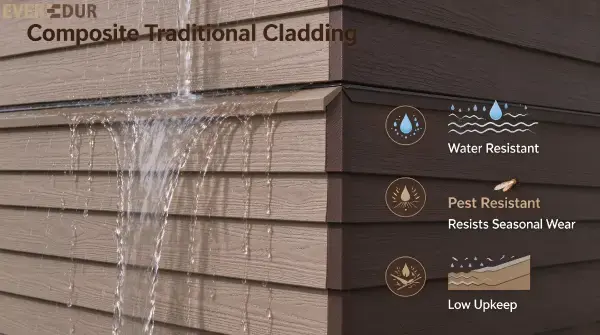
How Does Traditional Cladding Create a Classic Residential Exterior?
Putting straight wood-style boards around your house makes you feel safe and at home. In the last few hundred years, that visual language has shaped the way people build homes all over Europe and North America, from the log huts in the English countryside to the shiplap homes in New England. Traditional cladding honors that legacy by replicating the proportions, shadow lines, and surface character that make wood facades so enduringly appealing.
Composite siding is great for homes because it looks like wood but doesn't have the same risks as real wood. To make the profiles, precision extrusion is used. This means that each board in a project will have the same width, thickness, and surface roughness. When placed horizontally across a face of an outdoor wall, the slightly raised edges of each panel make natural shadow lines that give the wall depth and a sense of flow. This is the same thing that makes real weatherboard look so nice.
Beyond appearance, the geometry of traditional residential cladding profiles contributes to facade performance. The small slope of each board's face makes it easier for rainwater to run off without pooling against the wall. This simple way of managing water lowers the chance of water getting in at the joints, which is one of the most common places where home outdoor systems fail.
When architects and specifiers work on residential projects, they often say that traditional residential siding goes well with brick plinths, rendered sections, and wood window frames, so they don't have to make any special changes. The pictures are like the ones people already have in mind when they think of nice homes. This level of familiarity tends to speed up the approval process and make clients happier.
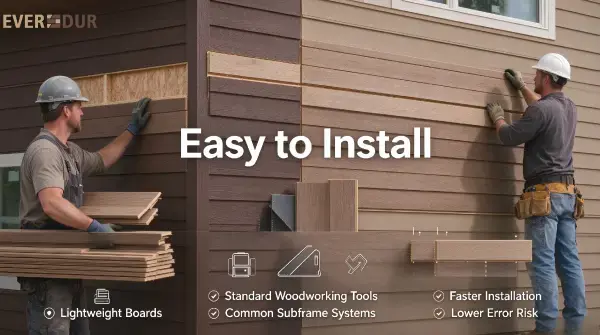
Because they aren't too heavy, composite wall pieces are easy for workers to move around on the job site. You can cut boards with regular woodworking tools and fix them with regular suspension systems. You don't need any special tools to work with them. There is less chance of making mistakes that could hurt how well it works in the long run, and it takes less time to install.
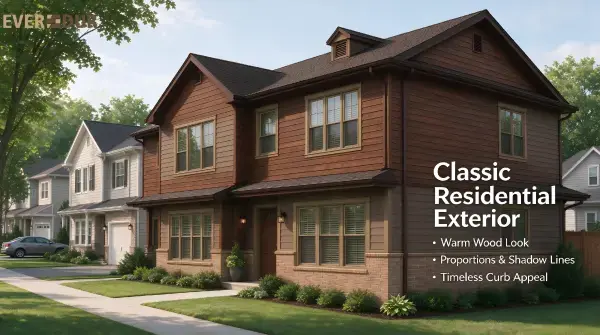
Traditional Cladding Colors and Wood Grain Styles for Home Facades
The color and feel of the surface are what make a coating system beautiful, not just useful for building. When people buy homes, they usually want finishes that match the walls, roof tiles, or window frames that are already there. These days, composite flooring comes in many colors, so it can match any project style.
As normal colors, you can get warmer wood tones like teak, walnut, cedar, mocha, and sandal wood. They also come in cooler neutral tones like ash gray, stone gray, and dark gray. With this range, the front of a building can either stay warm and natural, or it can be given a more modern, neutral color pattern.
A lot of what makes a wall look good is also the texture on the outside. A brushed finish has fine, straight grain marks that catch the light, just like planed wood. It looks more like sawn or rough-sawn wood when it has an etched finish because the surface is rougher. Plus, it looks even more real because it has a deep wood grain texture with knots and growth rings that look like real wood, even up close.
For projects where the standard color and texture choices don't quite work with the design idea, color and texture can be changed. This is very important for high-profile home projects where the front material needs to match a particular style or go with a carefully chosen group of materials.
You should also keep in mind that color stability is a real performance need, not just a matter of taste. When UV light hits composite flooring for a long time, the color doesn't fade. This makes it less likely that homeowners will call back or complain years after the job is done. Look for things that have been tested for UV safety for at least 2,000 hours and haven't changed much in color.
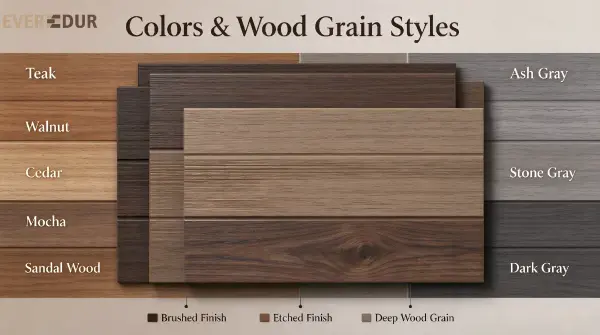
Traditional Cladding for Weather-Exposed Residential Building Walls
Performance in Rain, Humidity, and Coastal Environments
Conditions outside residential buildings in Northern Europe and some parts of North America would speed up the deterioration of untreated wood within a few seasons. Rain that doesn't stop, freeze-thaw cycles, high humidity, and salt air near the coast all put constant stress on surface materials. When these things happen, composite wall boards made from wood fiber and Grade A recycled HDPE behave differently than pure wood.
HDPE is naturally hydrophobic, which means it doesn't soak up water like wood does. This means that the boards don't swell, bend, or get surface cracks like wood does when it gets wet and dries many times. This dimensional stability is very useful when the weather freezes and thaws, because a board that doesn't hold water can't be hurt by the growth of ice inside it.
For sites near the coast, resistance to air that is full of salt is another thing to think about. Composite boards don't rust, and salt can't break down their surface over time because it doesn't have a base. And because of this, they are a good choice for beach homes where painted wood would need to be repainted every two to three years to keep its look and strength.
UV Resistance and Thermal Behavior in Exposed Climates
Sun exposure affects traditional eco-friendly cladding materials in two ways: UV light fades colors and changes the chemistry of the surface, and boards expand and contract as they heat up and cool down throughout the day and year. In the design, both of these things need to be taken into account.
On the inside of a good hybrid lining, not just on the outside, there are UV blocks. The UV protection is spread across the board's cross-section, so light surface wear doesn't show a base that isn't covered. It's not impossible for specifications experts to guess how long a product will keep its color after being in controlled UV light for more than 2,000 hours.
How the material is made and how it is put in place both affect how it moves thermally. The ends of fixed boards should have just the right amount of space for growth. Co-extruded composite profiles of the second generation are made to move less when the temperature changes than single-layer extrusion goods of the first generation. This helps it fit better and lessens the changes you can see in the gaps as the seasons change.
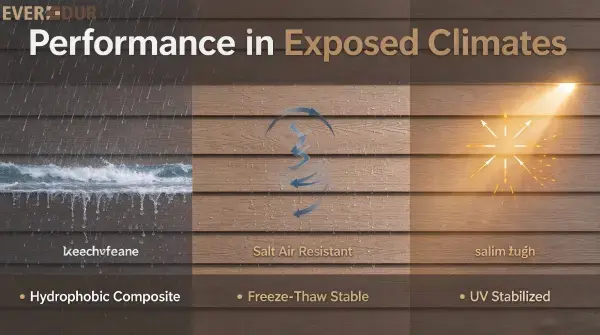
Long-Term Traditional Cladding Performance for Residential Buildings
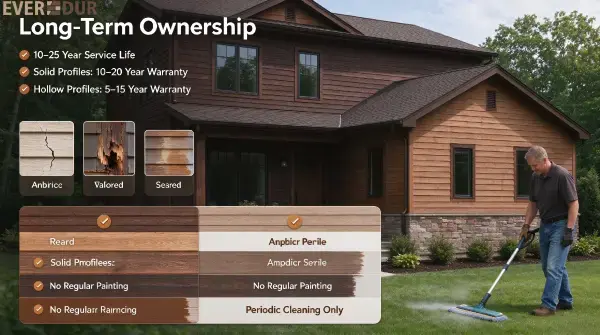
When picking an exterior material, you should compare how much it costs to buy to how much it will cost to own over the life of the building. Most composite siding on homes lasts between 10 and 25 years, though this depends on the type of siding and how well it was put. Solid-profile systems have warranties that last between 10 and 20 years, while hollow-profile systems have warranties that last between 5 and 15 years.
It doesn't need nearly as much care during that time as wood that has been painted or dyed. Every year, you don't have to paint or oil it, and you don't have to replace boards that are cracked or rotting. As part of regular upkeep, you should wash it every so often to get rid of any algae or dirt that has gathered. You can do this with normal cleaning supplies from around the house.
Traditional roofing made from salvaged materials is also good for the earth and looks good on buildings. When building something at home that needs to meet standards for energy efficiency or sustainability, picking materials that have been proven to contain recovered materials and have well-known environmental certifications can help. They don't add much to the cost compared to what they give you in the long run.
Conclusion
Traditional cladding remains a well-regarded choice for residential exteriors because it answers a genuine need: the desire for a facade that looks considered and lasting, without demanding continuous maintenance or imposing unsustainable material choices. Modern composite forms of this standard design go even further than those qualities. They add stability in shape, resistance to moisture, and proven environmental credentials to the attractive look that wood-style covering has always had. It's a solid, useful choice that homeowners, contractors, and specifiers working on residential projects in Europe and North America should really think about.
FAQ
Q: What is the typical lifespan of composite traditional cladding on a residential home?
A: Depending on the profile type chosen and how well they are installed, composite wall boards usually last between 10 and 25 years. More often than not, solid-profile boards do better at the top of this range, especially in sheltered areas. The length of the warranty usually depends on the structure that was chosen. For example, hollow profiles have shorter warranty terms, while solid profiles have longer ones.
Q: Does traditional residential cladding require painting or sealing after installation?
A: Not at all. One useful benefit of composite siding over solid wood is that it doesn't need to be painted, stained, or sealed on a regular basis. Since the color and UV stabilizers are built into the material when it is made, the board will keep its look even if it isn't treated regularly. Most of the time, all that is needed is regular cleaning to get rid of surface dirt.
Q: Can traditional cladding be used on all residential wall types, including those in high-rainfall regions?
A: Composite siding works well in places that get a lot of rain because it doesn't soak up water like wood does. This keeps it from growing, bending, and rotting. When the boards are installed correctly, with enough space between them and an open base, water and air can flow behind the covering layer, protecting the wall structure even more. For places near the coast or that get a lot of direct sunlight, choosing a product that has been tested for UV and wetness protection gives you more trust in the standard.
Ready to Specify Traditional Cladding for Your Residential Project? Contact Everdur
For Construction Firms and Architects: Everdur offers full technical documentation, sample boards, and project-specific specification support to help you detail and specify with confidence. Our products comply with EU CE certification, US ASTM D7039 standards, China GB/T 24137, and carry FSC, REACH, RoHS, and Recycled Content certification with E0 environmental standard compliance — giving your project the documentation it needs for planning submissions and sustainability assessments.
For Building Materials Wholesalers and Distributors: Competitive wholesale pricing structures, consistent supply from 50-plus production lines, and annual capacity exceeding 1,500 containers mean reliable stock availability for your customers. Contact us to discuss exclusive pricing tiers and free sample arrangements.
For Fence Contractors and Resellers: Straightforward installation compatibility with standard subframe systems reduces your on-site labor costs. Ask about our contractor support program.
For End Customers and Homeowners: Receive free design guidance and color consultation tailored to your home's exterior palette. We'll help you identify the right profile, texture, and color to achieve the facade you have in mind.
As a dedicated traditional cladding manufacturer with 16 years of production experience and an active customer base spanning more than 60 countries, Everdur welcomes inquiries from across Europe, North America, and beyond. Reach our team directly at violet@wpcsupplier.com to request samples, technical datasheets, or a project quotation.
References
1. Hutchings, P., & Williams, C. (2019). Timber and Timber-Alternative Cladding Systems: Performance in Northern European Climates. Building Research & Information, 47(4), 412–428.
2. BRE Group. (2021). Guidance on External Wall Cladding Materials for Residential Buildings. BRE Press, Watford, UK.
3. European Committee for Standardization. (2020). EN 15534: Composites Made from Cellulose-Based Materials and Thermoplastics. CEN, Brussels.
4. American Society for Testing and Materials. (2017). ASTM D7031: Standard Guide for Evaluating Mechanical and Physical Properties of Wood-Plastic Composite Products. ASTM International, West Conshohocken, PA.
5. Forest Stewardship Council. (2022). FSC Chain of Custody Certification: Requirements for Composite Wood Products. FSC International, Bonn, Germany.
6. Rowell, R. M. (Ed.). (2013). Handbook of Wood Chemistry and Wood Composites (2nd ed.). CRC Press, Boca Raton, FL.
7. Construction Products Association. (2020). Specifying External Cladding for New-Build and Renovation Residential Projects: A Practical Guide. CPA Publications, London, UK.
Send Inquiry
You may like