_1777451497595.webp)
3D Composite Decking vs Regular Composite: Which Is More Stylish?
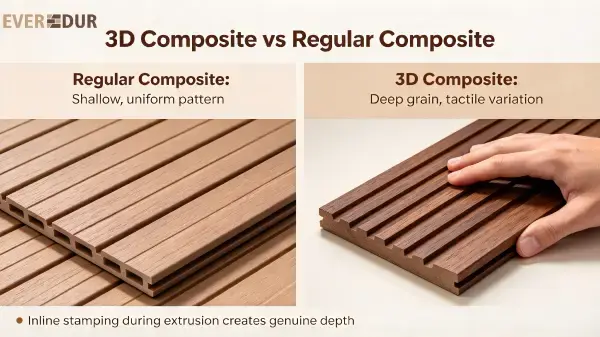
When comparing 3D composite decking to regular composite boards, the visual difference becomes clear the moment you place them side by side. Regular composite decking typically features a flat or lightly embossed surface that can look noticeably manufactured — pleasant enough, but lacking the authentic warmth of natural timber. 3D composite decking, by contrast, uses an inline stamping process applied during extrusion, creating grain patterns with genuine depth and tactile variation. The end result is a surface with shadow lines, grain changes that look like they happen naturally, and a roughness you can feel on your feet. This difference is important for homes, builders, and workers in North America and Europe who are making outdoor areas that need to look well-planned and put together. Style is more than just picking a color. It's also about how a material looks in natural light, how it ages, and how well it fits in with the architecture around it. When looking at these things, boards with deep embossed profiles are more like real wood than boards with a flat surface. Why is that? This piece looks at how the two types compare in terms of feel and sturdiness, as well as what you should think about before choosing one over the other.
What Makes 3D Composite Decking Look More Like Natural Wood?
The visual character of natural timber comes from its irregularity — grain lines that change direction, subtle colour shifts between early wood and late wood, and a surface that catches light differently depending on the angle. Replicating that complexity in a manufactured board is genuinely difficult, and it is where the production method makes the biggest difference.
Standard 3D composite decking is typically produced through a continuous extrusion process where the board exits the die and cools without any additional surface treatment. Some manufacturers apply a light emboss at the end of the line, but this tends to produce a shallow, repetitive pattern that looks uniform across the whole board length — something natural wood never does.
When making deep-profile boards, the straight pressing method is used in a different way. The roughness is pressed into the surface while the material is still semi-plastic during compression. This gives the grain effect more depth and makes it feel like it's part of the board instead of just being on the surface. As a result, the grain lines feel raised and depressed in a way that really looks and feels like real oak, teak, or cedar boards.
The composition of the material also plays a role. Recycled wood fiber and Grade A recovered HDPE are mixed to make boards. These boards have a naturally warm base tone. If you layer color pigments through this base instead of painting them on, the color has a depth that makes it look natural instead of painted. When combined with a rough surface—brushed, wood grain, or stamped options all react differently in direct sunlight compared to shade—the total look is much more like wood than a flat composite board can achieve.
It's important to remember that no composite board is exactly like wood. The goal is not to copy the wood, but to make a material that looks natural, weathers well, and needs much less maintenance than the wood it looks like.
3D Composite Decking vs Regular Composite: Texture and Grain Depth
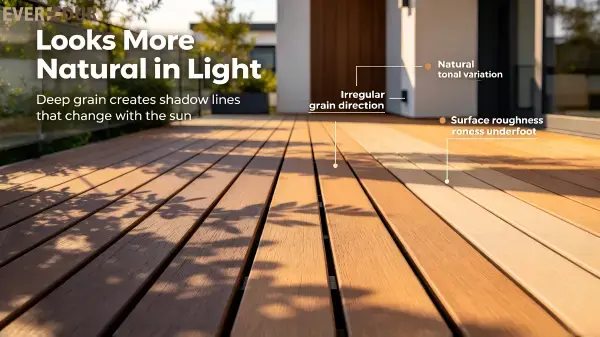
Texture is where the stylistic gap between these two product categories is most measurable. Running your hand across a standard composite plank, you typically feel a consistent, low-relief pattern — functional for slip resistance but not particularly distinctive. The surface sits flat in terms of visual interest, and under raking morning or evening light, it can look quite industrial.
A 3D textured deck surface behaves differently under the same lighting conditions. The deeper grain channels cast small shadows across the board face, creating a sense of movement and dimension that shifts as the sun moves across the sky. This is the same optical phenomenon that makes natural timber look alive throughout the day, and it is the reason deep-profile boards tend to photograph more convincingly and integrate more naturally into landscaped settings.
Grain depth also has a practical dimension. Deeper surface relief means the texture remains perceptible even after years of foot traffic and weathering. On shallower embossed surfaces, wear gradually smooths the pattern, and the board progressively loses what visual character it originally had. Boards with integral deep grain — where the texture is part of the board's structure rather than a surface treatment — retain their appearance over a considerably longer service period.
For design professionals specifying materials for projects in northern Europe, where low-angle winter light is prevalent, or in North American markets where wide deck surfaces are common, the way a board reads across a large area is a serious consideration. A 3D profile distributes visual interest evenly, preventing the flat, monolithic look that wide composite deck surfaces can sometimes produce.
Colour selection interacts with texture as well. The same colour in a flat-surface and a deep-embossed profile will look noticeably different once installed. The embossed version will appear richer and more varied because the texture introduces tonal variation. This is worth accounting for during material selection.
How Does 3D Composite Decking Perform in Outdoor Spaces?
Weather Resistance and Structural Stability
Outdoor decking in European and North American climates faces a wide range of conditions — freeze-thaw cycles, prolonged UV exposure, heavy rain, and humidity fluctuations across seasons. A board's ability to maintain its dimensions and surface integrity under these stresses determines how it looks and functions over time.
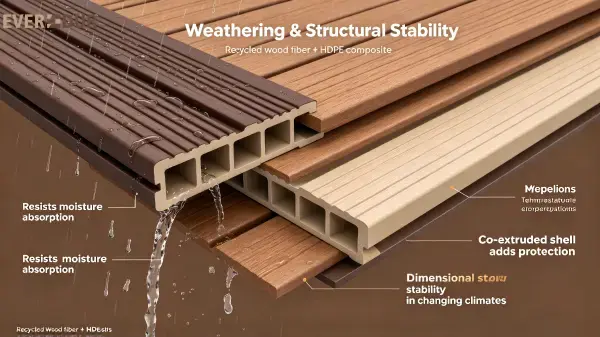
Boards manufactured from recycled wood fibre and HDPE resist moisture absorption significantly better than untreated timber. Because HDPE does not absorb water in the way natural wood does, the swelling, warping, and cracking associated with seasonal moisture changes are substantially reduced. The co-extrusion process, where a protective shell is formed around the board's core during manufacturing, adds a further layer of resistance to both moisture ingress and surface abrasion.
UV stability is equally important for maintaining the visual quality that makes 3D WPC board an attractive choice. Composite boards formulated with UV-resistant additives show minimal colour shift after extended exposure. Products tested to over 2,000 hours of UV exposure without significant fading provide a reliable benchmark for colour stability in markets with high solar radiation.
Thermal expansion is a real consideration for outdoor boards, particularly over long deck runs. Well-engineered composite boards manage this through dimensional stability in the core profile and appropriate installation spacing, which accommodates movement without compromising the surface's visual continuity.
Slip Resistance and Surface Safety
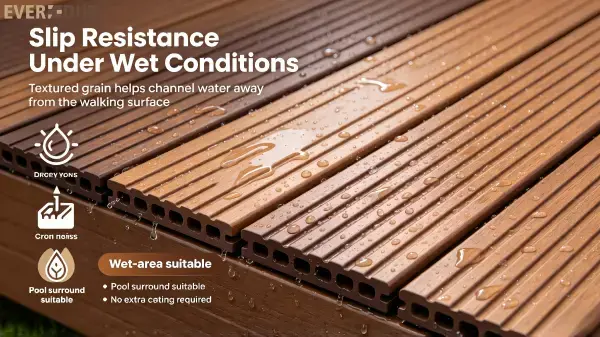
Outdoor surfaces need to remain safe underfoot when wet, particularly around pools, on terraces exposed to morning dew, or in climates with frequent rainfall. The textured surface of deep-embossed composite boards provides meaningful slip resistance without requiring additional coatings or treatments.
The grain channels on a 3D profile help channel water away from the walking surface more effectively than a flat board, reducing the standing water that contributes to slippery conditions. This is a practical benefit that complements the aesthetic purpose of the texture.
Safety ratings for 3D composite decking surfaces are assessed against standards that measure wet and dry slip resistance. Specifying boards that meet recognised outdoor slip-resistance criteria is relevant for commercial projects, public spaces, and any residential installation where safety liability is a consideration.
Long-Term Appearance Maintenance
One of the consistent concerns among outdoor material specifiers is how a product looks after five or ten years in service — not just on installation day. Composite decking that requires regular staining, sealing, or sanding to maintain its appearance introduces ongoing cost and disruption that many end-users want to avoid.
Composite boards do not require painting, staining, or sealing. Periodic cleaning with water and a standard deck brush is sufficient to keep the surface clear. The wear resistance built into the material means the surface remains functional and visually consistent across the product's service life, which ranges from ten to twenty-five years depending on the product specification.
For long-term design coherence — particularly in projects where the decking needs to remain consistent in appearance alongside other architectural elements — this maintenance profile is a meaningful advantage over natural timber.
3D Composite Decking for Modern Decks, Fences, and Outdoor Railings
Design Integration with Contemporary Architecture
Modern residential and commercial architecture in Europe and North America increasingly uses natural material references — timber, stone, raw concrete — in combinations that feel warm and considered rather than purely industrial. Outdoor decking, fencing, and structural elements need to complement these references without introducing visual inconsistency.
Deep-embossed composite profiles work well in these contexts precisely because they carry the visual language of timber without its maintenance demands. A garden terrace finished with a dark grey or stone grey composite board reads as intentional and material-aware in a way that flat, uniform composite surfaces sometimes do not.
Colour availability is also relevant here. A product range that extends beyond standard brown and grey tones — offering options such as ash, cedar, mocha, walnut, and teak alongside contemporary neutrals — gives designers flexibility to match or contrast existing building materials. Custom colour options further extend this flexibility for specific project requirements.
Outdoor Fencing Applications
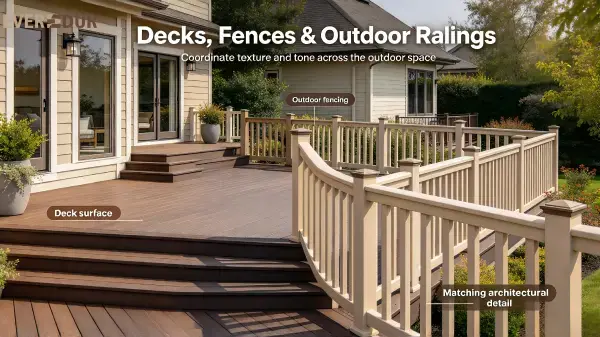
Composite materials are used for outdoor fencing as well as deck surfaces, and the same texture and durability benefits apply. A fence finished with a wood grain composite profile reads as a natural extension of a composite deck, creating visual continuity across the outdoor space.
It is worth being clear that composite fencing products are designed exclusively for outdoor installation. They are not suitable for interior applications. For outdoor use, however, the resistance to moisture, UV degradation, and pest damage that applies to decking boards extends equally to fencing profiles, making them a practical specification choice in climates with significant weathering demands.
The structural consistency of composite fencing — no warping, splitting, or checking over time — also means the fence maintains its visual quality without requiring the periodic maintenance that painted timber fencing demands.
Combining Texture Profiles Across an Outdoor Space
A considered outdoor design often uses more than one surface finish — a deck with a specific grain direction, a fence with a complementary but distinct profile, perhaps an overhead pergola element in a matching tone. Composite materials allow these elements to be coordinated in a way that timber cannot easily match, because the colour and texture are produced consistently across the product range.
Dual-surface composite boards — where each face carries a different texture — offer additional flexibility for applications where two distinct looks are needed within a single profile. This can be useful in fence applications where the internal and external faces of an enclosure benefit from different surface treatments.
Choosing 3D Composite Decking for Long-Term Outdoor Design
Matching Material to Project Requirements
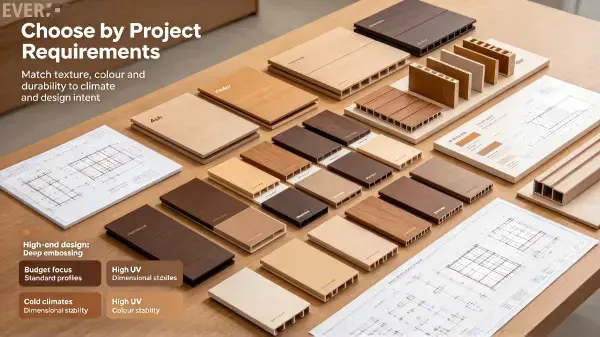
Not every project needs the same set of rules. A private patio for a home on a mild coastal climate needs different things than a business rooftop deck in a city in northern Europe or a public path in a park with a lot of foot traffic. These changes should be taken into account when choosing between normal composite profiles and deep-embossed composite profiles.
When looks are very important, like in high-end residential, hotel, or architectural landscape work, the thicker texture and richer look of stamped boards make them a good choice. Standard composite boards are still a good choice for projects where the most important thing is getting the job done at a certain cost.
The climate also affects the choice of materials. In places where there are a lot of freeze-thaw cycles, it's important that the board's profile stays the same size. When UV levels are high, surface UV protection and color stability become the most important things to think about. In harsh settings, boards made for specific climates can last longer and work better than standard specs. This is something that trustworthy makers can do as part of their customization options.
Understanding Service Life and Warranty Coverage
Service life and guarantee coverage show how confident a company is in their product, so it's important to compare them carefully. Due to the extra security that a co-extruded shell gives to the core material, hollow composite boards usually have shorter guarantees than solid or co-extruded boards.
A co-extruded solid board with a twenty-year warranty is not the same as a hollow board with a five-year warranty. The price difference between these two products should be understood in terms of how long they last and how much maintenance they don't need during that time.
Longer service life and, by extension, longer warranty coverage are not just a way to make people feel better; they are financially useful for commercial projects where disruption and replacement costs are high.
Environmental Credentials and Responsible Specification
Green building standards are becoming more important in North America and Europe, and specifying composite decks made from recycled materials is in line with them. Reclaimed HDPE and recycled wood fiber are used to make boards. These boards keep materials out of landfills and lower the demand for new wood.
The fact that formaldehyde and other harmful chemicals are not in the material is important for both environmental approval and the health and safety of end users in home and leisure settings. European chemical safety standards have been used to test composite decking that meets REACH and RoHS standards. This gives environmental claims a solid foundation that can be checked.
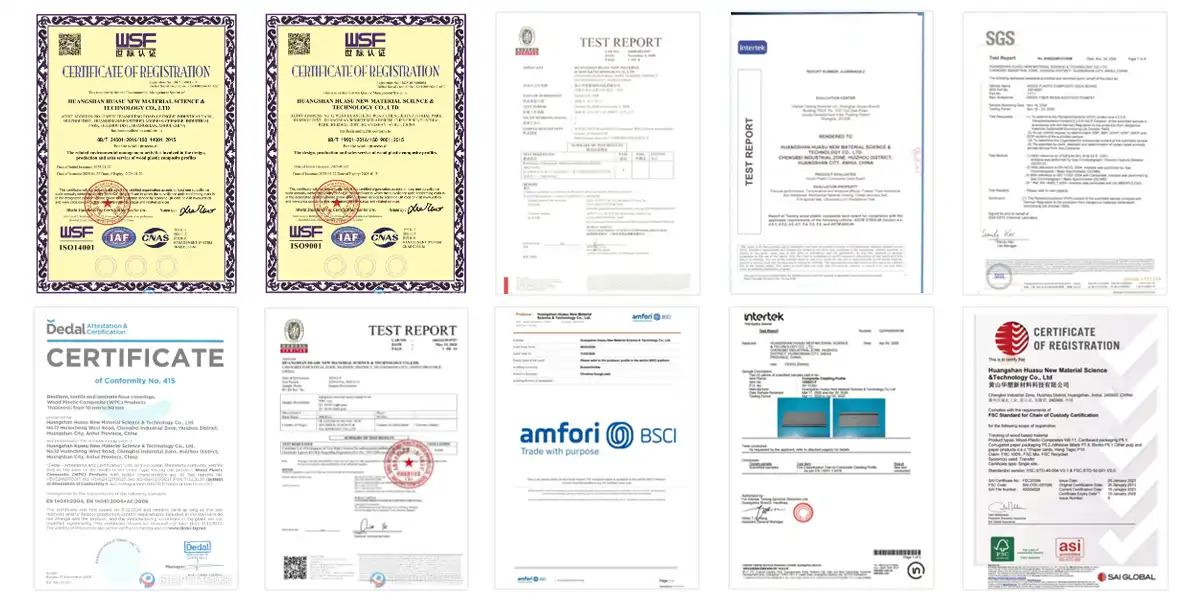
FSC certification makes sure that the wood fiber is sourced in a responsible way, and ISO 9001 certification makes sure that the manufacturing process is always the same. All of these certificates help with making choices about specifications for projects that need to show proof of their environmental and quality standards.
Conclusion
The stylistic case for deep-embossed composite decking over standard flat profiles rests on a combination of visual depth, material authenticity, and long-term appearance retention. Regular composite boards serve their purpose reliably, but the grain shallowness and surface uniformity that characterise most standard products limit their capacity to integrate naturally into considered outdoor design. A 3D composite decking profile — with its deeper grain, tactile surface variation, and richer tonal character — sits more comfortably alongside natural materials and architectural timber references. For projects where the outdoor space is expected to carry genuine design weight, that difference is worth accounting for in the specification process.
FAQ
Q: Is 3D composite decking suitable for wet climates or areas with heavy rainfall?
A: Yes. Composite decking manufactured from HDPE and wood fibre resists moisture absorption effectively. The textured surface also helps channel water away from the walking plane, supporting slip resistance in wet conditions. Boards that meet relevant outdoor safety and moisture resistance standards are appropriate for climates with significant rainfall.
Q: How does the colour of deep-embossed composite decking hold up over time compared to flat composite boards?
A: Both product types can be formulated with UV-resistant pigments, but the visual effect of colour fading differs between them. On a flat surface, even minor fading becomes evenly apparent across the board face. On a textured board, the tonal variation introduced by the grain relief means the surface continues to read as rich and varied even as pigment density gradually reduces. Boards tested to over 2,000 hours of UV exposure with minimal colour shift provide a reliable measure of long-term colour stability.
Q: Can composite decking with a 3D profile be used for both deck surfaces and outdoor fencing within the same project?
A: Yes, and this is one of the design advantages of composite materials. Coordinating deck and fence profiles in the same colour family and grain direction creates visual continuity across the outdoor space. Note that composite fencing products are designed for outdoor use only and are not suitable for interior applications. Dual-surface board options are also available for fence installations where the interior and exterior faces require different surface treatments.
Ready to Specify 3D Composite Decking for Your Next Project? Contact Everdur
Whether you are a construction firm tendering a commercial landscape project, a fence contractor looking for a reliable outdoor composite supply, a building materials wholesaler seeking consistent volume and competitive pricing, or a homeowner planning a private terrace, Everdur's team is ready to support your requirements.
For construction firms and fence contractors: Technical consultation, project-specific material recommendations, and stable supply across large-volume orders — backed by a manufacturing facility with over 50 WPC production lines.
For building materials wholesalers and resellers: Enquire about wholesale pricing structures and request free product samples to evaluate quality directly before committing to an order.
For end customers: Reach out for free design guidance and installation advice tailored to your specific outdoor space.
All Everdur composite decking products are manufactured in compliance with EU CE certification, US ASTM D7039, and China GB/T 24137 standards. Environmental credentials include Recycled Content certification, E0 environmental standard compliance, FSC, REACH, RoHS, and ISO 9001. Products are formaldehyde-free and fully recyclable, supporting green building specifications in European and North American markets.
As a dedicated 3D composite decking manufacturer, Everdur combines production reliability with genuine material expertise. To discuss your project or request samples, contact the Everdur team directly at violet@wpcsupplier.com.
References
1. Clemons, C. M. (2002). Wood-plastic composites in the United States: The interfacing of two industries. Forest Products Journal, 52(6), 10–18.
2. European Committee for Standardization. (2012). EN 15534: Composites made from cellulose-based materials and thermoplastics (usually called wood-polymer composites (WPC) or natural fibre composites (NFC)). CEN.
3. Stark, N. M., & Rowlands, R. E. (2003). Effects of wood fiber characteristics on mechanical properties of wood/polypropylene composites. Wood and Fiber Science, 35(2), 167–174.
4. ASTM International. (2017). ASTM D7032: Standard specification for establishing performance ratings for wood-plastic composite deck boards and guardrail systems. ASTM International.
5. Kazemi Najafi, S. (2013). Use of recycled plastics in wood plastic composites — A review. Waste Management, 33(9), 1898–1905.
6. Brandt, C. W., & Fridley, K. J. (2003). Load-duration behavior of wood-plastic composites. Journal of Materials in Civil Engineering, 15(6), 524–536.
7. European Parliament. (2006). Regulation (EC) No 1907/2006 concerning the Registration, Evaluation, Authorisation and Restriction of Chemicals (REACH). Official Journal of the European Union.
Send Inquiry
You may like