_1777451497595.webp)
Waterproof WPC Fence: Ideal for Coastal and Humid Areas
There is a hidden drawback to living by the ocean or in a humid environment. Moisture, salt air and temperature changes may wreak havoc on your outdoor projects. In these conditions standard wood fences may tend to bloat, rot or peel after a few seasons leaving homeowners and builders seeking for a more permanent option. It is a chronic problem and WPC fence (Wood-Plastic Composite fence) is a convenient solution. WPC fence is constructed from a mixture of recycled wood fiber and high-density polyethylene (HDPE) that gives you the appearance of warm, real timber – but without many of timber’s most bothersome drawbacks. WPC panels, unlike untreated wood, do not absorb moisture and tend to distort or decay much less notably in humid, coastal or salt-spray circumstances. WPC fence has been extensively employed in European and American markets in the past 10 years, notably in private gardens, villa perimeters and waterfront properties where durability and minimum maintenance are non-negotiable. So, whether you are choosing materials for a coastal development or a home garden, it is necessary to start by understanding how WPC fence functions in hard situations.
Why Is a WPC Fence Suitable for Coastal and Humid Outdoor Areas?
It is common to misjudge how quickly a material may break down in a coastal or humid area. Salt-laden wind corrodes metals, moisture seeps into the grain of lumber and encourages fungal growth and the combination of heat and humidity causes many organic materials to expand and contract again and over until they break fundamentally. Fencing material selection under these situations is an esthetic choice and a practical and budgetary choice as well.
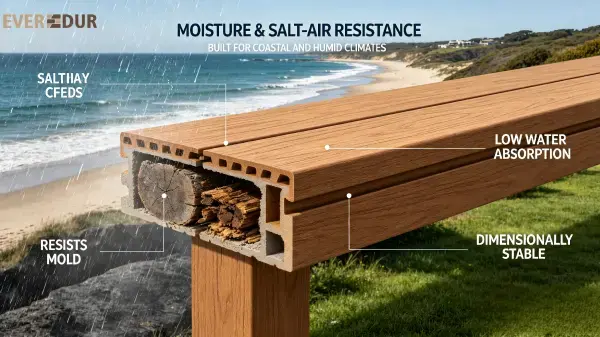
WPC fence is particularly designed to take these stresses into account. The basic makeup – wood fiber coupled with HDPE and stabilizing chemical additives – provides a material that is significantly superior than solid lumber in resisting moisture absorption. Wood naturally includes cellulose, which absorbs water and swells. In WPC profiles, the wood fiber is enclosed in a polymer matrix, which greatly reduces that moisture absorption.
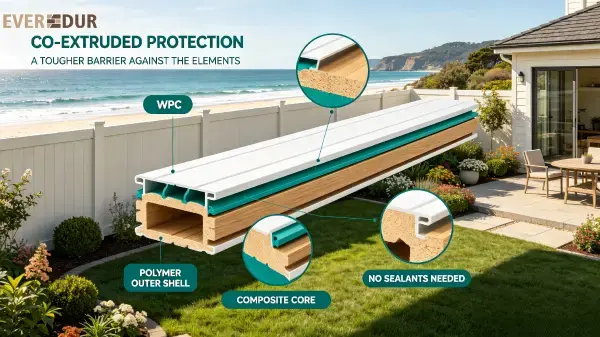
Co-extrusion technology goes one step farther. In the manufacturing process, a protective shell of polymer is fused around the composite core, adding another physical barrier to water intrusion. This is especially useful for coastal gardens, villa borders and waterfront decks where constant exposure to rain, sea spray and ground moisture is a regular fact of life.
In addition to being moisture-resistant, WPC fence is naturally resistant to salt-air oxidation that rusts steel fencing or peels paint off aluminum. For owners of coastal gardens who have historically had to contend with rusted metal rails or warped wood panels, WPC is frequently a good long-term solution. Its dimensional stability ensures the panels keep their form across the seasons, particularly important in areas with hot, humid summers and colder, wetter winters - conditions found in portions of the UK, France, the US Gulf Coast and the Pacific Northwest.
WPC Fence Protection Against Moisture, Mold, and Salt-Air Exposure
Moisture control is perhaps the single most distinguishing characteristic that differentiates high-performance WPC fence from inferior offerings. For tropical, subtropical and coastal settings, the materials used for fence are exposed to constant humidity rather than intermittent rains. A material that can resist a quick rain but degrades after months of ambient moisture exposure has little practical use.
Weatherproof Co-extrusion Technology WPC The outside surface of fence panels is sealed to considerably limit water penetration into the structure of the panel. This is significant because biological degradation (mold, mildew, fungal colonization) requires moisture and organic material to flourish. A well-made WPC weatherproof fence also lowers moisture absorption, so it resists mold and fungus development without any chemical treatment or seasonal sealants.
Salt air is a problem of a different order than mere wetness. Fine salty particles carried by coastal breezes function as a mild abrasive over time, and salt may hasten the breakdown of many surface coatings. WPC panels with a co-extruded shell are not dependent on a surface layer of paint or varnish for their color – the pigmentation is incorporated into the outer shell material and is significantly less susceptible to salt damage than painted wood or powder-coated metal.
Termites and wood-boring insects are another prevalent problem for outdoor timber constructions in warmer climes, since they flourish in humid environments. These creatures do not think that WPC material is a suitable home or food source. This is a huge benefit in gardens and properties situated in subtropical areas or near water where bug activity is high.
WPC fence is a solid solution for long-term outdoor privacy constructions for property owners near the Atlantic coast, the Mediterranean or the Gulf of Mexico, providing comprehensive safeguards against the elements, water, mildew, salt and insects.
How Does a WPC Fence Resist UV Exposure and Temperature Changes?
UV Stability in Outdoor Fencing Materials
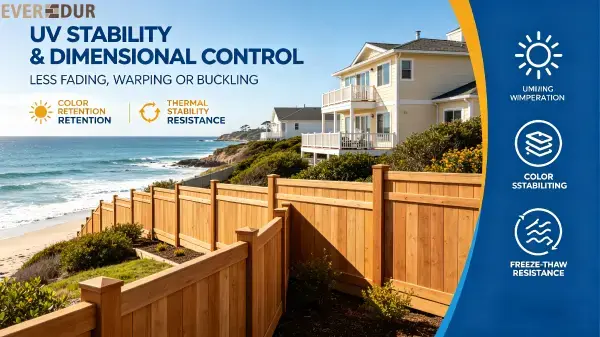
The primary cause of the color loss and surface damage of outdoor construction materials is prolonged exposure to UV radiation. Much of the composite and plastic products created in previous generations of WPC production exhibited obvious fading after two to three years of outdoor installation. Modern WPC panels made by co-extrusion process overcome this problem by adding UV-stabilizing chemicals directly into the outer shell during the production process. Independent testing techniques such as exposure testing using ASTM D7039 compliant criteria for color retention after prolonged UV exposure, show that correctly formulated panels fade very little even after 2,000+ hours of UV testing. This degree of stability is especially important in sun heavy areas such as Southern Europe, US south west and coastal Australia.
Dimensional Stability Across Temperature Ranges
One of the more subtle but functionally crucial properties of premium composite horizontal fence panels is dimensional stability. Solid lumber responds to heat and humidity by expanding and to cooling by contracting, a process that slowly loosens joints, warps boards and causes gaps or buckling along fence lines. WPC profiles, and especially hollow co-extruded panels, are designed to limit this thermal movement. The HDPE offers some flexibility, but the composite construction restricts the total amount of expansion and contraction. In locations with significant seasonal temperature variations – Northern Europe, Canada, the US Midwest – this stability translates to fence lines that stay visually clean and structurally strong year after year.
Performance in Freezing and Tropical Conditions
WPC fence is placed over a wide geographic range, from Scandinavian seaside homes to tropical mansion gardens in Southeast Asia and the Caribbean. The widespread use of the material is proof of its performance in harsh climates. Panels designed with the right polymer compositions do not become brittle as certain plastics do at sub-zero temperatures, and their resistance to moisture means they do not fracture and spall with freeze-thaw as porous materials, such as concrete or untreated lumber, do. Well formulated WPC panels are resistant to surface blooming and color shift that may be experienced with lesser grade composites in high heat, high humidity tropical environment. The most dependable way to challenge climatic installations is to specify panels that fulfill published performance criteria, rather than depending only on marketing statements.
Low-Maintenance WPC Fence for Long-Term Outdoor Privacy
No Painting, Staining, or Sealing Required
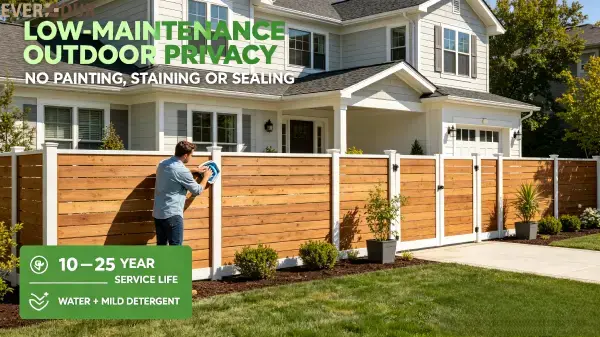
The lower continuing maintenance needs are a major practical advantage of WPC fence, especially for residential and villa applications. In humid or coastal conditions, timber fences would normally need to be sanded and re-stained every two to three years to avoid degradation – a regular investment in time and materials. WPC panels do not need painting, staining or sealing to retain their weather resistance. The surface stability means they may be cleaned occasionally with water and a little detergent which is usually adequate to keep them looking well kept. This is a substantial quality-of-life benefit for property managers with a portfolio of residential units or homeowners who just like to spend their weekends in a different way.
Long Service Life for Outdoor Installations
Quality WPC fence products are meant to last between 10 and 25 years, depending on the profile type, manufacturing method, and installation conditions. Co-extruded hollow profiles and solid profiles have various structural compositions, hence their durability and warranty durations are variable. Choosing the right sort of panel for a certain setting, e.g. a solid co-extruded profile for a high exposure coastal boundary fence, or a hollow profile for a protected garden screen is a choice worth considering in conjunction with an informed manufacturer. The longevity of a fence has consequences for sustainability as well. A fence that operates effectively for 20 years requires less replacement material than a fence that requires frequent replacement of portions.
Privacy Screening for Coastal and Garden Settings
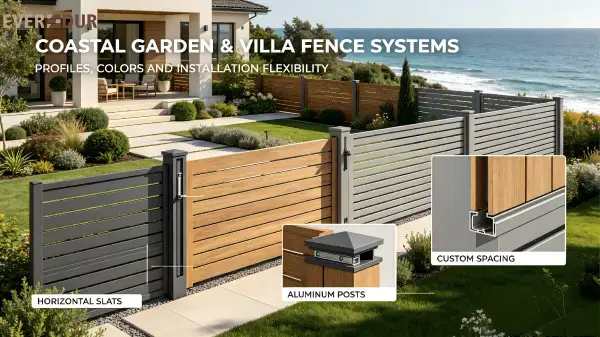
Composite horizontal fence panels are often used to provide privacy screening in seaside gardens, villa grounds and manicured residential buildings. The horizontal position of the boards gives a clean, contemporary visual line that fits modern buildings and is well-suited to natural coastal environments. Design may be used to manipulate slat spacing to provide a balance between seclusion and ventilation. Tighter spacing can be used for complete visual screening and broader spacing for partial privacy, while still keeping air moving, which is especially important in warm coastal gardens as air circulation can have an impact on outdoor comfort. Designers and specifiers may match fence esthetics to wider landscape plans, with a variety of surface textures available, including brushed, embossed and wood grain, without affecting weathering performance.
WPC Fence Designs and Installation Options for Coastal Gardens and Villas
Profile Dimensions and Popular Sizes
WPC fence panels are available in a variety of profile sizes to meet various design needs and structural spans. The widths are generally between 90mm and 200mm, the thickness between 15mm and 35mm, and the common lengths are 1.8m, 2.2m and 2.9m. Commonly demanded sizes for residential and villa buildings are 120×20mm, 140×25mm and 150×25mm profiles. Profile dimensions impact the visual rhythm of the constructed fence — larger boards provide a broader, horizontal esthetic, while narrower boards bring depth and texture. For the coastal garden, where the fence must also serve as a wind screen, specify panel thickness and post spacing in consultation with the manufacturer to guarantee structural soundness against prevailing wind loads.
Color and Surface Texture Options
The color of coastal and garden fence is often a careful balance between personal taste and functional requirements. Lighter tones such as ash gray, stone gray, ivory and sandal wood are often visually attractive in high-sunlight coastal areas and easily complement bleached driftwood esthetics that are popular in coastal garden design. Darker tones such as dark gray, walnut and coffee offer a greater visual definition and also match modern villa building well. The texture of the surface—whether brushed, embossed, sanded or wood grain—affects the how a fence feels to the touch and how it looks. The wood grain textures from a distance read warm and natural, while the brushed and smooth finishes provide a more consciously modern look. Co-extruded panels retain these surface features permanently since the texture is part of the outer shell, not an applied coating.
Installation Methods and Structural Compatibility
WPC fence panels are often put in a modular post and rail system with the structural frame made from posts of aluminum or steel. There are two main ways of installing them. You may either slide the panels into slots in the posts, or mount the boards on rails. Both solutions use conventional panel profiles and, with careful design, may be adapted to sloping ground or uneven garden borders. Aluminum post systems are especially effective near the shore since they don’t succumb to the rust that eventually does in galvanized steel in salt air. For villa projects needing crisp completed look for post tops and fence ends, professional WPC manufacturers provide suitable trim accessories and post caps to provide a clean finish to the installation.
Conclusion
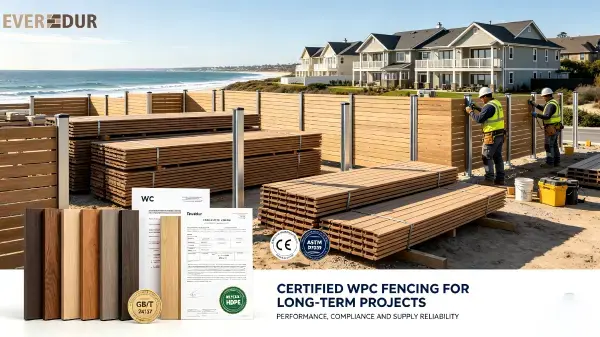
Coastal and humid environments demand fencing materials that can withstand sustained moisture, salt air, biological growth, and UV exposure without requiring intensive ongoing maintenance. WPC fence addresses these demands through its composite material structure, co-extrusion manufacturing process, and inherent resistance to the conditions that degrade timber and metal alternatives. For residential gardens, villa perimeters, and commercial landscaping in challenging climates, WPC panels offer a durable and visually appealing solution with documented service lives of 10 to 25 years. Selecting panels that meet recognized performance standards and sourcing from a manufacturer with verified quality credentials are the most reliable paths to a successful long-term installation.
FAQ
Q: Can WPC fencing be installed directly in sandy or coastal soil without special foundations?
A: WPC panels themselves are suitable for coastal environments, but the post foundation requirements depend on soil conditions and local wind load requirements. In sandy coastal soils, deeper post embedment or concrete footing is typically recommended to ensure structural stability. Consult your installer or the panel manufacturer for site-specific guidance.
Q: Does WPC fencing require any surface treatment after installation in a humid climate?
A: No surface treatment, sealing, or painting is required after installation. The weather resistance of a co-extruded WPC panel is built into the material itself. Periodic cleaning with water and a mild detergent is sufficient to maintain appearance in humid or coastal conditions.
Q: How long does WPC fencing last in a salt-air environment, and what warranty is typically offered?
A: Well-manufactured WPC fence panels have documented service lives of 10 to 25 years depending on panel type and installation environment. Co-extruded solid panels generally carry longer warranty periods than standard extruded profiles. Always request written warranty terms and supporting certifications from your supplier before purchasing.
Ready to Source WPC Fencing for Your Coastal or Villa Project? Contact Everdur
For construction firms and fence contractors: Everdur offers OEM and ODM manufacturing services with flexible profile dimensions, surface textures, and color options to match your project specifications. Competitive bulk pricing, documented certifications, and consistent production capacity across 50+ production lines support large-scale project delivery.
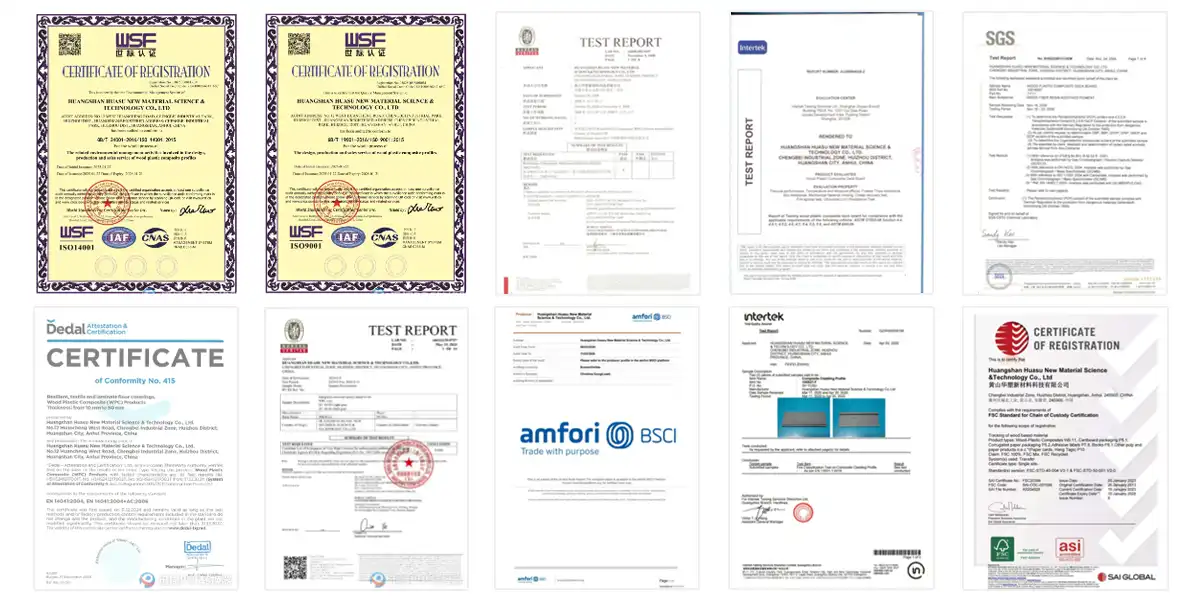
For building materials wholesalers and resellers: Exclusive wholesale pricing structures and sample panels are available to support your sales process. Everdur's certifications — including CE (EU), ASTM D7039 (US), GB/T 24137 (China), FSC, REACH, and RoHS — provide the compliance documentation your markets require. Our panels also use recycled HDPE content, supporting green building and E0 environmental standards for environmentally conscious procurement.
For end customers and homeowners: Free design consultation and installation guidance are available to help you select the right panel profile, color, and spacing for your coastal garden or villa project. Our team will walk you through material options suited to your specific climate and aesthetic goals.
Reach out to our team directly at violet@wpcsupplier.com to request samples, pricing, or technical specifications. As a dedicated WPC fence manufacturer, Everdur is ready to support your project from specification through delivery.
References
1. Clemons, C. M. (2002). Wood-plastic composites in the United States: The interfacing of two industries. Forest Products Journal, 52(6), 10–18.
2. Klyosov, A. A. (2007). Wood-Plastic Composites. John Wiley & Sons.
3. American Society for Testing and Materials. ASTM D7031: Standard Guide for Evaluating Mechanical and Physical Properties of Wood-Plastic Composite Products.
4. EN 15534-1:2014. Composites made from cellulose-based materials and thermoplastics — Part 1: Specifications for compounds and products.
5. Forest Stewardship Council. FSC Standard for Chain of Custody Certification. FSC-STD-40-004.
6. European Chemicals Agency. REACH Regulation (EC) No 1907/2006 — Guidance on Safe Use of Chemicals in Construction Products.
7. Schwarzkopf, M., & Burnard, M. (2016). Wood-Plastic Composites: Performance and Environmental Impacts. Environmental Impacts of Traditional and Innovative Forest-based Bioproducts, Springer, Singapore.

Send Inquiry
You may like