_1777451497595.webp)
Top Hollow WPC Decking Designs for Modern Gardens
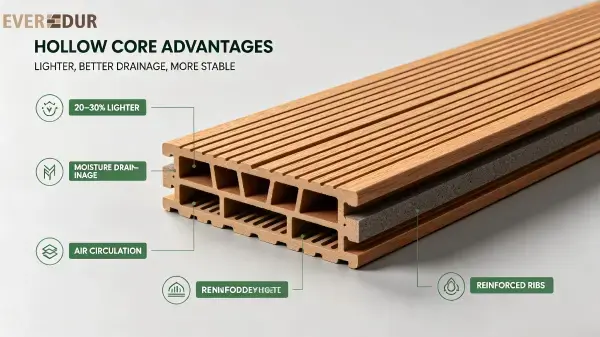
Today’s garden design has come a long way from plain lawns and flowerbeds. Homeowners, landscape architects and builders in Europe and North America are turning to hollow WPC decking as a practical and esthetically pleasing option for outdoor flooring. WPC, or wood-plastic composite, is a mixture of recycled wood fibers and high-density polyethylene that produces boards resistant to moisture, UV exposure and daily wear, without the care required of genuine lumber. The hollow core construction decreases the weight of each board by 20-30% over similar solid board options, making them much easier to handle and install on site. In addition to the structural benefits, hollow composite decking is supplied in a variety of colors, surface textures and profile sizes, enabling designers to complement almost any garden style, from the clean lines of Scandinavian minimalism to the warmth of Mediterranean patios. If you are designing a new patio, poolside platform or meandering garden walk, knowing what styles and combinations are out there can help you make an educated decision. In this guide, we discuss the most desirable hollow composite deck designs for today’s outdoor areas including colors, surface treatments, layout concepts, and application zones.
What Makes Hollow WPC Decking Suitable for Modern Garden Design?
Contemporary landscape design places an emphasis on easy-care materials that provide visual unity and can be relied upon to operate through the changing seasons. Each of these criteria is addressed by hollow composite decking, due to its hollow cavity architecture and material make-up.
The hollow chamber design is not only for weight conservation. The inside air tubes enable moisture to drain away from the board surface instead of building up and causing warping. Reinforced interior ribs distribute the pressure equally over the board so foot traffic does not concentrate tension on any one spot. The bottom is grooved to allow air to circulate between the board and subframe, cutting down on the potential for mildew and algae, a frequent problem with wood decks in the humid European and American climates.
Design-wise, the precision-extruded profile means every board is the same size, which is very important when constructing vast terrace areas where misalignment shows up over time. Clip-and-joist installation technologies enable for boards that do not have visible fasteners and provide a smooth surface that complements the clean look of contemporary outdoor designs.
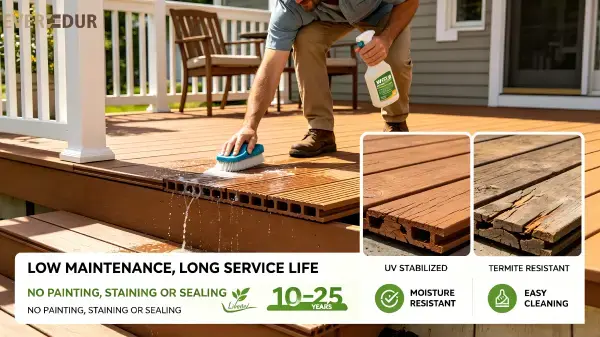
The material’s composition of recycled wood powder mixed with Grade A recycled HDPE and stabilizing chemicals results in boards that are termite resistant, corrosion proof, and resistant to surface deterioration from long-term UV exposure. This resilience eliminates a huge maintenance load from gardens in coastal locations or places with excessive rains. Composite boards keep their color with little or no maintenance for a service life of generally 10 to 25 years depending on product specification and local circumstances, unlike painted or stained wood.
Hollow outdoor composite boards also have sustainability attributes that important to eco-conscious specifiers. The utilization of recycled material and ethically produced wood fiber may help support compliance with certifications like as FSC, increasingly sought by European procurement teams and landscape contractors.
Hollow WPC Decking in Teak, Grey, Coffee and Custom Colors
Color selection is one of the first considerations in any decking project, and Hollow WPC Decking composite boards now provide a palette wide enough to meet both traditional and modern preferences.
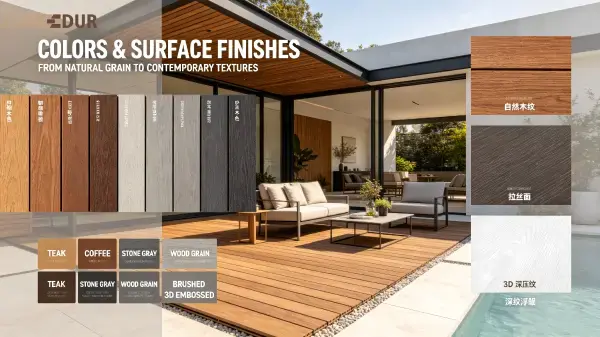
Teak is a popular choice since it has a warm, amber-like look of natural hardwoods but doesn't have the harvesting problems of tropical lumber. A combination seen often in modern European villa gardens is teak-colored decking, a perfect partner to whitewashed garden walls, stainless-steel furnishings and architectural planters.
Gray tones are the prevailing option in Scandinavian and Northern European landscape design. The light gray boards provide a feeling of space and reflect the light around, which is especially useful if you have a smaller space in the city. Charcoal and dark gray alternatives complement industrial-style gardens where the decking grounds a palette based around concrete, black steel and sculptural vegetation.
Coffee brown is a good compromise – warmer than gray, but not as bold as teak. It looks well in outdoor settings with natural stone pavement or terracotta features. For designers working with certain material schemes, stone gray and sandal wood tones take the palette a step farther.
Custom color matching is available for project-specific needs. This is an advantage to contractors managing branded hospitality facilities, or home developers who want a uniform esthetic across many plots. The hollow deck is pigmented to withstand UV rays and preserve color stability during long-term exposure to the elements. Performance is usually tested by independent labs using a UV chamber for a minimum of 2,000 hours of simulated sunlight.
A well-specified hollow composite board must have UV stabilization on the surface layer, not just on the top coating, in every color choice. This is a significant long term cosmetic difference and something to check with any manufacturer when choosing a product.
Wood Grain, Brushed and 3D Embossed Hollow WPC Decking
The tactile and visual character of a deck is determined by the surface texture, which affects not just esthetics but also slip resistance. Hollow composite boards are made with a range of surface finishes, each of which is suitable for particular design goals.
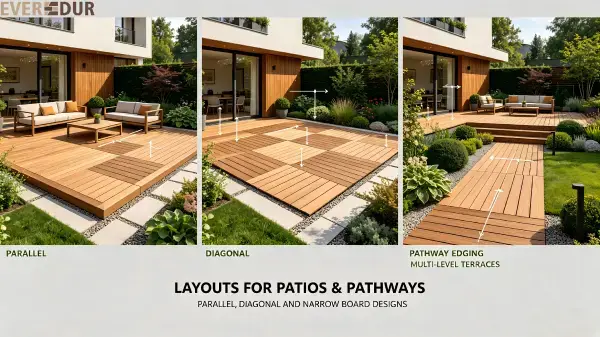
Wood grain embossing replicates the natural fiber patterns of hardwood species, giving composite boards a surface that, from a viewing distance, looks convincingly like timber. This finish is ideal for outdoor settings where naturalistic look is the design goal. Think of cottage gardens, rural getaways or old style patios where natural materials dominate.
Brushed finishes are achieved using a mechanical technique which pulls small lines along the length of the board to produce a delicately striated surface. The result is a sleek, modern texture that diffuses rather than reflects direct light, decreasing glare on south-facing terraces. The brushed surface also offers good slide resistance, which is crucial in outdoor locations exposed to rain.
The 3D deep grain embossing creates a more prominent surface relief to create shadows and depth, giving the board a more realistic appearance. This technique works especially well for larger outdoor applications when the surface is seen at standing height, as the dimensional texture gives visual interest over a broad deck. The deeper profile also helps to direct surface water away from the standing area, a benefit around pool surrounds or garden areas subject to irrigation runoff.
Modern Hollow WPC Decking Layouts for Patios, Pathways and Terraces
The layout arrangement impacts how a deck reads in its broader garden environment, and how effectively the area works for its intended usage.
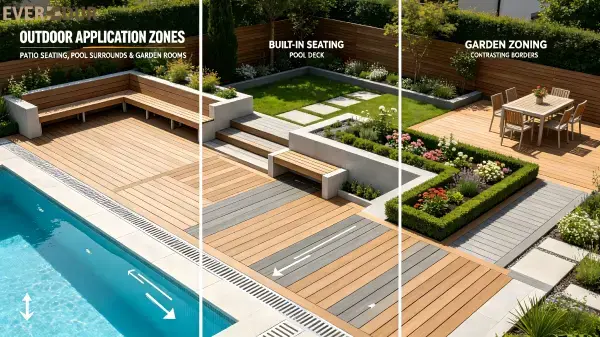
The most typical form is still parallel board lines set widthwise across a rectangular patio, and for good reason - they're inexpensive to install, they reduce waste, and they provide a feeling of visual expansion along the longer axis of the area. For small urban gardens, running boards parallel to the house wall drive the attention outward and make the garden seem bigger proportionately.
Angled or diagonal layouts provide a dynamic element to terrace designs, especially when the garden is seen from above – from a first story window or raised terrace. The diagonal boarding on a square deck, disrupts the predictability of the orthogonal lines and is appropriate for architectural gardens where geometry is an intentional design strategy. The trade off is a little more waste of material as you cut things out, so you need to allow for it in your amounts for the job.
Narrower board profiles in pathway applications direct movement through a garden without overwhelming the surrounding plants. Hollow outdoor WPC boards measuring between 90mm and 135mm wide are very suitable for garden walkways, creating a sophisticated edge feature that complements gravel, bark mulch or grass margins on each side. The clip and joist fastening technique maintains a neat finish by keeping visible fasteners away from the path surface.
Composite decking is sometimes used on two or more levels, joined by stairs or retaining structures, in multi-level terrace designs more typical to sloping European garden plots. The light weight of the hollow boards minimizes the load on the subframe structures on higher levels, a practical concern in retrofit projects where the load limitations of the existing structure are set.
Hollow WPC Decking Ideas for Outdoor Seating, Pool Areas and Garden Zones
In various areas of a yard you will have varied requirements for decking and you may put together Hollow WPC Decking boards in the right way to suit each situation.
Good slip resistance and color tones that are still pleasant under direct sun are a plus for outdoor sitting spaces. The lighter gray and sandalwood colors are more effective in reflecting solar radiation than the dark boards, helping to keep surface temperatures lower during hot summer afternoons – an increasingly important factor as European summers get hotter. Integrating fixed seating into the deck structure itself – built-in benches wrapped in composite board, for example – produces a coherent look, with the same material language running through the floor and furniture.
Pooling materials should be able to withstand many wet-dry cycles without breaking down. In these cases, hollow WPC decking is reliable because the HDPE-heavy composite will not absorb water and the slip-resistant surface will still perform while wet . Boards running perpendicular to the side of the pool move water away from the waterline to drainage points. It’s worth mentioning that composite decking is designated for outdoor usage and works best in ventilated surroundings if you’re considering using it for indoor pool areas or enclosed spas.
Garden zoning is becoming more popular with residential landscape designers, who are zoning portions of the garden for dining, gardening, play and relaxing all in one garden. Composite decking assists in zone demarcation by a clearly demarcated floor surface that indicates a change in purpose. A cantilevered eating area off a lawn is divided by a modest planter border, making it read as a defined outdoor room rather than an amorphous expanse of grass. This spatial hierarchy is reinforced with composite boards of contrasting color or texture to the surrounding pavement materials, without necessitating structural separation.
Conclusion
Hollow WPC Decking has established itself as a durable, design-flexible material for modern garden projects across Europe and North America. Its combination of reduced weight, reliable weather resistance, extended service life, and broad aesthetic range makes it a practical specification for a wide variety of outdoor settings — from intimate residential patios to larger commercial landscape projects. Color consistency, surface texture variety, and the ability to customize profiles and dimensions mean that the material adapts to design intent rather than constraining it. For anyone planning a garden upgrade or a larger landscape project, exploring hollow composite decking options is a worthwhile step early in the design process.
FAQ
Q: How long does hollow composite decking typically last in outdoor conditions?
A: Service life varies based on material specification and local climate conditions, but hollow composite boards generally perform reliably for 10 to 25 years with minimal maintenance. Co-extrusion products with a protective outer shell tend to sit at the upper end of that range.
Q: Is hollow composite decking suitable for a pool surround where the surface gets wet regularly?
A: Composite boards are well suited to pool areas because they resist moisture absorption and the slip-resistant surface remains functional when wet. These boards are designed exclusively for outdoor, ventilated environments.
Q: Can hollow WPC boards be cut to custom lengths on site?
A: Standard lengths are typically 2.2m, 2.9m, and 3.6m, and boards can be cut to project-specific lengths using standard woodworking tools. Custom lengths and profile dimensions are also available directly from manufacturers for large projects.
Connect with Everdur's Hollow WPC Decking Manufacturer Team
Whether you are sourcing at scale or planning a single garden transformation, Everdur's team supports your project from specification through to delivery.
For construction firms and landscape contractors: Access technical data sheets, profile samples, and project-specific dimension customization to streamline your specification process.
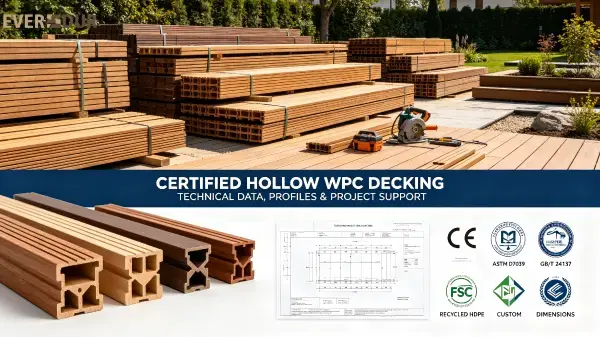
For building materials wholesalers and resellers: Competitive wholesale pricing structures, consistent production capacity exceeding 1,500 containers annually, and co-extrusion hollow composite boards that meet EU CE, US ASTM D7039, and China GB/T 24137 standards, alongside FSC, REACH, RoHS, and Recycled Content certifications, give your business a reliable supply foundation.
For end customers: Receive color sample packs, surface texture references, and layout guidance tailored to your garden dimensions — no commitment required.
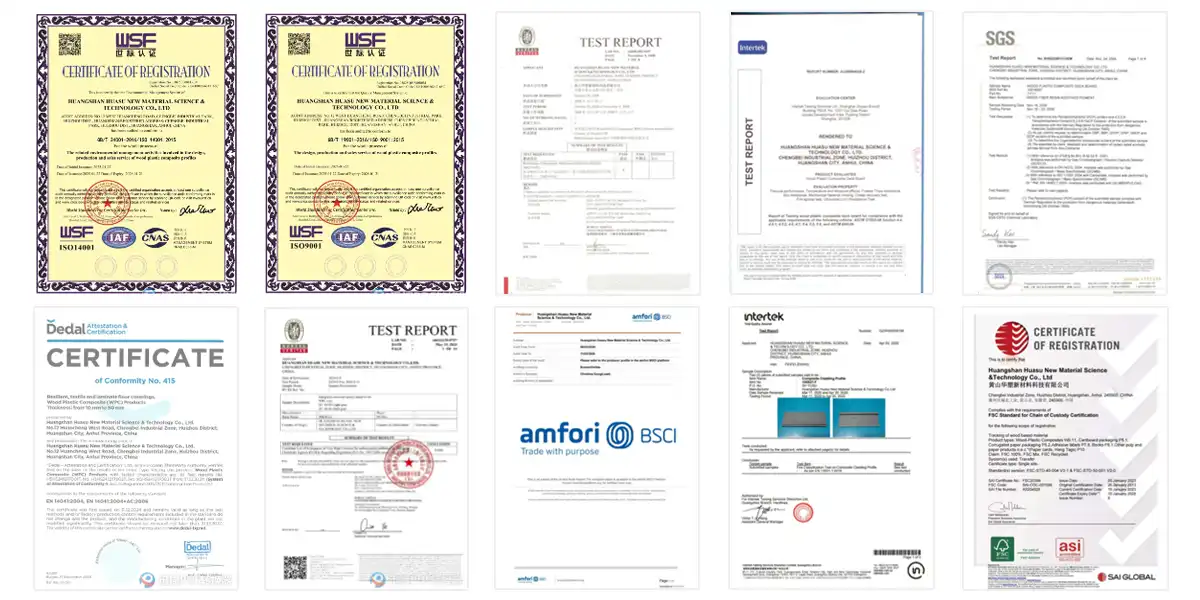
Everdur's hollow WPC decking manufacturer team holds ISO 9001, ISO 14001, CE, FSC, REACH, RoHS, and Intertek certification. All products meet E0 environmental standards and are produced using Grade A recycled HDPE and sustainably sourced wood fibers.
Send your project details or sample request to: violet@wpcsupplier.com.
References
1. European Committee for Standardization. EN 15534 — Composites Made from Cellulose-Based Materials and Thermoplastics (Wood-Polymer Composites or Natural Fibre-Polymer Composites). CEN, Brussels.
2. ASTM International. ASTM D7032 — Standard Specification for Establishing Performance Ratings for Wood-Plastic Composite Deck Boards and Guardrail Systems. ASTM International, West Conshohocken, PA.
3. Forest Stewardship Council. FSC Standard for Chain of Custody Certification. FSC International, Bonn, Germany.
4. Verhey, S., Laks, P., Richter, D., and Heiden, P. Laboratory Decay Evaluations of Woodfiber-Thermoplastic Composites. Forest Products Journal, Vol. 51, No. 9.
5. Clemons, C.M. Wood-Plastic Composites in the United States: The Interfacing of Two Industries. Forest Products Journal, Vol. 52, No. 6.
6. Kim, J.W., and Pal, G. Weathering Performance of Wood-Plastic Composites Under Simulated and Natural UV Exposure Conditions. Composites Part A: Applied Science and Manufacturing.
7. European Outdoor Flooring Industry Association. Performance Benchmarks for Composite Decking in Residential and Commercial Outdoor Applications. Industry Technical Report Series.

Send Inquiry
You may like