_1777451497595.webp)
WPC Landscape Walls for Public Parks: Safe & Sustainable
Public parks carry a quiet but real responsibility — they must be welcoming, safe, and resilient for everyone who uses them. When it comes to outdoor boundary solutions, WPC landscape walls have become a practical choice for park planners, landscape architects, and municipal procurement teams across Europe and North America. Made from a blend of recycled wood fiber and high-density polyethylene (HDPE), these composite panels hold up against the kind of continuous outdoor exposure that breaks down conventional materials over time. Unlike painted timber that chips or galvanized steel that oxidizes, WPC panels maintain structural integrity and surface appearance across seasons. They resist moisture infiltration, insect activity, and UV degradation without requiring the reapplication of sealants or protective coatings. For public spaces where long service cycles and low intervention are priorities, this matters considerably. This article explores why WPC wall systems are finding increased adoption in public park environments, covering safety considerations, weather performance, environmental credentials, and day-to-day maintenance realities.SEND INQUIRY
Why Are WPC Landscape Walls Suitable for Public Parks?
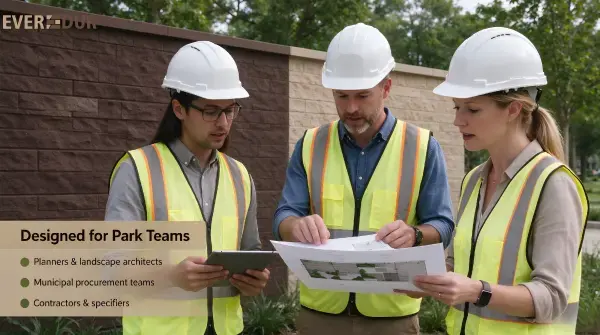
Conditions in public parks are different from those in most private gardens. There is constant foot traffic, the building is exposed to the weather all year, and repair windows are small. If you put up a fence or other structure to keep people out, it needs to meet a number of requirements at the same time. It needs to be strong, look good with the plants around it, and have a surface that kids and older people can touch safely.
These needs are met in a unified way by Composite garden walls made from wood-plastic composite materials. The main ingredients are wood powder, HDPE resin, and a number of processing aids. Together, they make a panel that responds consistently to changes in temperature, doesn't break down biologically, and doesn't release dangerous chemicals into the land or water nearby. This chemical stability is really important in parks with water features, play places for kids, or areas with plants.
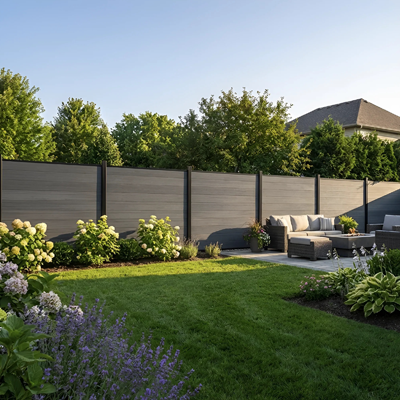
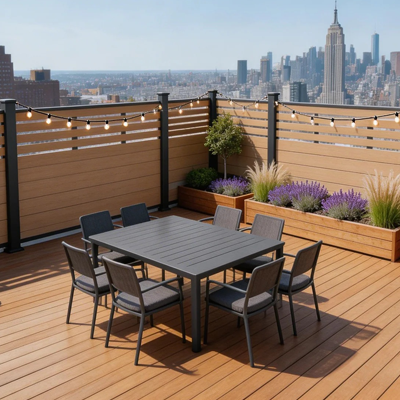
From a structural point of view, WPC panels can be put on steel or aluminum subframes either horizontally or vertically. This lets designers set up walls, screens, and partitions in any way that fits their needs. Slatted designs let air flow through while making edges stand out. Placements of solid panels block views in private areas like maintenance grounds, utility stations, or quiet seating areas.
There is a wide range of styles. Park planners don't have to choose between performance and looks because surfaces can have wood grain, brushed textures, and embossed profiles. Earthy tones, like gray, teak, walnut, and cedar, blend in perfectly with planted fields and don't need as much care as real wood does. This mix of good looks and long-lasting quality is a good deal for public infrastructure funds over a service cycle of ten to twenty-five years.
WPC Landscape Walls for Safe Boundaries and Outdoor Privacy
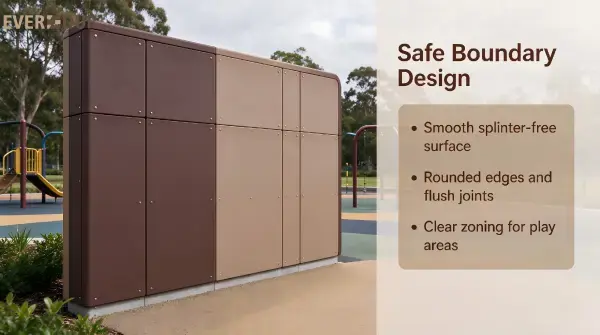
Safety is built into public places, not something that is added on later. Boundary structures can't have any sharp edges or splinter risks, they must stay physically sound even after years of accidental touch, and they can't make it easy for kids to get stuck or hurt themselves while climbing.
Extrusion molding is used to make WPC outdoor wall panels. This process makes smooth, even surfaces without the raising of grains or separation of fibers that happens over time in natural wood. Edges that have been worn down don't pose a splinter risk. You can ask for profiles with rounded sides and flush joint systems that get rid of protrusions where panels meet.
For public parks that have different areas for different purposes, like play areas, event spaces, ecological reserves, and dog exercise areas, composite boundary walls make the lines between them clear and easy to read. This is better than using institutional-looking chain-link fences or concrete block structures. A well-made WPC privacy screen shows where the boundaries of the space are while keeping the open, casual feel that park visitors expect.
The soundproofing isn't very good, but it helps keep people comfortable in places that get a lot of use. Solid panel arrangements reduce background noise between areas that are next to each other, making parks that are close to roads or business areas more pleasant places to be.
When it comes to chemical safety, reliable WPC wall goods are checked against international standards like REACH and RoHS to make sure they don't contain any banned substances. This is especially important for city buying teams that have to show they did their research when choosing materials for public infrastructure.SEND INQUIRY
WPC Landscape Walls for Heavy Public Use and Weather Exposure
Structural Performance Under Sustained Outdoor Conditions
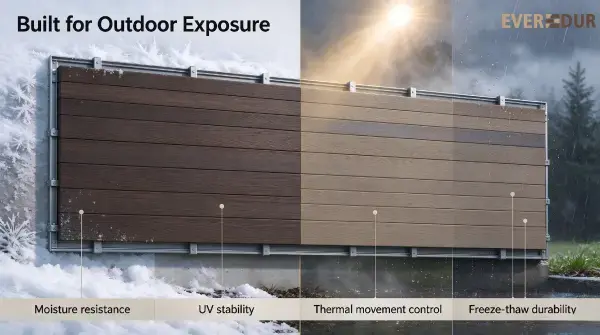
Outdoor structures in public parks are put under a lot more mechanical and environmental stress than garden enclosures in homes. Walls in areas with a lot of foot traffic are often hit by maintenance vehicles, cyclists, and organized outdoor activities. The weather is always there: frost in northern Europe in the winter, long periods of UV light in the Mediterranean and North American summers, and long periods of wetness in parks near the coast or rivers.
Composite UV resistant garden walls are made to handle all of these stresses. Because the HDPE matrix in the composite core doesn't like water, it keeps the core from absorbing it, which would cause it to swell, warp, or break when it freezes and thaws. When UV stabilizers are added during production, they protect the surface pigmentation and structural integrity from damage caused by the sun. After more than 2,000 hours of rapid UV exposure tests, quality goods still show little color change.
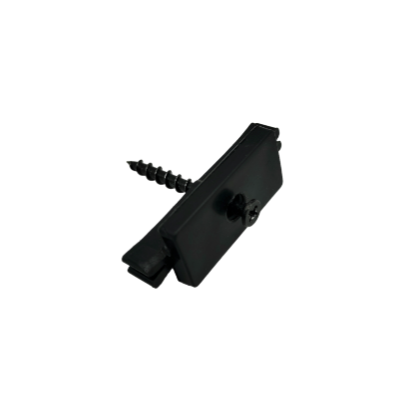
Thermal expansion can be controlled by using the right joints and fixings. Metal subframe systems can handle the small changes in size that happen across temperature ranges. This keeps panels from buckling when it's hot and keeps them in place when it's cold. This physical stability is a big plus for park equipment that needs to look good all year without any changes caused by the seasons.
Weather-Adaptive Design for Diverse Climates
In North America and Europe, parks are spread out in a lot of different temperature zones. For example, the British Isles and the Pacific Northwest have marine climates, while Central Europe and the American Midwest have continental climates. It's important for a boundary wall system to work well in more than one situation if it's going to be a reliable specification for procurement teams that work in different places or regions.
During production, WPC formulations can be changed to meet the needs of different climates. In places where it stays cold for a long time, versions that are better at handling impacts at low temperatures keep things from breaking. Surface treatments and material grades are chosen to keep biofilm from building up and surface stains from showing up in places with a lot of humidity or near the coast, where salt air and biological growth are constant.
Because they are made to adapt to different climates, composite outdoor wall panels are not a product that can be used in any situation. Responsible manufacturers offer material customization that matches the performance of the product with the real environmental conditions of the installation site. This is an important point to make during the buying and specifying process.
Long-Term Color and Surface Stability
Maintaining a public park installation's good looks over its long life is important for more than one reason. Boundary structures that are faded and look bad express neglect, make people less safe, and can lead to higher upkeep costs that weren't planned for in the original project budget.
When making WPC wall systems with co-extrusion technology, a dense, weather-resistant cap layer is put on top of the composite core. The color and pattern of the surface are on this cap layer. It acts as a barrier against water, UV light, and surface wear that is much better than single-layer extrusion goods. Color stability over a 10 to 25-year service period means that the edges of public parks keep looking the same with just regular cleaning. This helps keep the visual quality consistent across a park estate without having to be painted or resurfaced.
Sustainable WPC Landscape Walls Made With Recycled Materials
Recycled Content and Material Sourcing
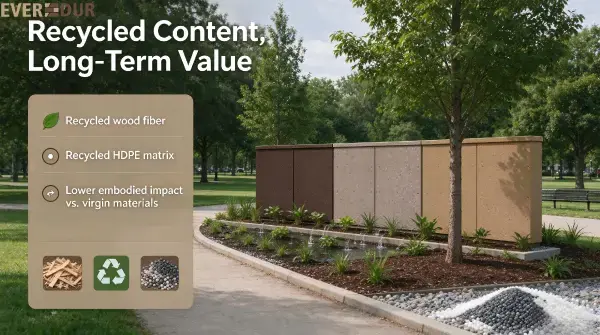
In both Europe and North America, standards for sustainability in public buying have grown stronger. More and more, municipal bids include minimum recycling content levels, environmental product statements, and proof of material tracking. With recycled HDPE from post-consumer plastic streams and recovered wood fiber, WPC composite panels meet these standards in a way that can be checked.
The wood fiber in WPC panels usually comes from waste wood from factories that handle wood and old wood. This keeps the material out of landfills and low-value burning paths. Plastic grades that would have gone into trash would be used to make the HDPE matrix. This makes a product with a significantly smaller embodied material impact than options made from new wood or steel, without lowering its structural or aesthetic quality.
The known recycled content of WPC panels gives park planners who are writing environmental impact studies or sustainability statements for big projects solid evidence to back up their purchase arguments and green infrastructure reports.
Compliance With Environmental Certification Standards
To specify environmentally friendly materials, you need more than just claims from the supplier; you also need proof that the materials meet recognized standards. As proof of their safe materials, Everdur WPC landscape walls are certified by both FSC and REACH, which means they don't contain any chemicals that are very highly harmful. RoHS testing proves that the panels don't have any dangerous materials in them that could harm the soil or water quality in parks.
These certifications can't be used in place of each other, and each one covers a different aspect of health and the environment. They work together to give buying teams a solid base for meeting many sustainability requirements in a single standard.
End-of-Life Considerations and Circular Economy Alignment
A material's sustainability profile includes more than just the materials used to make it. It also includes how it behaves when its useful life is over. Because they are made of plastics, WPC composite panels can be recycled in the right industry channels, including composite garden walls. In many places, the infrastructure for recovering composite materials is still being built up by cities. However, in Europe and North America, both governments and businesses are clearly investing in ways to make it easier to recycle composite materials.
Choosing WPC materials for public park infrastructure now puts cities and companies in a position to benefit from the new circle economy. This will help them keep their long-term sustainability promises that go beyond the life of a single project.SEND INQUIRY
WPC Landscape Walls for Low-Maintenance Public Landscape Management
Reduced Maintenance Cycles and Operational Costs
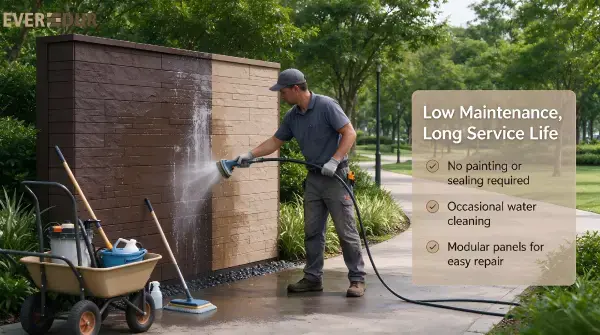
Budgets for maintaining public parks are always limited. Any decrease in the costs of labor and materials used to maintain fences and walls has a direct and positive effect on the management of a park estate as a whole. During their lifetime, WPC composite panels don't need to be painted, stained, sealed, or treated to stop rot. Cleaning needs are limited to washing with water every so often to get rid of surface dirt.
When compared to wooden boundary structures that need to be repainted or re-oiled every two to three years and treated with pressure more often, composite panels significantly lower the ongoing costs of maintenance. A twenty-year service period can make the cost difference between a WPC wall system and a maintained wood option quite large, especially when work costs are added to the costs of materials.
Compatibility With Park Management Workflows
Public park maintenance is based on the seasons and unpredictable events like storm damage, vandalism, and times when a lot of people use the park. Structures for privacy and boundaries that need specific tools or skills to fix put too much pressure on park management teams.
Because WPC panel systems are modular by design, they can easily be replaced in parts. It is possible to take out and put back on a broken panel without affecting nearby parts of the wall structure. Standardized subframe parts mean that installation doesn't need any special tools or trade skills above and beyond what general groundswork contractors already have.
Because it's flexible, reactive repair is cheaper and less disruptive, which makes park management more efficient across big or multiple-site estates.
Warranty and Performance Documentation for Procurement
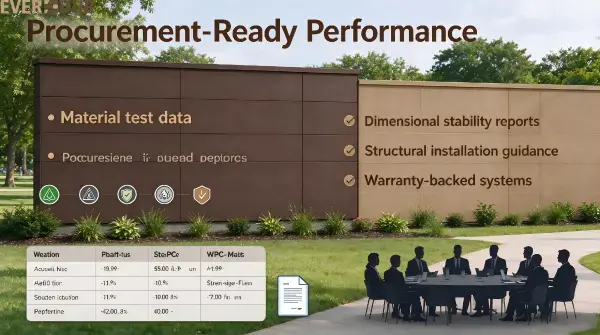
When the government buys things, warranty terms and performance documentation are not extras; they are necessary parts of the supplier evaluation process. Composite wall systems from well-known brands come with structured warranty periods: hollow co-extrusion products usually have 15-year warranties, and solid co-extrusion products have 20-year warranties. This supports the business case for investing in long-lasting outdoor infrastructure.
Performance data, such as UV exposure test results, dimensional stability measurements, and load-bearing standards, are the detailed documents that procurement and engineering teams need to evaluate specs and bids. Having this information available at the start speeds up the design process and lowers the chance of performance disputes after the installation.
Conclusion
Outdoor structures that work well for communities, look good in natural settings, and don't need constant attention from maintenance teams that are already busy should be in public parks. WPC landscape walls are excellent for public parks because they are made from recycled materials, last a long time in all kinds of weather, have a safe surface, and don't cost much to run. They're not marketed as high-end luxury items; instead, they're a useful, well-known option for outdoor privacy and boundary needs where long life and low maintenance are important. Composite walls are a good choice for park planners, landscape architects, and city procurement teams that are looking at different wall options because they are durable, perform well, and have prices that are easy to handle over time.SEND INQUIRY
FAQ
Q: Can WPC landscape walls be used outside all year in cold places?
A: Yes. WPC composite panels are made to be used outside and will work well in a wide range of temperatures. The HDPE structure doesn't let water in, so it doesn't get damaged by freeze-thaw cycles like wood and some concrete goods do. For places where it stays below zero for long periods of time, there are material formulas that are better at withstanding impacts at low temperatures.
Q: How long do WPC wall panels last in a park?
A: Service life varies on the grade of the product and how well it was installed, but well-specified WPC panels that are used outside usually last between 10 and 25 years. When it comes to guarantees, co-extrusion goods with a protective cap layer tend to be on the higher end of that range. Depending on the profile type, the maker will cover them for 15 to 20 years.
Q: If a piece of a WPC boundary wall is broken, can the whole wall be replaced?
A: Yes. By design, WPC panel systems are modular, which means that individual panels can be taken off and put back on without affecting the wall structure as a whole. This makes reactive maintenance easy and keeps you from having to replace the whole section, which is what some monolithic boundary materials need.
Get in Touch With Everdur for Your Park Landscaping Project
Everdur's WPC landscape walls manufacturer team is ready to help you with your project from the first brief to the technical specification, whether you are in charge of a big city tender or choosing materials for an upgrade to a community park.
- For Construction Firms and Landscape Contractors: Get access to detailed technical datasheets, installation guides, and engineering help that is tailored to your project. We offer custom profile sizes and climate-adapted material formulations that can be used on your site.
- For Fence Contractors and Resellers: Our 50-line production plant has competitive trade prices, uniform product quality across big orders, and dependable wait times. You can get sample panels if you ask for them.
- For Building Materials Wholesalers: Special wholesale prices, private label choices, and OEM/ODM customization for names that sell in North America and Europe.
- For End Customers and Park Authorities: Free design help, color and texture samples, and full installation instructions to help you choose the best panel layout for your outdoor space.
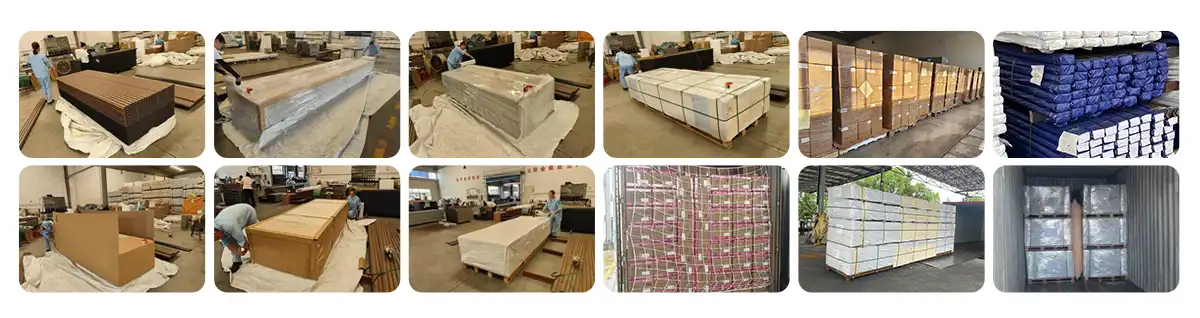
All Everdur composite outdoor wall panels meet the performance requirements set by the EU (CE) and the US (ASTM D7039). They also meet the performance requirements set by China (GB/T 24137). Some environmental certifications are FSC responsible sourcing, Recycled Content verification, REACH, RoHS, and E0 environmental standard compliance. Feel free to email our team at violet@wpcsupplier.com to talk about the needs of your application.
References
1. European Committee for Standardization. EN 15534: Composites Made from Cellulose-Based Materials and Thermoplastics (Wood-Polymer Composites). CEN, Brussels.
2. ASTM International. ASTM D7032: Standard Specification for Establishing Performance Ratings for Wood-Plastic Composite Deck Boards and Guardrail Systems. ASTM International, West Conshohocken, PA.
3. Forest Stewardship Council. FSC Certification Standards and Chain of Custody Requirements. FSC International, Bonn.
4. European Chemicals Agency. REACH Regulation (EC) No 1907/2006: Registration, Evaluation, Authorisation and Restriction of Chemicals. ECHA, Helsinki.
5. Clemons, C. M. Wood-Plastic Composites in the United States: The Interfacing of Two Industries. Forest Products Journal, Vol. 52, No. 6, 2002.
6. Morrell, J. J. Wood-Plastic Composite Durability: A Review of Field and Laboratory Performance. Forest Products Laboratory, USDA Forest Service, Madison, WI.
7. Brandt, C. W., & Fridley, K. J. Load-Duration Behavior of Wood-Plastic Composites. Journal of Materials in Civil Engineering, Vol. 15, No. 6, 2003.
Send Inquiry
Related Industry Knowledge
- Low MOQ Hollow WPC Decking: Perfect for Small Residential Projects
- WPC Composite Fencing for Residential Properties: Stylish & Secure
- Low MOQ WPC Composite Fencing: Perfect for Small Gardens
- WPC Villa Fence with Wood Grain: Enhance Your Villa’s Aesthetics
- WPC Villa Fence Installation: Guide for Luxury Villa Projects
- Co Extrusion WPC Decking vs Regular WPC: Which Saves You More Money?
- WPC Decking Maintenance Tips: Keep Your Outdoor Deck Looking New for Years
- Privacy WPC Fence: Perfect for Residential and Villa Outdoor Spaces
- Hollow WPC Decking Maintenance Tips: Keep It New for 10+ Years
- High-Quality WPC Decking for Poolside: Waterproof and Anti-Slip Solutions