_1777451497595.webp)
Grooved WPC Decking: Anti-Slip Flooring for Poolside & Walkways
Slippery surfaces around pools and walkways are a genuine safety concern — one that many homeowners, contractors, and landscape designers think about long before a project breaks ground. Grooved WPC decking has become a practical answer to this challenge, combining structural slip resistance with the natural warmth of a wood-like aesthetic. Made from a blend of recycled wood fiber, high-density polyethylene (HDPE), and stabilizing additives, this composite material is engineered specifically for outdoor environments where moisture, foot traffic, and seasonal weather converge.
Unlike options with a smooth surface, grooved composite boards' curved shape moves water away from the stepping surface instead of letting it pool. This makes the deck safer to walk on whether it's wet from rain, splashing, or morning dew. In addition to being safe, these boards are stable in size, don't rot or grow, and come in many colors and styles, so they can be used for both small decks at home and bigger outdoor areas at businesses.
This guide talks about the main reasons curved WPC panels are used for outdoor walkways and places by pools, as well as what you should look for when choosing them for your project.SEND INQUIRY
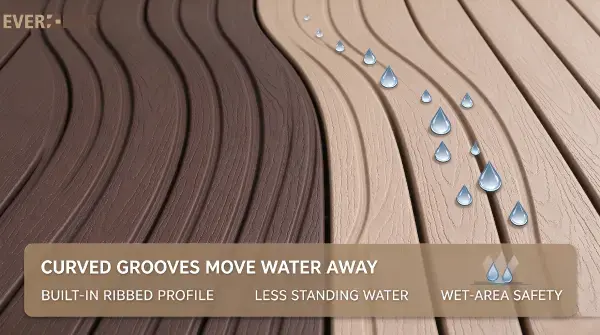
How Does Grooved WPC Decking Improve Slip Resistance Around Outdoor Pools?
Poolside surfaces are among the most demanding outdoor flooring environments. Water is constant, bare feet are the norm, and the risk of a slip is always present. This is where the geometry of a grooved anti-slip WPC board does meaningful work.
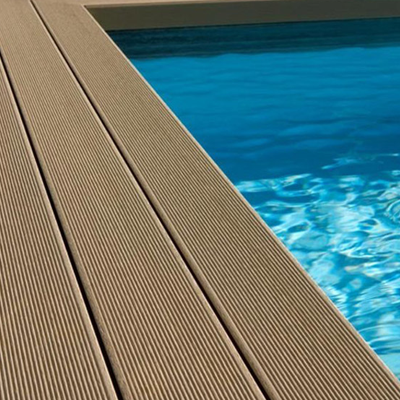
The horizontal lines that run along the surface of the board do two things at the same time. In addition to making raised bumps that make the sole of the foot stick to the floor more, they also move water away from the touch area. Traditional wood or clay tiles that are smooth depend a lot on surface roughness treatments that wear off over time, making them less useful over time. A WPC grooved board, on the other hand, has a ribbed profile that stays in place; it doesn't peel, fade, or wash off.
Standardized tests show that these boards are good at keeping people from slipping. Reputable makers test their goods using EN 13893 (slip resistance for flooring) and other related standards, making sure that the coefficient of friction meets the right levels for wet outdoor circumstances.
The surface treatment is important, not just the groove shape. Brushed and sanded finishes give the ridges a micro-texture that makes them easier to grab without making the surface rough or hard to clean. Co-extrusion composite boards add a secure shell that keeps the surface's structure over years of use. This means that the anti-slip properties that were tested on the first day are still there after ten years.
When it comes to pool surrounds, the groove depth, board width, and surface finish should all be matched to the amount of foot traffic and water that will be present. In areas with a lot of splashing water, wider boards with deeper grooves tend to work better. On the other hand, yard paths that don't get much use should have shorter profiles.
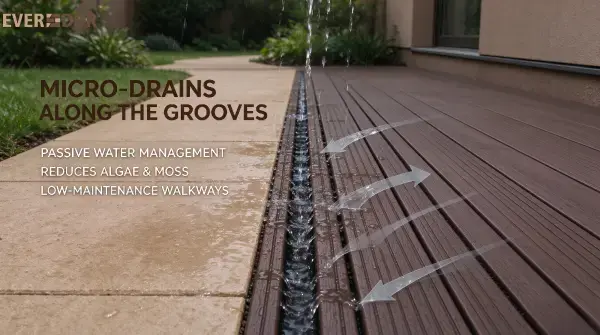
Grooved WPC Decking for Efficient Water Drainage on Outdoor Walkways
Walkways are used by people on foot in all kinds of weather, whether they're in a park, along a business harbor, or between different parts of a vacation. Not only does standing water on a walkway path make it easier to slip, but it also speeds up surface wear and encourages the growth of algae and bacteria.
This is directly dealt with by the lengthwise groove design on grooved WPC floor boards. The lines act as micro-drains, moving water away from the walking surface and toward the board ends when it rains or irrigation water comes to the surface. This system for passive drainage doesn't need any extra equipment to work, which makes installation easier and upkeep easier.
How well sewage works depends on how it is installed. It is best to lay the boards with a slight slope (usually 1% to 2%) in the direction that is not parallel to the grooves. This will let gravity help the drainage process. The space between the boards, which is controlled by hidden clips, also plays a role. Small gaps let any remaining moisture escape through the substructure.
A common problem with wooden walkways in damp or shady places is that algae and moss grow on them. Organic growth is less likely to happen on WPC composite boards than on natural wood because the HDPE part doesn't soak up water, which is what algae need. If there is surface growth, it can be taken off with a stiff brush and light cleanser. There is no need to sand, seal, or chemically strip the surface.
When it comes to business walks, grooved composite decking's low upkeep appearance means lower running costs. There is no need to oil it once a year, replace boards that are warped or split after a wet winter, or keep track of a painting schedule.SEND INQUIRY
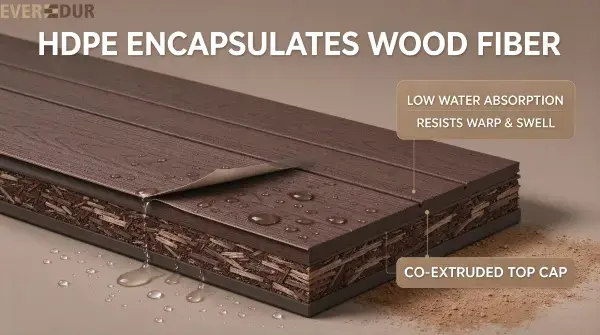
What Makes Grooved WPC Decking Suitable for Rainy and Humid Outdoor Areas?
Moisture Resistance at the Material Level
The heart of a WPC board is made of wood grain that is surrounded by HDPE. Because the wood particles are enclosed, they are not directly exposed to water. This means that they can't soak up water and swell like solid wood does. The practical benefit is that the boards don't warp, bow, or crack when the humidity changes with the seasons.
A continuous top cap made of pure HDPE or ASA polymer wraps around the core of co-extrusion boards, which goes one step further. This top layer doesn't let water through at the surface and keeps the structure inside safe from the damaging effects of frequent freeze-thaw cycles that happen in northern European and North American climates.
UV and Color Stability in Open-Air Conditions
Long-term contact to the sun breaks down many things; it bleaches colors, stiffens plastics, and wears away surface coats. For outdoor use, WPC mixes have UV-stabilizing ingredients that soak up and release ultraviolet energy before it can damage the board's polymer chains or pigments. After being exposed to UV light for at least 2,000 hours, products that have been through rapid aging tests show little color change. This is useful for projects that need to keep looking the same over time.
Fungal and Biological Resistance Without Chemical Treatment
Natural timber used outdoors requires periodic application of biocidal treatments to resist fungal decay and insect damage. WPC composite boards do not support fungal growth in the same way because the wood fiber component is isolated from the moisture and oxygen that decay organisms need. There is no need for pressure treatment, boron compounds, or periodic reapplication of protective coatings — an attribute that aligns with environmental procurement criteria increasingly applied to construction projects across Europe and North America.
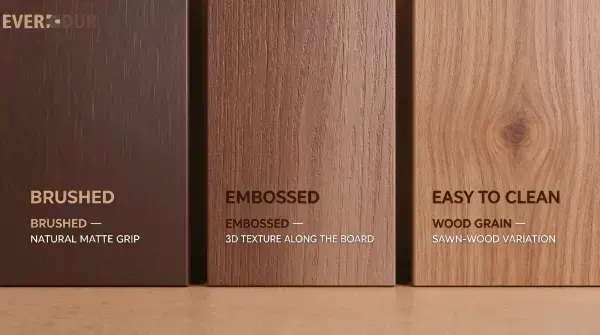
Grooved WPC Decking Surface Profiles, Textures, and Color Options for Outdoor Design
Surface Profiles: Choosing Between Brushed, Embossed, and Wood Grain
Choosing a surface shape is first and foremost a matter of function, then of style. Brushed finishes make a fine, linear roughness that makes the board easier to grip and gives it a natural, matte look. During production, embossed features press a design into the board surface. This gives the board a three-dimensional feel that stays the same all the way along its length. Wood grain surfaces show the natural variations of sawn wood, such as small knots and grain patterns, which works well for projects that want to look natural.
How each finish cleans and gets dirty is different. This type of surface is the easiest to clean with a power washer or deck brush after being buffed or scraped. Fine dirt can get stuck in deep etched profiles, but most of the time, regular washing is enough to get rid of them.
Color Ranges and Custom Matching
Standard color offerings for outdoor composite boards typically span warm tones — teak, cedar, walnut, sandal wood — alongside cooler neutrals such as ash grey, stone grey, and dark grey. This range accommodates the majority of residential and commercial design schemes without custom production.
For projects with specific architectural color requirements, custom color matching is available through the manufacturing process. Pigment formulations are adjusted at the extrusion stage, meaning the color runs through the full depth of the board cap rather than being applied as a surface coating. This approach is more durable than painted or stained finishes and will not peel or chip under normal outdoor conditions.
Two-Sided Board Designs for Versatile Installation
Some grooved pool deck boards are manufactured with different surface textures on each face — grooved on one side, wood grain or brushed on the reverse. This dual-surface design gives installers the option to select the most appropriate finish at the time of installation and provides a practical backup if one surface sustains damage during handling or use.SEND INQUIRY
How to Install Grooved WPC Decking for Stable, Low-Maintenance Outdoor Flooring?
Substructure Requirements for Outdoor Composite Decking
A strong composite deck is built on a substructure that has been properly prepared. The best support materials are WPC joists or aluminum extrusions because they have the same moisture and temperature properties as the decking boards. This means that there is no difference in movement, which can damage the fixings or bend the deck plane over time.
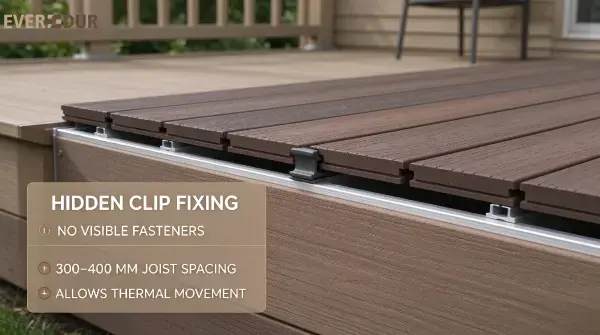
Most household and business buildings use joists that are spaced 300–400 mm apart. When there is a lot of foot traffic or the boards are longer, tighter spacing makes them more rigid and less likely to bend underfoot. It's also important that there is enough wind under the deck so that wetness doesn't build up in the foundation. This keeps all the parts in better shape for longer.
Hidden Clip Fixing Systems for a Clean Finish
The most widely used installation method for grooved WPC boards involves stainless steel or reinforced nylon clips that locate in the groove along the board edge. The clip attaches to the joist and holds the board in position without any visible fastener on the walking surface. This produces a continuous, uninterrupted deck plane that is cleaner in appearance and eliminates the small holes that surface screwing creates — holes that can collect water and debris.
Clip systems also accommodate the minor thermal expansion and contraction that all composite materials undergo. The gap maintained between boards by the clip geometry allows boards to move slightly without buckling or creating pressure points at the fixing locations.
Long-Term Maintenance Practices
Routine maintenance for composite outdoor decking is straightforward. Periodic sweeping removes loose debris, and occasional washing with water and a mild soap solution addresses surface soiling. Avoid abrasive cleaning agents or metallic scrubbing tools that can scratch the board surface. In climates with heavy leaf fall, keeping debris from accumulating in the drainage channels prevents the moist environment that encourages surface algae to establish.
Beyond cleaning, composite decking does not require the cyclical resealing, sanding, or repainting that timber maintenance programs demand. This characteristic is a significant consideration for property managers, resort operators, and homeowners who want a reliable outdoor surface without a demanding care schedule.
Conclusion
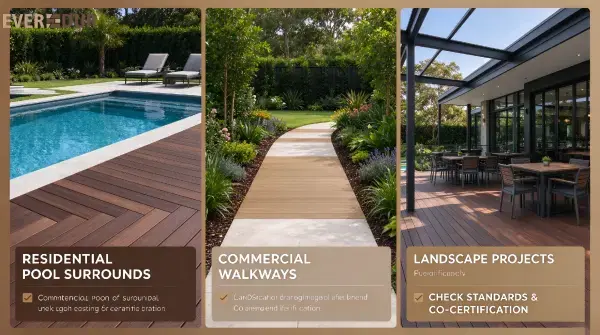
Outdoor flooring for pools and walkways needs to balance safety, durability, and appearance across years of variable weather. Grooved WPC decking boards address each of these requirements through their material composition, ribbed surface geometry, and UV-stable pigmentation. The passive drainage function built into the groove profile reduces standing water and the slip risk associated with it, while the HDPE-based core resists moisture uptake, mold, and the structural degradation that shortens the service life of timber alternatives.
When contractors, landscape architects, and property owners specify outdoor surfaces, they need to know how the surface profile, installation method, and substructure design all work together. This is what makes the difference between a deck that works well and one that needs to be fixed all the time. From brushed finishes to co-extrusion board technology, the choices in this guide show the variety of options that are out there to fit different project sizes, climates, and design goals.SEND INQUIRY
FAQ
Q: Is grooved WPC decking suitable for very cold climates with freeze-thaw cycles?
A: Yes. Co-extrusion technology is used to make WPC composite boards. These boards have a dense outer cap that keeps water out, which is what causes freeze-thaw damage. Boards keep their shape and surface structure even when the temperatures drop and rise, which is common in northern European and Canadian winters. For cold-weather uses, picking a product that has been tested to EN 13929 or similar freeze-thaw standards is another way to be sure of its quality.
Q: How does the slip resistance of grooved composite decking compare to natural timber in wet conditions?
A: Because the curved shape is built into the board and not just on top of it, grooved composite boards always have good slip resistance. The non-slip properties of natural wood are often based on surface treatments like oils, paints, or grit strips that wear off over time. When tested by a third party in wet conditions, composite grooved boards usually meet or beat the requirements for public outdoor surfaces in terms of friction coefficients. On the other hand, untreated wood performance drops significantly when wet.
Q: Can grooved WPC decking boards be cut to length on site?
A: Yes. WPC composite boards can be cut with standard woodworking tools — a circular saw or miter saw fitted with a fine-tooth blade produces clean, accurate cuts. End cuts should be positioned over a joist for structural support. Where cut ends are exposed, end caps or trim pieces are available to provide a finished appearance and prevent moisture entry at the cut face.
Partner with Everdur: Request Your Custom Grooved WPC Decking Quote
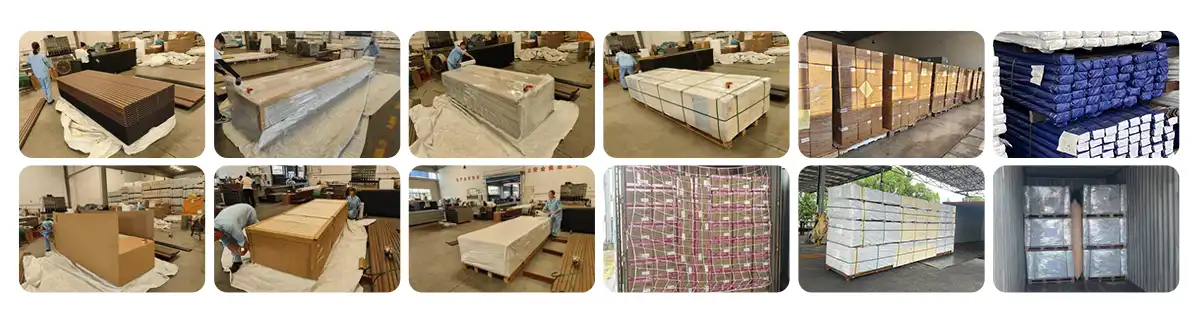
For construction firms and landscape contractors: Everdur supports your project from specification through delivery, with technical documentation, dimensional samples, and project-specific quantities available on request. Our products comply with CE (EU), ASTM D7039 (US), and GB/T 24137 (China) standards, and carry FSC, REACH, RoHS, and Recycled Content certifications — ready for inclusion in project compliance files at any scale.
For building materials wholesalers and resellers: We offer competitive wholesale pricing structures, consistent supply from 50+ production lines, and OEM/ODM capability for branded product lines. Free samples are available to qualified trade partners, and our team can support your sales process with technical materials and color swatch sets.
For end customers: If you are planning a pool surround, garden walkway, or patio renovation, our team can provide free design guidance and installation recommendations matched to your climate and project dimensions. You choose the surface texture, color, and board profile — we supply the materials to your door.
Everdur is a dedicated grooved WPC decking manufacturer with over 16 years of composite decking production experience, exporting to more than 60 countries across Europe, America, Asia, Africa, and Oceania.
Send your project details or sample request to violet@wpcsupplier.com and our team will respond with a tailored proposal.
References
1. European Committee for Standardization. EN 13893: Floor Coverings — Measurement of Dynamic Coefficient of Friction on Smooth Flooring. CEN, Brussels.
2. ASTM International. ASTM D7032: Standard Specification for Establishing Performance Ratings for Wood-Plastic Composite Deck Boards and Guardrail Systems. ASTM, West Conshohocken, PA.
3. Forest Stewardship Council. FSC Standard for Chain of Custody Certification. FSC International, Bonn.
4. European Chemicals Agency. REACH Regulation (EC) No 1907/2006: Registration, Evaluation, Authorisation and Restriction of Chemicals. ECHA, Helsinki.
5. British Standards Institution. BS 7976-2: Pendulum Testers — Method of Measurement of Slip Resistance. BSI, London.
6. Clemons, Craig M. Wood-Plastic Composites in the United States: The Interfacing of Two Industries. Forest Products Journal, Vol. 52, No. 6, 2002.
Send Inquiry
Related Industry Knowledge
- WPC Cladding: The Ultimate Solution for Durable and Stylish Building Exteriors
- WPC Composite Fencing for Residential Properties: Stylish & Secure
- Eco-Friendly Co Extrusion WPC Decking: Sustainable Outdoor Solution
- Exterior WPC Cladding for Commercial Buildings: Bulk Discounts Available
- 3D Composite Decking: Elevate Your Outdoor Space with Textured Flooring
- Top Traditional WPC Decking Manufacturers for Quality Products
- Low MOQ Traditional Cladding: Ideal for Small Traditional Projects
- Exterior WPC Cladding: Durable & Stylish External Wall Solution 2026
- WPC Cladding vs Vinyl Cladding: Which Is Better for Outdoor Use?
- Privacy WPC Fence: Perfect for Residential and Villa Outdoor Spaces