_1777451497595.webp)
Eco-Friendly Co Extrusion WPC Decking: Sustainable Outdoor Solution
Outdoor decking has come a long way from pressure-treated pine and oiled hardwood. Today, homeowners, architects, and contractors across Europe and North America are rethinking what a durable, low-maintenance outdoor surface should look like — and many are landing on co extrusion WPC decking as their preferred answer. This second-generation composite technology bonds a high-performance polymer shell directly around a wood-fiber and HDPE core during production. This makes a board that is resistant to water, UV light, and surface wear without needing the regular maintenance that natural wood does. The story behind the materials is also important. Recycled wood fibers and recovered HDPE keep trash out of landfills, so each board is a step toward a greener outdoor building. Whether you are planning a garden patio for a home, a pool deck at a resort, or a business center, knowing how this technology works chemically and physically will help you make a better design choice. The sections that follow explain how capped composite decking works, how it protects itself, how well it stands up to weather, and how it can be designed in different ways. This way, you can clearly see your options.SEND INQUIRY
How Does Co Extrusion WPC Decking Protect the Core from Outdoor Moisture?
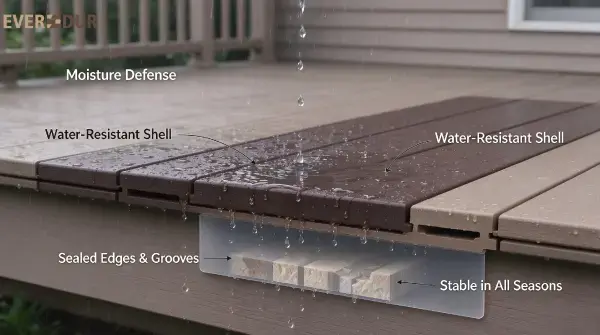
Any surface outside is silently in danger from moisture. Traditional wood soaks up water through its end grain and surface pores, expanding when it's wet and contracting when it's dry. Over time, this repeated spinning causes the wood to lose its structural integrity. Even standard single-side capped composites leave their grooves, edges, and bottoms open, which is exactly where water tends to gather and stay after it rains or is cleaned.
The safety feature in a properly made capped composite board starts working as soon as it is made. During extrusion, controlled heat and pressure fuse a dense polymer layer onto the composite core. This makes a bond that doesn't need to be coated after production. It means that the cap is not put on after the fact; it is grown onto the board as a single layer. Because of this, water can't get through the top into the wood-fiber inner.
End-grain exposure is a weakness in cut-to-length decks. To fix this, responsible makers make grooves and fitting tools that keep the wood from coming into direct touch with water as much as possible. When the board's secret bolt holes are also covered, the installation points, which have been a weakness in composite decks in the past, stop letting water in.
In real life, this is most important in places where it rains a lot, where the air is salty, or where it freezes and thaws often. If a board takes water, it will grow unevenly, delaminate where the cap meets the board, or get bubbling on the surface over time. A fully sealed profile, on the other hand, keeps its shape throughout the year. This is why well-made capped composites are usually expected to last 15 to 25 years with little maintenance.
360° Capped Protection: The Structure Behind Co Extrusion WPC Decking
When selling composite decking, the term "360° capping" is often used, but it's important to understand what the structure actually is so you can judge promises correctly.
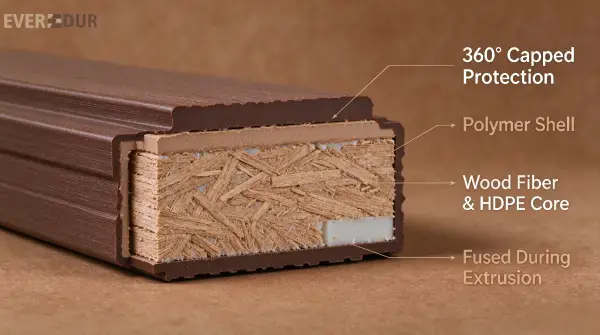
There are six different sides of a decking profile that a real full-perimeter cap covers. These are the walking surface on top, the bottom that faces the joists, both narrow lateral edges, and the inside walls of any drainage or fastener holes that are cut into the board. In a normal hollow or curved shape, the inner channels are some of the most likely places for water to gather because they don't let it drain fast. If the cap layer stops at the groove's edge instead of going inside it, the core is left uncovered in the exact place where it will be exposed for the longest time.
The core of the composite is made up of wood fiber, which is usually recycled sawdust or agricultural waste, mixed with Grade A high-density polyethylene and processing additives that control how the fibers flow, spread, and stay stable over time. The board's weight, how it expands and contracts when heated, and how hard it is are all affected by the amounts of these ingredients used. For example, boards made for winters in northern Europe might be made with less room for error in their thermal expansion rates than boards made for markets in the tropics.
In a co-extruded board, the upper polymer shell is made separately from the core blend. It usually has UV stabilizers, colorfast pigments, and impact modifiers that make the surface feel different when sanded, brushed, embossed, or wood-grained. Because this shell is put on as a continuous extrusion instead of a spray or dip coat, it sticks to the core in a way that is both mechanical and chemical at the same time. This makes a bond that won't peel even when heated for a long time.SEND INQUIRY
Why Does Co Extrusion WPC Decking Resist UV Fading, Stains, and Scratches?
UV Stabilization: How the Polymer Shell Handles Solar Radiation
Ultraviolet radiation degrades organic polymers through a process called photo-oxidation — essentially, UV photons break the molecular chains in the material, causing color shift and surface chalking. In natural timber, this produces the familiar silvery-grey weathering that appears within months of installation. In lower-grade composites, it manifests as uneven bleaching and surface roughening.
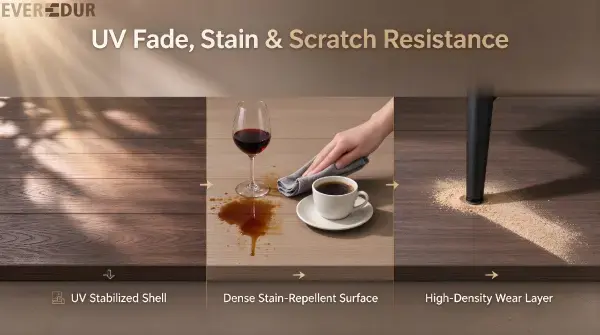
The polymer cap in a co-extruded WPC deck addresses this through UV absorbers and hindered amine light stabilizers (HALS) incorporated directly into the shell formulation. These compounds intercept UV photons before they reach the chromophores responsible for color, effectively extending the period over which the surface retains its original tone. Accelerated UV testing — typically conducted in weathering chambers that simulate thousands of hours of solar exposure — provides the quantitative basis for fade-resistance claims. Boards that demonstrate minimal color shift after 2,000+ hours of such testing are generally considered reliable for long-term outdoor use in European and North American climates.
Stain Resistance: Why the Dense Cap Surface Repels Contaminants
Most of the time, tannins in wet leaves, organic leftovers from food and drink spills, algae growth in shady areas, or mineral deposits from hard water are what stain outdoor decks. If the surface is porous, like wood or an untreated blend, these things will soak in before they can be wiped off. This means that the color will probably stay.
This absorption window is much smaller on a covered board because its surface is thick and has few holes. Most stains that happen outside stay on the surface long enough that mild soap and a soft brush can get rid of them without the need for chemical strippers or sanding. This trait is highly valued in commercial hospitality settings like poolside bars, rooftop terraces, and outdoor dining areas, where spills happen often and cleaning windows are short.
Scratch and Surface Wear: The Role of the High-Density Shell
Outdoor areas get worn down by furniture legs, foot traffic, and grit that comes in from paths. If you buy a good capped board, the polymer shell is much harder than the exposed composite core of a cheaper uncapped board. Even though no outdoor surface is completely resistant to sharp impacts, a well-formulated polymer cap makes it last longer before surface flaws show up. With regular maintenance, the deck will look good for many years.
Co Extrusion WPC Decking for Poolside, Coastal, and High-Exposure Outdoor Spaces
Pool Decks: Chlorine, Wet Feet, and Slip Resistance
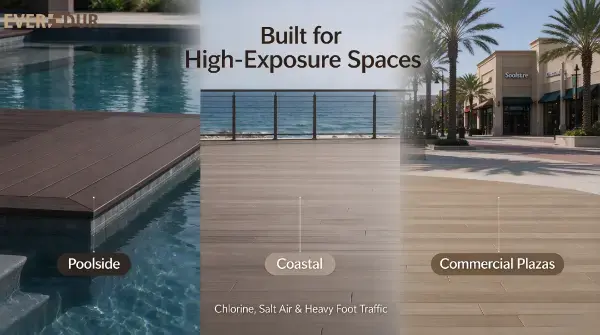
Pool environments combine standing water, chlorinated splash, and constant foot traffic from bare, wet feet — a combination that exhausts natural timber within a few seasons and creates ongoing maintenance obligations. Eco-friendly co-extruded deck boards address chlorine exposure through the inert chemistry of the polymer shell, which does not react with the concentrations of chlorine typically found in residential or commercial pool environments.
Slip resistance is a parallel concern in pool settings. Surface texture — whether brushed, embossed, or wood-grained — affects the coefficient of friction underfoot when wet. A fine-brushed or lightly embossed texture provides meaningful grip without trapping debris in deep grooves that are difficult to clean. For commercial pool facilities required to meet specific slip-resistance standards, surface finish selection should be confirmed against the applicable local safety regulations.
Coastal Installations: Salt Air, Humidity, and Biological Growth
Coastal environments accelerate the deterioration of most building materials. Salt-laden air deposits chloride ions on surfaces, which promotes corrosion in metal components and degradation in organic materials. Biological growth — algae, lichen, and mold — flourishes in the persistent humidity of maritime climates.
A fully capped composite board, because its outer surface is a polymer rather than an organic substrate, offers no nutritional value to mold or algae. The absence of accessible wood fiber on any exterior face removes the primary growth medium. While surface biofilm can form on any outdoor material given sufficient time, it remains superficial on a capped board and is removed easily without aggressive scrubbing or biocidal treatments.
High-Traffic Commercial Plazas and Elevated Walkways
Large-scale business projects, like raised walks, public plazas, and rooftop decks, have different structure and size requirements than domestic decking. In these situations, boards are subject to maintenance routines that value speed and simplicity over accuracy. They also carry heavier point loads and go through more thermal cycling because they are exposed on more than one face.
Capped composite profiles made for industrial use usually have either a hollow-core shape that saves weight and money on materials without losing bending stiffness or a solid-core construction that can hold the most weight. Before specifying for commercial use, you should always check with the manufacturer to make sure that the joist spacing requirements and load ratings for each profile are correct.SEND INQUIRY
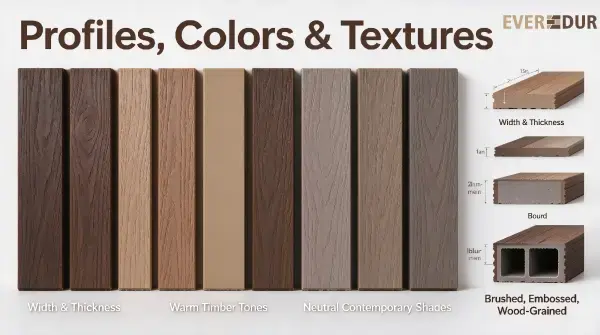
How to Choose Co Extrusion WPC Decking Profiles, Colors, and Textures for Your Project?
Selecting the Right Profile Dimensions for Your Deck Structure
How the finished deck looks and how well it holds up are both affected by profile measurements like width, thickness, and whether the boards are solid or hollow. Wider shapes, like 138–150 mm, look more modern and lower the number of seams that can be seen in big installations. Narrower boards, like those between 90 and 120 mm, have a more classic, fine-grained look that reminds me of hardwood strip flooring.
The thickness of the board determines how far it can span. For example, a 23 mm board can usually span 400 mm between joists under normal residential loads. However, projects with wider joist spacing or more foot traffic may need a thicker solid-core option. Manufacturers who are capable of ODM production can make custom profiles with specific widths, thicknesses, or groove configurations. This means that you can match an existing architectural rhythm or meet a structural engineer's requirements without any problems.
Color Selection: Matching Deck Tones to Architectural Context
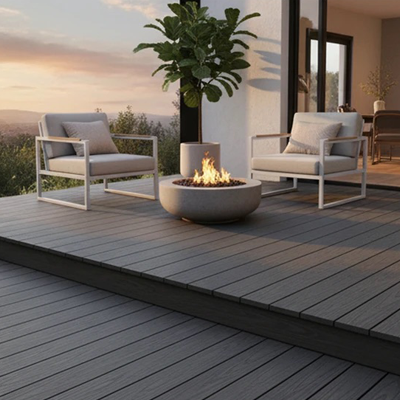
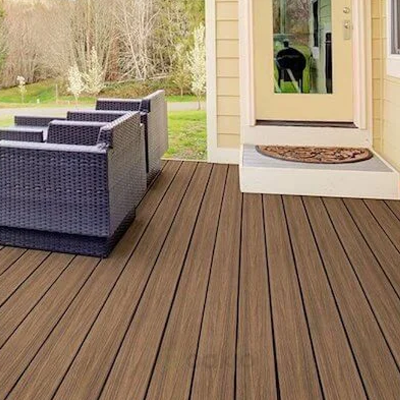
Composite decking is available in a palette that spans warm timber tones — teak, walnut, cedar, sandal wood — through neutral contemporary shades such as ash grey, stone grey, charcoal, and ivory. The choice between warm and cool tones depends substantially on the surrounding architecture: red brick and natural stone typically pair well with warmer brown-family tones, while rendered facades, glass balustrades, and steel structures tend to read better with cooler greys.
Color stability over time is a legitimate evaluation criterion. Boards with polymer caps formulated with quality UV stabilizers will maintain closer fidelity to their original specification color across years of sun exposure. When assessing color options, requesting physical samples and exposing them to direct sunlight for several weeks before finalizing a specification gives a more reliable indication of long-term appearance than catalog images alone.
Surface Texture and Its Impact on Aesthetics and Maintenance
The texture of the surface affects both how the deck feels to walk on and how easy it is to clean. Brushed finishes, which have fine lines running along the length of the board, make it feel like real wood grain and give it a modest amount of grip without making shelves that collect leaf litter. Embossed finishes have a deeper relief on the surface, which makes it easier to hold on to, but they need a little more care when cleaning to keep the texture channels clear. Textures that look like wood grain are the most like real wood, and they're popular in homes where blending indoor and outdoor flooring is important for design reasons.
A brushed or lightly sanded finish is often easier to keep clean than a deep-embossed one for projects that will be in shady, damp places where dirt and other organic matter can build up quickly. Before committing to a finish specification, you should talk to your supplier about how the chosen texture will work in practice with the conditions of the installation site.

Conclusion
Co extrusion WPC decking has matured into a dependable, well-understood category of outdoor building material. A thick, UV-stabilized polymer shell is welded onto a recovered wood-fiber and HDPE core. This solves the specific failure modes that made natural wood and older composite forms high-maintenance options. Different types of decks, like pool decks, coastal terraces, commercial plazas, and private garden spaces, have different needs. The latest generation of co-extruded WPC deck products is very flexible when it comes to profile sizes, color palettes, and surface textures, so most needs can be met without any problems. When it comes to building materials, the truth of technical claims and the quality of the manufacturing are more important than marketing speak. That's why certifications, third-party test data, and open communication with your supplier are still the best ways to make an informed purchase decision.SEND INQUIRY
FAQ
Q: What is the practical difference between a co-extruded board and a standard composite board for an outdoor deck?
A: A normal composite board is made from a mix of wood fibers and plastic, and it doesn't have a separate layer of protection on the outside. This means that the surface of the material is directly exposed to water, UV light, and wear and tear. A co-extruded board has a separate polymer shell that is attached to the core during production. This makes the outer surface stronger and thicker, and it fights water damage, color fading, and surface wear better than the core material alone. The difference is most clear in hot conditions, along the coast, and in places with a lot of foot traffic, where a surface that isn't covered would start to wear down quickly.
Q: How long does the color of a co-extruded WPC deck last in a sunny climate like Southern Europe or the American Southwest?
A: How long the color lasts in outdoor materials relies on how well the UV stabilizers are mixed in with the surface. After more than 2,000 hours of rapid UV tests, well-made covered composite boards with good HALS-based UV protection show almost no color change. This is about the same as many years of natural sun exposure in high-UV areas. However, it is normal for outdoor materials to fade over time. If you choose a color in the middle of a palette instead of a very dark or very light tone, the change will be less noticeable over time.
Q: Can co-extrusion WPC decking be used on rooftop terraces where thermal movement is more pronounced?
A: Rooftop installations experience more extreme thermal cycling than ground-level decks because the boards are exposed to solar gain from above and have less thermal mass from the surrounding environment to moderate temperature swings. Capped composite boards with a well-balanced wood-fiber-to-HDPE ratio and properly formulated additives exhibit lower linear thermal expansion than uncapped composites, making them suitable for rooftop use provided that installation guidance on board spacing and fixing is followed. For projects with very long continuous board runs, consulting with your supplier about expansion joint placement and joist spacing is advisable before installation begins.
Get Sustainable Composite Decking for Your Next Project — Connect with Everdur
For construction firms and architects: Everdur offers technical documentation, custom profile engineering, and project-specific sampling to support your specification process from concept to installation. Our co extrusion WPC decking manufacturer team can work with your structural and design requirements to develop a product that fits your build — not a compromise.
For building materials wholesalers and resellers: Competitive wholesale pricing, flexible MOQ from 100 SQM, and consistent annual production capacity of 30,000 tons mean you can rely on supply continuity across seasons. Exclusive wholesale pricing and free samples are available for qualified partners.
For fence contractors and outdoor installers: We provide installation guidance, fastener system specifications, and technical support to help your crew deliver a clean, professional result on every job.
For end customers: Free design consultation and installation guidance are available so your outdoor space comes together exactly as you envisioned.
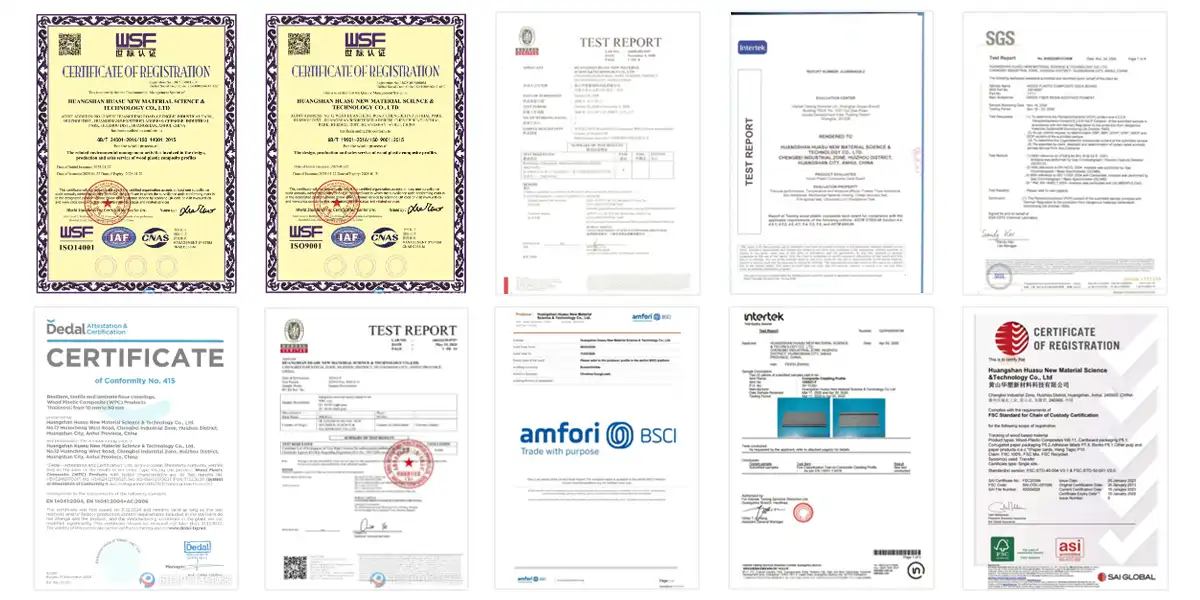
All Everdur products comply with international quality and safety standards, including EU CE marking, ASTM D7039 (US market requirements), and China GB/T 24137. Environmental credentials include FSC certification, REACH and RoHS compliance, Recycled Content certification, and production aligned with E0 environmental standards. Every batch is inspected under 5S on-site quality control and verified by third-party testing through Intertek and SGS.
Ready to discuss your project? Reach out directly to our team at violet@wpcsupplier.com — we respond promptly and are happy to provide samples, technical sheets, and pricing tailored to your requirements.
References
1. Clemons, C. M. (2002). Wood-plastic composites in the United States: The interfacing of two industries. Forest Products Journal, 52(6), 10–18.
2. European Committee for Standardization. (2012). EN 15534-1: Composites made from cellulose-based materials and thermoplastics. CEN.
3. Stark, N. M., & Rowlands, R. E. (2003). Effects of wood fiber characteristics on mechanical properties of wood/polypropylene composites. Wood and Fiber Science, 35(2), 167–174.
4. Klyosov, A. A. (2007). Wood-Plastic Composites. John Wiley & Sons.
5. American Society for Testing and Materials. (2011). ASTM D7032: Standard Specification for Establishing Performance Ratings for Wood-Plastic Composite Deck Boards and Guardrail Systems. ASTM International.
6. Pilarski, J. M., & Matuana, L. M. (2005). Durability of wood flour-plastic composites exposed to accelerated freeze-thaw cycling. Journal of Applied Polymer Science, 100(1), 35–39.
Send Inquiry
Related Industry Knowledge
- Affordable WPC Decking Wholesale: Direct from Factory to Your Project
- Hollow WPC Decking Installation Cost: How to Save Big in 2026
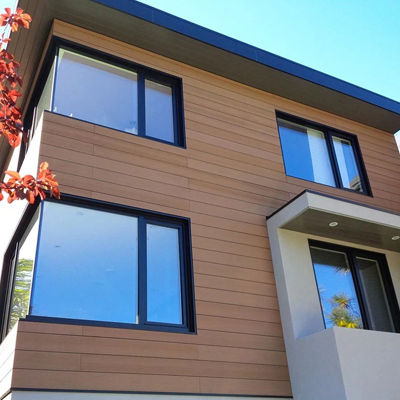
- How to Choose WPC Cladding: Material, Design and Installation Tips
- WPC Landscape Walls Installation: Guide for Garden & Park Projects
- Traditional Cladding for Residential Buildings: Classic & Reliable
- Top Traditional WPC Decking Manufacturers for Quality Products
- Low MOQ Traditional Cladding: Ideal for Small Traditional Projects
- Composite Screen Fencing: Privacy & Decorative Screen for 2026
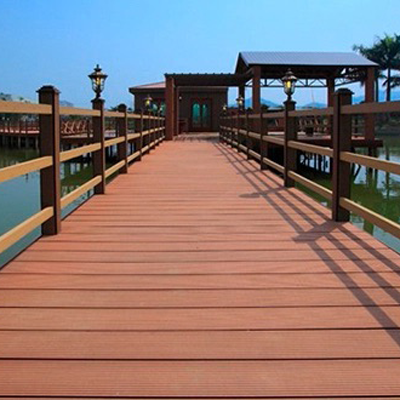
- How to Install WPC Decking Easily: A Step-by-Step Tutorial for Beginners
- Top Benefits of WPC Decking for Residential and Commercial Use in 2026