_1777451497595.webp)
WPC Landscape Walls Installation: Guide for Garden & Park Projects
Installing WPC landscape walls the right way makes the difference between a boundary that looks polished for decades and one that warps, sags, or fades within a few seasons. Composite wall panels are a useful option to wood, concrete, and metal that can be used to surround a private house garden, make paths through a public park, or make privacy screens for a housing development. They don't need to be maintained like traditional materials do because they are resistant to water, UV light, and biological attack. This guide walks you through every important step of the installation process, from preparing the ground and choosing the frame to panel direction, spacing, blending in with nearby landscaping features, and long-term maintenance. The information is just as useful for individuals planning an outdoor project as it is for workers handling multiple sites. You'll get specific advice on how to choose a plan, how to space things out so they work well together, and how to do care in a way that really makes things last longer. After reading this, you'll have a good idea of how to confidently and correctly install composite outdoor garden walls. You'll also understand why the choices you make at the beginning affect the results you get in the end.SEND INQUIRY
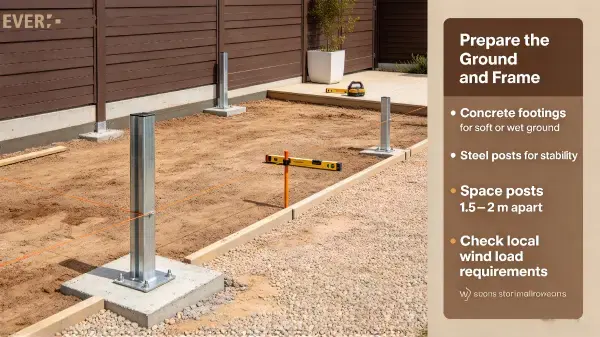

How Should You Prepare the Ground and Frame Before Installing WPC Landscape Walls?
Most installers don't give this step enough attention, but it's the one that leads to the most problems later on. The structure that holds up a composite panel is what makes it stable.
Start by looking at the ground. Make a note of any soft spots, hills, drainage channels, or tree roots that could move over time as you walk around the outside of the line you want to use for the wall. Even though composite panels are good at dealing with water, if the ground moves under a post, the panels will not be lined up correctly. If the ground is soft or wet, concrete footings are highly recommended and not just a choice.
Post choice and spacing are very important. For external composite wall systems, steel posts that are either galvanized or powder-coated metal are the best choice because they don't rust or bend. In sheltered areas, wooden posts can be used, but they add a level of maintenance that most installers would rather not have. Posts should be spaced out 1.5 to 2 m apart for panels that are 140 mm to 220 mm wide, but this can change depending on the length of the panel and the wind load needs in your area.
It takes time to set up posts properly. Set each post at least one-third of the way up from the ground, and make sure the base is in formed concrete instead of just packed down dirt. After letting the concrete dry for a full 24 to 48 hours, you can connect any panels. When this stage is rushed, lean is introduced that gets worse as the wall gets longer.
Leveling can't be changed. Use a laser level or spirit level to make sure that every post is straight and that the tops of all the posts are level across the whole run. Before you start installing, write the height of a panel on each post so that you don't have to keep measuring as you go. If the ground slopes, you need to decide whether you want to step the wall in horizontal steps or rake the panels to follow the grade. Both can be done with composite systems, but they require different ways of cutting and placing the clips.
Before you decide on a frame design, check the local wind load requirements. Garden walls and park boundaries that are out in the open may need deeper footings and tighter post spacing in seaside or high-altitude areas compared to protected areas inland. This isn't too hard to understand, but it needs to be dealt with before the first post is driven into the ground.

WPC Landscape Walls: Horizontal vs. Vertical Layouts for Garden and Park Designs
The orientation of your panels shapes both the visual outcome and the functional performance of the wall. Neither horizontal nor vertical is universally superior — the right choice depends on your design brief, site conditions, and the spatial impression you're trying to create.
Horizontal layouts are currently the dominant aesthetic in contemporary residential and commercial landscaping across Europe and North America. Boards running parallel to the ground emphasize width and openness, which works particularly well in gardens where the goal is to elongate a narrow space visually. Horizontal installation also tends to be faster on straightforward flat-ground runs because panels can be slotted into position sequentially from bottom to top without complex jig work. Drainage is slightly improved with horizontal boards on slotted designs since water runs off along the board length rather than pooling at joints.
Vertical layouts suit projects where height needs to be emphasized — entrance features, tall privacy screens, or boundary walls for park pavilions where the architecture calls for a more formal, linear character. Vertically oriented WPC garden walls can also help a shorter wall appear taller than it is, which is useful on plots where planning restrictions limit actual wall height. Installing panels vertically requires more precise bottom rail alignment since every board hangs from the same horizontal datum.
Mixed layouts — combining horizontal lower sections with vertical upper sections, or alternating orientations across panels — are increasingly popular in landscape architecture projects where the wall is as much a design element as a functional boundary. Composite systems accommodate this flexibility well because panels can be cut cleanly without the grain-splintering issues that affect real timber.
Consider sightlines and airflow. Slatted horizontal boards with consistent gaps promote air circulation, which is valuable in garden settings where plants grow close to the wall. Solid configurations on either orientation are better suited for acoustic attenuation or visual privacy, though they require adequate drainage detailing at the base to avoid water accumulation.SEND INQUIRY

What Panel Spacing Works Best for WPC Landscape Walls and Outdoor Privacy?
Spacing between boards is one of the most consequential decisions in the design of composite outdoor garden walls. It directly affects privacy, airflow, light penetration, and the overall visual weight of the structure.
A gap of 5mm to 10mm between boards is the practical standard for most residential privacy applications. At this range, direct sightlines through the wall are effectively eliminated from typical viewing distances while still allowing adequate ventilation. Wider gaps — 15mm to 25mm — create a slatted screen effect that filters light attractively without fully enclosing the space, which suits garden areas where planting visibility from the outside is desirable, such as show gardens or ornamental park borders.
Structural performance should inform spacing decisions too. Boards with minimal gaps create a larger wind-catching surface area, which increases the lateral load on posts and footings. In exposed locations, a slatted profile with generous spacing reduces wind resistance significantly and may allow for lighter framing as a result.

WPC Landscape Walls Around Gates, Decking, and Other Landscape Features
Integrating wall panels with gates, decking surfaces, pergolas, and other built elements requires careful dimensional coordination before installation begins rather than adjustments after the fact.
Where a composite wall meets a gate, the gate post should be independent of the wall panel framing. A dedicated gate post, set in its own concrete footing with sizing appropriate to the gate weight, prevents the mechanical movement of the gate from transmitting stress into the panel system. Allow a 10mm clearance gap between gate frames and adjacent wall panels to accommodate thermal movement — composite materials expand and contract with temperature variation, and a tight fit at this junction will generate visible buckling in warm conditions.
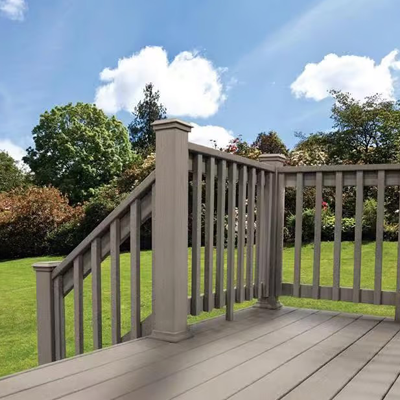
When composite outdoor garden walls terminate at a decking area, the detail at the junction needs to accommodate water runoff from both surfaces. A drip edge or flashing at the base of the wall prevents water from wicking back into the bottom rail channel. The base of the wall should ideally sit 10mm to 15mm above the decking surface rather than resting directly on it, which preserves drainage clearance and prevents debris accumulation.

How Do You Maintain WPC Landscape Walls After Installation for Long-Term Outdoor Use?
Composite wall panels require significantly less maintenance than timber, but "low maintenance" is not the same as "no maintenance." A modest annual routine is all that separates a WPC landscape walls that looks well-kept after fifteen years from one that looks tired after five.
Wash panels once or twice a year with a mild soapy solution and a soft brush. Pressure washing is acceptable at low settings but should not be directed at joints or clip locations at close range. Remove organic debris — leaves, soil, and plant matter — from gaps and the base of the wall regularly, since accumulated organic material holds moisture and encourages surface staining even on materials that resist biological attack.
Inspect the frame annually. Check post bases for any ground movement, verify that clips and fasteners remain tight, and look for any surface scratches deep enough to expose the core material. Minor surface scratches on brushed finishes can usually be blended with a fine abrasive pad.
Color stability on quality co-extruded composite panels is strong — expect minimal perceptible fading after 2,000 hours of UV exposure under standard test conditions — but panels in extreme southern European or coastal climates will benefit from an occasional rinse-down after prolonged dry, sunny periods to remove salt and dust accumulation from the surface.

Conclusion
Installing composite boundary panels successfully comes down to preparation, precision, and material knowledge applied consistently at each stage. Ground conditions, frame design, panel orientation, spacing decisions, junction details, and maintenance habits all connect. Attend to each stage with the same care, and the result is an outdoor structure that performs reliably and holds its appearance for a decade or more without significant intervention.SEND INQUIRY
FAQ
Q: Can WPC landscape walls be installed directly on soil without a concrete footing?
A: Direct-to-soil installation is not recommended for permanent structures. Posts set in concrete footings provide the stability needed to prevent lean and movement over time, particularly on soft or seasonally waterlogged ground.
Q: How long do composite wall panels typically last outdoors?
A: Service life depends on material quality, installation method, and maintenance habits. Well-installed co-extruded composite panels in residential and park settings typically perform well for 15 to 25 years, with warranty coverage varying by product type.
Q: Are composite wall panels suitable for coastal or high-humidity climates?
A: Yes. Composite panels using HDPE and wood fiber with a co-extruded protective shell perform well in coastal conditions. Salt air, high humidity, and frequent rainfall do not cause the structural deterioration seen in untreated timber under the same conditions.
Partner With Everdur for Your Next WPC Landscape Wall Project
For construction firms and fence contractors: Everdur offers technical specification support, project-volume pricing, and documentation packages suitable for planning submissions and contractor records. Our engineering team provides guidance from layout through installation to help your projects stay on schedule.
For building materials wholesalers and resellers: Wholesale pricing structures, sample panels, and full product documentation are available on request. With over 225 clients across more than 60 countries and 50-plus active production lines, Everdur maintains consistent supply capacity to support distribution partners reliably.

For end customers: Free design consultation and installation guidance are available for residential and private garden projects. Tell us your dimensions, climate, and design preferences, and we'll recommend a profile, color, and system configuration suited to your site.
All Everdur products comply with EU CE certification, US ASTM D7039, and China GB/T 24137 standards. Environmental credentials include FSC certification, REACH compliance, RoHS approval, and Intertek verification. Our materials incorporate recycled HDPE content, meeting E0 environmental standards for responsible outdoor construction.
Looking for a reliable WPC landscape walls manufacturer for your next project? Contact our team directly at violet@wpcsupplier.com to discuss specifications, request samples, or ask about customization options.
References
1. European Committee for Standardization. EN 15534: Composites Made from Cellulose-Based Materials and Thermoplastics. CEN, Brussels.
2. ASTM International. ASTM D7032: Standard Specification for Establishing Performance Ratings for Wood-Plastic Composite Deck Boards and Guardrail Systems. ASTM International, West Conshohocken, PA.
3. Forest Stewardship Council. FSC Chain of Custody Certification: Guidance for Outdoor Building Product Manufacturers. FSC International, Bonn.
4. Ashori, A. "Wood–Plastic Composites as Promising Green-Composites for Automotive Industries." Bioresource Technology, vol. 99, no. 11, 2008, pp. 4661–4667.
5. Clemons, C. M. "Wood-Plastic Composites in the United States: The Interfacing of Two Industries." Forest Products Journal, vol. 52, no. 6, 2002, pp. 10–18.
6. Wróblewska-Krepsztul, J., et al. "Recent Progress in Biodegradable Polymers and Nanocomposite-Based Materials for Packaging Applications." International Journal of Polymer Analysis and Characterization, vol. 23, no. 4, 2018, pp. 383–395.
Send Inquiry
Related Industry Knowledge
- Affordable WPC Decking Wholesale: Direct from Factory to Your Project
- How to Choose WPC Landscape Walls for Your Garden or Park
- 2026 Brushed WPC Decking Trends: Stylish & Durable Options
- Exterior WPC Cladding: Durable & Stylish External Wall Solution 2026
- WPC Fence Buying Guide: How to Choose the Right Fence for Your Garden and Villa
- WPC Decking Maintenance Tips: Keep Your Outdoor Deck Looking New for Years
- WPC Cladding vs Vinyl Cladding: Which Is Better for Outdoor Use?
- Privacy WPC Fence: Perfect for Residential and Villa Outdoor Spaces
- Waterproof WPC Fence: Ideal for Coastal and Humid Areas
- High-Quality WPC Decking for Poolside: Waterproof and Anti-Slip Solutions