_1777451497595.webp)
Hollow WPC Decking Installation Cost: How to Save Big in 2026
Planning an outdoor deck project in 2026? Understanding the real cost of hollow WPC decking installation — not just the material price — is where most buyers either save significantly or overspend unnecessarily. Hollow WPC decking, made from recycled wood fiber and Grade A HDPE, is structurally lighter than solid composite or traditional timber, which directly affects labor time, shipping weight, and subframe requirements. These differences have real-world effects on the budgets of homes, builders, and people who sell building materials in Europe and North America. In 2026, the real cost of installing hollow composite decking will be between €18 and €45 per square meter in Europe and between $20 and $50 per square foot in the US. The exact cost will depend on the board shape, finish quality, subframe complexity, and labor rates in the area. The good news is that you can cut the total cost of the project by 20–35% without sacrificing performance or appearance outside if you choose the right products, plan your joists correctly, and buy from a reputable manufacturer. This guide walks you through each cost layer in a clear and useful way.SEND INQUIRY
What Factors Determine Hollow WPC Decking Installation Cost in 2026?
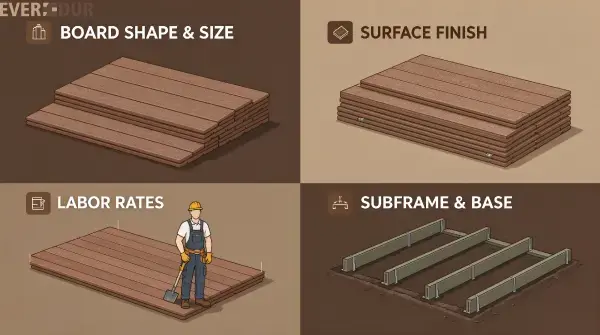
The total cost of installing an outdoor deck is never just one number. It is made up of a number of factors that change depending on the location, the size of the job, and the type of product being used.
The shape and size of the board are very important. A lot of the time, hollow WPC boards are between 135mm and 150mm wide and 20mm to 25mm thick. Because wider boards cover more area per piece, there are fewer clips and joists, which means less money spent on materials overall. Thinner profiles use less material per board, but the spacing between joists may need to be closer to keep the structure strong.
Prices are also affected by the surface finish and the ability to change the color. For each unit, standard finishes like embossed or brushed are cheaper than deep 3D wood grain textures or custom color-matched profiles that are ordered through an OEM/ODM deal. Custom surface treatments may be worth the extra cost for big business or landscaping jobs because they cut down on the amount of finishing work that needs to be done on-site.
One of the most important cost factors is the regional rate of wages. Rates for skilled outdoor installation work are much higher in Western Europe (like Germany, the Netherlands, and Scandinavia) than in Eastern Europe or some parts of the American Midwest. For the same amount of space, a job that takes two workers two days to finish in Poland might cost twice as much to do in Norway.
Both material and labor prices are affected by the factors of the subframe and base. If the base isn't level or is broken, it needs to be fixed before any roofing boards are put down. Aluminum joists are more expensive up front than treated wood joists, but they don't need any upkeep and won't rust in wet or seaside areas, so the cost is usually worth it over 15 years or more of use.
Shipping and transportation are important, especially for people who buy things from other countries. Prices listed as FOB from Shanghai or Ningbo do not include freight, import taxes, or delivery within China. When Europeans buy things from Asia, they need to think about container freight rates, which changed a lot after 2020 and will continue to change until 2026.
Knowing about all of these layers before asking for a quote keeps buyers from being surprised by their budgets and gives them more power when negotiating with suppliers.
Hollow WPC Decking Cost Breakdown: Materials, Labor, Joists & Clips
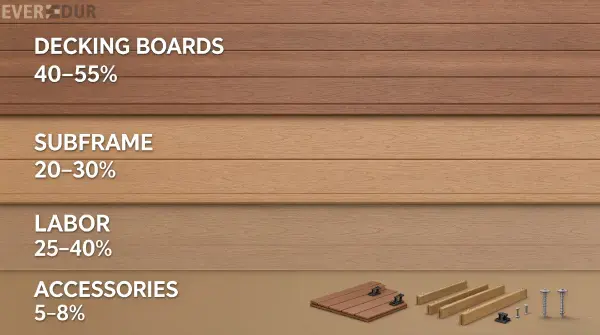
Breaking down an installation quote into its component parts gives buyers clarity and negotiating power. A well-structured cost analysis typically separates four major categories.
Decking boards usually represent 40–55% of total installed cost. For hollow composite deck boards sourced directly from a manufacturer, FOB unit pricing varies based on profile size, co-extrusion or standard extrusion technology, and order volume. Co-extruded boards — which carry a protective polymer shell — cost slightly more per unit but offer superior UV resistance and surface hardness, reducing long-term replacement risk.
About 20 to 30 percent of the total cost goes to subframe parts like joists, support beams, and pedestals. For projects that want to last, aluminum frames with secret clips made of stainless steel or composite material are the norm. Treated wood joists are a cheaper option, but they need to be checked on a regular basis in wet or seaside areas.
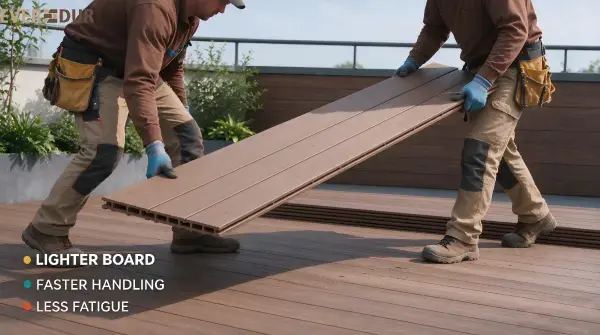
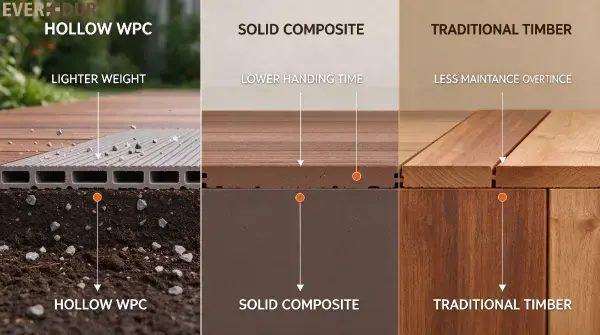
Depending on the area and the difficulty of the spot, labor usually makes up 25–40% of the cost of installation. Hollow WPC flooring boards are about 20–30% lighter by weight than solid composite options. This makes them easier to handle and speeds up the installation process. When working on bigger projects, this weight advantage cuts down on work hours in a meaningful way.
Accessories and consumables like starter clips, end caps, fascia boards, screws, and expansion gap tools are often forgotten in the budgeting process, but they can add 5–8% to the total cost if they aren't planned for in the beginning. Getting these parts from the same company that makes the boards makes sure that the sizes are compatible and prevents problems with fitment on-site.
The best way to find ways to save money on costs before a job starts is to ask your source for a detailed quote that breaks down the cost of the board, clips and joists, and packing.SEND INQUIRY
How Does Hollow WPC Decking Reduce Handling and Installation Labor Costs?
Weight Advantage in Real Installation Conditions
One of the underappreciated financial benefits of hollow WPC flooring is the direct relationship between board weight and installation labor hours. A standard hollow composite deck board in the 140×25mm profile weighs approximately 3.5–4.5 kg per linear meter, compared to 5.5–7 kg for a solid board of equivalent dimensions. Across a 50–100 square meter residential deck, this weight differential reduces the physical strain and time associated with unloading, staging, and positioning boards — particularly on elevated decks, rooftop terraces, or balcony installations where material must be carried up stairs or through narrow access points.
Using hollow-profile boards instead of solid ones saves contractors a lot of time when they work in crowded cities with limited space for storing materials and limited access to elevators. Less travel, less tiredness, and faster board placement all cut down on work hours. Even cutting assembly time by half a day can save a lot of money on the project's labor budget for a medium-sized business job.
The hollow boards' internal hole structure, which is made up of strengthened ribs and air ducts, keeps the structure strong while removing extra mass. We didn't weaken the board in any way; this was a conscious engineering choice that makes fitting easier without affecting the board's ability to hold weight in normal outdoor use.
Joist Spacing and Hidden Clips: Avoiding Extra Costs During Hollow WPC Decking Installation
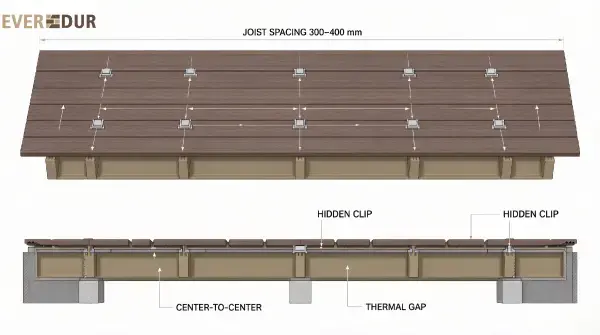
One of the most important choices in installing a hollow composite deck is how far apart the joists should be. It's also one of the ones that people forget to specify. For normal household loads, the recommended joist spacing for hollow WPC boards with a width of 140 to 150 mm is 300 to 400 mm center-to-center. In an effort to save money on frame materials, spacing them too far apart can cause boards to bend when they're loaded, which hurts both the look and the strength of the structure over time.
On the other hand, joist spacing that is too close together wastes money on materials and doesn't improve the structure at all. A simple step that keeps you from under-engineering or over-spending on the subframe is to check with the board maker to make sure that the joist spacing is right for the chosen shape.
When compared to face-screw methods, hidden clip systems have a cleaner look because the clips engage the board groove and attach to the joist without using surface screws. It also takes less time to install each board. With a good T-clip or M-clip device, boards can be placed, engaged, and locked in place all at once. Over a 75-square-meter deck, the time saved on each clip adds up to a big drop in work. Hidden clips also let you control the gaps for thermal expansion, which is useful for outdoor setups in places where the weather changes a lot from season to season.
When you order clips and joists from the same seller as the boards, you can be sure that the sizes and expansion tolerances will be compatible. This will also avoid the fitting delays that happen when you mix parts from different suppliers.
How to Lower the Total Cost of Hollow WPC Decking Without Sacrificing Outdoor Performance?
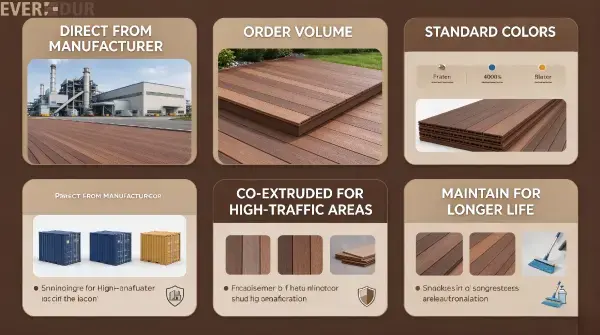
Cost reduction in outdoor decking does not require downgrading material quality. It requires smarter procurement decisions at each stage of the supply chain. Sourcing hollow WPC decking directly from a verified manufacturer — rather than through a multi-tier distributor chain — removes intermediary margins that can add 15–30% to the per-board price without any corresponding improvement in product quality.
Ordering at or above the minimum order quantity (MOQ) threshold — typically 100 square meters for direct manufacturer supply — unlocks better unit pricing and more favorable packaging arrangements. For contractors managing multiple projects, consolidating board orders across projects into a single container shipment reduces per-unit freight cost substantially.
Choosing standard color options from the manufacturer's existing palette, rather than fully custom colors, avoids the minimum run surcharges associated with bespoke color production. Many manufacturers offer 12–14 standard colorways — covering natural teak, grey tones, coffee brown, and charcoal — that satisfy the majority of residential and commercial design briefs without custom color premiums.
Specifying co-extruded boards for exposed, high-traffic areas while using standard-extrusion boards in lower-visibility or lower-traffic zones within the same project is a nuanced approach that optimizes material spend without compromising the overall visual or functional standard of the installation.
Maintaining hollow WPC boards properly — periodic cleaning with water and mild detergent — extends the service life toward the upper range of the 10–25 year performance window, lowering the annualized cost of ownership considerably compared to timber alternatives that require regular sealing, staining, and replacement.
Conclusion
Hollow WPC decking installation costs in 2026 are shaped by more variables than board price alone. Weight, joist design, clip system, labor rates, and sourcing strategy all contribute to the final number on a project invoice. Understanding each layer — and making deliberate decisions at each stage — is how buyers in Europe and North America consistently deliver quality outdoor spaces within budget. The structural and handling advantages of hollow composite boards make them a practical choice across residential gardens, commercial terraces, and poolside environments where performance and cost efficiency need to coexist.SEND INQUIRY
FAQ
Q: What is a realistic installed cost per square meter for hollow WPC decking in Europe in 2026?
A: Installed costs typically range from €18 to €45 per square meter depending on board profile, surface finish, subframe specification, and regional labor rates. Direct sourcing from a manufacturer and standard color selection are two of the most effective ways to keep costs toward the lower end of this range.
Q: How long does hollow composite decking last outdoors, and does it affect the cost-per-year calculation?
A: Co-extruded hollow composite boards are designed for a service life of 15–25 years under normal outdoor conditions. When calculated as an annualized cost, this service life compares favorably against traditional timber, which typically requires replacement or significant maintenance investment within 7–12 years in temperate European climates.
Q: Can hollow WPC boards be used around pools or in wet outdoor environments?
A: Yes. Hollow WPC boards are moisture-resistant and designed for outdoor use in varied weather conditions. Their slip-resistant surface texture and water-resistant core make them suitable for pool surrounds, garden terraces, balconies, and other outdoor settings where water exposure is a regular factor.
Ready to Get an Accurate Cost Estimate for Your 2026 Decking Project? Contact Everdur
Whether you are a construction firm planning a large-scale residential development, a decking contractor quoting for a client, a building materials wholesaler looking for reliable supply, or a homeowner designing your first outdoor terrace, Everdur offers tailored support for every project scale.
For construction firms and contractors: Volume pricing, technical datasheets, and project-specific profile recommendations are available on request. Our 50+ production lines support consistent supply even for large, time-sensitive orders.
For building materials wholesalers and resellers: Exclusive wholesale pricing structures, free product samples, and OEM/ODM support for private-label programs. Supply agreements backed by ISO 9001 and ISO 14001 certified manufacturing.
For homeowners and end customers: Free design consultation, color sample dispatch, and step-by-step installation guidance to help you achieve the outdoor space you have in mind — without unnecessary cost.
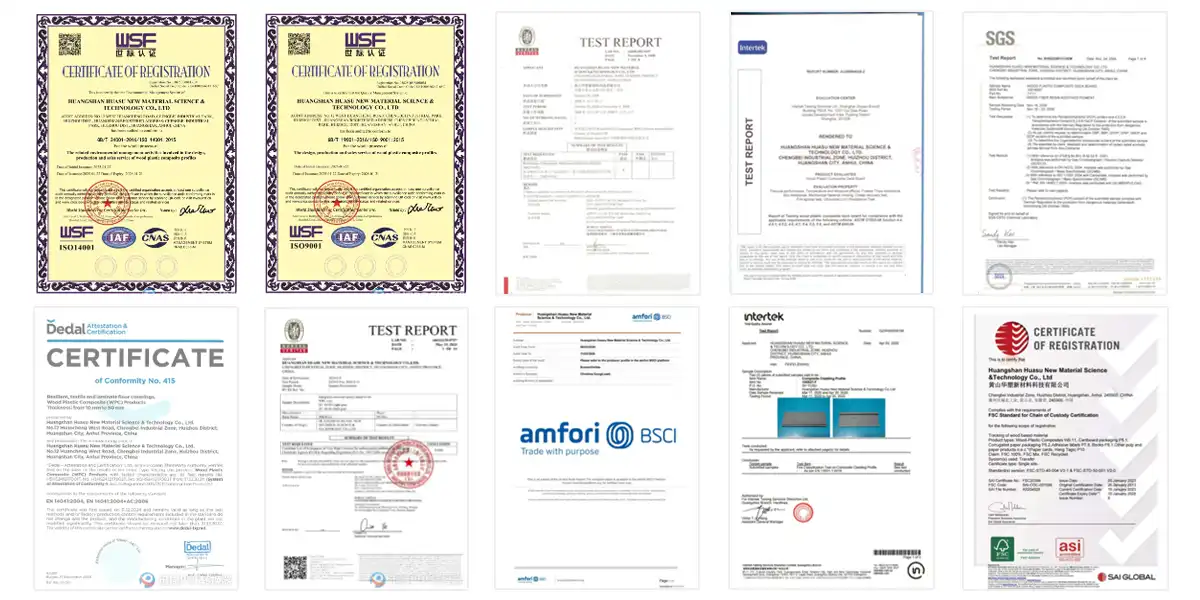
Everdur's hollow WPC decking manufacturer capabilities are verified against internationally recognized standards, including EU CE certification, US ASTM D7039, China GB/T 24137, and environmental certifications covering Recycled Content and E0 environmental standards. Additional certifications including FSC, SGS, REACH, RoHS, and INTERTEK are available on request.
Contact our team directly for a detailed quotation, free samples, or technical support: violet@wpcsupplier.com.
References
1. European Outdoor Living Industry Association. Composite Decking Market Trends and Material Performance Standards in Europe. Annual Industry Report, 2024.
2. American Society for Testing and Materials. ASTM D7032: Standard Specification for Establishing Performance Ratings for Wood-Plastic Composite Deck Boards and Guardrail Systems. ASTM International, 2023.
3. Forest Stewardship Council. Recycled Content Standards for Wood-Based Composite Products. FSC International, 2023.
4. BRE Group (Building Research Establishment). Durability and Service Life Assessment of Composite Decking Materials in Temperate Climates. BRE Press, 2023.
5. European Committee for Standardization. EN 15534: Composites Made from Cellulose-Based Materials and Thermoplastics — Test Methods for Characterization. CEN, 2022.
6. International Organization for Standardization. ISO 9001:2015 Quality Management Systems — Requirements. ISO, 2015.
7. U.S. Green Building Council. Material Transparency and Recycled Content in Outdoor Building Products: LEED v4 Reference Guide. USGBC, 2023.
Send Inquiry

Related Industry Knowledge
- How to Choose WPC Cladding: Material, Design and Installation Tips
- Top WPC Composite Fencing Manufacturers in 2026
- How to Choose WPC Landscape Walls for Your Garden or Park
- 2026 Brushed WPC Decking Trends: Stylish & Durable Options
- WPC Villa Fence Installation: Guide for Luxury Villa Projects
- Composite Screen Fencing for Patios & Gardens: Privacy & Aesthetics
- Top Composite Screen Fencing Manufacturers in 2026
- WPC Fence Buying Guide: How to Choose the Right Fence for Your Garden and Villa
- WPC Decking Maintenance Tips: Keep Your Outdoor Deck Looking New for Years
- Waterproof WPC Cladding: Perfect for Coastal and Rainy Areas