_1777451497595.webp)
Top WPC Composite Fencing Manufacturers in 2026
Finding a dependable manufacturer for WPC composite fencing takes more than a quick search. In 2026, the outdoor fencing market has matured considerably, and buyers across Europe and North America are asking sharper questions before committing to a supplier. They want documented UV resistance, verified recycled content, flexible customization, and a production partner who can fulfill large orders consistently.
This guide goes over the things that set good makers apart from average ones. It talks about things like materials, finishes, how well they work in bad weather, installation systems, and how to compare suppliers based on their certifications and capacity. The information here is meant to help you make an educated choice, whether you're looking for a home building, a business gardening project, or a way to get your products to people.
Everdur is a Chinese company that makes WPC fence. They have been making it for 16 years, have 50 busy extrusion lines, and ship more than 1,500 crates of goods to customers in more than 60 countries every year. The information in this piece comes from that background in creation as well as advice from the business that is available to the public. Carefully read through and compare your choices, and then get in touch when you're ready to talk about details.SEND INQUIRY

What Should Buyers Look for in WPC Composite Fencing Manufacturers in 2026?
If you don't do your research first, buying outdoor fence from a company in another country comes with real risks. There are more important things to think about in 2026 than just price per square meter.
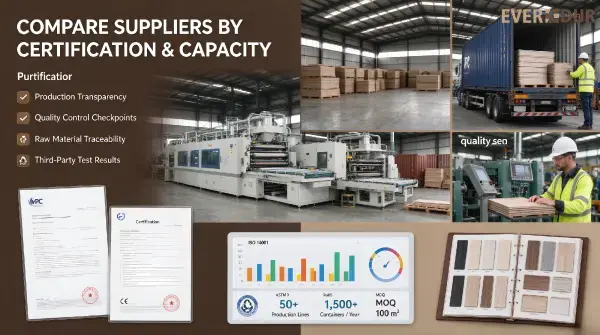
Transparency in production is a good place to start. It's easier to trust a manufacturer that has clear quality control checkpoints, documented 5S on-site management, and a way to track where their raw materials come from than one that makes vague promises. Ask to see pictures of the work being done, audit records, or the results of a third-party review.
Coverage certification is very important, especially for people who want to sell their goods in Europe or North America. For the EU market, look for CE marking. For the US market, look for ASTM D7039 compliance. As a minimum, look for ISO 9001 quality management certification. Environmental qualifications like FSC chain-of-custody, RoHS, REACH compliance, and proof for recycled material are being asked for more and more by businesses and government agencies that buy things.
Another thing that sets reliable partners apart from bad ones is how reliable their deliveries are. A provider with more than 50 production lines and a steady amount of shipments each year has shown that they have the systems to handle repeat orders without any worries about wait times.
A third part of the picture is responsibility after the sale. The terms of warranties are very different across the business. When a company backs up their product claims with a 15-year warranty on hollow co-extrusion panels and a 20-year guarantee on solid co-extrusion panels, they are not just using marketing speak.
Lastly, think about how the supplier communicates. How responsive they are during the inquiry phase is often a good sign of how they'll respond to technical questions during the project.
WPC Composite Fencing Materials, Profiles, and Surface Finishes for Outdoor Projects
Understanding what goes into a composite exterior fencing panel helps buyers evaluate quality claims with greater precision.
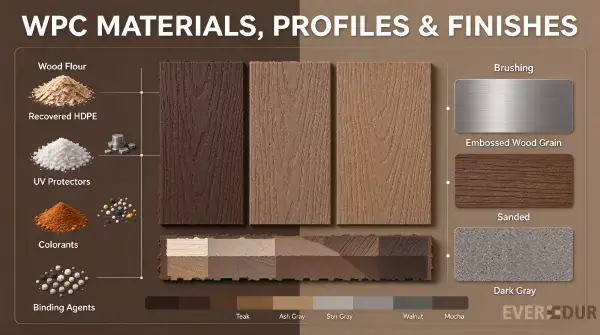
Wood flour, recovered high-density polyethylene (HDPE), and chemicals like UV protectors, colorants, and binding agents are mixed together to make most WPC fence. The amount of these parts and especially the quality of HDPE used affects how well it works outside over time. Grade A recovered HDPE is more stable in terms of size and resistance to moisture than lower grades.
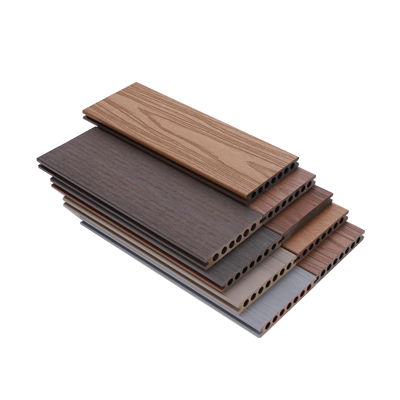
How a fence works in real life is also affected by its profile design. Most cross-sections are between 90×25mm and 150×25mm, and panels can be 140mm to 220mm wide and 20mm to 40mm thick. Although hollow profiles are lighter and cheaper, they may not be able to hold as much weight as solid profiles. With co-extrusion technology, a protected polymer shell is formed around the core during extrusion. This adds a layer of surface protection that makes it harder to scratch and keeps the color better.
The finish on a surface affects both how it looks and how easily it slips. Textures that have been brushed have a clean, straight look that works well in modern outdoor areas. With embossed wood grain, you can get the natural look of wood without having to do as much upkeep. Sanded finishes are better for some architectural settings because they are smoother to the touch. For commercial and residential projects that are done outside, the surface should be able to grip the ground well without collecting water.
Most fence layouts can work with standard lengths of 1.8m, 2.2m, and 2.9m, but manufacturers with flexible extrusion setups can make custom lengths as well. Neutral colors like ash gray, stone gray, and dark gray are common, along with warmer colors like wood, teak, walnut, and mocha. Suppliers who have their own color development departments can do custom color matching.SEND INQUIRY
How Do WPC Composite Fencing Manufacturers Ensure UV, Moisture, and Weather Resistance?
Outdoor fencing is always being stressed by the weather. It is important to look closely at how well a maker can show, not just say, that their products are weatherproof.
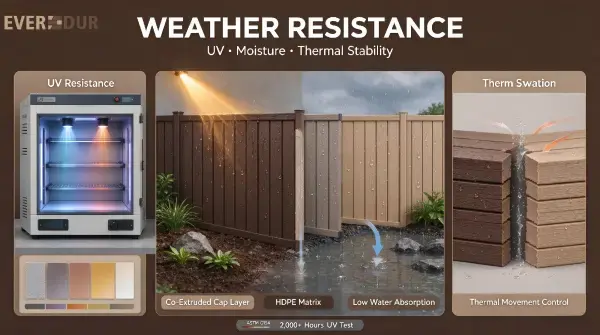
One of the main reasons why wood-plastic composites lose their color and become chalky is UV breakdown. Trustworthy companies add UV protector packages to the core mixture and then add a co-extruded cap layer that protects the core from direct sunlight. A good way to compare colors is to have them tested by a third party under controlled settings for more than 2,000 hours of UV exposure, using ASTM G154 or similar standards.
How well the moisture is managed depends on the quality of the polymer matrix and how much wood fiber is encased in it. Panels with more HDPE and a co-extruded shell soak up less water, which in cold places lowers swelling, biological growth, and freeze-thaw stress. This is a very useful thing to think about for buyers in northern Europe or the northern United States.
Thermal expansion and contraction change the tolerances for installation gaps and the long-term strength of the structure. The next generation of co-extrusion products is being worked on to reduce thermal movement. This will be a big help for large fence installations in places where temperatures change a lot from season to season.
WPC Composite Fencing Installation Systems: Privacy Panels, Slats, Posts, and Gates
A well-thought-out fence system cuts down on the time it takes to build and the chance of mistakes happening on the job site.
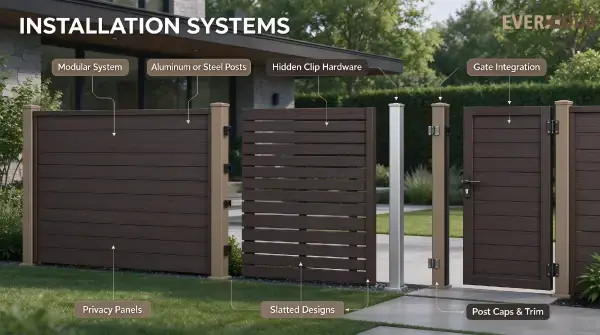
As structural supports, modular WPC fence systems use aluminum or steel posts. Panels or slats are clipped into place using hidden clip hardware. This method gets rid of the need for visible fasteners on the finished face and lets panels be taken off and put back on without taking apart sections that are next to them. For most home and light business setups, you don't need any special tools.
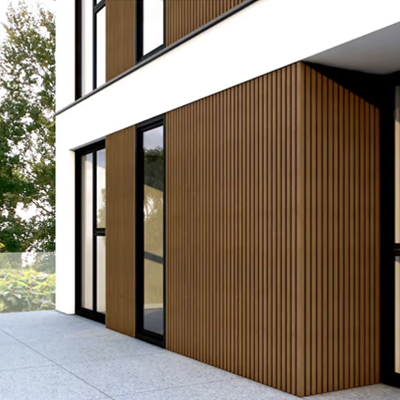
Privacy panel configurations use full-width boards installed horizontally or vertically to eliminate sightlines between spaces. Slatted designs — where boards are spaced with deliberate gaps — allow airflow and partial visibility while maintaining a structured appearance. Both orientations suit residential garden applications, villa perimeter fencing, and WPC commercial fencing projects in parks, hospitality venues, and mixed-use developments.
Gate integration is a practical requirement for most perimeter applications. A fencing system that accommodates matching gate frames, hinges, and latch hardware in compatible materials avoids the visual mismatch that often results from combining products from different suppliers. Post caps, trim pieces, and corner connectors are additional accessories that contribute to a clean, finished installation.
How to Compare WPC Composite Fencing Manufacturers by Customization, Certifications, and Supply Capacity?
Large-scale project managers need makers who can change to meet the needs of the project without taking a long time to build new products.
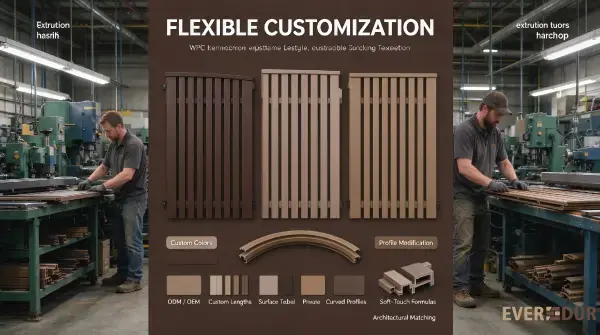
Customization level changes a lot from one business to the next. Manufacturers who have their own tools can change the surface roughness, color, shape measurements, and structure form. ODM and OEM services, in which the maker makes the product based on the buyer's designs or private label needs, are helpful for developers and marketers who want to make their products stand out. Specialized product lines, like bent curves or soft-touch WPC formulas, show that a company makes more than just normal stock items.
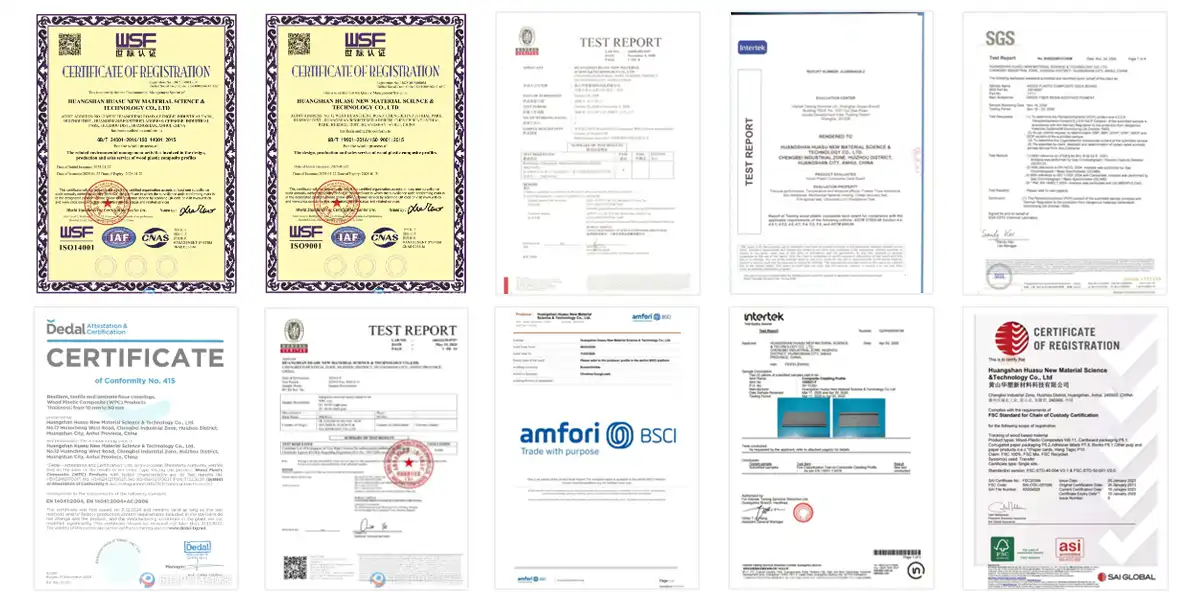
Coverage for certifications should be checked, not just assumed. ISO 9001 is about systems for managing quality, and ISO 14001 is about systems for managing the environment. CE stamp shows that a product meets EU rules for building products. FSC certification shows that the wood fiber content was sourced in a responsible way. Chemical safety rules for European markets are covered by REACH and RoHS compliance. In the US, ASTM D7039 is the standard for wood-plastic composite lumber and fencing profiles. If a buyer is exporting or distributing goods to more than one market, they should make sure that the supplier has up-to-date copies of the certifications their customers need.
How well a manufacturer can grow with your business depends on their supply capacity. An annual shipping volume of more than 1,500 containers and more than 50 production lines give you a good chance of not running out of stock during busy project times. With a MOQ of 100 square meters, smaller buyers or trial orders can still place their first orders.
Conclusion
Selecting a WPC composite fencing manufacturer in 2026 is a decision that benefits from structured evaluation rather than headline price comparisons. Material quality, surface durability, installation system design, certification currency, and production capacity all contribute to the total value a supplier delivers. Everdur's 16-year track record, verified international certifications, and flexible customization services make it a practical option for buyers sourcing outdoor fencing for European and North American projects. Review the specifications, request samples, and start a conversation about your specific project requirements.SEND INQUIRY
FAQ
Q: What is the expected service life of WPC composite fencing in outdoor conditions?
A: Service life relies on the type of product and where it is installed. Most solid co-extrusion panels come with a 20-year warranty, while most thin co-extrusion panels only come with a 15-year guarantee. The warranty for classic solid profiles is 10 years, and the warranty for classic empty profiles is 5 years. All of Everdur's fencing products are only meant to be used outside.
Q: Can WPC fencing panels be customized for specific project colors or dimensions?
A: Yes. Manufacturers who have their own extrusion tools and color development facilities can make panels in any size, color, or surface texture that isn't available in their catalog. Everdur offers color matching, profile customization, and custom structural designs that are made to fit the needs of architects.
Q: Which certifications should I verify before purchasing WPC fencing for European or US distribution?
A: For European distribution, verify CE marking, REACH compliance, RoHS compliance, and FSC certification. For the US market, ASTM D7039 is the primary standard for wood-plastic composite profiles. ISO 9001 and ISO 14001 are baseline quality and environmental management credentials worth confirming across any market.
Ready to Source WPC Composite Fencing for Your Next Project? Contact Everdur
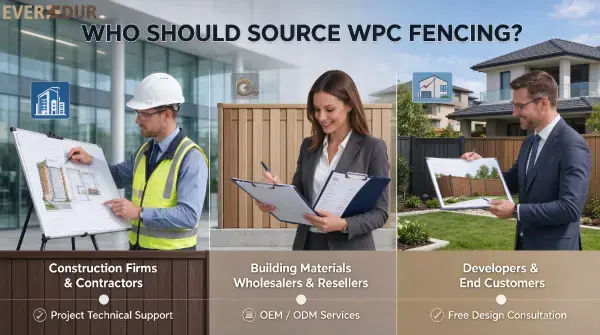
Whether you're a fence contractor pricing a residential development, a building materials wholesaler expanding your product range, a construction firm specifying WPC composite fencing for a commercial landscape, or a reseller looking for a reliable manufacturer partner — Everdur has structured its offering to match your needs precisely.
For construction firms and fence contractors: Project-specific technical support, custom profile development, and consistent lead times across large volume orders.
For building materials wholesalers and resellers: Exclusive wholesale pricing structures, free samples for product evaluation, and OEM/ODM services for private label requirements.
For end customers and developers: Free design consultation, installation guidance, and a full accessory system including posts, clips, gates, and trim.
All Everdur fencing products comply with CE (EU), ASTM D7039 (US), and GB/T 24137 (China) standards. Environmental certifications include FSC chain-of-custody, Recycled Content certification, E0 environmental standard, REACH, and RoHS — documentation available upon request.
Send your project details or product inquiry to violet@wpcsupplier.com and receive a response within one business day.
References
1. ASTM International. ASTM D7039: Standard Specification for Wood-Plastic Composite Deck Boards and Guardrail Systems (Guards or Handrails). ASTM International, West Conshohocken, PA.
2. European Committee for Standardization. EN 15534: Composites Made from Cellulose-Based Materials and Thermoplastics (Usually Called Wood-Polymer Composites (WPC) or Natural Fibre Composites (NFC)). CEN, Brussels.
3. Forest Stewardship Council. FSC Chain-of-Custody Certification: Guidance for Manufacturers and Retailers. FSC International, Bonn, Germany.
4. Clemons, Craig M. Wood-Plastic Composites in the United States: The Interfacing of Two Industries. Forest Products Journal, Vol. 52, No. 6, 2002.
5. European Chemicals Agency (ECHA). REACH Regulation (EC) No 1907/2006: Understanding REACH. ECHA, Helsinki, Finland.
6. Klyosov, Anatole A. Wood-Plastic Composites. John Wiley & Sons, Hoboken, NJ, 2007.
Send Inquiry

Related Industry Knowledge
- How to Choose WPC Landscape Walls for Your Garden or Park
- 3D Composite Decking: Elevate Your Outdoor Space with Textured Flooring
- Low MOQ Traditional Cladding: Ideal for Small Traditional Projects
- WPC Villa Fence Installation: Guide for Luxury Villa Projects
- Exterior WPC Cladding: Durable & Stylish External Wall Solution 2026
- WPC Cladding vs Vinyl Cladding: Which Is Better for Outdoor Use?
- Waterproof WPC Cladding: Perfect for Coastal and Rainy Areas
- How to Install WPC Decking Easily: A Step-by-Step Tutorial for Beginners
- Why Co-extruded WPC Decking Is a Must for Your Outdoor Project
- Eco-Friendly WPC Decking: Sustainable Choice for Modern Outdoor Spaces