_1777451497595.webp)
Top Residential WPC Decking Suppliers for Homeowners 2026
Choosing the right outdoor decking supplier is one of the more consequential decisions a homeowner makes — not just for aesthetics, but for long-term comfort, safety, and property value. As more families across Europe and North America move away from traditional timber, residential WPC decking has become the practical and appealing alternative. Wood-plastic composite boards combine recovered wood fiber with high-density polyethylene, producing outdoor flooring that resists moisture, pests, and UV degradation without the seasonal upkeep that natural wood demands.
In 2026, the market for composite outdoor decking has matured considerably. Homeowners now have access to a wider range of profile designs, co-extrusion technologies, and environmentally responsible material options than ever before. But the abundance of suppliers also makes it harder to identify who genuinely delivers on quality, certification, and after-sales support — and who simply makes claims.
This guide walks through everything a homeowner should weigh before committing to a supplier, from material composition and design versatility to warranty terms and real-world service support. Whether you are planning a villa garden, a private yard retreat, or a balcony terrace upgrade, understanding what separates a dependable manufacturer from a mediocre one will save you considerable time and money.SEND INQUIRY

What Should Homeowners Look for in a Residential WPC Decking Supplier?
Sourcing outdoor composite flooring is not the same as buying paint or garden furniture. A decking installation is a structural project that will be exposed to rain, frost, intense sunlight, and foot traffic for potentially two decades. The supplier you choose shapes every aspect of that experience — from the day the boards arrive to the afternoon you host a garden party ten years later.
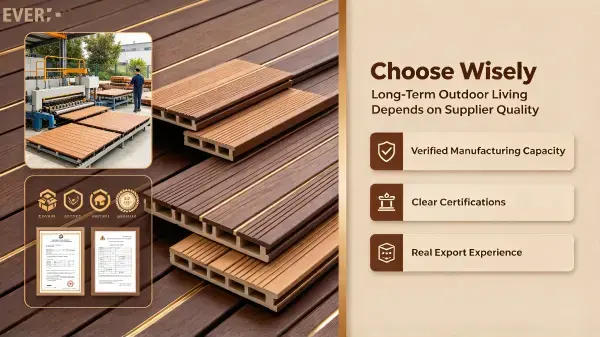
One of the first things that should be looked at is the verified manufacturing capacity. If a supplier has a lot of production lines that all make the same amount of product every year, they are less likely to skimp on the quality of the material mixing or extrusion. Find out if they have their own plant or if they handle orders through third parties. The difference is important for quality stability.
It's just as important for certifications to be clear. Suppliers who are honest will gladly share proof that their products meet standards such as CE (European conformity), FSC (Forest Stewardship Council chain of custody), REACH compliance, and RoHS material safety. If the seller isn't clear or takes a long time to give these, that's a sign that you should pay attention to.
Export knowledge is also useful in real life. A company that has shipped composite decking boards to different climates, like the cold winters of Scandinavia, the hot summers of the Mediterranean, and the humid coastal areas, has put their products through more stress tests than a company that only makes products in the United States. Find out where their current customers are and how long they've been keeping in touch with them.
Being able to customize this completes the picture. Residential projects are very different. For example, the esthetic needs of a porch on a Georgian townhome are very different from those of a pool deck on a modern mansion. When suppliers let customers change things like color, surface texture, profile size, and even the make-up of the material, homes can get results that are truly unique instead of having to settle for what's in stock.

Residential WPC Decking Product Ranges, Materials, and Design Choices
What goes into making a home floor board determines how good it is. The best composite boards are made from Grade A recovered HDPE, which is the same dense polymer that is used to make bottles and pipes. They also have clean wood fiber and chemical additives that are carefully measured out, including residential eco-friendly WPC. This mixture decides how well the board works when it is exposed to changing temperatures, UV light for a long time, and water for a long time.
Profile sizes change depending on the use. Standard lengths for homes are between 135 mm and 150 mm, and standard thicknesses are between 20 mm and 25 mm. Most home plans work with the standard lengths of 2.2 m, 2.9 m, and 3.6 m, but providers with flexible extrusion setups can make custom lengths. There are pros and cons to both hollow and solid core options. Hollow profiles are lighter and easier to work with during installation, while solid boards are more stable underfoot.
The way the surface is treated is where design style comes in. The feel of hand-planed wood is reflected in brushed surfaces. Raised patterns give things more depth and make them easier to grip when they're wet. The look of wood grain patterns can be very close to that of teak, walnut, or cedar, but they don't require as much upkeep. For homeowners who are working with a builder or garden artist, providers who offer custom surface texture development in addition to a standard catalog give them a lot of room to be creative.
The number of colors available has grown a lot. Along with the classic natural wood tones like cedar, walnut, sandalwood, and mocha, there are now more modern shades like ash gray, stone gray, and dark gray that look great with modern building materials. Color stability is just as important as the original shade. Look for goods that have minimum fading after long-term UV testing, which should be backed up by independent lab results instead of just marketing copy.
The use of co-extrusion technology is a big step forward in this product area. Co-extruded boards are better at resisting stains, water absorption, and surface wear because they surround the core composite material with a protective polymer shell during the extrusion process. This structural method is different from single-layer extrusion and leads to a significantly longer service life. This is why top makers now market their co-extruded ranges as their best residential products.SEND INQUIRY

How Can You Verify Residential WPC Decking Quality and Warranty?
Evidence is what proof is based on. Some well-known third-party labs that can give you test results include SGS, Intertek, and Bureau Veritas. These labs should be able to tell you about the stability of the dimensions, the strength in bending, the resistance to slips, and the ability to keep the color under UV light. A reliable provider will have these on file and be happy to give them to you. Pay attention to which standard is used for each test. For example, EN 15534 is usually used to evaluate residential products in Europe, while ASTM standards are used by buyers in North America with residential decking board.
The terms of a warranty show how sure a company is in their goods. Standard warranties last for 10 years, but co-extrusion board types from well-known manufacturers usually have warranties that last for 15 to 20 years. Carefully read the warranty's terms and conditions. Does it only cover flaws in the material, or does it also cover things like color stability and how well the product fits together? The safety is stronger if the warranty wording is more detailed.
Access to the factory for audits or video tours of the facility add another layer of security. Structured quality management systems, like ISO 9001 for consistent production and ISO 14001 for environmental process management, make sure that suppliers check their work every day, which is good for the product you get.

Residential WPC Decking Samples, Installation Support, and After-Sales Service
Before placing a full order, physical samples are still the best way to test a residential eco-friendly WPC board. You can feel the surface texture, make sure the colors are accurate in the lighting at your site, and check the board's weight and rigidity to make sure it meets your installation needs. Suppliers with a good reputation send samples quickly and without too many restrictions.
Help with installation can come in many forms, from technical documentation to hands-on guidance. The most common construction mistakes can be avoided by following clear joist spacing guidelines, clip system specs, and expansion gap guidelines. Some suppliers offer how-to videos or the chance to talk to technical staff who can give advice based on the specifics of the site, such as terraces that are higher than the rest of the building, areas with big changes in temperature, or areas that need drainage management under the boards.
After-sales service is the part that is easiest to forget about when making a purchase choice but is felt the most afterward. When a supplier has active clients on several continents, they have to have developed quick ways to communicate and useful ways to solve problems. Find out how long it usually takes for technical questions to be answered and if there are specialized account contacts who can help with current projects.

Comparing Residential WPC Decking Suppliers for Long-Term Home Projects
Outdoor living projects that last a long time recognize providers who can keep up with production while also developing new products. A company that has been shipping composite decking for more than ten years has learned from real-world performance feedback in a variety of locations and used that information to improve both the materials and the way they are made. That information is really helpful for a homeowner who is investing for 20 years.
Homeowners with clear ideas need to know about OEM and ODM capabilities. A manufacturing partner is different from a catalog supplier because they can change the material's composition to fit a certain climate, such as adding more UV stabilizers for areas in southern Europe that get a lot of sun or making it more resistant to water in coastal areas. They can also make sure that the profile size fits an odd-shaped space.
Everdur has built partnerships with over 100 customers in more than 60 countries, including well-known European building materials stores. The company has more than 50 production lines that can make 30,000 tons of product each year. Their second-generation co-extrusion boards and work on the next-generation lighter, more thermally stable profiles show that they are making products based on how well they work rather than how they look in the market.

Conclusion
In 2026, choosing a supplier for residential composite decking will require more than just comparing the products on the surface. The types of materials used, the co-extrusion technology, the certification paperwork, the length of the warranty, and how quick the company is after the sale will all affect whether your outdoor space is a joy to use or a constant source of upkeep. The most stable base for long-term outdoor living projects is a supplier with proven export experience, clear quality systems, and the ability to make important customizations, including residential WPC decking.SEND INQUIRY
FAQ
1.How do composite floor boards hold up in the cold winters of Europe?
A: Good composite boards made with stable HDPE and wood fiber keep their shape through freeze-thaw cycles. Boards made with co-extrusion protective shells are very strong because the outer layer stops moisture from getting in, which is what causes lower-quality products to expand and damage them.
2.For a home yard, what is the real difference between hollow and solid composite decking profiles?
A: Hollow profiles make the boards lighter overall, which makes them easier to handle and puts less stress on the framework that supports them, which is good for stairs or patios that are higher up. Solid shapes feel heavier and more rigid underfoot, and they are often chosen for ground-level uses where load distribution is not as important.
3. Can composite decking be put down on top of a concrete patio?
A: Yes, composite boards can be put down on top of concrete using a suitable system of fixed or movable joists. To keep water from pooling, there must be enough drainage pathways between the boards, and the joist system must take into account any uneven surfaces. Before starting, it's a good idea to look at the supplier's detailed installation instructions.
Partner with Everdur for Your 2026 Residential Decking Project
Wholesalers and distributors of building materials: Everdur offers special volume pricing, priority production scheduling, and free sample sets to help you with your catalogs and client presentations. Our production capacity lets us handle steady orders for a lot of containers all year long.
As a homeowner or private client, you can get a free design consultation, suggestions on colors and surface textures, and detailed installation instructions that are made to fit your outdoor space.
For building companies and landscapers, you can get OEM and ODM customization for profile sizes, material makes, and surface styles. Our technical team helps with planning from the specification stage all the way through delivery.
Everdur's composite decking meets the requirements for EU CE certification, ASTM D7039 (the standard for the North American market), and GB/T 24137 material specifications. FSC chain-of-custody certification, REACH and RoHS compliance, and ISO 14001 certification for production processes are some of the environmental credentials. All of the boards are made with recycled HDPE that meets the standards for documentation of recycled materials.

Get in touch with our team of home residential WPC decking manufacturers to talk about the needs of your project. You can email our export team at violet@wpcsupplier.com.
References
1. European Committee for Standardization. EN 15534: Composites Made from Cellulose-Based Materials and Thermoplastics (Wood-Polymer Composites). CEN, Brussels.
2. ASTM International. ASTM D7032: Standard Specification for Establishing Performance Ratings for Wood-Plastic Composite Deck Boards and Guardrail Systems. ASTM International, West Conshohocken, PA.
3. Forest Stewardship Council. FSC Chain of Custody Certification: Requirements for the FSC Chain of Custody Standard. FSC International, Bonn.
4. European Chemicals Agency. Understanding REACH: Guidance for Importers and Downstream Users of Chemical Substances in Articles. ECHA, Helsinki.
5. Ashby, M.F., and Johnson, K. Materials and Design: The Art and Science of Material Selection in Product Design. 3rd ed., Butterworth-Heinemann, Oxford.
6. Morrell, J.J., and Stark, N.M. Wood-Plastic Composites: Performance and Environmental Impacts. Forest Products Laboratory, USDA Forest Service, Madison, WI.
Send Inquiry
Related Industry Knowledge
- Low MOQ Hollow WPC Decking: Perfect for Small Residential Projects
- Wood Grain Grooved WPC Decking: Stylish & Functional Outdoor Flooring
- Top Residential WPC Decking Suppliers for Homeowners 2026
- Eco-Friendly Co Extrusion WPC Decking: Sustainable Outdoor Solution
- Anti-Slip Residential WPC Decking: Safe for Kids & Pets at Home
- 3D Composite Decking: Elevate Your Outdoor Space with Textured Flooring
- Brushed WPC Decking Installation: Achieve a Sophisticated Look
- Composite Screen Fencing for Patios & Gardens: Privacy & Aesthetics
- Low MOQ Grooved WPC Decking: Ideal for Residential & Commercial
- Eco-Friendly WPC Decking: Sustainable Choice for Modern Outdoor Spaces