_1777451497595.webp)
How to Install Solid WPC Decking for Long-Lasting Durability
Installing composite decking the right way makes a measurable difference in how long it performs outdoors. Solid WPC decking — built from a dense blend of wood fiber and recycled HDPE — is engineered to resist moisture, decay, and heavy foot traffic for up to 25 years. Unlike hollow boards, the full-body core structure eliminates flex points, meaning correct installation directly amplifies the material's inherent strength. The steps for installing a platform by a pool, a deck on a rooftop, or a business walkway are always the same: make sure the foundation is steady, allow for heat movement, hold the boards firmly, and keep the surface clean with little work. If you skip or hurry through any of these steps, you create stress points that shorten the product's useful life. This guide carefully walks you through each step, from preparing the site and laying out the joists to fixing them, leaving space for growth, and taking care of your deck in the long term, so your outdoor deck stays strong and looks good all year. These steps work for standard profile lengths between 135 mm and 150 mm and can be used for both home and business projects in temperatures in Europe and North America.SEND INQUIRY
How to Prepare for Solid WPC Decking Installation for Long-Term Stability?
Solid preparation work is the foundation that everything else rests on — quite literally. Before a single board is laid, the substrate and surrounding conditions need careful evaluation.
Site assessment and drainage planning
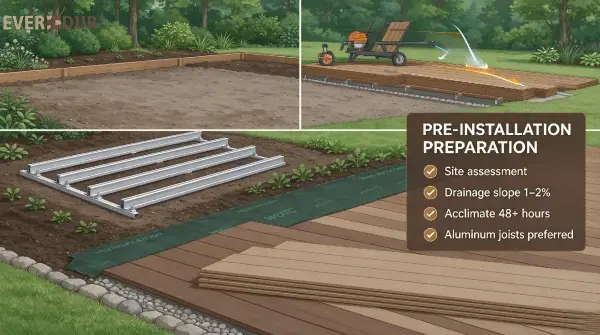
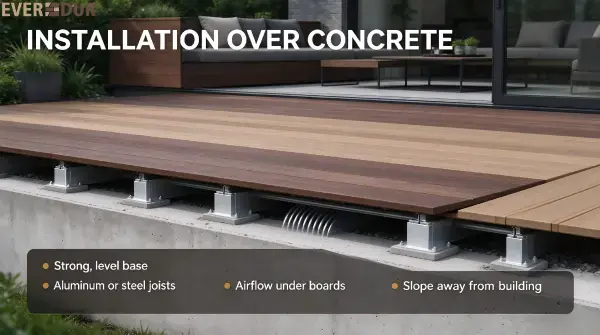
First, look at the surface of the ground or building where the deck will go. When it comes to outdoor composite decks, it works best when water flows away from the boards instead of collecting under them. Installation engineers usually say that the slope should be at least 1% to 2% away from any nearby building walls. On concrete or brick bases, look for cracks or odd spots on the surface that could make the joists less stable. In ground-level installs, a weed barrier material is put under the subframe to stop organic growth that can weaken frames over time.
Acclimation of boards before installation
When composite boards are made by extrusion molding, they still have some internal stress that goes away when they are exposed to room temperature. Before you put the boards, you should leave them out on a flat surface at the installation spot for at least 48 hours. This is especially important in places where seasonal temperature changes a lot, like northern Europe and North America. Boards that come from a temperature-controlled warehouse need time to adjust to the new temperature.
Subframe material selection
Aluminum joists are the preferred subframe material for outdoor composite decking installations because they resist corrosion and maintain dimensional accuracy over time. Galvanized steel joists are a functional alternative where budget is a consideration. Pressure-treated timber joists can be used, though they require monitoring for moisture absorption over time. The joist system must be level across its entire span before any decking boards are placed, as any variation greater than 3 mm per 2-meter run will create visible surface irregularities once the deck is complete.
Tool and material checklist
Gather the following before installation begins: composite-specific hidden clips, stainless steel or coated screws, a rubber mallet, circular saw with a fine-tooth blade, tape measure, chalk line, drill with torque control, and safety equipment including eye protection and gloves. Having everything on-site before starting prevents workflow interruptions that can lead to measurement errors.SEND INQUIRY
Solid WPC Decking Joist Spacing and Support Requirements for Durable Installation
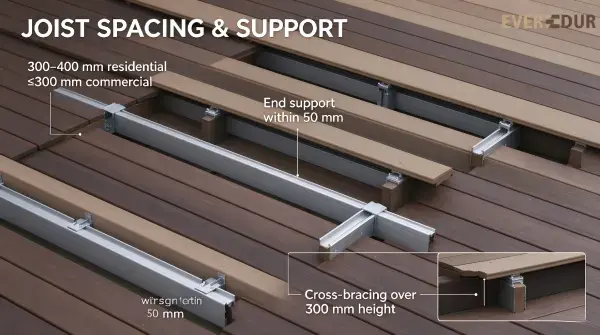
The spacing between joists directly governs how much load a deck can bear without deflection. For solid outdoor WPC boards with a thickness of 20–25 mm, joist spacing of 300–400 mm center-to-center is standard for residential use. In commercial or high-traffic environments — such as resort walkways, hotel terraces, or public plazas — reducing spacing to 300 mm or less adds a meaningful safety margin under dynamic load conditions.
At the edges of the deck and where two boards meet, joists should be doubled up or placed within 50 mm of each end to provide strong support. One of the main reasons why board ends crack after several freeze-thaw cycles is end joints that aren't supported.
To make up for the longer length of the board that isn't supported between bearing points, diagonal installations, which look good on large decks, need closer joist spacing, usually 250–300 mm.
If the deck is more than 300 mm above the ground, cross-bracing should be added between the frames. It stops the subframe from moving side to side when the wind blows and keeps its shape even when the amount of moisture in the air changes with the seasons.
How to Fasten Solid WPC Decking With Joists and Clips for Maximum Strength?
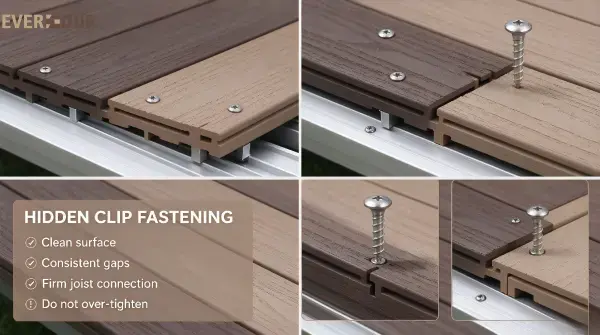
Hidden clip fastening is the usual way to install solid WPC flooring because it leaves a clean surface with no obvious screws or bolts while still keeping the structural link between the board and the frame.
First, put the starter board up against a set edge, like a wall, a fascia board, or a chalk line. Place the first row of T- or I-shaped clips into the groove that runs along the edge of the board. Then, use stainless steel screws driven at a small downward angle to attach each clip to the joist below. Because of this angle, the board stays tightly against the joist surface while the screw is seated, so it doesn't move or rattle.
As you go along each row, snap the groove of the next board onto the tab that sticks out of the clips that are already in place. The clip system keeps the gap between boards consistent, which takes care of both drainage and small changes in temperature at the same time.
For face-fixing, which is sometimes needed around edges or for stair nosings, use countersunk holes that have already been drilled to keep the surface from cracking. Don't overtighten screws; doing so can cause the surface to compress around the fixing point. Instead, drive screws to a consistent depth.
Solid WPC Decking Expansion Gaps for Dimensional Stability in Outdoor Conditions
Any material that is subject to changes in temperature outside will naturally expand and shrink. Even though well-designed composite boards make this movement less likely, gaps must still be made to allow for it without the board buckleing.
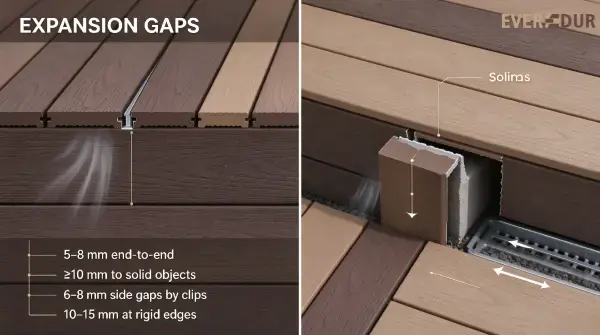
A gap of 5–8 mm along the length of the board (from end to end) is fine for normal installations in temperate climates in North America and Europe. If you live somewhere where summer temps always go above 35°C, you should put the gap toward the upper end of this range. Leave at least 10 mm of space between the end of a board and any solid object, like a wall, a post, or a skirting board.
The hidden clip system usually leaves a 6–8 mm gap on the sides between board widths, which is enough for air flow and drainage. Do not close this gap by squeezing the boards together tightly, even if they feel stable in their dimensions when they are being installed.
At the deck's edge, a full expansion allowance of 10–15 mm against rigid boundary elements lets the whole deck field move freely as a single unit, rather than creating pressure points that put stress on individual boards or fixings.SEND INQUIRY

How to Maintain Solid WPC Decking for 10–25 Years of Outdoor Durability?
Maintenance requirements for solid WPC flooring are genuinely low compared to natural timber, but periodic attention extends service life and preserves surface appearance across the full rated lifespan.
Two to four times a year, use warm water and a light soap on a soft-bristle brush to clean the deck's surface. To get rid of dirt and other organic matter from the surface, work along the grain of the board. Use clean water to rinse well. If you wash something with high pressure up close, the surface roughness of brushed or stamped finishes can wear away over time.
In the fall, get rid of the leaves and other biological waste right away. Decomposing organic matter keeps water against the surface of the board. This wetness can't rot a composite board, but it can help mold or algae grow, which stains the surface and needs more work to get rid of.
Every year, check the subframe and the fastening system. Make sure that the clips are still in place and that none of the joist bolts have come loose because of the changing of the seasons. On elevated decks, check the understructure for any trash that could get in the way of drainage.
In the first few months after installation, UV light causes the color to slowly fade. This is a normal effect of outdoor composite materials. After 8–12 weeks of being outside, the color of the boards stays the same. Quality composite boards contain UV protectors that greatly slow down color change after the initial time. This means that the boards will keep their look over years of outdoor use.
Conclusion
Installing composite solid WPC decking correctly is a straightforward process when each stage is approached methodically. A level, well-drained subframe, appropriate joist spacing, proper fastening technique, and correctly sized expansion gaps work together to let the material perform as intended over its full service life. Periodic light cleaning and an annual check of the substructure are the only ongoing requirements. With a dense, recycled-material core and a rated service life of 10–25 years, composite boards offer a practical, low-maintenance surface for a wide range of outdoor environments.SEND INQUIRY
FAQ
Q: Can solid WPC decking be installed over an existing concrete slab?
A: Yes. A concrete slab makes a strong, level base for putting in a composite deck. For air flow and draining under the boards, aluminum or steel joists are attached or pedestaled above the slab surface. Before putting down the joist framework, make sure that the block surface dips slightly away from the buildings next to it.
Q: What is the recommended gap between boards for outdoor use in cold climates?
A: In climates where winter temperatures drop significantly below freezing, an end-to-end expansion gap of 8 mm is advisable. Side gaps set by the hidden clip system — typically 6–8 mm — remain appropriate. These allowances accommodate the contraction that occurs at low temperatures without creating excessive gaps in warmer months.
Q: How do I cut composite decking boards on site without damaging the surface?
A: Use a circular saw fitted with a fine-tooth carbide blade, cutting face-down to reduce surface chipping. Mark cut lines clearly with a pencil or chalk line before cutting. After cutting, lightly sand any rough edges with medium-grit sandpaper to remove burrs. Cut ends exposed at the deck perimeter should be capped or positioned against a fascia board to maintain a finished appearance.
Get in Touch with Everdur — Solid WPC Decking Manufacturer for Your Project
For Construction Firms and Contractors: Everdur provides technical installation documentation, project-specific load calculations, and sample boards for pre-approval. Our production capacity across 50+ extrusion lines supports consistent supply for large-scale projects without lead-time uncertainty.
For Building Materials Wholesalers and Resellers: Exclusive wholesale pricing structures, OEM/ODM customization, and consolidated shipping from FOB Shanghai or Ningbo make Everdur a straightforward sourcing partner. Free samples are available for new wholesale accounts.
For End Customers and Landscape Designers: Free design guidance and profile recommendations tailored to your specific outdoor environment — poolside, rooftop, or garden — are available on request.

Everdur's composite decking complies with EU CE certification, US ASTM D7039 performance standards, and China GB/T 24137 quality specifications. Our products carry FSC, ROHS, REACH, and Recycled Content certifications, meeting E0 environmental standards for low-emission outdoor materials. As a committed solid WPC decking manufacturer, Everdur supplies customers across 60+ countries and holds long-term supply relationships with internationally recognized building materials retailers.
Send your project details or request a sample today. Our team responds promptly to all inquiries.
📧 Contact us: violet@wpcsupplier.com
References
1. Brydson, J. A. Plastics Materials, 7th ed. Butterworth-Heinemann, 1999. Relevant chapters on polyethylene properties and weathering behavior.
2. American Society for Testing and Materials. ASTM D7031: Standard Guide for Evaluating Mechanical and Physical Properties of Wood-Plastic Composite Products. ASTM International, West Conshohocken, PA.
3. European Committee for Standardization. EN 15534: Composites Made from Cellulose-Based Materials and Thermoplastics (Usually Called Wood-Polymer Composites or Natural Fibre Composites). CEN, Brussels.
4. Forest Stewardship Council. FSC Principles and Criteria for Forest Stewardship. FSC International, Bonn, Germany.
5. Clemons, C. M. "Wood-Plastic Composites in the United States: The Interfacing of Two Industries." Forest Products Journal, vol. 52, no. 6, 2002, pp. 10–18.
6. Klyosov, A. A. Wood-Plastic Composites. John Wiley & Sons, Hoboken, NJ, 2007.
Send Inquiry
Related Industry Knowledge
- WPC Landscape Walls Installation: Guide for Garden & Park Projects
- 3D Composite Decking: Elevate Your Outdoor Space with Textured Flooring
- Traditional Cladding for Residential Buildings: Classic & Reliable
- WPC Composite Fencing Installation: Easy Guide for Beginners
- Composite Screen Fencing for Patios & Gardens: Privacy & Aesthetics
- Top Composite Screen Fencing Manufacturers in 2026
- WPC Cladding vs Vinyl Cladding: Which Is Better for Outdoor Use?
- Waterproof WPC Cladding: Perfect for Coastal and Rainy Areas
- Privacy WPC Fence: Perfect for Residential and Villa Outdoor Spaces
- Why Co-extruded WPC Decking Is a Must for Your Outdoor Project