
Waterproof WPC Decking vs Tile: Which Is Better for Wet Spaces?
2026-11-05 17:20:44
When considering wet outdoor flooring choices, whether around a pool or on a balcony, a terrace by the sea or a rooftop application, two materials commonly fight for the limelight: waterproof WPC decking and ceramic or porcelain tile. Each is good at different things but their performance levels vary quite a bit when you account in moisture, foot traffic and long-term durability.
For decades, tile has been a popular choice for outdoor flooring, and for good reason: it's strong, inexpensive and easy to get. But it does have some severe issues in places that are consistently moist. Grout lines absorb moisture, surfaces can become dangerously slick, and thermal expansion causes cracking over time.
Waterproof WPC decking, however, is designed to address moisture at the material level. Made from a composite of wood fiber and recycled HDPE, it's water resistant, dimensionally stable from season to season, and has a naturally textured surface that feels good underfoot – even when wet.
In this post we do an in-depth analysis of the two materials based on moisture performance, slip resistance, maintenance requirements and lifespan. Whether yo're a contractor picking materials for a commercial work, or a homeowner thinking about an outdoor remodel, being aware of these differences can help you make a more informed selection.SEND INQUIRY

Why Choose Waterproof WPC Decking for Wet Outdoor Areas?
The flooring materials are under great stress from outdoor regions that are regularly exposed to water. Not regular instances, but constant realities a flooring material must undergo without deterioration: rain pooling, humidity swings, irrigation runoff, and splashes by the pool.
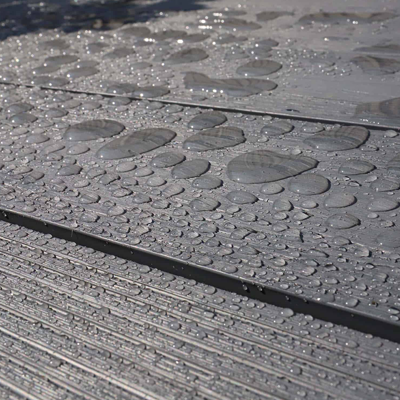
This is where the base material makeup of water resistant WPC decking comes into play. At the molecular levels, the hybrid structure of wood powder and grade A recycled HDPE is hydrophobic. That means that WPC composite boards do not absorb any substantial amount of water, unlike typical lumber that absorbs moisture into their cellular structure and begins to bloat, distort or rot. This is not a surface coating that will wipe off. It is a property of the material.
Co-extrusion technology takes it a step further. In production, a protective outer layer is bonded directly to the board, providing an extra barrier to moisture intrusion, UV deterioration and surface discoloration. The result is a product that retains its dimensional stability even after extended contact with standing water or high humidity.
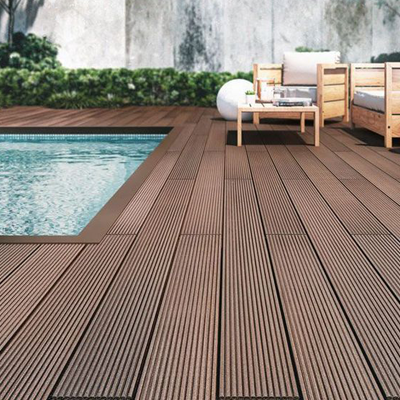
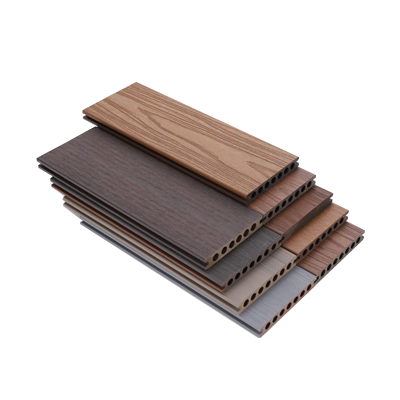
Hollow-core WPC boards feature drainage channels integrated into the boards. They are structurally engineered to drain water away from the surface quickly, avoiding the chance of pooling and slippage. This design is especially effective on pool decks because water is constantly reintroducing itself to the surface.
Glazed tile is non-porous, but it relies on the grout lines to hold the individual tiles together—and those grout lines are porous. Moisture that enters the grout causes mold, efflorescence, and eventual deterioration of the structure. In the freeze-thaw environment typical of Northern Europe, this cycle of expansion and contraction can crack tiles in a matter of seasons.
Specifically, WPC composite decking offers structural advantages in outdoor wet regions that cannot be obtained by treating tile surfaces alone.SEND INQUIRY

Waterproof WPC Decking vs Tile: Moisture and Drainage Performance
The most difficult thing with a typical outdoor flooring is moisture management. Both WPC decking and tile say they are waterproof, but the ways they do it - and the constraints - are very different.
Glazed porcelain tile is theoretically impervious to water with a water absorption rate of less than 0.5%. But that value pertains just to the tile body. The mortar bed underneath, the grout between the tiles, and any irregularities in the substrate all provide conduits for water to follow. If installed incorrectly on sloped terraces or balconies, waterproof composite plank can help avoid water pooling under the tiles, causing the substrate to deteriorate faster and resulting to costly cleanup.
WPC composite decking has varied moisture handling. The board structure, hollow or solid, is independent of grout, glue or mortar. The boards are spaced apart, and the hollow-core design channels water down into tunnels inside. No adhesive layer to fail, no grout to crack, no substrate trapping moisture against the framing underneath.
In coastal areas, the high salty air hastens the corrosion of metal parts and the breakdown of organic materials, which is where the HDPE presence in WPC decking offers a real advantage. Salt does not chemically react with HDPE as it does with iron hardware or natural wood.
Another moisture-related risk is thermal expansion. Both materials expand and contract with temperature changes, but the results are different. If there are not enough expansion joints during installation, the tile will expand and produce lippage, cracking, or bond failure. WPC boards expand linearly along their length and this expansion can be accommodated with no structural consequences if the right end gaps are used at the time of installation.
WPC decking is more predictable and forgiving than tile installations in locations with extreme seasonal temperature swings common to much of North America and continental Europe.SEND INQUIRY

Slip Resistance of Waterproof WPC Decking in Poolside Areas
Slip resistance is not a luxury, it is a safety essential, particularly around swimming pools and water features, where bare wet feet are the norm.
Smooth glazed tiles seem good, but are very slippery when wet. Many outdoor tile works also need anti-slip strips or coatings to meet safety standards – and such additions require their own upkeep and eventual repair.
WPC decking boards include surface textures including brushed, embossed, wood grain or sanded finishes that provide natural grip without any extra treatments. The micro-texture of these surfaces gives you friction underfoot, even when wet. This is especially true with poolside installations where the surface may be wet for lengthy portions of the day.
The performance of non-slip surfaces should be measured against measurable standards. Look for products tested to EN 13893 (wet slip resistance) or equivalent ASTM requirements. The reputable producers do not use any marketing hype, they supply you with test documentation.
For the decking surface of commercial swimming pools, sports facilities and public terraces that are heavily used, a safety standard is a project need, not an afterthought. Architects and project managers can specify co-extruded WPC boards with an embossed or brushed surface for aquatic circumstances knowing that they would perform well in wet slip resistance testing on an ongoing basis and produce good results.SEND INQUIRY

Maintenance Differences Between Waterproof WPC Decking and Tile
Homeowners and company operators have different expectations of upkeep, but the fundamental question is the same, how much ongoing effort does this material demand?
Tile care is often disregarded in terms of point of sale. The tile itself is easy to wash clean but in outdoor circumstances grout lines tend to collect dirt, algae and other things. In a humid outdoor environment, cleaning grout can include chemical treatment, washing or regrouting periodically, all adding cost and work. Replacement tiles should match in color and texture, which is difficult to perform years after the original installation.
Composite WPC decking maintenance is not very difficult. Routine cleaning with water and a mild detergent can eliminate surface grime. The co-extruded outer shell is resistant to discoloring tannins, oils and other outdoor contaminants. No grout lines for algae to build on, no surface treatments to reapply every year.
That said, water-resistant decking panel is not maintenance free 100%. Boards placed in damp, shady locations may develop surface algae over time and periodic washing will prevent build-up. Fastener hardware exposed to marine or coastal environments should be inspected annually. These are things you can do, not intensive treatments.
Tile maintenance over 10 years (grout treatment, possibly resealing and periodic tile replacement) can be equal or higher than total WPC deck board replacement cost. This cost difference is important to the investment decision for commercial operators with big area installations.SEND INQUIRY

Which Flooring Lasts Longer in Wet Outdoor Environments?
The outdoor wet environment service life is based on the material deterioration, quality of installation and unique site conditions.
Properly placed and maintained in outdoor locations, porcelain tile can endure 20 years or longer. The body of the tile itself is quite robust. The limitation is generally connected to the installation system -- the adhesive, the grout and the substrate. Poor design or installation of drainage can greatly reduce effective service life, and tile failures within five to ten years are not unusual in freeze-thaw regions.
WPC decking is covered by manufacturer warranties that range from 5 years for conventional hollow boards to 20 years for co-extruded solid boards. These guarantees are based on reasonable performance expectations under normal outdoor settings. The HDPE portion of WPC boards does not biodegrade, does not corrode and does not support insect infestation – three failure modes that remove natural wood from long-life outdoor applications.
Co-extrusion method is a differentiator relevant to durability. The wood fiber core is protected from UV exposure and moisture cycling, the two forces that most degrade composite boards over time, by the fused outer shell. More than 2,000 hours of UV exposure testing ensures color stability, which means little to no fading even years in direct sunshine.
Except for moist outdoor situations, a properly specified co-extruded WPC decking installation will deliver comparable or better service life than tile, with fewer variables related to installation quality.SEND INQUIRY

Conclusion
There's no definitive winner between waterproof WPC decking and tile, they both have their place. Tile is good where there is drainage and maintenance resources, and it's covered or sheltered. In open wet situations such as pool decks, seaside balconies, rooftop terraces and garden walkways, composite WPC decking is better in terms of moisture management, slip resistance, maintenance burden and service life.
In the end, the selection is based on the particulars of your project conditions, your maintenance expectations and your long-term cost horizon. Coextruded WPC boards have structural and performance benefits that make them a feasible and reliable specification for most wet outdoor applications.SEND INQUIRY

FAQ
Q: Does waterproof WPC decking require sealing or waterproofing treatment before installation?
A: No. Unlike natural timber, waterproof WPC decking does not require sealing, staining, or waterproofing prior to installation or during its service life. The waterproof properties are inherent to the material composition and, in co-extruded boards, reinforced by the fused outer shell. Routine cleaning is sufficient for ongoing maintenance.
Q: Can WPC decking boards be installed over an existing tile surface?
A: In some cases, yes — provided the existing tile surface is structurally sound, level, and capable of supporting a joist and clip installation system. However, drainage performance and long-term stability are best achieved when WPC decking is installed on a purpose-built subframe. A structural assessment of the existing surface is advisable before proceeding with overlay installation.
Q: How does WPC decking perform in freeze-thaw climates common in Northern Europe and Canada?
A: WPC composite boards have demonstrated dimensional stability across significant temperature ranges. The HDPE component does not absorb water, which eliminates the freeze-thaw expansion cycle that damages tile grout and natural wood. Boards should be installed with appropriate end-gap allowances to accommodate linear thermal movement, particularly in climates with large seasonal temperature differentials.

Ready to Specify Waterproof WPC Decking for Your Project?
For Construction companies and Architects: Support your project design with complete technical documentation, climate-adapted material formulations and custom specifications from Everdur. Our products are certified for EU CE, US ASTM D7039 and China GB/T 24137 standards and we have environmental certificates for FSC, REACH, RoHS and Recycled Content (E0 standard). We can deliver predictable lead times for large volume production programs.
For Fence Contractors and Installers: Get product samples, installation instructions and technical help direct from our team. We make installation and specifications simple.
For Building Materials Wholesalers and Resellers: Everdur offers competitive wholesale pricing structures, constant product availability across 50+ production lines and co-branding possibilities for OEM and ODM applications. Try a free sample batch and see the quality of the product yourself.
For End Customers: Enjoy a free design consultation and installation tips specific to your outdoor environment. Whether you want to build a swimming deck, update a balcony or build a garden terrace, our specialists can assist you select the correct product specification.
Reach out to the team at Everdur directly to discuss your project requirements at violet@wpcsupplier.com As a professional producer of waterproof WPC decking, with 16 years of experience in production and more than 225 clients in over 60 countries, we offer practical experience for each question.SEND INQUIRY

References
1. European Committee for Standardization. EN 15534: Composites Made from Cellulose-Based Materials and Thermoplastics (Wood-Polymer Composites). CEN, Brussels.
2. ASTM International. ASTM D7032: Standard Specification for Establishing Performance Ratings for Wood-Plastic Composite Deck Boards and Guardrail Systems. ASTM International, West Conshohocken, PA.
3. Forest Stewardship Council. FSC Certification Standards for Recycled and Reclaimed Materials. FSC International, Bonn, Germany.
4. European Chemicals Agency. REACH Regulation (EC) No 1907/2006: Registration, Evaluation, Authorisation and Restriction of Chemicals. ECHA, Helsinki.
5. Rowell, Roger M. Handbook of Wood Chemistry and Wood Composites, 2nd ed. CRC Press, Boca Raton, FL.
6. Winandy, Jerrold E., and Roger M. Rowell. "Chemistry of Wood Strength." Wood and Cellulosic Chemistry, Marcel Dekker, New York.
Send Inquiry
Related Industry Knowledge
- Anti-Slip Landscape WPC Decking: Safe for Public Landscape Areas
- Does 3D composite decking fade?
- Upgrade Your Outdoor Spaces with WPC Railings
- Brushed WPC Decking: Premium Textured Flooring for Luxury Outdoor Spaces
- Grooved WPC Decking: Anti-Slip Flooring for Poolside & Walkways
- Exterior WPC Cladding for Commercial Buildings: Bulk Discounts Available
- Anti-Slip Residential WPC Decking: Safe for Kids & Pets at Home
- 3D Composite Decking vs Regular Composite: Which Is More Stylish?
- WPC Villa Fence with Wood Grain: Enhance Your Villa’s Aesthetics
- WPC Villa Fence Installation: Guide for Luxury Villa Projects