_1777451497595.webp)
Brushed WPC Decking: Premium Textured Flooring for Luxury Outdoor Spaces
2026-10-10 12:58:55
When homeowners and project designers seek outdoor flooring that balances aesthetics with long-term practicality, brushed WPC decking consistently emerges as a compelling choice. These textured decking boards are different from smooth-faced composite boards or raw timber planks because they have the feel and warmth of natural wood grain while also having the strength of composite engineering. When the board is made, the brushing process is applied directly to the surface. This makes fine linear striations that spread light slowly and feel really natural when you walk on them. This is very important for balconies with views of Alpine scenery, swimming decks in coastal areas, and yard patios that get a lot of rain during the summer. Outdoor flooring needs to be able to handle changes in temperature, wetness levels, and foot traffic without needing constant maintenance from the owner. These needs are met by Everdur's brushed composite decking, which was created over 16 years of production experience and is sold in more than 60 countries. No matter if you are looking for something for a private villa garden or a commercial hospitality project, knowing how this surface treatment works (both technically and esthetically) will help you make a smart purchase.SEND INQUIRY
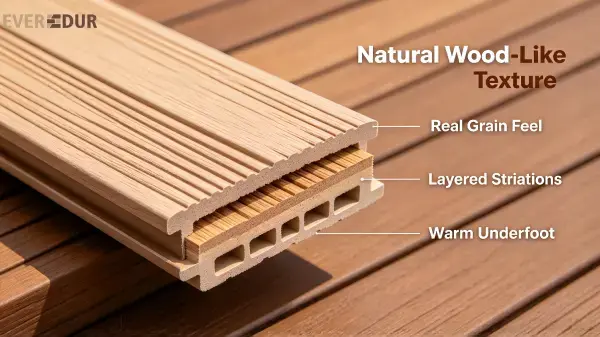
How Does Brushed WPC Decking Create a Natural Wood-Like Texture?
The grain, which are the parallel fibers that form as a tree grows through the different seasons, has always been what makes a piece of wood look unique. It takes more than surface painting to get that grade in a composite board. When brushed outdoor WPC boards are made, mechanical rubbing is applied lengthwise along the extrusion shape. This lifts and separates the top fibers softly, revealing a layered, striated surface. The end result looks natural instead of man-made, especially in natural light where the micro-ridges cast thin shadows that make the texture look deeper.
The real feel is what sets this apart from surfaces that are stamped or painted with wood grain. Under heat and pressure, embossing pushes a design into the board, making a repeated pattern that can look artificial up close. While brushing, on the other hand, works with the material's natural composite grain. This means that there are small differences in the structure of each log, which is exactly what makes natural lumber attractive.
What the board is made of at its heart supports this outward nature. The boards made by Everdur are made of natural wood powder, Grade A reclaimed HDPE, and carefully chosen chemical additives. The wood fiber content adds real cellulose structure to the surface, which reacts to brushing in a way that is similar to how raw wood would. The HDPE matrix holds those fibers together and keeps them stable, making the structure strong instead of flimsy. This surface doesn't peel, crack, or get splinters over time; it just ages evenly, keeping its rough look from season to season.
This is more important than just looking good for builders and garden planners who are looking for materials for high-end outdoor projects. A surface that looks natural but doesn't need as much care as natural wood solves a long-standing problem in outdoor design: people want natural warmth while also expecting performance that doesn't need much work.
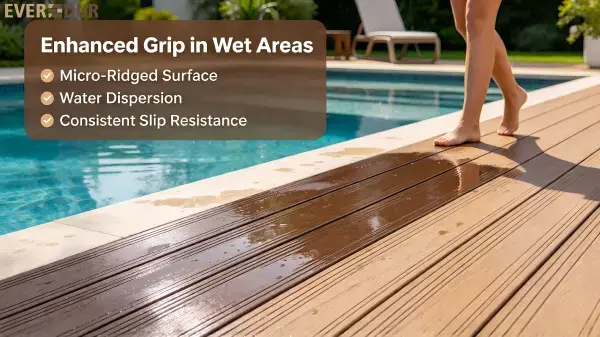
Brushed WPC Decking for Enhanced Grip in Wet Outdoor Areas
Slip resistance is not a secondary consideration in outdoor flooring — it is a functional requirement, particularly in climates where rainfall is frequent or where poolside and coastal installations create consistently wet underfoot conditions. Smooth composite boards, while durable, can develop a degree of slipperiness when surface water accumulates. The micro-ridged profile of brushed texture WPC boards addresses this directly.
The fine striations created during the brushing process interrupt the continuous smooth plane of the board's surface. Water film — the thin layer responsible for most slip incidents — disperses through these micro-channels rather than sitting as a uniform sheet. The effect is a measurable increase in grip coefficient under wet conditions, without any surface coating that might wear away over time. Because the texture is integral to the board profile rather than applied as a secondary treatment, the slip-resistance properties remain consistent throughout the product's service life.
This characteristic makes brushed composite decking particularly well-suited to pool surrounds, waterfront terraces, shower areas adjacent to outdoor spas, and any garden path subject to heavy morning dew or shade-related moisture retention. Children running barefoot around a family pool, elderly users navigating a garden path after rain, or restaurant guests crossing a terrace during light drizzle — all benefit from a surface that prioritises safety without sacrificing visual quality.
Everdur's brushed boards meet slip-resistance benchmarks aligned with international safety standards, and the surface performs consistently across the full range of available widths — from 135 mm profiles suited to residential balconies through to 150 mm planks preferred for broader commercial decking areas.SEND INQUIRY
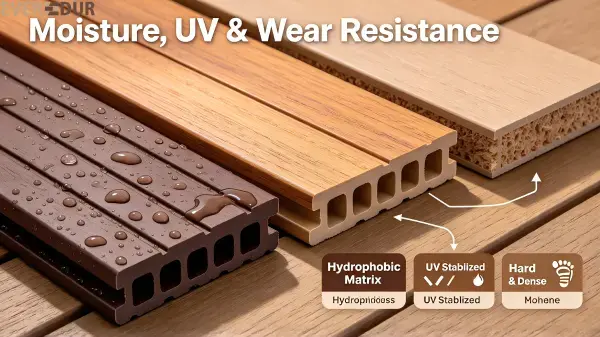
What Makes Brushed WPC Decking Resistant to Moisture, UV, and Wear?
The Role of HDPE in Moisture Resistance
High-density polyethylene is the continuous matrix phase in composite floor boards. The product's ability to resist water is based on its hydrophobic chemical structure. HDPE does not absorb liquid like natural wood does. Natural wood absorbs water through its cell structure, which causes it to swell, twist, and become subject to fungus rot. The wood fiber part of the composite is completely encased in this polymer matrix. This stops water from getting in, which is what breaks down solid wood decking. Everdur's second-generation co-extrusion technology adds an extra layer of shell during the extrusion process. This makes the board's cross-section even less likely for water to get through. This is especially important in places where it rains for a long time or where people will be directly touching the ground, like around pools and on walks in marinas.
UV Stabilisation and Long-Term Color Retention
Over time, ultraviolet radiation breaks down polymer chains, which is what causes the color changes and surface chalking that are common in composites with lower specifications. The recipe for Everdur's mixture includes UV stabilizers in the board itself, not just on the surface. This means that safety is spread throughout the whole material. The boards' color stays the same even after being exposed to UV light for more than 2,000 hours without losing much of its brightness. This is especially important in North America and Europe, where the summer sun is very strong and customers expect their outdoor flooring to look good for at least ten years.
Wear Resistance Across High-Traffic Applications
The mechanical durability of composite decking derives from the density and consistency of the extruded profile. Everdur's production process, operating across more than 50 production lines with rigorous 5S quality management, delivers boards with consistent dimensional tolerances and surface hardness. The brushed surface, while textured, does not sacrifice hardness — the micro-ridges are part of the board's outer layer, not a soft foam or fibrous coating. Under commercial foot traffic conditions, in hotel courtyards, restaurant terraces, or public promenades, the surface maintains its texture profile and structural integrity across a service life rated between 10 and 25 years.
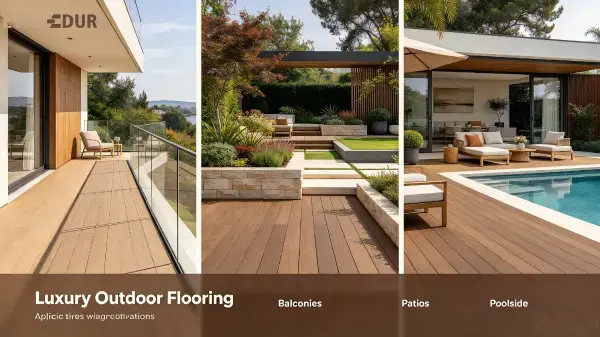
Luxury Outdoor Flooring with Brushed WPC Decking: Balconies, Patios, and Poolside Areas
Balcony and Terrace Applications
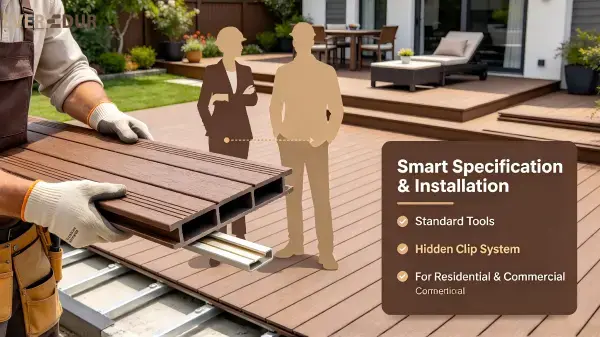
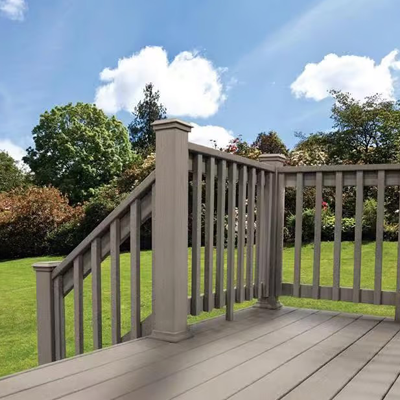
Balconies present a concentrated set of challenges for outdoor flooring: limited drainage gradients, direct sun exposure, periodic heavy rain, and the expectation of a refined finish visible from interior living spaces. Brushed composite decking handles each of these conditions with practical competence. The textured surface channels water effectively, the UV-stable composition resists solar bleaching, and the refined grain aesthetic complements contemporary balcony furniture and architectural finishes. Available widths between 135 mm and 150 mm accommodate standard joist spacing, and hidden clip installation systems produce a clean surface free of visible fasteners.
Patio and Garden Decking
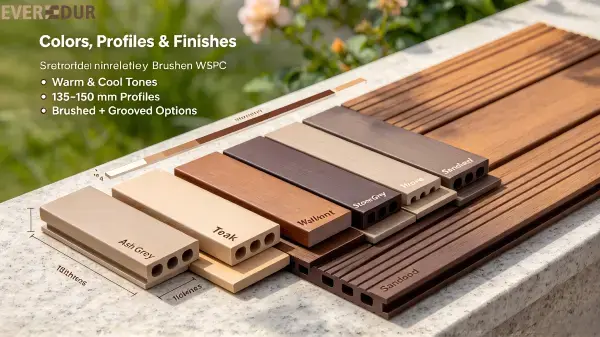
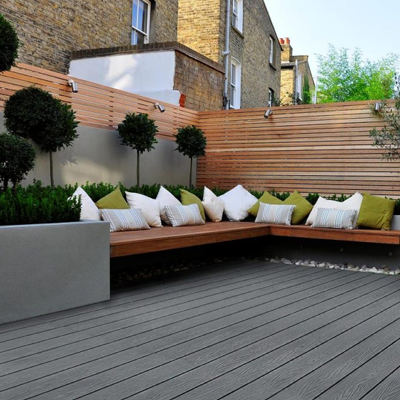
Garden patios are perhaps the most versatile application space for brushed composite planks. The organic surface texture integrates naturally with planted borders, stone retaining walls, and timber pergolas — materials that characterise premium residential garden design in European markets. The color range available from Everdur, including options such as Ash Grey, Teak, Walnut, Stone Grey, and Sandal Wood, provides sufficient variety to coordinate with different architectural palettes without requiring custom specification in most cases. For projects where a specific tone or grain character is required, custom color matching is available beyond the standard range.
Poolside and Wet-Area Installations
Poolside decking operates in a chemically and mechanically demanding environment. Chlorinated splash water, prolonged UV exposure, bare foot traffic, and the visual prominence of the pool terrace combine to set a high performance bar. Brushed composite boards meet this bar through their inherent slip resistance, moisture-stable composition, and color-stable formulation. The absence of splinters — a genuine safety advantage over timber in bare-foot zones — and the resistance to mold and mildew growth further support suitability for this application. Dimensional stability across thermal cycles ensures the deck surface remains level and gap-consistent through summer heat and winter cold.SEND INQUIRY
How to Choose Brushed WPC Decking Colors, Profiles, and Surface Finishes?
Selecting Colors That Complement Outdoor Environments
Color selection for outdoor decking functions differently from interior flooring choices. Outdoor materials are viewed against natural backgrounds — sky, planting, stone, water — and under variable natural light rather than controlled artificial illumination. Warmer tones such as Teak, Cedar, and Copper Brown read well against lush garden planting and complement warm-toned masonry. Cooler tones — Ash Grey, Dark Grey, Stone Grey — align with contemporary architectural language and tend to read crisply against rendered facades, glass balustrades, and stainless hardware. Everdur's standard color palette covers both registers, and color samples are available to assess actual material appearance on-site before specification is confirmed.
Profile Dimensions and Structural Considerations
Plank width and thickness selection should reflect both the aesthetic intent and the structural requirements of the installation. Wider boards — at 145 mm or 150 mm — create a more expansive, horizontal visual flow suited to generous terraces and commercial decking. Narrower profiles at 135 mm or 138 mm work well in tighter spaces or where a more traditional timber-deck proportion is desired. Thickness selection — ranging from 20 mm to 25 mm — relates directly to joist span: thicker boards support longer spans between joists, which can reduce substructure cost on elevated decks. Everdur offers profile customisation for projects where standard dimensions do not align with architectural requirements.
Surface Finish Combinations and Design Flexibility
The brushed surface is available in combination with other finish treatments, including grooved undersides for drainage and dual-design options that pair brushed upper faces with embossed lower faces for installation versatility. For projects requiring a uniform design language across multiple surface types — decking, cladding, screening — surface finish consistency across product lines supports a coherent outdoor palette. Everdur's ODM and OEM services accommodate project-specific surface specifications, allowing contractors and design professionals to achieve a bespoke result without the lead times and cost typically associated with fully custom manufacturing.
Conclusion
Brushed WPC decking occupies a well-defined position in the outdoor flooring market — it delivers the tactile warmth and visual depth of natural timber through a surface treatment that genuinely replicates wood-grain character, combined with the moisture resistance, UV stability, and low maintenance expectations of composite construction. For balconies, garden terraces, poolside areas, and commercial outdoor spaces in European and North American markets, it addresses the real performance requirements of outdoor use without the upkeep burden of traditional timber. Everdur's brushed composite range, supported by 16 years of manufacturing experience, multi-continent distribution, and a comprehensive certification portfolio, offers a dependable basis for both residential and commercial outdoor flooring projects.SEND INQUIRY
FAQ
1. Q: How long does brushed WPC decking typically last in outdoor conditions?
A: Service life varies with installation quality, climate exposure, and maintenance practice. Everdur's brushed composite boards are rated for 10 to 25 years of outdoor service under normal conditions. The co-extrusion construction and UV-stable formulation support the upper end of this range in well-installed applications.
2. Q: Does the brushed surface texture wear down over time with heavy foot traffic?
A: The brushed texture is integral to the board's outer layer rather than a surface coating, so it does not wear away as a separate treatment might. Under normal residential and commercial traffic, the texture profile remains consistent throughout the product's service life. The composite material itself — dense extruded HDPE and wood fibre — is inherently resistant to surface abrasion.
3. Q: Can brushed composite decking boards be cut and installed using standard carpentry tools?
A: Yes. Composite decking boards can be cut with standard circular saws fitted with fine-tooth blades, and standard drill bits work for any pre-drilling required at board ends. Everdur's boards are installed using a joist-and-clip system that does not require surface fasteners, producing a clean finish. Detailed installation guidance is available from Everdur's technical team on request.
Connect with Everdur: Brushed WPC Decking Solutions for Your Next Project
Everdur supplies brushed WPC decking as a certified manufacturer with production capacity suited to projects of any scale — from single residential terraces to large commercial hospitality developments.
For construction firms and contractors: Technical specification support, large-volume pricing, and consistent lead times backed by 1,500-plus containers of annual production capacity.
For building materials wholesalers and resellers: Exclusive wholesale pricing structures, product samples, and ODM/OEM options for private-label requirements.
For end customers: Personalized design consultations, color sampling, and installation guidance to help you select the right profile, finish, and color for your specific outdoor space.
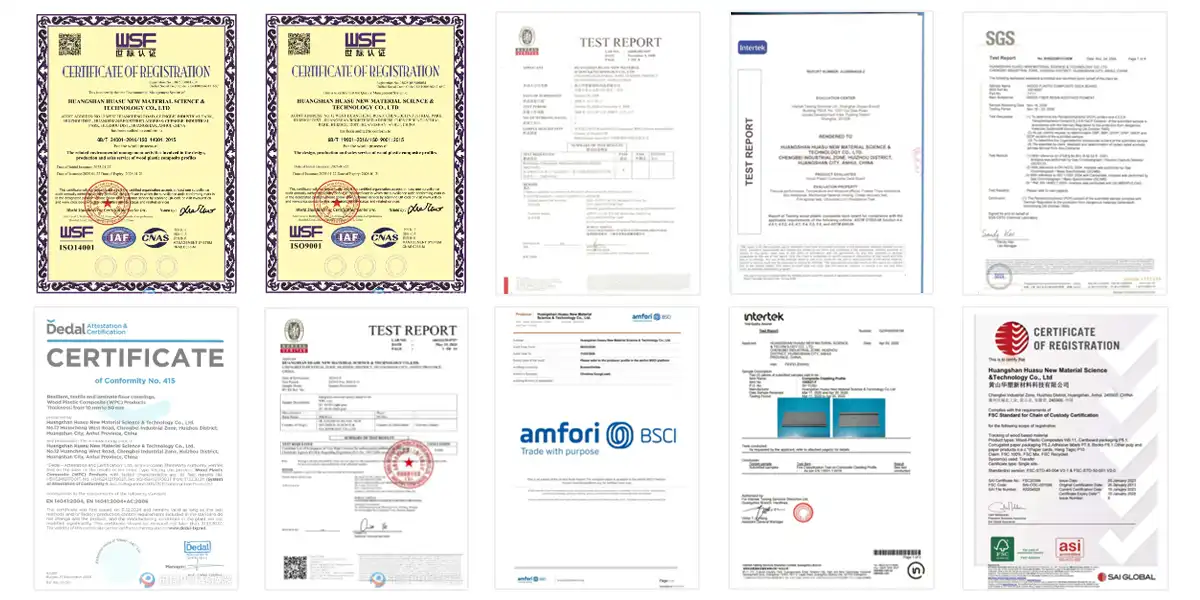
All Everdur products comply with international quality and environmental standards, including EU CE certification, US ASTM D7039, China GB/T 24137, FSC recycled content certification, and E0 environmental standard, giving you documented assurance of material safety and sustainability across every order.
Reach out to our team directly at violet@wpcsupplier.com to discuss your project requirements, request samples, or obtain a quotation.
References
1. Clemons, C. M. (2002). Wood-plastic composites in the United States: The interfacing of two industries. Forest Products Journal, 52(6), 10–18.
2. European Committee for Standardization. (2012). EN 15534: Composites made from cellulose-based materials and thermoplastics (usually called wood-polymer composites or natural fibre composites). CEN.
3. Klyosov, A. A. (2007). Wood-Plastic Composites. John Wiley & Sons.
4. American Society for Testing and Materials. (2018). ASTM D7032: Standard Specification for Establishing Performance Ratings for Wood-Plastic Composite Deck Boards and Guardrail Systems. ASTM International.
5. Stark, N. M., & Matuana, L. M. (2006). Influence of photostabilizers on wood flour–HDPE composites exposed to xenon-arc radiation with and without water spray. Polymer Degradation and Stability, 91(12), 3048–3056.
6. Forest Stewardship Council. (2023). FSC Chain of Custody Certification: Guidelines for Recycled Content Claims. FSC International.
7. Segerholm, B. K., Ibach, R. E., & Westin, M. (2012). Moisture sorption, biological durability, and mechanical performance of WPC containing modified wood and polylactic acid. BioResources, 7(4), 4575–4585.
Send Inquiry


Related Industry Knowledge
- Affordable WPC Decking Wholesale: Direct from Factory to Your Project
- 2026 Guide to Grooved WPC Decking: Sizes, Styles & Prices
- How to Install WPC Fence Easily: Step-by-Step Guide for Beginners
- Wood Grain Grooved WPC Decking: Stylish & Functional Outdoor Flooring
- WPC Villa Fence: Luxury Fencing for Villas & High-End Properties
- Wholesale Traditional Cladding: Bulk Supply for Traditional Buildings
- Top Traditional WPC Decking Manufacturers for Quality Products
- Low MOQ Traditional Cladding: Ideal for Small Traditional Projects
- Exterior WPC Cladding: Durable & Stylish External Wall Solution 2026
- How to Install WPC Decking Easily: A Step-by-Step Tutorial for Beginners