_1777451497595.webp)
2026 Guide to Grooved WPC Decking: Sizes, Styles & Prices
2026-10-10 12:58:57
Planning an outdoor deck project in 2026 means navigating a wider range of material choices than ever before. Grooved WPC decking sits at the intersection of practicality and visual appeal — it combines recycled wood fiber with high-density polyethylene (HDPE), then profiles the surface with parallel channels that improve drainage and grip underfoot. Whether you are specifying materials for a poolside terrace in Spain, a garden patio in Germany, or a commercial walkway in the United States, understanding how groove profiles, board dimensions, surface finishes, and pricing tiers connect will help you make a confident purchase. This guide covers everything buyers, contractors, and resellers need in 2026: the key technical differences between profile types, the size configurations most common in European and North American projects, the cost variables that actually move the needle, and a practical comparison framework so you can match the right board to the right application. Prices are influenced by co-extrusion technology, board density, and order volume — all of which are explained in plain terms below.SEND INQUIRY
What Should You Know About Grooved WPC Decking Before Buying?
Decking that is outside has to last in situations that would quickly break down materials that weren't made to be outside. A deck's surface is affected by rain, UV rays, freeze-thaw cycles, foot traffic, and biological pressure from mold and insects all at the same time. Regular chemical treatment, brushing, and re-coating—every two to three years in Northern European climates—doesn't help with any of these problems with traditional softwood boards.
Most of that upkeep isn't needed with wood-plastic hybrid boards. The core of the material is made up of wood powder, recycled HDPE polymer, and chemicals that make it more stable. Because of this, the board doesn't take much water—usually less than 1% by weight. This is why failure modes like bending, cupping, and rot aren't talked about much in WPC project reviews.
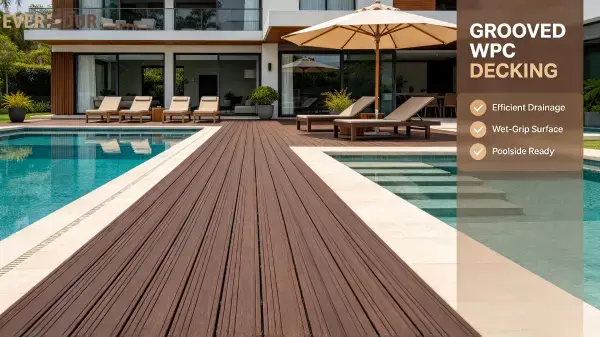
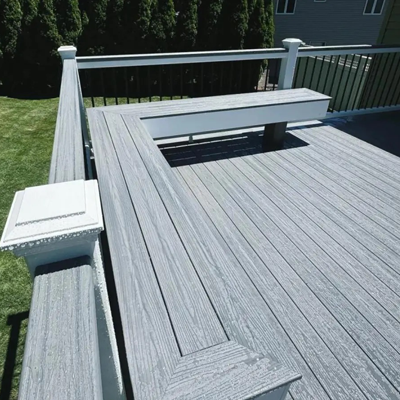
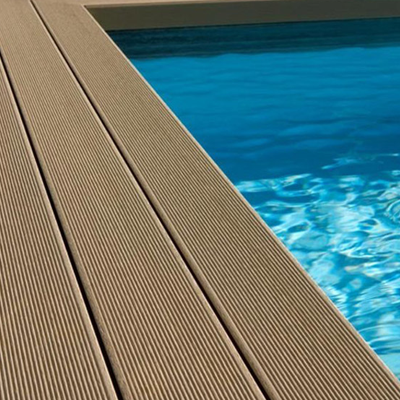
The groove pattern on the surface isn't just there for looks. These long lines do two things for the structure: they make a ribbed touch surface that makes things stick together more when they're wet, and they also drain water quickly off the deck face. Both features are most useful in places with a lot of water, like pools, boardwalks along the coast, and platforms by lakes. However, they are useful anywhere that it rains a lot.
Before you buy, make sure you understand three things from any supplier. Ask for proof that the surface won't slip (in Europe, a pendulum test number above 36 is usually thought to be safe for wet walking paths). Find out if the product has a co-extrusion cap layer or a single-layer extrusion cap layer. The cap layer greatly increases the durability of the color and the hardness of the surface. If the boards' widths change by more than ±0.5 mm, it can be hard to place them with hidden clip systems. Ask about the dimensional limits. By getting clear answers to those three questions, you can get rid of a lot of choices that aren't reliable before you even ask for a sample.
Grooved WPC Decking Sizes, Profiles, and Surface Configurations
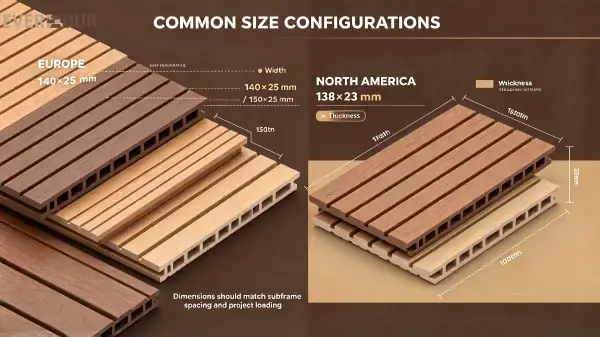
As the market has grown over the past ten years, board sizes in the WPC category have come together to form a useful range. Most of the time, widths are between 135 mm and 150 mm for standard home and light business uses. Thicknesses range from 20 mm to 25 mm, with 25 mm boards being best for tall buildings with joist spans over 400 mm. Standard lengths of 2,200 mm, 2,900 mm, and 3,600 mm match common European and North American framing modules. This means that on most projects, offcuts are not wasted.
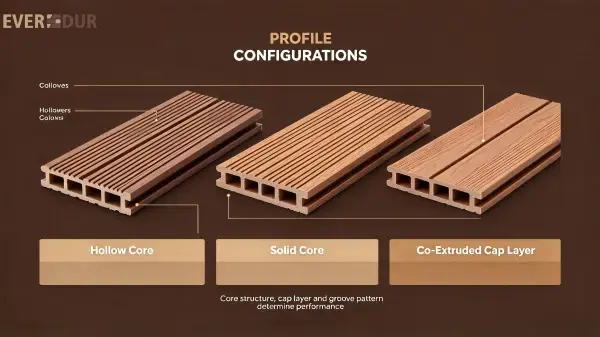
In that range of width and thickness, the cross-section shape changes more than buyers usually think. Hollow-core boards are lighter and cheaper per unit, but they can still handle most residential loads. Solid boards can hold more weight and are better for business patios that get a lot of foot traffic. Co-extruded boards have a hollow or solid core with a polymer cap layer that is usually 0.5 mm to 3 mm thick. This layer makes the board more resistant to UV light, stains, and scratches.
There are different ways to set up the surface, such as brushed finishes (which make the wood grain texture feel better through mechanical abrasion), sanding (which makes the surface feel smoother and more uniform), embossing (which presses a repeating pattern into the surface during extrusion), and deep wood grain (which looks more like the relief of natural wood). The grooved composite deck profile, which is made up of parallel lines going along the length of the board, can show up on either one or both faces. This means that the installation can be done in different ways for projects where the look needs to change over time.
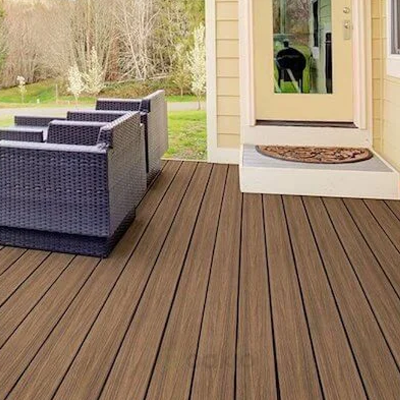
In Europe, 140x25 mm and 150x25 mm boards are common sizes for garden decking. In North America, however, contractors often ask for 138x23 mm profiles that fit with existing steel or aluminum subframe systems. You can choose from neutral grays to warm shades of cedar, teak, and walnut. For large architectural projects, you can even get colors that are perfectly matched.SEND INQUIRY
What Factors Affect Grooved WPC Decking Prices?
Raw Material Composition and Production Technology
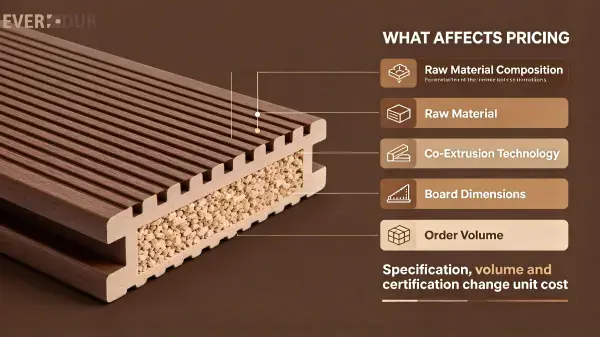
What goes into the extruder and how it is handled is the single most important factor that affects the cost of the board. Instead of using lower-quality fillers, boards that are made with more recycled HDPE and clean wood fiber cost more per kilogram of output but are better at resisting moisture and keeping their shape. The production process needs more tools, stricter process controls, and more expensive cap-layer compounds because co-extrusion adds a capping step. The price per square meter does include those real costs. There may be a price difference between a basic single-layer extruded board with a 140×25 mm profile and a co-extruded version of the same size. This is because the co-extrusion process and materials are fundamentally different. Before assuming that two prices are the same, buyers who are reviewing quotes need to make sure that they are using the same production method.
Board Dimensions and Profile Complexity
More raw materials are needed per square meter for boards that are wider and thicker. That relationship is easy to understand. How profile complexity affects tooling and throughput is not as clear. It's more difficult to make an exact die for a "grooved texture composite" shape with fine, closely spaced channels than for a simple flat-face board, and the slower extrusion speeds are caused by the tighter tolerances. Custom cross-section shapes, like non-standard widths, asymmetric groove patterns, or dual-face reversible configurations, have costs that are spread out over the order amount for the equipment. Buyers who buy in large quantities and stick to standard sizes can benefit from mature tools that don't cost extra to amortize.
Order Volume, Certification Requirements, and Logistics
The size of the order has a meaningful effect on the unit price. A minimum order number of 100 square meters has a different cost per unit than an annual supply deal for 500 containers. Certification packages also have costs. For example, to get goods tested and certified to CE, ASTM, FSC, REACH, and RoHS standards, they have to go through work in a third-party lab and be audited on a regular basis. Honest makers include these costs in their prices. People who need certified products for government projects or building projects that have to follow rules shouldn't just compare prices of certified products and non-certified alternatives. They should also think about this. The landed cost includes freight terms (FOB vs. CIF), the port of origin, and any customs duties that need to be paid at the destination.
Grooved WPC Decking for Different Outdoor Areas and Project Sizes
Residential Gardens, Patios, and Poolside Areas
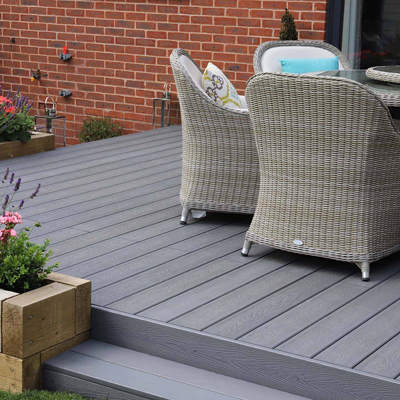
The average size of a project for homeowners and builders is between 20 and 150 square meters. In this price range, minimizing the cost is usually not as important as making something look good, keeping it safe from slips, and keeping it in good shape for a long time. The groove channel profile immediately gives the drainage and non-slip qualities that are needed by poolside applications. For most garden and patio styles in North and Europe, a 140x25 mm or 150x25 mm board with a brushed or wood grain finish will look good. When used on this scale, co-extruded boards are worth the extra cost because their longer color life—little to no fading after more than 2,000 hours of UV exposure—means that the deck will look the same for many years without needing to be refinished.
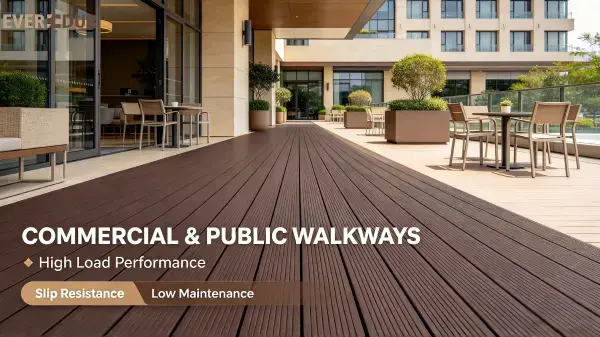
Commercial Terraces, Hospitality Venues, and Public Walkways
Hotels, restaurants, public boardwalks, and retail outdoor areas have tighter compliance requirements, more frequent repair plans, and higher load requirements. This is a good place for solid-core boards or co-extruded solid profiles. It's no longer possible to negotiate slip resistance approval, especially in European countries where public liability rules for wet areas are very strict. The longer life of composite materials compared to softwood timber is most important for businesses, where the yearly cost of labor for maintaining natural wood is a real expense that composite materials almost completely eliminate.
Large-Scale Contractor and Developer Projects
Companies that build things and develop properties and work on more than one site benefit from having relationships with suppliers that offer uniform product specs, dependable shipping schedules, and the ability to increase order numbers without affecting quality. At this level, the talk moves from pricing per board to the dependability of the supply chain, the need for technical paperwork for building permits, and the ability to keep colors and sizes the same throughout a multi-stage development with grooved texture composite. Suppliers with many production lines and a lot of work that can be done each year can promise to delivery dates that makers with only one line can't.SEND INQUIRY
How to Compare Grooved WPC Decking Options for Your Project
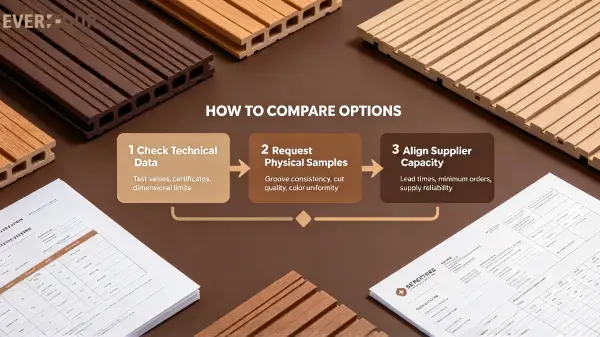
Evaluating Technical Data Sheets and Certification Documents
The wording used in marketing doesn't tell you much. Technical data sheets show you if a board does what it says it will do. Ask for slip resistance pendulum test values, dimensional stability numbers (shown as a percentage change over defined temperature and humidity ranges), and load-bearing test results when comparing options. Ask about the specific qualifications that are held, such as CE marking for European markets, ASTM approval for North American standards, and FSC chain-of-custody for projects that need to be environmentally friendly. Also, make sure that the certificates are up-to-date and came from a reputable third-party organization. You should be wary of a source that can't give you up-to-date third-party test results for a certain board profile.
Requesting Samples and Assessing Physical Quality
There is no way to replace touching a real board sample with a digital picture. When the sample comes in, make sure that the groove profile is the same all the way along the length of the board. The channels should be the same depth and not taper or vary in width. It's important to press on the surface and listen for hollow resonance, which could mean that the board has thin wall sections. Check the cut ends to make sure the material is spread out evenly. Flex the board by hand and see if it returns to flat or keeps a small bow. If it doesn't, that means the materials aren't mixed well. The color should be the same from person to person, with no streaks. These are quality signals that can be seen, are easy to evaluate (takes five minutes), and strongly link to success in the real world.
Aligning Supplier Capacity with Your Project Timeline
Even if the board looks good and meets your technical needs, it is only useful if it can be provided on time for your project. Directly inquire about production lead times for the sizes and colors you've specified, as well as the current order backlog and minimum order quantities. Suppliers with a wide range of production options, like multiple extrusion lines that can handle different shapes, are better able to handle last-minute orders or changes to project specifications than those with only one line. For long-term supply agreements, find out if there is enough stock for repeat sales to make sure that the colors and sizes stay the same from one project step to the next.
Conclusion
There are more things to think about when picking outdoor decks in 2026 than there were even five years ago. The level of co-extrusion technology, the shape of the groove profile, the size of the board, the certification requirements, and the supplier's capacity can all change performance and cost. The above framework gives buyers, workers, and project specifiers an organized way to compare choices based on what the project needs, not just price. Grooved WPC decking has a good history in outdoor projects in both Europe and North America. This type of decking will keep getting better—lighter profiles with less thermal movement are already being made for products that will be available soon.SEND INQUIRY
FAQ
Q: How long does grooved WPC decking typically last outdoors?
A: Service life depends heavily on production method, material composition, and local climate. Co-extruded boards with a polymer cap layer perform well for 15 to 25 years in most European and North American outdoor conditions. Single-layer extruded boards in the same conditions tend toward the 10 to 15-year range. Proper subframe installation — adequate drainage clearance beneath the boards, appropriate joist spacing — is also a meaningful factor in realized service life.
Q: Is grooved composite decking suitable for pool surrounds and wet areas?
A: Yes, outdoor grooved composite decking is well-suited for poolside and wet-area applications. The longitudinal channels drain standing water efficiently, and the ribbed surface provides friction underfoot when wet. Verify slip resistance test values with the supplier before specifying for pool surround use, particularly for public or commercial venues where regulatory thresholds may apply.
Q: What maintenance does grooved WPC decking require?
A: Routine maintenance is minimal. Periodic cleaning with a stiff brush and mild detergent removes surface soiling and prevents organic buildup in the groove channels. Annual inspection for any displaced fixings or subframe movement is advisable. Unlike softwood timber, WPC boards do not require sanding, staining, or sealing.
Get Grooved WPC Decking Samples and Pricing from Everdur
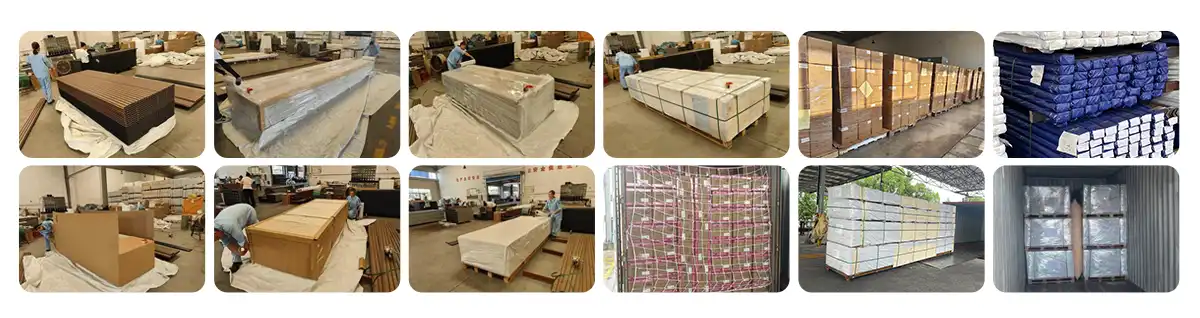
Everdur makes grooved WPC decking and has more than 50 production lines that make 30,000 tons of it every year. Products are sent to over 60 countries and meet environmental standards like CE, ASTM D7039, GB/T 24137, FSC, REACH, RoHS, and reclaimed material. They also meet E0-grade environmental compliance for formaldehyde emission control.
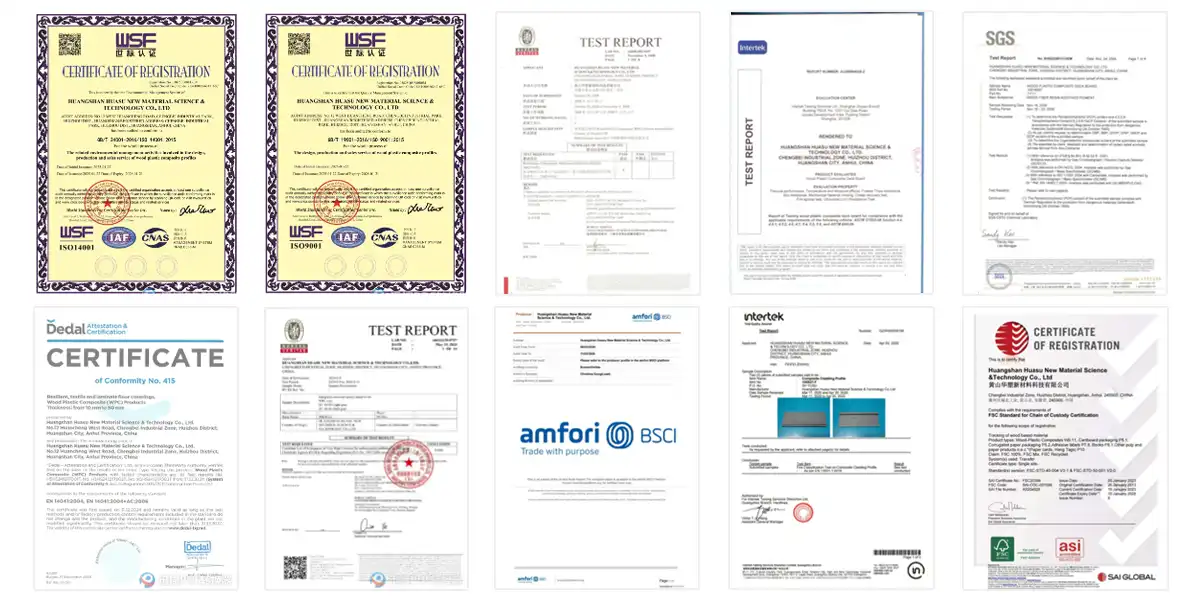
For building companies and builders: technical documentation packages, custom sizes made for each project, and reliable supply schedules for multi-phase projects. Get in touch to talk about pricing and delivery terms for large orders.
For building materials wholesalers and resellers: special wholesale prices, OEM/ODM choices, and free trial packages to check the quality of the board before ordering a lot of it.
For end users and homeowners: free design help to match colors, sizes, and finishes to your outdoor space, plus installation tips to make sure the job is done right and lasts a long time.
Send your project details, preferred sizes, or sample requests to violet@wpcsupplier.com. All technical and business questions are answered quickly by the team.
References
1. European Committee for Standardization. EN 15534: Composites Made from Cellulose-Based Materials and Thermoplastics (Wood-Polymer Composites). CEN, Brussels, multiple parts updated through 2022.
2. ASTM International. ASTM D7032: Standard Specification for Establishing Performance Ratings for Wood-Plastic Composite Deck Boards and Guardrail Systems. ASTM International, West Conshohocken, PA, current edition.
3. Forest Stewardship Council. FSC Chain-of-Custody Certification: Standard and Guidance for Organizations. FSC International, Bonn, 2023.
4. European Chemicals Agency. REACH Regulation (EC) No 1907/2006: Guidance on Requirements for Substances in Articles. ECHA, Helsinki, updated 2023.
5. Building Research Establishment (BRE). GreenGuide to Specification: An Environmental Profiling System for Building Materials and Components. BRE Press, Watford, 4th edition.
6. Rowell, Roger M., ed. Handbook of Wood Chemistry and Wood Composites. CRC Press, Boca Raton, 2nd edition, 2012.
Send Inquiry
Related Industry Knowledge
- Affordable WPC Decking Wholesale: Direct from Factory to Your Project
- Wholesale Traditional Cladding: Bulk Supply for Traditional Buildings
- How to Choose WPC Cladding: Material, Design and Installation Tips
- Anti-Slip Residential WPC Decking: Safe for Kids & Pets at Home
- WPC Landscape Walls Installation: Guide for Garden & Park Projects
- WPC Composite Fencing Installation: Easy Guide for Beginners
- Composite Screen Fencing: Privacy & Decorative Screen for 2026
- WPC Decking Maintenance Tips: Keep Your Outdoor Deck Looking New for Years
- Privacy WPC Fence: Perfect for Residential and Villa Outdoor Spaces
- Top Benefits of WPC Decking for Residential and Commercial Use in 2026