_1777451497595.webp)
How to Install WPC Fence Easily: Step-by-Step Guide for Beginners
2026-10-10 12:58:49
WPC fence installation is a weekend activity that homeowners and professionals can do without training. WPC panels mix recycled wood fibre and HDPE to make an outdoor fence material that resists rain, UV exposure, and temperature changes without warping or rotting. Instead of sanding, painting, and sealing wood every year, composite panels are prefinished. The procedure involves prepping the site and laying out the panels, attaching the poles, mounting the panels, and verifying stability one more time. When installing steel posts on a corporate or household border, the processes are the same. The fence's appearance and longevity depend on the posts' distance, panel orientation, and clip or slot attachment. It explains each process in straightforward English. It follows European and North American specialists' technical details and installation methodologies. Before using a drill, read the manual. Knowing everything ahead of time saves time and money.SEND INQUIRY

What Do You Need to Prepare Before Installing a WPC Fence?
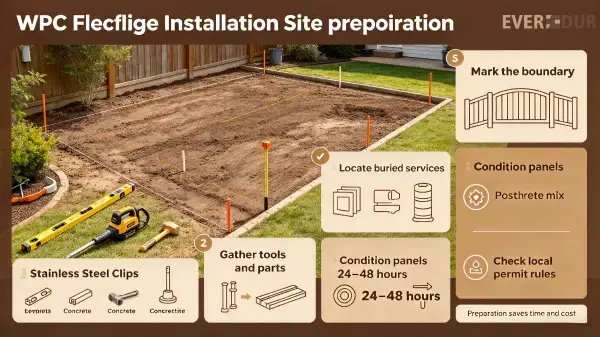
Most beginners don't think enough about how important it is to prepare for a project. Skipping it can cause posts to be out of place, panel spacing to be off, or panels that don't fit the length of the run without having to be cut in strange ways.
Mark your property's boundary. Walk around the fence site and mark the trail with spray paint or string. Note any gates, hills or curves after writing down the line's length. The panels must be stepped or raked on sloping terrain. Horizontal wood walls must be bent or stepped before installing a post.
Look for services that are buried. Before you dig, you are required by law to let a local utility-marking service know in most places in Europe and North America. It's free to call and can help you avoid serious problems.
Gather tools and parts. A basic installation kit includes a level, tape measure, string line, post hole digger or rotary drill with auger bit, concrete mix, rubber mallet and panel shape-specific clips or screws. Because zinc-plated screws rust fast in moist environments, stainless steel or hot-dip galvanised screws are suitable for outdoor usage.
Getting the frames ready. Composite pieces don't grow and contract as much as solid wood, but they still need to be kept flat and off the ground for 24 to 48 hours before they are put together. This gives any small changes in size that happened during shipping time to settle down. The manufacturer's specification sheet will tell you how much space you should leave between each end of the panel for expansion. Most of the time, this gap is 5 to 10 mm, but it always depends on the profile.
Look over the neighborhood permit rules. Fence height limits and rules for setting back boundaries are different in each country, area, and city. In many places of Germany, the UK, and the US, you need a building permit for walls that are taller than 1.8 m or 2 m. It's cheaper to make changes now than to pay a lot of money later to fix mistakes.

WPC Fence Posts and Panel Dimensions: Choosing the Right Setup
Post selection and panel sizing are interconnected decisions. Getting them wrong is the most common cause of structural problems down the line.
Options for posting. Lightweight, corrosion-resistant aluminium posts are ideal for residential and coastal installations with salt air. Steel posts are better for business borders and higher privacy screens since they can carry more weight. Both materials work with slot-in and rail-mounted composite panels. Post sections commonly measure 60 x 60 mm to 100 × 100 mm, depending on fence height and panel weight.
Post spacing. Standard horizontal WPC fence post centers are 1,500–2,400 mm. Hollow-core co-extruded profiles bear stronger bending loads than single-extrusion hollow boards, therefore they may have wider spacing. Always check the panel manufacturer's maximum unsupported span data for your profile.
Panel sizes. Composite fence planks come in several widths and thicknesses. The most frequent widths are 90, 120, 140, and 150 mm. Special lengths may be created for tight projects, although 1.8, 2.2, and 2.9 m are standard. When choosing a panel width that splits equally into your fence height, you won't have unequal sections at the top or bottom of each bay.
Footing depth. An embedment depth of one-third of the post's height above ground, or 600 mm in firm soil, is recommended. Concrete posts are less likely to shift. Before loading panels, use a fast-setting mix and brace the post straight for 24 hours while the concrete dries.SEND INQUIRY

How Do You Install WPC Fence Panels With Aluminum or Steel Posts?
Once posts are set, plumb, and fully cured, panel installation is straightforward. Begin at one end of the fence run and work consistently in one direction.
Fit the bottom rail or bottom clip at the correct height above finished ground level — usually 50–100 mm to allow drainage and prevent moisture accumulation at the base of the panels. Slide or clip the first board into position, check it is level along its length with a spirit level, and secure it. Each subsequent board locks into the one below using the clip system, which hides the fixings and maintains consistent spacing automatically. At post positions, trim panels to the manufacturer's recommended end gap using a circular saw with a fine-tooth blade. Co-extruded profiles cut cleanly; avoid hand saws that leave frayed edges on the composite shell.

WPC Fence Privacy, Slat Spacing, and Horizontal Panel Alignment
The horizontal layout of composite horizontal fence panels directly controls how much privacy the finished fence provides and how it reads visually from a distance.
Tight-butt or close-clip installation — where boards are stacked with minimal gap — delivers full visual privacy and is the most common choice for residential rear gardens and villa perimeters. A 5–10 mm shadow gap between boards retains a degree of ventilation and visual lightness without sacrificing meaningful privacy; this spacing is popular in contemporary landscape architecture and commercial courtyard projects. Wider slat gaps, used in decorative screen applications, allow air movement and partial sightlines, and reduce wind loading on the posts.
Horizontal alignment matters as much as spacing. Before installing the first board, snap a chalk line across all posts at the intended base height. Check it with a long level or laser level. Every board installed above that reference line will only be as straight as the first one — a slight lean introduced at board one compounds visibly by board ten. Use the same clip-type consistently across the run; mixing clip depths introduces unintended variation in board projection.SEND INQUIRY

How Can You Check WPC Fence Stability After Installation?
Before the site is turned over or called finished, the fence should be checked in a structured way. If you skip this step, you won't find problems until it's too late to fix them because of weather or load.
Press down on the top of each post with your side hand one at a time. A post that is set properly and has enough ground depth should not move much. If you can see rock in a post, it means that either the footing is too shallow, the concrete didn't cure all the way, or the post wasn't braced properly while it was being set. Take care of this before you cover or landscape around the base.
Walk along the whole fence and look at how the panels are aligned from three to five meters away. Take a step back so that you can see the top edge and every board joint across the whole bay. Small misalignments are easier to see from a distance than they are up close. Make sure that all of the clip fixings are fully engaged. Over time, a board above a clip that is only partially seated will spring outward.
Inspect all cut ends and any drill penetrations for composite fencing profiles. The co-extruded shell provides weather protection, but exposed cut ends on boards that will be in contact with standing water benefit from a dab of exterior-grade sealant. Finally, verify that expansion gaps at panel ends are present and consistent. Composite materials expand less than natural wood, but a fully constrained panel in a hot summer climate can generate enough internal stress to deform the fixing.

Conclusion
Installing a composite wood fence is an accessible project when the preparation, post setting, and panel alignment steps are followed in sequence. The material performs reliably outdoors across the climate ranges typical in Europe and North America, requiring no painting or sealing after installation. Taking time with post depth, footing cure, and level reference lines at the start repays itself many times over in a fence that stays straight and stable for years.SEND INQUIRY

FAQ
Q1: Can WPC fence panels be installed on sloped ground?
Yes. You can put horizontal composite panels on hills in two ways: stepped (where each bay drops in height steps) or scraped (where panels follow the ground angle). The choice depends on how steep the slope is and how you want the yard to look. For higher slopes, stepped placement is more typical.
Q2: How long does a composite fence typically last outdoors?
With proper placement and regular upkeep, like a quick wash with water every so often, composite outdoor fence panels can last anywhere from 10 to 25 years, based on the profile type and the weather where you live. Most of the time, co-extruded solid shapes come with longer warranties than hollow single-extrusion boards.
Q3: Do I need planning permission to install a composite fence?
Where you live affects what permits you need. In many places of Europe and the US, fences up to a certain height (usually 1.8 m to 2 m) along a private border don't need official permission. However, the rules vary from municipality to municipality and depend on how close the fence is to roads or historic buildings. Before starting any work, you should always check with your local planning or building authority.
Ready to Start Your Fence Project? Get in Touch with Everdur
For building companies and fence builders: To back up your bids, ask for technical data sheets, profile samples, and project-specific volume pricing. The more than 50 production lines that Everdur has allow them to make both large-scale improvements and custom shapes.
For people who buy and sell building products in bulk: Check to see if they offer special wholesale prices, minimum order quantities (MOQs), and co-branded packaging. If you qualify, you can get free samples.
This is for end users and house owners: Get in touch with us for a free design advice and construction guide that is tailored to your outdoor area, temperature zone, and privacy needs.
All Everdur composite fencing products comply with CE (EU), ASTM D7039 (US), and GB/T 24137 (China) standards. Products carry FSC, REACH, and RoHS certifications, and are manufactured using recycled HDPE content in accordance with recognized Recycled Content certification criteria and E0 environmental standards — supporting green building and sustainable landscape projects.

Everdur is an experienced WPC fence manufacturer committed to product quality and responsible material sourcing. To discuss your project, contact our team directly at violet@wpcsupplier.com.
References
1. EN 15534-1:2014 — Composites made from cellulose-based materials and thermoplastics (wood-polymer composites or natural fibre composites). European Committee for Standardization, Brussels.
2. ASTM D7032 — Standard Specification for Establishing Performance Ratings for Wood-Plastic Composite Deck Boards and Guardrail Systems. ASTM International, West Conshohocken, PA.
3. ASTM D7039 — Standard Test Method for Sulfur in Gasoline, Diesel Fuel, Jet Fuel, Kerosene, and Related Fuel Blends by Monochromatic Wavelength Dispersive X-ray Fluorescence Spectrometry. ASTM International (referenced within composite material additive compliance testing frameworks).
4. BS 8605-1:2014 — Fences. Code of Practice for Planning, Design, Installation, Operation and Maintenance of Fencing. British Standards Institution, London.
GB/T 24137-2009 — Wood-Plastic Composite Products. Standardization Administration of the People's Republic of China, Beijing.
5. Forest Stewardship Council. FSC Chain of Custody Certification: An Introduction for Businesses. FSC International, Bonn, Germany.
6. Morrell, J.J. Wood-Plastic Composites: Performance and Environmental Impacts. Oregon State University Wood Science and Engineering, Corvallis, OR.
Send Inquiry
Related Industry Knowledge
- Brushed WPC Decking: Premium Textured Flooring for Luxury Outdoor Spaces
- Eco-Friendly Co Extrusion WPC Decking: Sustainable Outdoor Solution
- Best WPC Cladding Designs for Villa and Luxury Residential Projects
- How to Choose WPC Cladding: Material, Design and Installation Tips
- Top WPC Composite Fencing Manufacturers in 2026
- Traditional Cladding for Residential Buildings: Classic & Reliable
- WPC Villa Fence Installation: Guide for Luxury Villa Projects
- Composite Screen Fencing for Patios & Gardens: Privacy & Aesthetics
- Waterproof WPC Cladding: Perfect for Coastal and Rainy Areas
- Waterproof WPC Fence: Ideal for Coastal and Humid Areas