_1777451497595.webp)
Anti-Slip Traditional WPC Decking: Safe for Families & Pets
2026-10-15 18:09:39
When kids run across the patio or a dog runs to the garden, the ground matters. For homeowners and landscaping professionals who want safe, durable, and attractive outdoor flooring, traditional WPC decking is a good option. Untreated wood splinters, bends in rain, and fades randomly in the sun. Wood-plastic hybrid boards, however, retain their form and grip year-round. It contains Grade A reused HDPE and recycled wood fiber. It produces a surface that doesn't shrink in rainy European winters or dry American summers. The non-slip pattern is integrated into the surface form, not applied later. The structure-based traction method provides families a safe outdoor floor year after year. A smooth, ribbed texture protects pet paws from wear and tear without claw-catching edges. The next sections describe how this material earns its safety ratings, how it performs in actual weather, and how a busy family should handle long-term care.SEND INQUIRY
How Does Traditional WPC Decking Provide a Safer Surface for Families and Pets?
Safety in outdoor flooring is rarely one dimensional. A board can be slip-resistant when dry but treacherous when wet, or it can feel comfortable underfoot but harbor sharp edges along its grain. Composite wood decking addresses both concerns through its manufacturing process rather than through add-on treatments.
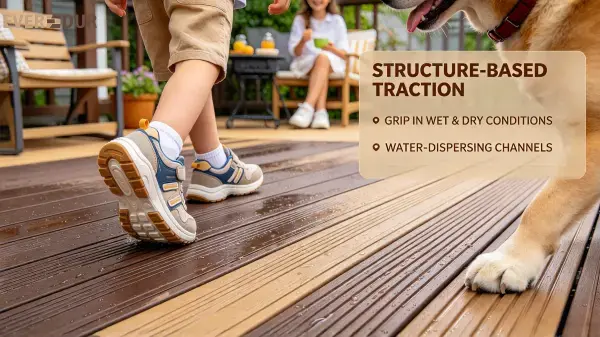
The anti-slip performance of classic anti-slip WPC boards comes from embossed or brushed surface profiles pressed into the board during extrusion. These micro-textured patterns create friction between the sole of a shoe or a bare foot and the board surface. When rain or dew accumulates, the channels between the texture ridges help water disperse rather than pool, maintaining grip. Independent testing methods such as those referenced in ASTM D7039 measure slip resistance under wet conditions, and quality composite boards are engineered to meet those thresholds consistently across the board's surface, not just at the center.
Homeowners with dogs also consider surface shape. When running or changing directions, dogs and cats employ surface grip. Smooth wooden decks or tiles may stress joints, particularly in elderly animals. Composite boards provide an embossed texture that grips safely without hurting delicate paw pads. Sharp edges and nail heads are absent. Small dogs' paws can't get entangled in the board gaps either.
Decks are utilized differently by youngsters and adults. Some crawl, roll, drop toys, and trip and fall. Certified composite boards can't include formaldehyde-releasing glue, and reliable products have REACH compliance papers showing harmful chemicals are under limits. Home outside spaces should have safe floors for humans, children, and animals.
Traditional WPC Decking Without Splinters: Barefoot Comfort for Everyday Outdoor Living
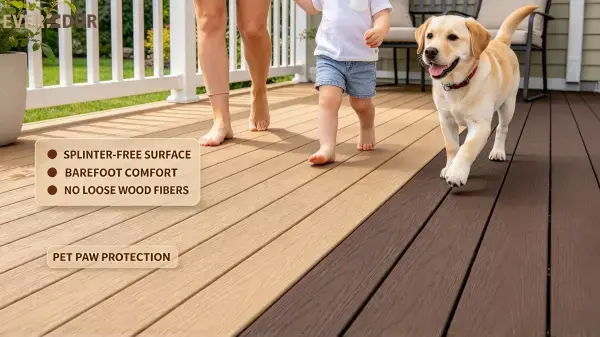
Natural timber has a tactile quality that many homeowners genuinely appreciate, but it comes with a structural reality: wood fibers degrade over time. UV exposure breaks down the lignin that holds wood cells together, leaving the surface fibrous and prone to splintering. A splinter-free morning walk to the garden is not a minor luxury — for barefoot adults, toddlers, and dogs with sensitive paws, it is a functional requirement.
Classic residential WPC boards do not splinter because the wood fiber component is fully encapsulated within the polymer matrix during extrusion. The fiber never reaches the surface as loose strands. What you feel underfoot is a consistent, smooth-to-firm texture that retains its character even after years of foot traffic and weather exposure. The second-generation co-extrusion process used in current manufacturing goes a step further by adding a protective shell layer over the board's core, which shields the composite material from surface wear and moisture ingress at the same time.
In real life, this means that families can leave the deck barefoot-ready without having to prepare for the season. There is no need to sand it once a year, check for screws sticking out, or worry about rough spots forming where rain has raised the grain. The surface that is put down is pretty much the same surface that is there five or ten years later, given that it is used normally outside.
For pet owners, the constant surface roughness also keeps dirt and other things from building up in the grain. It's easier to clean because mud, pet hair, and other organic matter don't get stuck in the open holes of the wood. They stay on top.SEND INQUIRY
How Does Traditional WPC Decking Handle Rain, UV Exposure, and Seasonal Changes?
Performance in Wet Conditions
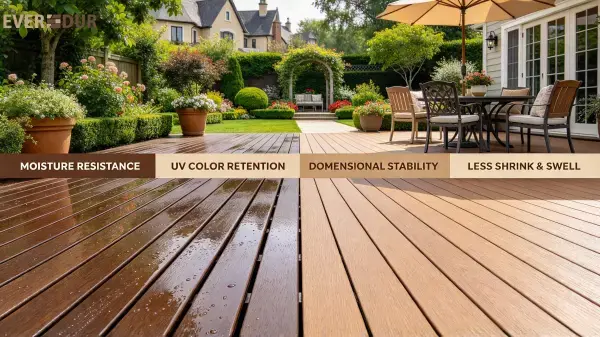
Water damages all outdoor decking materials most. Wood expands when wet and shrinks when dry. It loosens screws and warps boards slowly. The polymer in composite decking, generally recycled HDPE, doesn't absorb water like bare wood, therefore it manages moisture differently. Water doesn't contact the wood fiber if the plastic mesh seals it.
The proportions remain constant during wet seasons. Boards don't swell much when it rains and go back to normal when the weather changes. If placed properly with the manufacturer's expansion gaps, a composite deck remains level during rainy European winters and temperate American wet-dry cycles. The grooves on the non-slip surface allow water drain, reducing its duration on the board.
UV Resistance and Color Retention
Long-term UV radiation causes untreated wood to gray in one season. UV stabilizers slow photochemical color deterioration in composite boards. After long-term UV exposure, quality boards are checked for color retention. After over 2,000 hours of testing, trustworthy products fade minimally.
People who pick an outdoor color scheme may find this handy. Choosing a warm teak or wood tone while building the deck should keep it from going gray after two or three years.
Thermal Expansion and Seasonal Stability
Temperature causes all materials to expand and contract. No difference with composite decking. However, a well-designed composite board's movement is predictable. Since the heat movement range is established, manufacturers may recommend expansion gap size. That may be considered by installers to keep the deck stable in summer and winter without cupping or gapping like genuine wood.
Second-generation composites exhibit less thermal mobility than single-extrusion products. This implies the material will operate dependably in more climates.
Traditional WPC Decking Wood-Grain Textures, Colors, and Surface Finishes for Outdoor Spaces
Surface Finish Options and Their Practical Impact
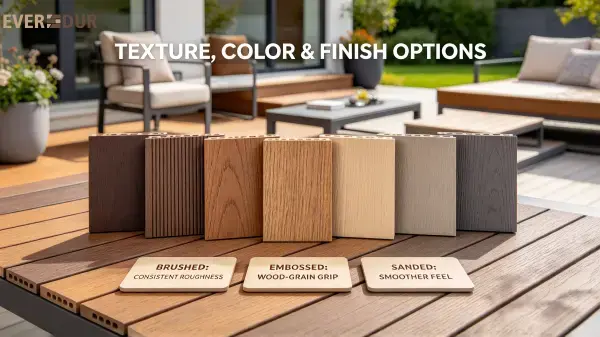
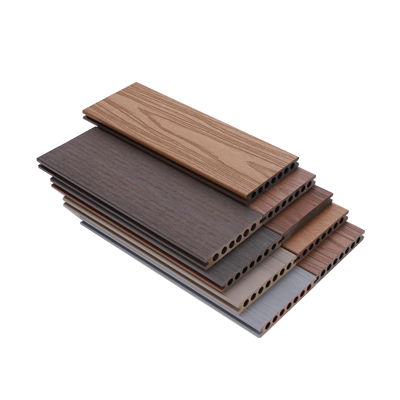
The surface finish of a composite deck board influences its appearance and flooring performance. Brushed finishes provide surfaces a consistent roughness like hand-planed wood and give you greater walking control. Embossed finishes mimic wood's cellular grain and give all-around grip. A sanded finish is smoother, smaller, and less harsh. Each option suits a distinct project and style, and you may compare their grip characteristics before choosing.
Color Selection for Residential and Landscape Projects
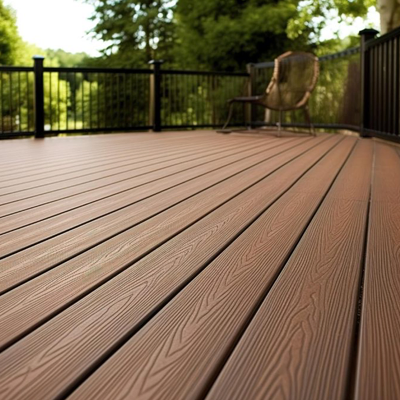
Wood-tone composite boards such as cedar, teak, walnut and sandal wood look fantastic in gardens and complement structures constructed of wood. Cooler colors, such as ash gray, stone gray and dark gray, go well with contemporary landscape patterns prominent in northern European houses and modern American suburbia. Some profiles have two sides, with various colors or textures, so the workers may select how to set them in place.
For larger undertakings when the decks need to meet a particular design need or brand personality, colors may be modified beyond normal possibilities. This is particularly true for landscape architects designing tiered villas for residences, or developers picking materials for several apartments.
Wood-Grain Aesthetics for Family Outdoor Spaces
The visual warmth of a wood-grain surface is frequently cited by homeowners as the primary reason they choose composite over plain plastic or concrete alternatives. Modern extrusion technology reproduces the variability of natural grain — the knot-like markings, the fiber directionality, the slight tonal shifts across a board's width — with enough accuracy that the visual distinction from natural timber requires close inspection. This allows families to achieve the aesthetic of a traditional WPC decking without the maintenance obligation that timber carries.SEND INQUIRY

How to Maintain Traditional WPC Decking for Long-Term Family and Pet-Friendly Use?
Routine Cleaning Practices
The most important thing to do to maintain composite decking is to clean it every so often to get rid of dirt, algae, and stains. Most buildup can be removed with a soft-bristle brush and a light cleaning solution. Moss or algae growth on the surface is standard in places where plants or buildings hang over the edge, and it can be removed with a light brush. For deep cleaning every so often, low to moderate pressure washing works well. However, directing the spray parallel to the board's surface roughness keeps the non-slip profile over time.
When you have pets, you should clean a little more often to get rid of muddy paw prints and other organic matter. Because composite boards don't have pores, most of the dirt and debris sit on top of them instead of going through them. This makes cleanup pretty quick.
Protective Measures for Busy Family Use
Putting furniture covers under the legs of tables and chairs spreads out the weight and stops surface wear in places that get a lot of use. Putting grill mats under outdoor cooking tools keeps the surface finishes from getting too hot, even if the materials are heat-resistant. Pet water bowls that are directly on the deck should be changed every so often so that there isn't a buildup of moisture in one spot, which would allow plants to grow under the bowl rim.
These steps are more for safety than necessity, but they keep the surface looking the same across the deck and increase the time between repairs.
Long-Term Care and Service Life Expectations
If you build a composite deck properly and keep it in good shape, it can last anywhere from 10 to 25 years, based on the product, the environment, and how often you use it. The co-extrusion protective shell layer on today's boards adds another layer of protection against surface wear. This means that the board's structural life is extended as well as its esthetic life.
It is a good idea to check the state of the subframe, growth gaps, and fixes once a year. Even though composite boards don't soak up a lot of water, the subframe that supports them should be checked for any structural damage on a regular basis, especially in places where it rains a lot. If necessary, replacing a single broken board is easy because the normal clip-fixing method lets boards be taken out and put back in without affecting the parts next to them.

Conclusion
An outdoor deck that really works for families and pets needs to be slip-resistant, strong, and low-maintenance all at the same time. Traditional WPC decking meets these needs with non-slip surface textures and dimensionally stable materials. It also eliminates the need for the yearly maintenance required by natural wood. Because it is splinter-free, provides reliable grip even when wet, and resists UV-related fading, it is a good choice for private outdoor spaces in many countries. The combination of a safe surface design and long-lasting materials creates reliable outdoor flooring that families can enjoy every day for years. This applies to a wide range of projects, whether it's a villa garden terrace, a backyard deck, or a courtyard space.SEND INQUIRY

FAQ
Q: Is the anti-slip texture on composite decking permanent, or does it wear away over time?
A: The anti-slip profile on quality composite boards is pressed into the board's surface structure during extrusion, not applied as a topcoat. This means the texture is integral to the board rather than a surface treatment, and it remains present throughout the board's service life under normal outdoor use conditions.
Q: Can composite decking become slippery for dogs even with textured surfaces?
A: In dry conditions, embossed and brushed composite surfaces provide reliable traction for dogs and other pets. In wet conditions, the texture channels assist water dispersal, which maintains grip. Periodic cleaning to remove algae or organic film is important, as biological growth on any outdoor surface can reduce friction if left unaddressed.
Q: Are the materials in composite decking safe for children who play on it regularly?
A: Reputable composite boards carry REACH compliance certification, confirming that the chemical content of the material remains within regulated safe limits. Products meeting EU CE standards and ASTM D7039 testing requirements have been assessed against safety benchmarks relevant to residential use. Checking the certification documentation of the specific product before purchase is always advisable.

Connect with Everdur's Traditional WPC Decking Manufacturer for Your Project
For Construction Firms and Landscape Architects: Stable production capacity across 50+ lines means your project timelines are supported. Request project-specific technical documentation, sample boards in your preferred surface finish, and specification guidance matched to your climate zone.
For Building Materials Wholesalers and Resellers: Explore wholesale pricing structures, consistent MOQ arrangements, and supply terms suited to ongoing distribution. Ask about exclusive pricing tiers and free sample programs for new product categories.
For End Customers: Receive free design consultation and installation guidance tailored to your outdoor space. Whether you are planning a family backyard or a villa terrace, Everdur's team can help you select the right board profile, color, and fixing system for your needs.
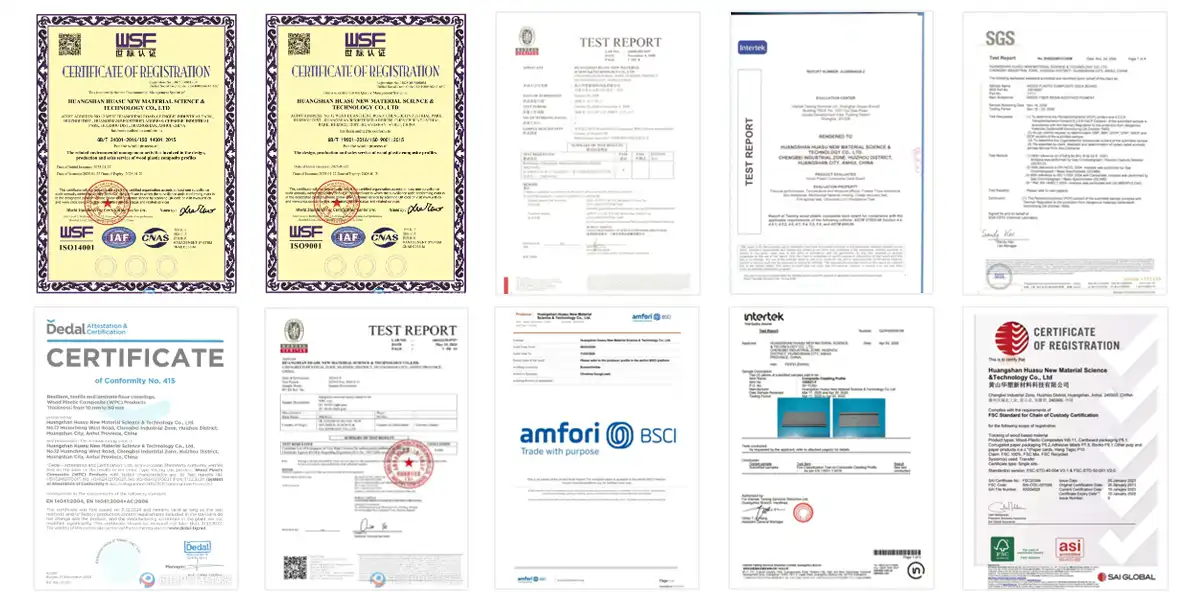
Everdur's traditional WPC decking is certified to EU CE, ASTM D7039, GB/T 24137, and carries FSC, REACH, and Recycled Content certification meeting E0 environmental standards. As a committed traditional WPC decking manufacturer, Everdur ensures every board shipped meets documented quality benchmarks.
Send your project details or sample request directly to violet@wpcsupplier.com to begin the conversation.
References
1. American Society for Testing and Materials. Standard Test Method for Evaluating Load Resistance of Wood-Plastic Composite Deck Boards (ASTM D7039). ASTM International.
2. European Committee for Standardization. EN 15534 Series: Composites Made from Cellulose-Based Materials and Thermoplastics (Wood-Polymer Composites). CEN.
3. Forest Stewardship Council. FSC Certification Standards for Recycled and Reclaimed Wood-Based Products. FSC International.
4. Chinese National Standards Administration. GB/T 24137: Wood-Plastic Composites — General Requirements and Test Methods. SAC China.
5. European Chemicals Agency. REACH Regulation (EC) No 1907/2006: Registration, Evaluation, Authorisation and Restriction of Chemicals. ECHA.
6. Clemons, C. M. Wood-Plastic Composites in the United States: The Interfacing of Two Industries. Forest Products Journal, 52(6), 10–18.
7. Wolcott, M. P., & Englund, K. A Technology Review of Wood-Plastic Composites. Washington State University Wood Materials and Engineering Laboratory Technical Report.
Send Inquiry

Related Industry Knowledge
- Low MOQ Hollow WPC Decking: Perfect for Small Residential Projects
- WPC Cladding: The Ultimate Solution for Durable and Stylish Building Exteriors
- Eco-Friendly 3D Composite Decking: Sustainable & Aesthetically Pleasing
- How to Choose Exterior WPC Cladding for Your Building
- Hollow WPC Decking Installation Cost: How to Save Big in 2026
- How to Choose WPC Cladding: Material, Design and Installation Tips
- How to Choose WPC Landscape Walls for Your Garden or Park
- Low MOQ WPC Composite Fencing: Perfect for Small Gardens
- How to Choose High-Quality Co Extrusion WPC Decking for Your Garden
- Hollow WPC Decking Maintenance Tips: Keep It New for 10+ Years