_1777451497595.webp)
Tips and Tricks for Perfect WPC Solid Decking
2026-10-13 14:38:49
It takes more than just choosing the color of the boards to make a composite deck seem good. Every choice you make, from initial site preparation to ongoing maintenance, affects the long-term performance of your outdoor area. Solid WPC decking combines recycled wood fiber and high-density polyethylene into a dense, uniform board that holds up well under foot traffic, furniture weight, and shifting weather. Because they are solid and not empty, solid boards spread the weight evenly across their whole cross-section. This makes them an excellent pick for work beside pools, on rooftop decks, and on business travels to areas near water. Whether you're a homeowner or a professional, this article will teach you the regular and uncommon ways to obtain a clean that lasts. How to choose and maintain a suitable surface finish is covered in detail. Whether you're working on a hotel project or a deck in your backyard, reading this article will teach you how to avoid typical pitfalls. The surface will retain its luster and your hard work will last longer if you do this. The following data is derived from published technical standards and current installation practices.SEND INQUIRY
How to Prepare for a Solid WPC Decking Installation?
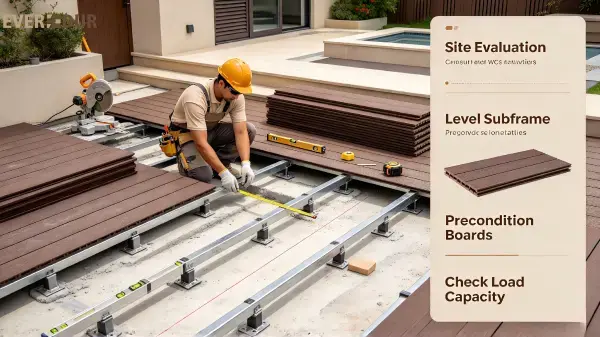
The degree to which an outdoor project is well-planned determines the degree to which it succeeds or fails. Avoiding twisting, sagging, and premature board wear and tear requires only a few hours of meticulous foundation.
First, the site must be evaluated. Drainage slopes should be considered while determining the area measurement. A one to two percent slant away from any adjacent buildings is recommended for composite decks in order to prevent water from collecting on them. The subframe rusts more quickly and the locking mechanism might become weaker if water remains beneath the deck.
The material of the subframe is more important than most buyers think. Aluminum joists are best for coastal and high-humidity areas because they don't rust and don't need to be painted or treated. In most European climes, galvanized steel does a good job. You could use timber joists, but they need to be treated with pressure and checked on a regular basis. Before you fix anything, use a spirit level or laser level across all bearing points to make sure the subframe is level, no matter what material it is made of.
Warm up the boards before putting them in. The temperature and humidity in the air affect even thick composite patterns. Before laying, keep the boards flat and off the ground in the area where they will be installed for at least 24 to 48 hours. This lowers the chance of physical shift after installation, especially in places where yearly temperature changes are strong.
Check the load-bearing capacity of the supporting structure. Solid composite boards are denser than hollow profiles, so factor their weight into the structural calculation when solid outdoor WPC rooftops or elevated platforms. Standard solid boards in the 135–150 mm width and 20–25 mm thickness range weigh noticeably more per linear metre than hollow equivalents.
Get everything you need ready before you begin. You should have at least a cordless drill, a rubber mallet, a chalk line, a fine-tooth circular saw, and coated or stainless-steel fasteners in your kit. You should stay away from bare steel screws since they produce unsightly rust streaks on the surface of the board.
Solid WPC Decking Layout and Board Spacing Tips
Both how the end deck looks and how long it lasts depend on the board plan you choose. It will not look good if you rush through this step, and after a few seasons, the structure will begin to fall apart.
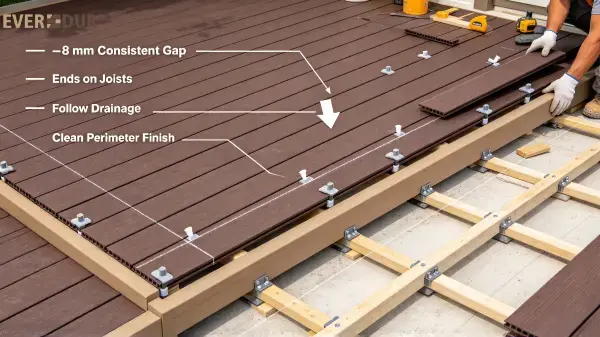
When you plan the run's path, think about the drains. There should be as few boards as possible that run in the same way as the main drains. Water can't flow along the gaps between the boards or around the outside of the building because of this.
It is necessary to have consistent space. A space of 5–8 mm exists between the edges of each board to let air flow and heat expand. When the temperature range is big, like in northern Europe, where winters are cold and summers are warm, it's best to err on the warmer side of the range. Instead of guessing, use plastic gap clips. You'll be able to tell the difference when the deck is finished.
Joints at the ends need support. Each end of the board should rest on a joist, not in the space between joists. When loads are put on ends that aren't supported, they bend and can crack at the point where they're fixed over time. When the boards are shorter than the span, spread the end joints out over the rows next to each other. This pattern spreads the stress more evenly and looks better.
A clean finish is given by perimeter frame. Putting a fascia board along the edges that are visible hides the joist subframe, covers the clip fixings, and keeps direct moisture from getting into the end grain of cut boards. For a clean, professional look, corners of fascia boards can be mitered.
Before putting down boards, mark where the joists will go on the perimeter frame. This keeps you from losing track of the fixed points while you're putting the deck together, which is especially helpful on bigger decks where the joists are hidden after the first row is put down.SEND INQUIRY
How to Install Solid WPC Decking With Joists and Clips?
Joist Spacing and Bearing Points
Joist centres for solid WPC decking boards are typically set at 300–400 mm for standard residential loads and tightened to 300 mm for high-traffic commercial applications. Always cross-reference joist spacing with the board manufacturer's technical data sheet, as recommendations vary with board thickness and profile geometry. Fix joists to the supporting structure using appropriate brackets — avoid direct contact between the joist and a concrete substrate, as trapped moisture accelerates deterioration. A rubber or plastic isolation pad between the joist foot and the concrete provides a simple moisture break.
Clip Fixing Technique
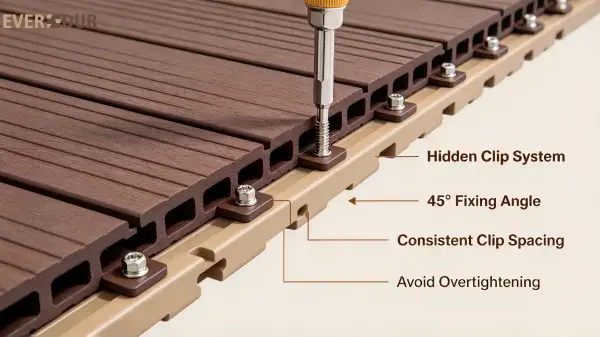
Hidden clip systems give composite decks a clean, fastener-free surface and simplify future board replacement. Insert the clip into the groove on the board edge, align the board, and drive the fixing screw at the correct angle — typically 45 degrees — to draw the board tight without splitting. Do not overtighten; composite material can compress slightly at the fixing point, which creates a visible indentation on the surface. Maintain consistent clip spacing along each joist according to the supplier's guidance, and always use the clips specified for the board profile — mismatched clips allow lateral movement.
End-of-Row Adjustments and Cutting
Cutting composite boards requires a fine-tooth circular or mitre saw blade. Coarse blades tear the surface and leave a rough edge that collects dirt. Cut ends benefit from a light sanding with 120-grit paper to smooth any fibres, and an end-cap or sealant can be applied where cut ends are permanently exposed to weathering. When cutting close to a joist, leave enough material either side of the cut for a secure clip or screw fixing.
Solid WPC Decking Surface Finishes for Better Outdoor Performance
Brushed, Embossed, and Sanded Surfaces
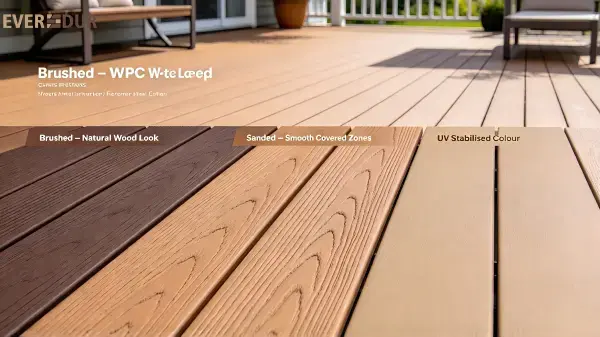
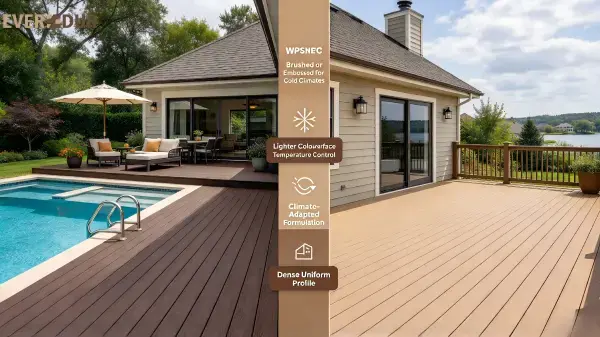
How a board appears, feels, and performs when wet is dependent on its surface roughness. Brushed treatments do not make the surface excessively slippery and mimic the appearance of real wood with a straight grain. Because of their more substantial, three-dimensional feel, embossed surfaces are more pleasant to hold. They are ideal for wet-weather decks, such as those found around pools and other bodies of water. Covered terraces or roofs are ideal for sanded surfaces since they are smoother and won't get wet as easily.
UV Stability and Colour Retention
All exterior composite surfaces experience some degree of colour shift in the first few months of UV exposure — this is a normal weathering response, not a defect. Quality boards manufactured with UV-stabilised additives reach a stable colour within roughly 8–12 weeks and maintain that tone thereafter. Independent testing against 2,000+ hours of UV exposure confirms minimal fading for boards with adequate stabiliser loading. When specifying for projects where colour consistency across a large area matters — hotel terraces, for example — order all boards from the same production batch to minimise variation.
Matching Finish to Climate
In northern European climates where it rains a lot and gets cold in the winter, a finish that is brushed or embossed is safer than a smooth surface. In dry, hot places, any lighter color lowers the surface temperature by a lot. In full sunlight, darker boards can get so hot that they're hard to walk on barefoot. You can get solid composite deck boards in climate-adapted formulas that change the amount of wood fiber to polymer and the mix of additives to fit the weather where you live.SEND INQUIRY
How to Keep Solid WPC Decking Looking Good for Years?
Routine Cleaning Practice
Cleaning your composite deck on a regular basis is the best way to keep it looking good. Once a week, sweep away leaves, sand, and grit to keep organic matter from sinking into the surface and causing mildew. Use a soft-bristle brush and warm water with a light, pH-neutral soap to clean the surface once a month. If you want to keep the surface in good shape, don't use stiff wire brushes or bleach-based cleaners on colored boards, as they can make the color fade unevenly.
Managing Stains and Seasonal Debris
Most problems with the surface of outdoor wood decks are caused by tannin spots from leaves and other organic matter. Take care of them while they are still fresh. Most biological spots can be removed with a soft cloth and a mix of white vinegar and water. For oil or grease stains from cooking outside, use a cleaner made specifically for composite decks, following the directions on the bottle and then rinsing well. In the fall, quickly remove any leaf buildup from between the boards. Leaving water in the gaps between the boards for too long encourages the growth of algae and mold.
Inspection and Long-Term Care
Check the board ends and fixing clips once a year. You should replace any clips that are beginning to bend, and the ends of the boards should stay in place on their joists. After a time of bad weather, check the subframe for any rust or movement. You don't have to paint, stain, or finish solid composite boards. But the things that wear them down faster can't happen if you keep the joints and surfaces clean. If you take care of your system, it should last at least as long as its rated service life.

Conclusion
Getting the most out of a composite deck installation is largely a matter of disciplined preparation, careful layout, and consistent upkeep. The density and structural integrity of solid WPC decking make it well-suited for demanding outdoor environments, But those features can only be fully used if the base, fixing system, and surface care are all done right. If you follow these useful tips from the start, you'll have a clean, stable, low-maintenance outdoor surface that works well for many years.SEND INQUIRY
FAQ
Q: How much gap should I leave between solid WPC boards during installation?
A: There should be a 5–8 mm gap between the edges of the boards. Lean toward 8 mm in places where temperatures change a lot from season to season so that boards don't press against each other.
Q: Can solid composite decking boards be cut on site to fit irregular spaces?
A: Yes. A circular saw or mitre saw fitted with a fine-tooth blade produces clean cuts. Lightly sand cut ends before installation, and use an end-cap or compatible sealant on any permanently exposed cut edges to reduce moisture absorption at the board end.
Q: Is solid WPC decking suitable for rooftop installations?
A: Solid composite boards are used on rooftop terraces, but the supporting structure must be rated for the combined load of the boards, subframe, and anticipated foot traffic. Consult a structural engineer for elevated or rooftop applications, and confirm drainage provision before finalising the subframe layout.
Get in Touch With Everdur — Your Solid WPC Decking Manufacturer
Everdur supplies solid WPC decking to construction firms, landscape contractors, building materials wholesalers, resellers, and end customers across Europe, North America, and beyond.
For construction firms and landscape contractors: Request technical data sheets, profile drawings, and project-specific formulation advice. We support specification from early design through to site delivery.
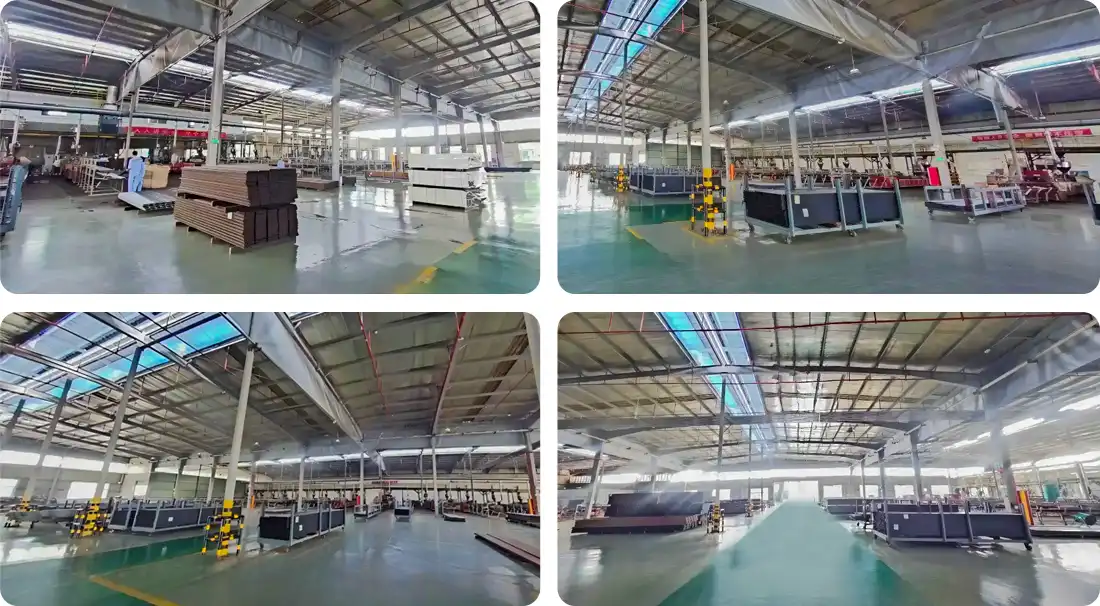
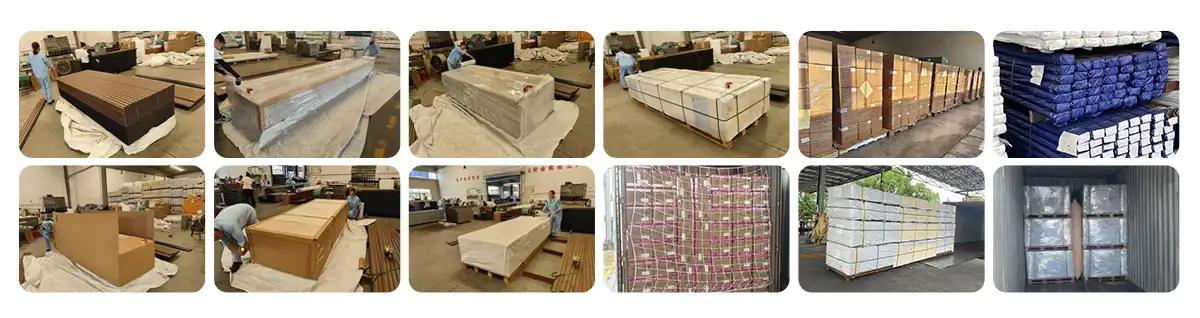
For building materials wholesalers and resellers: Stable supply from 50 production lines with an annual capacity of 30,000 tons. Ask about wholesale pricing structures and free samples for evaluation.
For end customers: Free design consultation and installation guidance to help you achieve the result you have in mind, in the colour and profile that suits your space.
All Everdur solid composite deck products comply with EU CE, US ASTM D7039, and China GB/T 24137 standards. Our products carry FSC, SGS, ROHS, REACH, and INTERTEK certifications, meet E0 environmental standards, and are manufactured using verified recycled content.

Send your enquiry or project brief to violet@wpcsupplier.com and a member of the team will respond within one business day.
References
1. European Committee for Standardization. EN 15534: Composites Made from Cellulose-Based Materials and Thermoplastics (Wood-Polymer Composites). CEN, Brussels.
2. ASTM International. ASTM D7032: Standard Specification for Establishing Performance Ratings for Wood-Plastic Composite Deck Boards and Guardrail Systems. ASTM International, West Conshohocken, PA.
3. Forest Stewardship Council. FSC Certification Standards for Chain of Custody and Recycled Content. FSC International, Bonn.
4. Clemons, Craig M. Wood-Plastic Composites in the United States: The Interfacing of Two Industries. Forest Products Journal, Vol. 52, No. 6, 2002.
5. Klyosov, Anatole A. Wood-Plastic Composites. John Wiley & Sons, Hoboken, NJ, 2007.
6. International Code Council. International Building Code: Chapter 4 — Special Detailed Requirements Based on Use and Occupancy, Exterior Decks and Balconies. ICC, Country Club Hills, IL.
7. Stark, Nicole M., Laurent M. Matuana, and Craig M. Clemons. Effect of Processing Conditions on the Color and Weathering of Wood-Flour/HDPE Composites. Journal of Applied Polymer Science, Vol. 93, No. 3, 2004.
Send Inquiry
Related Industry Knowledge
- Traditional WPC Decking Maintenance: Easy Tips to Extend Its Life
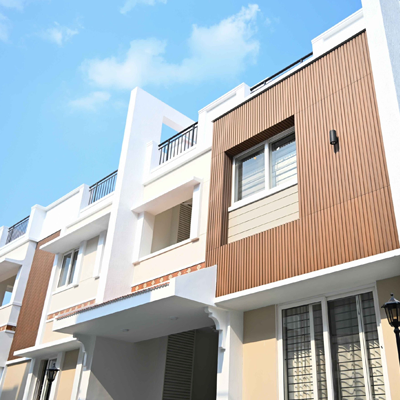
- How to Choose Exterior WPC Cladding for Your Building
- Brushed WPC Decking: Premium Textured Flooring for Luxury Outdoor Spaces
- Anti-Slip Residential WPC Decking: Safe for Kids & Pets at Home
- How to Choose WPC Landscape Walls for Your Garden or Park
- 3D Composite Decking: Elevate Your Outdoor Space with Textured Flooring
- Top Composite Screen Fencing Manufacturers in 2026
- Exterior WPC Cladding: Durable & Stylish External Wall Solution 2026
- How to Choose High-Quality Co Extrusion WPC Decking for Your Garden
- Waterproof WPC Fence: Ideal for Coastal and Humid Areas