_1777451497595.webp)
Traditional WPC Decking Maintenance: Easy Tips to Extend Its Life
2026-10-13 14:38:53
Maintaining your outdoor deck doesn't have to feel like a chore. Traditional WPC decking is designed to be low-maintenance by nature, while regular maintenance greatly increases the likelihood that it will retain both its esthetic value and its structural soundness as time passes. Composite wood-plastic decking can withstand outside exposure with far less maintenance than real wood, which requires frequent painting, sealing, and sanding. There is a difference between "zero maintenance" and "low maintenance." The buildup of dust, biological waste, seasonal wetness, and UV radiation may erode the surface or possibly cause harm to the substructure if not regularly maintained. Whether it's in your backyard, on a villa garden terrace, or in a common courtyard, decks need special care and attention to ensure they last as long as possible—anywhere from 10 to twenty-five years—and provide you with many years of pleasure. This book provides a straightforward and practical approach to maintenance that any homeowner, contractor, or property manager may benefit from. Keep reading to learn the simple measures you can do year after year to keep your deck looking great.SEND INQUIRY

How Often Should Traditional WPC Decking Be Cleaned?
How often does a composite deck need maintenance? That's a question a lot of homeowners have. How much foot activity the deck gets, the local temperature, and the plants around all play a role in the response.
In most home settings in North America and Europe, a basic scrub down in the spring and fall is all that's needed to keep a deck looking great. When you clean in the spring, you get rid of things that were there in the winter, like mold or mildew that may have grown because of the cold and wet weather, as well as any water that was left behind and leaf litter. If you clean up the leaves in the fall, they might not stain your floors as they break down over the winter.
Following these two deep cleanings, you can keep it clean by rinsing it gently with a garden hose every two weeks. This will keep dust, pollen, and surface dirt from building up. Decks that are close to trees or get a lot of use may need extra cleaning and washing every month.
Be very careful after storms. Surface discolouration may be accelerated by standing water, muck, and organic debris that is left on the surface for long periods of time. Unlike natural timber, your standard traditional WPC decking won't absorb moisture into its core due to its protective outer shell — but surface staining from biological growth is still worth preventing through consistent upkeep.
Establishing a simple cleaning schedule tied to the seasons removes any guesswork and ensures the deck always looks its best without any significant effort.
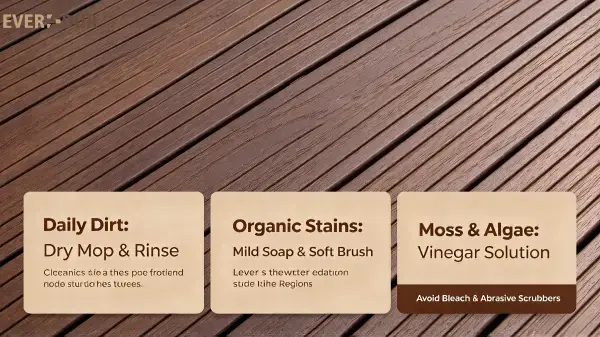
Traditional WPC Decking Cleaning Methods for Dirt, Stains, and Debris
Cleaning composite decking is straightforward, but using the right approach for different types of soiling matters.
Everyday Dirt and Dust
A dry mop or soft-bristle brush will get rid of most of the dust and loose dirt on the surface. Brush with the grain if you don't want to change the way the board feels. Then, briefly rinse the area with water from a yard hose.
Organic Stains — Leaves, Moss, and Algae
Over time, reddish spots would show up on a deck's surface where leaves had been left. A gentle brush and warm water mixed with mild dish soap will get rid of most organic stains. Do not rub the area too hard. Follow up with a good rinse to keep the lines on the board clean.
Moss and algae like damp, shady places to grow. A weak solution of white vinegar and water can get rid of them gently but effectively. Allow it to sit for a short time before you brush your teeth and wash it off. Bleach-based solutions should not be used on composite boards because they may take away the layer on the top of them over time.
Grease and Oil Stains
Outdoor cooking areas are prime locations for grease splatter. Address these promptly with a degreasing dish soap solution. The longer an oil stain sits, the more it penetrates the surface texture. Prompt action prevents a temporary blemish from becoming a permanent mark.
Pressure Washing
With great caution, standard composite deck planks may be pressure cleaned. Maintain a pressure below 1,500 PSI, always maintain a 30-centimeter distance from the surface, and direct the spray downwards, not across, the grain of the board. You risk permanently wearing away the surface texture if you push down too hard or at an angle.
Protecting this product from moisture and UV radiation is an external co-extruded layer; nevertheless, this layer may be destroyed by abrasive scrubbers, wire brushes, or solvent-based cleaners.SEND INQUIRY
How Can Proper Drainage Protect Traditional WPC Decking?
Water management is an often-overlooked aspect that impacts the longevity of composite decks. Standing water on or beneath the deck structure causes biological growth, substructure corrosion, and long-term joint stress, regardless of how well-designed the boards are to avoid moisture absorption.
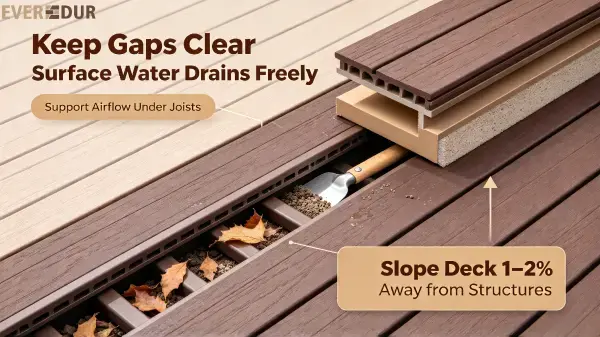
When traditional WPC decking is installed, the spacing between boards — typically 5 to 8 mm — allows surface water to drain freely. Over time, debris accumulation in these gaps can block drainage pathways. Use a flat-edged tool or a stiff brush to clear these gaps periodically, particularly after autumn leaf fall.
Your deck's foundation is as important as its surface boards. Water should not collect at the points of contact between joists and beams; instead, air should be able to circulate freely between them. One option to enhance drainage at ground level is to put a weed-suppressing membrane or gravel foundation if the soil under your deck retains wet.
Instead of collecting near walls or foundations, rainwater may be directed to naturally drain down a sloped installation, in which the deck surface is slanted just a little (1-2%) away from the structure. This is especially important for bigger outdoor platforms and villa terraces, since water may collect there after heavy rains.
Think about putting a channel drain around the deck's perimeter if you live in an area that gets a lot of rain throughout the summer. The deck remains solid all year round thanks to this modest infrastructure investment, which stops the foundation material under the substructure from eroding.
Traditional WPC Decking Care Tips for Sun, Rain, and Seasonal Changes
Outdoor decking faces relentless environmental stress across the calendar year. Understanding how UV radiation, precipitation, and temperature fluctuation affect your boards allows you to take targeted protective action.
UV Exposure
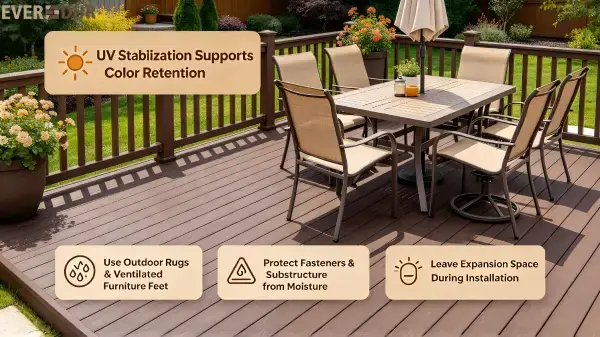
The use of UV-stabilizing chemicals in the formulation of high-quality composite boards considerably reduces the rate of color fading. Count on the color stability of boards that have been proven to withstand over 2,000 hours of UV exposure with negligible fading. Having said that, surface temperatures may increase significantly on hot days due to extended exposure to intense sunshine. To lessen the effects of localized heat retention and wear patterns on the surface of the board, it is recommended to use outdoor rugs or furniture with ventilated feet in areas with high summer sun. These considerations are also important when maintaining standard WPC decking, as proper care helps preserve its appearance and performance over time.
Rain and Moisture
Rain is no match for composite boards that have an outer shell that is co-extruded. The fasteners and substructure, and not the boards, pose the most threat. Clips and screws made of stainless steel or hot-dip galvanized steel will keep the board surface free of rust stains. Every year, check the fasteners and replace any that seem corroded.
Seasonal Temperature Shifts
When the temperature varies, the volume of any solid substance changes as well. Standard boards still need appropriate expansion spaces at the ends and sides during installation, even though next-generation composite formulas are meant to reduce thermal movement. There shouldn't be any noticeable shift in the deck due to the seasons if the proper spacing was used during installation. In really cold weather, you shouldn't put heavy or sharp-edged items directly on the surface of the board since brittleness might somewhat increase at such low temperatures.SEND INQUIRY

How to Extend the Service Life of Traditional WPC Decking?
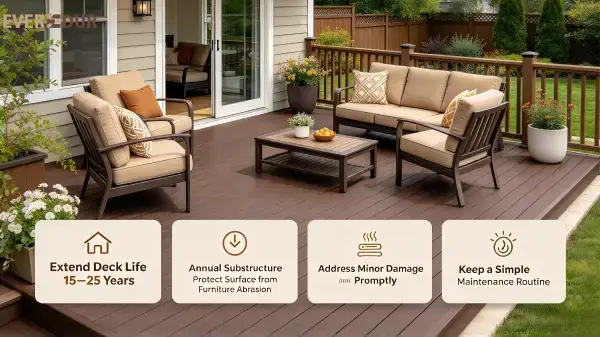
With normal maintenance, a composite deck may last for 15–25 years without showing signs of wear and tear and still looking great. A few simple routines have a significant impact.
Inspect the Substructure Annually
The deck boards often attract attention, but the joists and fixings beneath them carry the structural load. At least once a year — ideally at the start of spring — check the substructure for any signs of movement, loosening, or moisture damage. Catching a small issue early prevents it from becoming a costly repair.
Protect Against Furniture Abrasion
Over time, the deck will develop localized wear from heavy outdoor furniture that is dragged over it regularly. Chairs and tables may have felt or rubber feet put on them. Lift instead than dragging heavy objects while moving them. These little routines keep the surface roughness of the board intact for a lot longer than if it were neglected.
Address Minor Damage Promptly
Sharp impacts may sometimes create superficial gouges or deep scratches, however this is not very frequent. While they do not weaken the board in any way, they do make the surface less flat and hence more prone to dirt accumulation. Minor surface damage might be less noticeable with a basic grain-wise sanding. In contrast to poured or bonded outdoor surfaces, clip-based installation techniques allow for quicker restoration of individual boards in the event of severe damage.
Conclusion
Caring for traditional WPC decking is genuinely manageable when you know what to focus on. For your deck to last for years to come, all it really requires is a good cleaning once a season, some clear drainage routes, and a yearly inspection of the foundation. The material's design goal is to lessen the load of outdoor care; by maintaining a few regular behaviors, you may extend the decking's service life and preserve this benefit.SEND INQUIRY
FAQ
Q: Can I use a pressure washer on my composite deck boards?
A: Sure, however you need to maintain a pressure lower than 1,500 PSI and spray the board grain at a minimum distance of 30 cm. It is crucial to use reasonable settings and adequate technique while applying high pressure to avoid damaging the co-extruded top layer.
Q: Will my composite deck boards fade over time?
A: It is common for the surface to weather somewhat in the first few months after installation, which might cause a little shift in color. Boards treated with UV-stabilizing additives of good quality do not fade much after the first settling time has passed; in fact, boards exposed to over two thousand hours of UV light under typical circumstances seldom exhibit any fading at all.
Q: How do I remove mold or mildew from the deck surface?
A: One effective method for removing mildew and mold is to brush on a solution of white vinegar and warm water. Let it rest for a few minutes before cleaning. First steps in mitigating mold development include increasing airflow beneath the deck and plugging any drainage holes.

Connect with Everdur: Get the Right Composite Decking Solution for Your Project
Whether you're specifying materials for a large residential development or sourcing stock for your distribution network, Everdur's traditional WPC decking manufacturer team is ready to support your project at every stage.
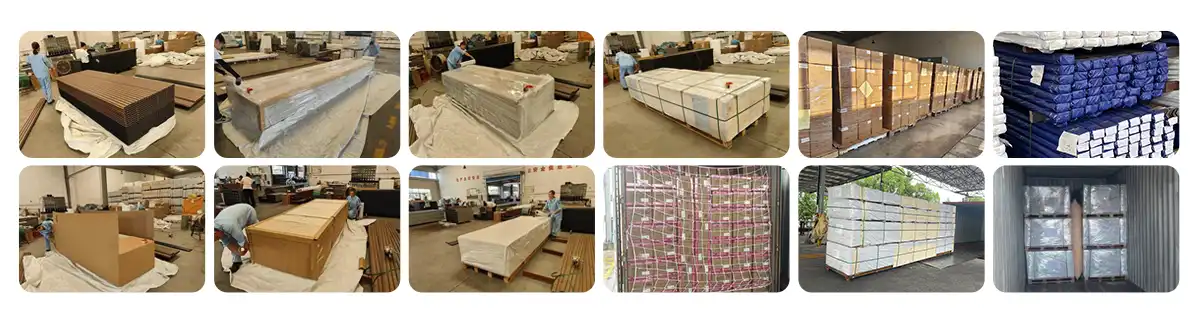
Get a steady supply from fifty or more production lines, as well as detailed papers and installation directions that are unique to your project. There are reliable wait times for orders that are placed in bulk.
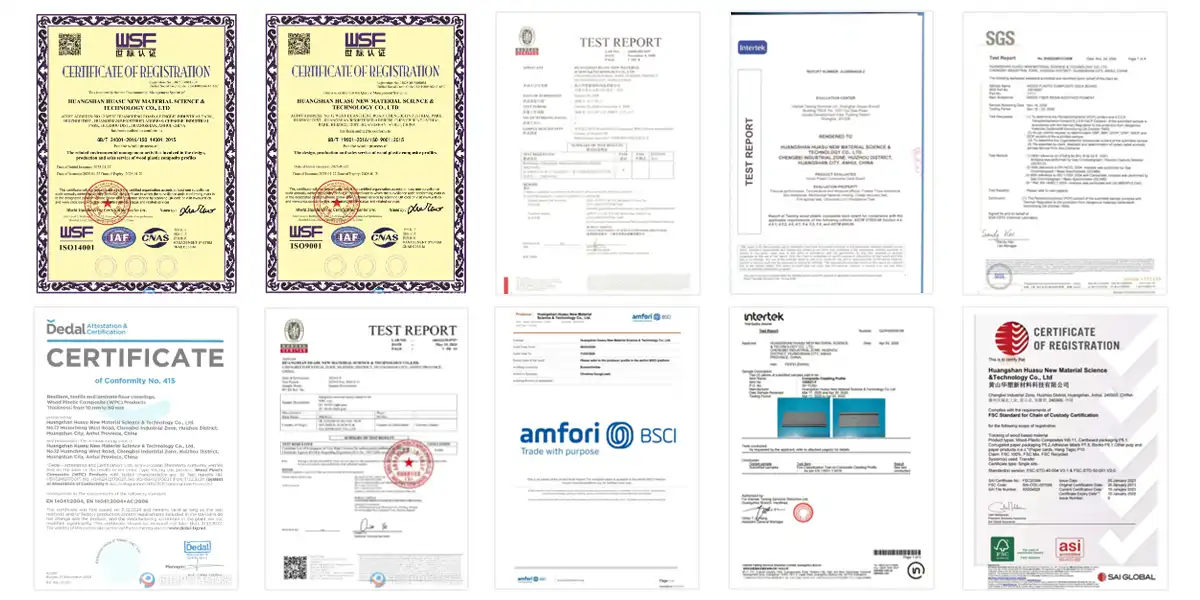
Our low prices, low minimum order amounts (MOQs) starting at 100 square meters, and free samples upon request are all good for people who buy and sell building products in bulk. Standards like EU CE, US ASTM D7039, and China GB/T 24137 make it easy for us to sell our goods in controlled markets. Environmental certifications such as the Recycled Content certification and the E0 environmental standard are also held by them.
People can get free design advice and installation instructions from us to help them make smart choices about their outdoor space.
Reach out to our team directly: violet@wpcsupplier.com
References
1. European Committee for Standardization. EN 15534: Composites Made from Cellulose-Based Materials and Thermoplastics (Wood-Polymer Composites). Brussels: CEN, 2014.
2. ASTM International. ASTM D7032: Standard Specification for Establishing Performance Ratings for Wood-Plastic Composite Deck Boards and Guardrail Systems. West Conshohocken, PA: ASTM International, 2021.
3. Forest Stewardship Council. FSC Principles and Criteria for Forest Stewardship. Bonn: FSC International, 2015.
4. Building Research Establishment (BRE). Specifying Sustainable Timber and Wood Products for Outdoor Construction Applications. Watford: BRE Press, 2019.
5. American Wood Protection Association (AWPA). Performance Standards for Wood-Plastic Composite Lumber and Decking. Birmingham, AL: AWPA, 2020.
6. ISO. ISO 9001:2015 Quality Management Systems — Requirements. Geneva: International Organization for Standardization, 2015.
7. Klyosov, Anatole A. Wood-Plastic Composites. Hoboken, NJ: John Wiley & Sons, 2007.
Send Inquiry
Related Industry Knowledge
- Low MOQ Hollow WPC Decking: Perfect for Small Residential Projects
- Wholesale Traditional WPC Decking: Affordable & Reliable Supply 2026
- Wood Grain Grooved WPC Decking: Stylish & Functional Outdoor Flooring
- WPC Composite Fencing for Residential Properties: Stylish & Secure
- 3D Composite Decking vs Regular Composite: Which Is More Stylish?
- WPC Villa Fence with Wood Grain: Enhance Your Villa’s Aesthetics
- WPC Villa Fence Installation: Guide for Luxury Villa Projects
- Top Composite Screen Fencing Manufacturers in 2026
- WPC Decking Maintenance Tips: Keep Your Outdoor Deck Looking New for Years
- Top Hollow WPC Decking Designs for Modern Gardens