_1777451497595.webp)
Wholesale Traditional WPC Decking: Affordable & Reliable Supply 2026
2026-10-12 16:37:52
Sourcing traditional WPC decking at scale requires more than a competitive unit price. Buyers entering the wholesale market in 2026 face a layered set of decisions: material composition, production consistency, lead times, certification compliance, and long-term supplier reliability. Whether you are managing outdoor renovation projects across Europe, supplying building materials to North American retailers, or coordinating large residential developments in Oceania, the fundamentals remain the same — you need a manufacturer that ships on schedule, holds the right paperwork, and keeps quality steady across every container.
This guide walks through what experienced procurement professionals and project managers actually want to know before committing to a bulk order. From profile dimensions and surface finish options to color customization and supply chain stability, the information here is designed to help you make a well-informed sourcing decision. Everdur has been manufacturing composite decking for over 16 years, supplying more than 225 clients across 60+ countries, and operates 50+ production lines with an annual output of 30,000 tons. That kind of production depth matters when your project timeline cannot afford delays.SEND INQUIRY

What Should Buyers Know Before Ordering Traditional WPC Decking Wholesale?
When it comes to composite decking, buying in bulk has real financial weight. Before sending in a buy order, procurement teams should think about a number of practical issues that are often missed during the early stages of talks.
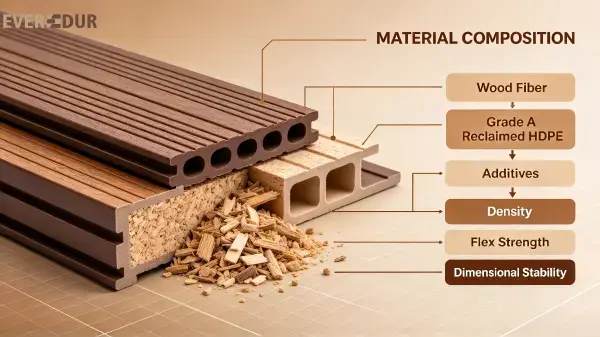
The first step is to look at the material makeup. Wood fiber (usually up to 70%) is mixed with Grade A reclaimed HDPE and useful chemical additives to make high-quality WPC boards. The number changes the mass, the flex strength, and the long-term stability of the dimensions. Ask your provider exactly what type of HDPE they use; this will have a direct effect on how well the board works in open settings with long-term UV exposure and changes in moisture levels.
Standard-quality boards are different from ones that will last for 15 to 25 years because of the technology used in production. During the extrusion process, second-generation co-extrusion technology covers the core of the board with a protected polymer shell. This makes it more resistant to surface stains, mold growth, and water absorption than first-generation hollow or solid single-extrusion profiles.
For wholesale buyers who serve the European or North American markets, certifications are a must. For the European market, your supplier should have at least a CE mark, FSC chain-of-custody paperwork for materials made from wood, ISO 9001 quality management approval, and REACH compliance for chemical substance limits. For some projects, like commercial public areas, you may also need ASTM performance data or SGS testing records.
The structures for MOQ and lead time are very different between manufacturers. A seller who can't make a lot of things might have good prices, but it might be hard for them to regularly fill reorders. Make sure you know the normal production wait times, minimum order quantities (Everdur's MOQ starts at 100 SQM), and whether the factory keeps safety stock or builds-to-order.
Logistics and packaging should be thought about before the order is placed, not after. Export-standard packaging, which includes PE film wrapping, wood pallets, and protective panel layers, cuts down on transit damage claims by a large amount, especially on long-haul ocean freight routes to North America or Europe.

Traditional WPC Decking Sizes, Profiles, and Surface Options for Bulk Orders
A lot of the time, wholesale buyers are in charge of more than one type of project at the same time, like public paths, villa terraces, and private gardens. Each type of project has slightly different size and style requirements. Knowing the range of specifications that are available ahead of time lets you combine SKUs and make buying easier.
The width of standard composite boards is between 135 mm and 150 mm. This range works with the most popular joist spacing configurations used in decking projects in North America and Europe. This cuts down on wasteful field cutting and wasted time. With thicknesses ranging from 20mm to 25mm, specifiers can find the right material for the job without over-engineering.
Length options are important for cutting down on off-cuts on-site. Most home and light business projects can be completed with standard lengths of 2,200 mm, 2,900 mm, and 3,600 mm. Large-scale projects can get custom lengths so that the dimensions are the same throughout the whole installation and less material is wasted.
There are four main types of surface finishes for classic decking panels: brushed, sanded, embossed, and wood grain. Brushed finishes have a light texture and a moderate level of slip resistance, which makes them great for patios that are covered. When it comes to high-visibility home projects, embossed and wood grain surfaces are often chosen because they feel more like real wood. People who want a cleaner, more regular look are more likely to like sanded finishes.
Dual-surface profiles, in which the two faces have different textures, give installation contractors more options because they can turn the board in any direction that meets the grip or visual needs of the job site.
The normal color palette has Ash Gray, Cedar, Coffee, Copper Brown, Dark Gray, Gray, Ivory, Mocha, Sandal Wood, Stone Gray, Teak, Walnut, and Wood tones. Custom color matching is available in addition to the standard card for bulk buyers who are in charge of branded projects or regional retail programs with clear color guidelines.
Knowing these choices before negotiating with a seller helps buyers combine requirements, make their product list easier to use, and cut down on the number of different SKUs they need to keep track of for various outdoor projects.SEND INQUIRY

How Can Traditional WPC Decking Manufacturers Ensure Stable Supply?
Production Capacity as a Foundation for Reliable Fulfillment
It all starts on the plant floor with a reliable supply. A company with more than 50 production lines and clear 5S management rules can handle sudden increases in demand without affecting lead times. With a yearly production capacity of 30,000 tons, Everdur has plenty of room to meet big, recurring wholesale orders while also taking on new customers. This isn't just theoretical capacity; it's based on hardware that has been used by over 100 live customers around the world.
Quality Control at Every Stage
Structured inspection protocols, not just end-of-line sampling, are needed for a wholesale program to have consistent output quality. There are four separate quality gates: checking the dimensions of the raw materials, checking the surface finish during production, and checking the final packing. When a wholesale buyer orders their third or fifth container, the product should work the same way it did the first time. Get certified to ISO 9001 to make this pledge to process stability official.
Logistics and Export Experience
The number of exports a company has is a useful indicator of how well they understand the supply chain. To ship to more than 60 countries on five continents, including North America and major European markets, you need to know about the necessary paperwork, how to handle freight at ports, and how to coordinate freight. FOB shipments through Shanghai and Ningbo give buyers access to trade lanes that are well-served, have low freight rates, and have regular ship schedules to ports in Europe and the United States.

Custom Traditional WPC Decking Colors and Textures for Wholesale Projects
Matching Regional Design Preferences
Different places have very different color tastes for traditional outdoor decks. In Scandinavia, homes are often built with cooler gray tones and pale ash finishes. Warmer wood and walnut shades are often chosen for house projects in southern Europe. Deck builders in North America often choose natural oak and wood-tone designs that go well with other wood structures. If a wholesale buyer knows the color preferences of their local customers, they can ask for color formulations that are tailored to those tastes instead of using a standard palette.
Surface Texture Customization for Specific Applications
In outdoor settings, surface texture is just as important as color when it comes to functionality. Commercial walkways with a lot of foot traffic need to be able to withstand slips and falls. This is especially important in places like Northern Europe and the Pacific Northwest where it rains a lot. Specificators can meet both safety and esthetic needs with a single product specification because embossing depths and brushing intensities can be changed. Everdur's customization program can handle changes to textures that are made to meet the performance requirements of a specific project.
Integrating Custom Options Into Wholesale Supply Programs
Customized specifications need to be coordinated with the manufacturer early on in the wholesale supply program. Custom color batches and non-standard designs have longer lead times than standard product runs, and you usually need to confirm the minimum batch amounts before they can be made. Buyers who are planning to launch special products or sets made just for a project should start talking about customization at least 8–12 weeks before the products need to ship. Before large production starts, Everdur's technical team works directly with wholesale buyers to come up with specs, get samples approved, and confirm production schedules.SEND INQUIRY

Traditional WPC Decking Supply Solutions for Large Outdoor Projects
Scaling Up for Commercial and Residential Developments
Large outdoor developments, like apartment complexes with multiple units, hotel terraces, and community park installations, have unique needs when it comes to how a supplier schedules production and manages inventory. To make sure that the color and pattern are the same across the whole installation, orders that cover several thousand square meters need to be sent out in production runs that are matched. Because Everdur can make a lot of things at once, it can combine them into one big batch. This lowers the chance that different container orders on the same job will have noticeable differences.
Supporting Contractors and Resellers With Project-Ready Supply
Supply arrangements that match delivery times with installation windows are good for contractors and people who sell building materials. Carrying costs for big pre-orders are lower with partial shipment plans, phased delivery schedules, and buffer stock agreements. Materials will still be available when teams are ready to install them. The best way to set up these deals is for the wholesale buyer and the manufacturer to talk to each other clearly during the planning phase of the project.
Long-Term Supply Relationships With Verified Performance Records
When managing ongoing outdoor project pipelines, wholesale buyers can get real benefits from working with a manufacturer that has a history of exporting and a list of documented customers. Over 225 customers in more than 60 countries show that they can reliably meet foreign supply needs. Because the maker has customers in so many places, they are also familiar with the legal paperwork, testing reports, and labeling needs of many markets. This cuts down on the paperwork that usually slows down the onboarding process for new suppliers.

Conclusion
When buying standard WPC decks in bulk in 2026, buyers who take the time to check production capacity, material quality, certification compliance, and customization options will be rewarded. Most of the time, a manufacturer's infrastructure, experience, and communication systems will determine whether or not their supply program runs smoothly with traditional WPC decking. This is true not only for the first order, but for the whole time they are working with the customer.SEND INQUIRY

FAQ
Q: What is the minimum order quantity for wholesale traditional WPC decking from Everdur?
A: The standard MOQ is 100 square meters. For large-scale commercial projects or reseller programs requiring custom colors and textures, the Everdur team can discuss project-specific batch requirements and phased delivery arrangements during the inquiry process.
Q: Which certifications does Everdur's composite decking carry for European and North American markets?
A: Everdur's classic decking panels are certified under ISO 9001, CE, FSC, REACH, SGS, ROHS, INTERTEK, and ASTM. These certifications cover quality management, chemical compliance, environmental sourcing, and structural performance — addressing the documentation requirements of most European and North American wholesale and commercial project buyers.
Q: How does co-extrusion technology affect the service life of a traditional outdoor deck?
A: Co-extrusion technology applies a protective polymer cap layer over the board's WPC core during manufacturing. This cap layer resists moisture ingress, surface staining, UV degradation, and biological growth more effectively than single-extrusion profiles. The result is a board that maintains structural integrity and color stability over a 10–25 year service life with minimal maintenance — a meaningful advantage for wholesale buyers whose customers expect long-term outdoor performance.
Ready to Source Traditional WPC Decking for Your Next Project? Contact Everdur
Everdur's bulk supply program is set up to meet your needs, whether you work for a construction company, an outdoor gardening company, a wholesaler of building materials, or a reseller in charge of a regional product list.
For builders and construction companies: pricing based on volume, project-matched batch production, and scheduled deliveries that happen in stages to fit your installation schedule with traditional WPC decking.
For people who buy and sell building materials in bulk, we offer special discounts, free samples, and full certification packages that include CE, FSC, ISO 9001, REACH, SGS, and ASTM compliance to help you meet your legal responsibilities in North American and European markets.

For end users and design professionals: Everdur's product team will give you free advice on decking standards, help choosing colors and textures, and technical support for installation.
For example, all of our products meet the requirements for EU CE marking, US ASTM D7039 performance standards, and China GB/T 24137 standards. Some environmental certifications are Recycled Content certification and E0 environmental standard compliance, which help meet the needs of green building projects.
Everdur has been making standard WPC decking for 16 years and has more than 50 working production lines that can make 30,000 tons of composite decking every year. They can answer any wholesale questions you have.
Talk to Everdur's wholesale team at violet@wpcsupplier.com to get samples, talk about project details, or get a bulk price quote.
References
1. European Committee for Standardization (CEN). EN 15534: Composites Made from Cellulose-Based Materials and Thermoplastics (Wood-Polymer Composites). Brussels: CEN.
2. ASTM International. ASTM D7032: Standard Specification for Establishing Performance Ratings for Wood-Plastic Composite Deck Boards and Guardrail Systems. West Conshohocken, PA: ASTM International.
3. Forest Stewardship Council (FSC). FSC Chain of Custody Certification Standard. Bonn: FSC International Center.
4. European Chemicals Agency (ECHA). Understanding REACH: Guidance for Importers and Downstream Users. Helsinki: ECHA Publications.
5. China National Standardization Management Committee. GB/T 24137: Wood-Plastic Composites — General Requirements. Beijing: Standards Press of China.
6. United States Green Building Council (USGBC). LEED v4 Reference Guide for Building Design and Construction: Materials and Resources Credit — Recycled Content. Washington, D.C.: USGBC.
Send Inquiry
Related Industry Knowledge
- How to Choose Exterior WPC Cladding for Your Building
- 2026 Guide to Grooved WPC Decking: Sizes, Styles & Prices
- Top Residential WPC Decking Suppliers for Homeowners 2026
- How to Install Solid WPC Decking for Long-Lasting Durability
- Top WPC Composite Fencing Manufacturers in 2026
- Traditional Cladding for Residential Buildings: Classic & Reliable
- Brushed WPC Decking Installation: Achieve a Sophisticated Look
- Composite Screen Fencing for Patios & Gardens: Privacy & Aesthetics
- Top Composite Screen Fencing Manufacturers in 2026
- Top Benefits of WPC Decking for Residential and Commercial Use in 2026