
Top 5 WPC Cladding Benefits for Commercial Buildings in 2026
2026-11-18 19:25:36
When developing a building exterior, commercial property owners and architects often ask the same question: what façade material can give constant performance without the need for regular maintenance? Wood siding fades and splits. The sea air rusts and dints metal panels. Vinyl will fracture under prolonged sun. WPC cladding provides a true answer to these concerns, providing you the beauty of real wood with the toughness of an engineered composite. Made from recycled HDPE and wood fiber it resists moisture, vermin and temperature variations and requires nothing more than the occasional clean to keep its beauty. As commercial construction continues beyond 2026, building owners are seeking materials that lower life cycle costs while meeting environmental requirements. In the article you'll be guided through 5 measurable benefits that make WPC cladding a logical choice for offices, retail buildings and hospitality projects, with comments on how co-extrusion technology enhances each benefit.SEND INQUIRY
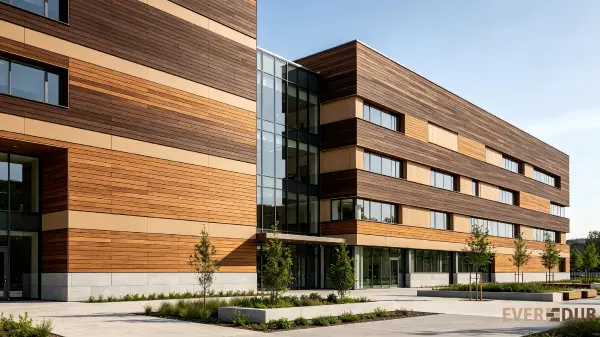
Why Is WPC Cladding a Cost-Effective Alternative to Traditional Commercial Facade Materials?
Developers evaluate façade materials on a single measure: how much value a material delivers during its service life compared to its initial cost. Wood looks great when it's first placed, but after a few seasons the cost of staining, sealing and plank replacement start to pile up. Aluminum and fiber cement are fairly resistant to weather deterioration. Material and labor expenses are greater for big commercial projects. WPC commercial cladding comes with a distinct price tag, mixing reasonable starting prices with a lifespan of 10-25 years and no maintenance.
Lower Installation and Material Costs Compared to Wood or Metal
Composite panels are installed using clip systems and concealed fasteners, saving labor time over wood siding, which frequently requires face-nailing, caulking and many coatings of finish before the inspector is satisfied. The standard widths are from 100mm to 220mm combined with 2.2m, 2.9m and 3.6m lengths to cover huge wall areas with less seams. Fewer seams imply fewer panels, connections and trim pieces on the materials order, keeping project costs predictable. Panels come with a factory-applied surface texture, so installation personnel don't have to finish them on site, as wood and certain painted metal systems do, before a building's final walkthrough. That's important on commercial schedules, because each week of outdoor work adds labor and scaffolding expenses to the project ledger.
Reduced Long-Term Repair and Replacement Expenses
If a material is prone to warping, cracking or corrosion, facciate repairs may soon become expensive. Refinishing wood siding on business buildings is often required every two to three years. Metal panels may have rust streaks near fasteners especially in moist, coastal environments. WPC cladding is weather-resistant, pest-resistant and surface-crack resistant, saving property managers money on patch repairs and panel replacements during a 20-year ownership window. The warranty terms are a confirmation of this: the warranty period for hollow co-extrusion panels is fifteen years and for solid co-extrusion panels is twenty years. This helps the facility manager to plan for future maintenance reserves instead of trying to predict when replacements might be necessary.
Energy and Resource Savings Across the Building Lifecycle
The choice of materials influences not just the line item for facade installation. Composite panels manufactured from recycled HDPE and wood fiber keep plastic waste out of landfills while satisfying the structural requirements of external wall systems. Documentation of recycled materials is available upon request and project teams applying for green building certification may use this recycled content toward sustainability points. The density of the composite also provides greater moderation of heat transmission through external walls than thin, uninsulated metal sheets, which may result in a considerable decrease in cooling load during the warmer months. The lower the replacement frequency, the lower the resources spent on producing, transporting and disposing of new façade material during the working life of a structure. These overall savings, distributed throughout installation, maintenance and running expenses, help explain why many commercial purchasers consider WPC cladding to be a good alternative to wood, vinyl and other lightweight metal systems when choosing materials.SEND INQUIRY

WPC Cladding Weather Resistance: Protection Against UV Radiation, Rain, and Temperature Changes
Commercial buildings are exposed to sun, rain, and changing temperatures throughout the year, and the façade receives the brunt of that exposure. If a cladding solution can't resist years of weather cycling, it will fade, fracture or distort far before the building's scheduled date for refurbishment. WPC cladding is made to endure these circumstances which is important for owners who want a façade that still looks decent a decade after installation.
UV Stability and Color Retention Over Time
Sunlight takes down many construction materials at the molecular scale, bleaching plastic trim and degrading paint in a few seasons. Everdur's WPC commercial cladding is evaluated for color stability and shows no fading after more than 2,000 hours of UV exposure in controlled testing. Such stability would imply that after a few years of service, the south-facing wall of a structure would not appear much different from its shadowed north counterpart. “Consistent color in all exposures maintains the visual investment made during design for retail storefronts and hospitality properties where curb appeal drives customer perception.
Moisture Resistance and Protection Against Rain Damage
If water gets trapped behind a façade or in the grain of a board, the wood absorbs the water, expands, and finally rots. The composite functions differently, since the HDPE component scatters water rather than absorbing it, minimizing the swelling and breaking that affect typical wood siding during rainy seasons. Buildings in areas of considerable seasonal rain, such as most of Western Europe and the Pacific Northwest, have the advantage of a facade that does not need yearly sealing to remain waterproof. Clip based installation solutions also allow for tiny drainage holes beneath the panels which allow rainwater to escape rather than pool against the wall assembly.
Performance in Extreme Temperature Swings
In countries with cold winters and hot summers, buildings really impose a strain on facade materials as they expand and contract over and over again. Metal panels might bend at the joints. Some polymers become brittle in cold weather. Co-extrusion composite panels are designed to handle this stress with a solid core and protective shell controlling movement within a predictable range across a broad temperature spectrum. Everdur's next generation products will be formulated for even lower thermal expansion and contraction – an important element for big commercial facades where slight dimensional changes across numerous panels may build up to apparent gaps or misalignment over time.SEND INQUIRY

How Does Co-Extrusion Technology Improve WPC Cladding Durability and Structural Stability?
Durability claims imply nothing without an explanation of the production process behind them. The co-extrusion process is the key manufacturing technique that distinguishes current composite cladding from older single-layer wood-plastic products and has a direct impact on the lifespan of a façade before wear and tear becomes visible.
What Co-Extrusion Means for Panel Strength
Co-extrusion is a process that applies two layers of material in one pass of manufacture, a structural core comprising wood fiber and HDPE, and a protective outer shell. This multi-layer design provides the panel better resilience to impact and bending than prior single-layer composite boards which wore out at the surface after only a few years outside. To maintain constant quality on big commercial orders where panel-to-panel consistency is important for a seamless facade look, Everdur employs more than fifty manufacturing lines devoted to this technique.
Protective Outer Layer Against Decay and Pests
Moisture, which is the main cause of degradation of wood-based goods, is prevented from penetrating by the outer shell formed during co-extrusion. It also keeps insect activity down . Bugs that normally dig into untreated wood find the tough composite shell more harder to penetrate . In humid or termite-prone areas, buildings have a practical benefit here, since the facade does not need chemical pest treatments that conventional wood cladding sometimes needs on a repeating basis.
Dimensional Stability Under Load and Climate Stress
Dimensional stability is not a trivial technical feature for large commercial facades, which must withstand wind load, their own weight and the stress of recurrent temperature cycling. Co-extrusion composite panels keep their form better and resist better these combined stresses than first generation wood-plastic composite, decreasing the likelihood of drooping, bending, or seam separation over a large stretch of wall. This structural stability is one reason why construction teams request co-extrusion panels for use in vented facade systems, where the cladding is some distance away from the wall structure and must maintain a level, even covering throughout its entire span without extra reinforcing.SEND INQUIRY

Commercial WPC Cladding Design Options: Wood Grain Textures, Colors, and Modern Facade Profiles
Performance counts, but a commercial structure has to appear thoughtful and modern, too. Designers and developers desire a façade that complements the architectural idea, not constrains it. Now there is a wide choice of designs for WPC commercial building facades that rival the look of genuine wood and painted metal, yet without the maintenance disadvantages of either.
Authentic Wood Grain and Surface Texture Choices
Surface treatments include embossed wood grain, brushed textures and sanded finishes, each providing a distinct feel and visual effect. A brushed finish is suitable for a minimalist business storefront, while a deep wood grain embossing is appropriate for a hospitality project that seeks a warmer, natural touch. The pattern is applied during manufacture rather than painted on, so the texture does not wear away like a painted wood-grain finish on metal siding ultimately does.
Color Palette and Custom Matching for Branding
Standard colors include Ash Gray, Cedar, Coffee, Copper Brown, Dark Gray, Gray, Ivory, Mocha, Sandal Wood, Stone Gray, Teak and Walnut. These colors will cover most commercial design palettes without bespoke tooling. Customization of colors other than the standard card is also possible for branded retail chains or projects that have a particular design identity. This allows a facade to conform to corporate color guidelines or to a larger design scheme for a campus that includes many building sites.
Profile Variety for Different Architectural Styles
Architects have a range of options to create the rhythm of the building's façade, from flat panels to grooved boards, from slatted systems to complete wall panel solutions. Slatted profiles are perfect for a modern office building requiring depth and shadow lines, whilst flat panel systems provide a cleaner, more uniform look ideal for retail and restaurant businesses. No matter what profile a project calls for, there are hidden fastening solutions and concealed fasteners that help provide a clean completed appearance that is free from obvious screws. This spectrum of profiles lets one material family address quite various architectural demands, without needing to swap suppliers or material systems between project stages.SEND INQUIRY

How Can Low-Maintenance WPC Cladding Reduce Long-Term Building Maintenance Costs?
Commercial building maintenance costs are often overestimated during the planning process, only to become a recurrent expenditure once the structure is inhabited. Facade care is one of the biggest line items in that budget . Material choice directly influences how that line item rises over time .
No Painting, Staining, or Sealing Required
Wood facades need to be repainted or stained every two to three years to avoid moisture damage and to keep them looking good. There is no need for this repeated treatment with WPC cladding since the color and texture are part of the material, not added as a surface coating. Not repainting a big business façade numerous times over the course of fifteen years of ownership means a considerable save in both materials and labor.
Simple Cleaning Routines That Save Labor Hours
The facade just has to be washed with water from time to time to make it attractive and does not require any additional cleaning products or protective treatments thereafter. The simplicity is a blessing for facilities teams managing various properties, since cladding maintenance does not need the scheduling of specialist contractors as is often the case with painted wood or certain metal coatings. A simple cleaning schedule also makes it less likely that maintenance will be delayed or missed since the activity doesn't need much preparation or equipment.
Resistance to Mold, Mildew, and Insect Damage
Mold and mildew development on a façade is more than just a visual problem. It might indicate trapped moisture which, in time, can degrade the wall assembly below the coating. Composite panels are more resistant to this development than untreated wood, lowering the amount of inspection and cleanup work that building managers would have to spend for each year. Coupled with resistance to insect damage, this implies fewer unscheduled maintenance calls, and a more predictable facilities budget during the operational years of the building.SEND INQUIRY

Conclusion
There is always a trade-off between upfront cost and performance over time when selecting a façade material for a commercial structure, and WPC cladding does well in both areas. It is resistant to UV fading, weather damage and temperature stress, and needs nothing more than the occasional cleaning to keep it looking good. The co-extrusion build offers structural stability that prior composite materials could not match, while the diversity of colors, textures and profiles offered enables architects freedom to fit a particular design concept. For commercial owners with projects planned for 2026 and beyond, these combined advantages indicate to a façade material that retains its look and performance for many years beyond the initial few years of operation, allowing for a more predictable maintenance expenditure throughout the life of the building.SEND INQUIRY

FAQ
Q: Is WPC cladding suitable for high-rise commercial buildings?
A: Yeah. The panels are used in vented facade systems and a variety of profiles and may be used for office towers, retail centers and hospitality buildings when fitted with proper structural support and fixing systems.
Q: How long does WPC commercial cladding typically last before replacement?
A: Service life spans from 10 to 25 years depending on the product line and exposure to climate. Warranty coverage is 15 years on hollow co-extrusion panels and 20 years on solid co-extrusion panels.
Q: Does WPC cladding require special cleaning products?
A: No. To keep its look it is only to wash it regularly with water, since throughout the whole service life the material does not need painting, staining or chemical sealants.

Partner with Everdur: Your Trusted WPC Cladding Supplier
Over 16 years of experience supporting commercial and residential projects in more than 60 countries, supported by over 50 manufacturing lines and an annual capacity of more than 1,500 containers. Our co-extrusion composite panels, including WPC cladding, fulfill worldwide standards including EU CE, US ASTM D7039, China GB/T 24137, as well as Recycled Content certification and E0 environmental standard for low emission interior air quality near installed cladding. ISO 9001 and ISO 14001 certified quality systems, stringent 5S on-site management, ODM and OEM services for bespoke colors, textures and profiles. We assist architects and developers in finding a facade solution that meets their project parameters and timeframe.For samples, technical documents, or a project price, reach out to our staff at violet@wpcsupplier.com.

References
1. American Society for Testing and Materials, Standard Specification for Oriented Strand Lumber and Structural Composite Lumber (ASTM D7039 series documentation for wood-plastic composite testing).
2. International Organization for Standardization, ISO 9001 Quality Management Systems and ISO 14001 Environmental Management Systems documentation.
3. Forest Stewardship Council, FSC Chain of Custody Certification standards for wood-based building products.
4. European Chemicals Agency, REACH Regulation guidance on restricted substances in construction materials.
5. China National Standardization Management Committee, GB/T 24137 standard for wood-plastic composite products.
6. Intertek Group, Building Products Testing and Certification Services overview for exterior cladding materials.
Send Inquiry


Related Industry Knowledge
- What is deep embossed composite decking?
- Garden WPC Decking Installation: Create a Beautiful Garden Patio
- Wholesale Wood Plastic Composite Fence Panels: Bulk Supply & Factory Prices
- Anti-Fade Decorative Composite Fencing: Long-Lasting Beauty
- Weather Resistant Brushed WPC Decking: Perfect for All Climates
- WPC Villa Fence: Luxury Fencing for Villas & High-End Properties
- 3D Composite Decking: Elevate Your Outdoor Space with Textured Flooring
- Brushed WPC Decking Installation: Achieve a Sophisticated Look
- Waterproof WPC Cladding: Perfect for Coastal and Rainy Areas
- Top Hollow WPC Decking Designs for Modern Gardens