_1777451497595.webp)
Weather Resistant Brushed WPC Decking: Perfect for All Climates
2026-10-15 18:09:43
Outdoor decking takes a beating. Between summer heat, autumn rain, coastal salt air, and winter freeze-thaw cycles, most materials show their limits within a few seasons. Brushed WPC decking addresses these demands directly — not through marketing claims, but through material science and surface engineering. Made from a blend of reclaimed HDPE and natural wood fiber, this composite decking category has gained steady traction across European and American markets precisely because it holds up where traditional timber fails. The brushed surface texture — a fine, directional grain applied during manufacturing — does more than add visual warmth. It creates micro-friction that keeps wet surfaces safer underfoot, something pool surrounds and garden terraces genuinely require. Whether you are specifying materials for a coastal villa in Portugal, a rooftop terrace in Chicago, or a garden deck in the English countryside, the core question is the same: will this material still look and perform well three, five, or ten years from now? This article walks through how brushed composite decking responds to specific climate stresses, what the technical data actually shows, and where this material makes the most practical sense for outdoor projects.SEND INQUIRY

How Does Brushed WPC Decking Handle Rain, Humidity, and UV Exposure?
Water is the worst thing for building materials that are outside, and decking is one of the most exposed areas of any outdoor space. When it rains on a surface that hasn't been treated or isn't properly defined, water gets into the material and makes it swell, warp, and eventually break down biologically. Brushed weatherproof WPC is made to be resistant to this at the level of the material, not just the coating on the outside.
The HDPE matrix that surrounds the wood fiber keeps water out. Natural wood has open cells that let water soak in easily, but the composite blend stops water from soaking in very little—usually less than 1% by weight in normal immersion tests. In real life, this is important because changes in size are directly linked to the intake of water. If a board doesn't swell too much when it gets wet, it stays flat at the joint lines and doesn't move when you walk on it.
Humidity is a more subtle problem. In places like the southern US or the Atlantic coast of Europe, where humidity stays high for a long time, surface mold or mildew can grow on things that still have organic leftovers on them. Composite boards with the right amount of HDPE don't let this growth happen because the surface doesn't have enough organic matter for microbes to colonize. Cleaning it regularly with water and light soap is enough to keep it looking good; you don't need any chemical treatments, sealants, or yearly refinishing.
The third way that things break down outside is through UV radiation. Long-term contact to the sun breaks down polymers and bleaches wood-based products. Some good composite decking materials have UV stabilizers built into the material itself, not just on the outside. Independent testing at 2,000 hours of accelerated UV exposure shows that properly formulated boards don't change color much. This is the same amount of time that boards would actually be exposed to high levels of sunlight in the real world. The brushed surface texture also spreads out light a little, which makes small changes in color less noticeable over time.
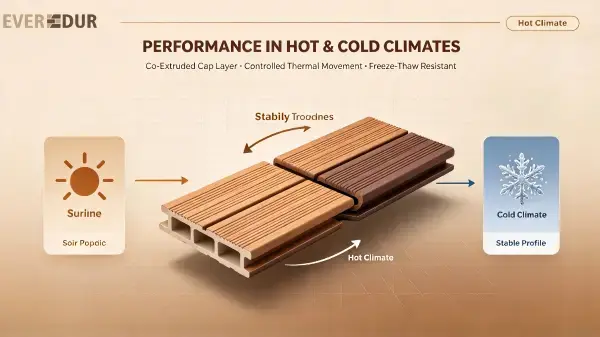
Brushed WPC Decking Performance in Hot and Cold Climates
When it comes to thermal performance, a lot of wood decking goods fall short. Solid materials all grow and contract when they get hot or cold. The question is how much and whether the installation system can handle that movement without any noticeable effects.
In places that are hot, like southern Europe, the Middle East, or the Sun Belt states of the US, dark-colored outdoor boards can get much hotter than the air around them on warm days. A well-made composite board will still be structurally sound at these temperatures, but it is still important to leave enough space between the gaps when installing it so that the board can expand linearly along its length. Everdur's second-generation co-extrusion decking, which is currently being made, and the next generation that will be coming soon are both designed to deal with thermal movement more effectively than earlier composite generations, with the goal of lowering the factors of expansion and contraction.
The main stressor in cold regions is the freeze-thaw cycle. When water gets inside something and then freezes, the ice's volumetric growth puts pressure inside the object. Materials that don't take much water, like the ones listed above, are naturally less likely to get damaged by freeze-thaw cycles because they don't have as much water to freeze. If the appropriate freeze-thaw cycle tests were passed, composite boards will keep their surface structure and dimensional shape as the seasons change.
In continental regions like Germany, the Midwest of the United States, and parts of Scandinavia, both extremes happen in the same year, so the material needs to be able to work in a wide range of temperatures. During the manufacturing process, the co-extrusion process bonds a cap layer to the core. This makes a board whose outer surface and structural core work together instead of coming apart when heated. Because they stay strong at different temperatures, brushed eco-friendly WPC formats have become popular in places where the weather changes a lot from season to season.SEND INQUIRY
Moisture and Color Stability of Brushed WPC Decking Outdoors
Color stability over time is a real concern for anyone choosing outdoor decking. Natural wood turns gray or silver after a season or two if it isn't oiled or stained regularly. Composite decking, especially goods with built-in UV protectors, keeps its color for a lot longer, but no outdoor material is completely resistant to damage from the weather.
The smooth finish is very interesting in this case. The fine texture spreads out light instead of reflecting it evenly. This makes minor surface wear less noticeable than it would be on a high-gloss smooth surface. After being outside for a long time, boards keep their visual warmth and tonal depth. Colors range from lighter ones like Ash Gray and Ivory to darker ones like Walnut and Dark Gray. This lets specifiers choose colors that will still look good as the material ages.
The hybrid matrix is helpful for jobs near the coast, where the salty air speeds up the surface wear and tear on metals and treated woods. There isn't any metal in it to rust, and the top hasn't been treated with salt to remove it. In solid profiles, the board's composition stays the same from the surface to the core. This means that even years of use don't show a structurally different interior.

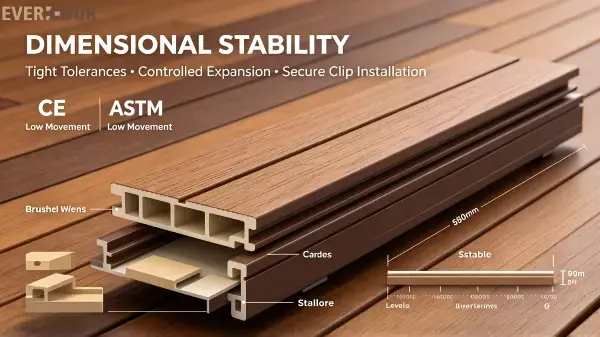
How Does Brushed WPC Decking Maintain Dimensional Stability?
Dimensional stability, or a board's ability to keep its original shape in different environmental conditions, is what makes a well-specified deck different from one that gets holes, bumps, and trip hazards after just a few seasons.
The most important factors are thermal growth and moisture uptake, which we already talked about. Composite boards made with the right amounts of HDPE and fiber, the right chemicals, and regular extrusion methods have tight size tolerances when they leave the plant and stay within those tolerances while they're in use. As part of the qualification process for certifications like CE and ASTM compliance, dimensional stability testing is done. This gives specifiers a way to compare products without just believing what the manufacturer says.
Installation practice also makes a big difference. The clip-and-joist method for installing composite decking lets you control the gaps between boards and the distance between them, so the deck can move without any problems. As long as the foundation is the right size and level, boards that are put down with the right amount of space between runs and at the ends will stay flat and stable over the course of the year.SEND INQUIRY
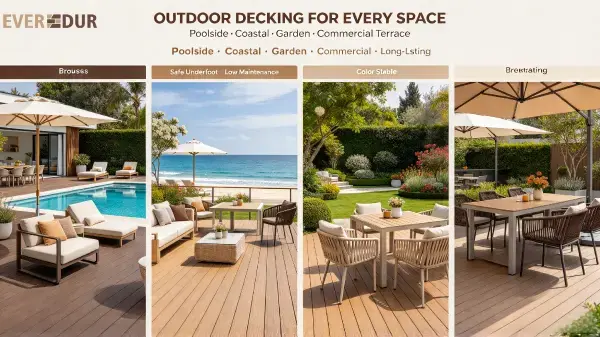
Brushed WPC Decking for Poolside, Coastal, Garden, and Terrace Areas
Decking materials must withstand various outside environments. Slip resistance and dampness tolerance are especially crucial for poolside positioning. In damp situations, brushed surfaces provide micro-friction that keeps your feet safe, making them better than smooth surfaces. The boards' plastic core doesn't expand, cup, or mold like wood counterparts near water since it absorbs little water.
Coastal sites face salty air, wind-driven rain, and high humidity year-round. Materials that must be stained, sealed, or painted often to be safe are high-maintenance. Composite decking doesn't need that care cycle, which is beneficial for holiday homes or rental properties where upkeep is difficult to schedule.
Composite decking is particularly popular in residential garden terraces and patios. The brushed texture gives visual warmth to plant-based spaces, while the dimensional stability keeps furniture legs level and the surface easy to walk on barefoot or with light shoes year-round. Garden terraces may compliment any type of building thanks to the large variety of hues available, from natural wood and teak to contemporary gray.
Hotel, restaurant, and commercial patios require durable materials that can withstand foot activity. Composite material doesn't require much care and retains its surface integrity after many uses, so it costs less to operate than wood solutions that need to be refinished every year or two.
Conclusion
Outdoor decking is both attractive and long-lasting, and its ability to withstand changes in temperature is what makes both of these things possible over time. Brushed WPC decking doesn't use coatings that wear off, but instead uses the right materials and surface engineering to deal with the real stresses that outdoor surfaces go through, like UV rays, biological growth, and changes in temperature. The brushed roughness makes the surface less slippery and gives it a different look without affecting the structure's function. This type of composite decking has been shown to work well on home patios, poolside areas, coastal properties, and business outdoor spaces in both Europe and the United States.SEND INQUIRY

FAQ
Q: How long does brushed WPC decking typically last in demanding outdoor climates?
A: If you choose the right product type and put it correctly, composite decking boards should last between 10 and 25 years, based on the environment and how well it was placed. As part of certification, products that meet CE and ASTM standards are tested for dimensional stability and UV protection. This gives an objective guideline for how long they should last instead of depending on promises that haven't been proven.
Q: Does the brushed surface wear down over time and lose its slip resistance?
A: The smooth look of good composite decking is not a covering on the surface; it is built into the board itself when it is made. In other words, it doesn't flake, peel, or wash off. Normal foot traffic over years of use wears down the surface over time, but the roughness will still work to keep the board from slipping for as long as it is properly kept and cleaned regularly.
Q: Can brushed composite decking be installed in both very hot and very cold climates?
A: Yes. The co-extrusion construction and composite mixture are made to keep the same size across a range of temperatures. When you install something correctly, including leaving enough space for expansion, you can account for the thermal movement that happens in all rigid materials. Products that are approved to both CE (European) and ASTM (North American) standards have been tried to make sure they work in the wide range of climates that are common in those regions.

Partner with Everdur: Request Your Decking Specification Today
If you need brushed WPC decking for a large-scale project or a small-scale outdoor makeover, Everdur can help. They offer full expert support and open delivery terms.
For construction firms and contractors: Technical data sheets, custom profiles, and project-volume prices can be sent to building companies and builders upon request. With 50 production lines that can make 30,000 tons of Everdur every year, the company can always meet project deadlines.
For building materials wholesalers and resellers: We offer competitive wholesale prices, a stable container supply of more than 1,500 units per year, and OEM/ODM services so you can bring high-quality goods to your market under your own brand name or as Everdur stock.
For end customers: Design advice, color matching outside of the standard range, and installation help you find the right specifications for your outdoor space before you place an order. The least you can order is 100 SQM.
All of Everdur's composite decking meets the standards set by the EU (CE), the US (ASTM D7039), and China (GB/T 24137). The products have FSC chain-of-custody certification, they meet REACH and RoHS standards, and they are made with recycled HDPE that meets E0 environmental standards.

Reach the Everdur team directly as a trusted brushed WPC decking manufacturer for samples, specifications, or pricing: violet@wpcsupplier.com
References
1. Clemons, C. M. (2002). Wood-plastic composites in the United States: The interfacing of two industries. Forest Products Journal, 52(6), 10–18.
2. Klyosov, A. A. (2007). Wood-Plastic Composites. John Wiley & Sons.
3. European Committee for Standardization. (2012). EN 15534: Composites made from cellulose-based materials and thermoplastics (usually called wood-polymer composites (WPC) or natural fibre composites (NFC)). CEN.
4. ASTM International. (2011). ASTM D7031: Standard Guide for Evaluating Mechanical and Physical Properties of Wood-Plastic Composite Products. ASTM International.
5. Stark, N. M., & Matuana, L. M. (2006). Influence of photostabilizers on wood flour–HDPE composites exposed to xenon-arc radiation with and without water spray. Polymer Degradation and Stability, 91(12), 3048–3056.
6. Hermanson, J. C., & Adcock, T. (2004). Moisture-related performance of wood-based exterior decking. Forest Products Journal, 54(4), 21–27.
7. Fabiyi, J. S., McDonald, A. G., Wolcott, M. P., & Griffiths, P. R. (2008). Wood plastic composites weathering: Visual appearance and chemical changes. Polymer Degradation and Stability, 93(8), 1405–1414.
Send Inquiry
Related Industry Knowledge
- Low MOQ Wood Grain WPC Decking: Perfect for Small Luxury Projects
- How to Choose Exterior WPC Cladding for Your Building
- How to Install WPC Fence Easily: Step-by-Step Guide for Beginners
- Grooved WPC Decking: Anti-Slip Flooring for Poolside & Walkways
- Best WPC Cladding Designs for Villa and Luxury Residential Projects
- How to Choose WPC Cladding: Material, Design and Installation Tips
- WPC Decking vs Wood Decking: Which Is More Durable and Cost-Effective?
- Low MOQ Traditional Cladding: Ideal for Small Traditional Projects
- WPC Villa Fence with Wood Grain: Enhance Your Villa’s Aesthetics
- Composite Screen Fencing: Privacy & Decorative Screen for 2026