_1777451497595.webp)
WPC Decking vs Wood Decking: Which Is More Durable and Cost-Effective?
If you're planning an outdoor deck and weighing your material options, you've likely come across this comparison more than once. The short answer is that WPC decking — wood-plastic composite — It usually lasts longer, doesn't get damaged by weather, and is cheaper in the long run than real wood, especially when used outside in Europe and North America. There's no denying that natural wood looks nice, but it needs to be maintained regularly because it is easily damaged by water, UV light, and organic rot. It costs money and takes time to do this. Composite deck boards, on the other hand, are made from recycled wood fiber and high-density polyethylene. This makes a material that doesn't break down like real wood does. Composite decking is even better now that it has a continuous polymer shell around the core thanks to new ways of making things like co-extrusion. This keeps the surface safer without using coats that come off. The most important things for homeowners, contractors, and people who buy building materials are how long they last, how well they hold up in bad weather, how much maintenance they need, how stable their sizes are, and how much they are worth over their lifetime. That's not to say that natural wood can't be used, but to give you a good idea of how each material works after being used outside for years.SEND INQUIRY
How Does WPC Decking Compare With Wood for Long-Term Durability?
When choosing decks, structural longevity is the first thing that should be thought about. This is especially true when the investment is meant to last through extreme weather and lots of foot traffic.
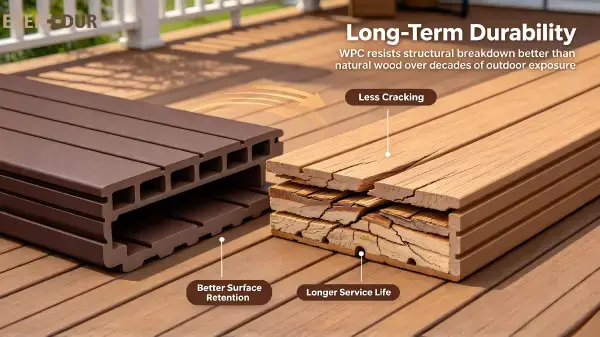
Whether it's made of softwoods like pine or hardwoods like ipe or teak, natural wood decking starts out in a pretty strong state. However, over time, being exposed to rain cycles, freeze-thaw stress, and living things weakens its cellular structure. Softwoods are especially likely to crack and split on the surface. Even thick oaks will check and break down over time if they are not treated regularly. Depending on the temperature zone, wood that hasn't been handled can lose a lot of its strength after five to seven years outside.
From the ground up, composite deck boards are made in a different way. Chemical preservatives are mixed with Grade A HDPE and wood powder in the body to make a material that doesn't soak up water like natural wood does. There isn't a grain structure that can break, no sapwood that can let fungi in, and no natural resin that wears away over time. The mass and make-up stay the same during the service time.
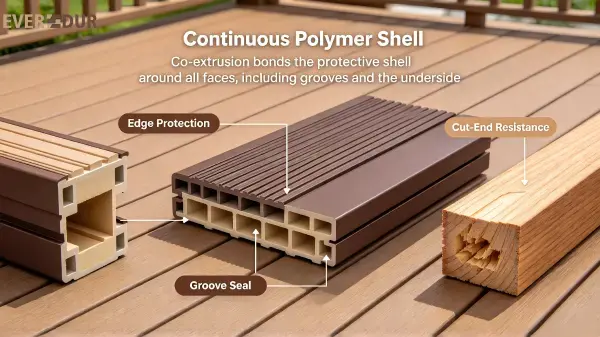
Where co-extrusion WPC decking specifically advances this further is in edge protection. Standard capped composites apply a protective layer to the top surface only, leaving grooves, cut ends, and undersides exposed. Co-extruded profiles bond the polymer shell continuously around all faces during manufacturing — including grooves and the bottom surface — which eliminates the weak points where moisture and mechanical stress most often initiate failure. This distinction matters across a full decade of outdoor exposure, particularly in coastal environments where salt air accelerates degradation, or in alpine regions where freeze-thaw cycles create repeated expansion and contraction stress.
In practical terms, co-extruded composite decking consistently demonstrates better surface retention — resisting scratching, indentation, and surface fiber breakout — compared with both natural wood and earlier-generation composite materials. This makes it a structurally sound choice for both residential outdoor spaces and higher-traffic commercial applications.
WPC Decking vs Wood: Moisture, Rot, and UV Resistance Outdoors
Water and direct sunlight are the two worst things for outdoor decking. Both work steadily for years, and neither material is completely safe, but their weaknesses are very different in type and intensity.
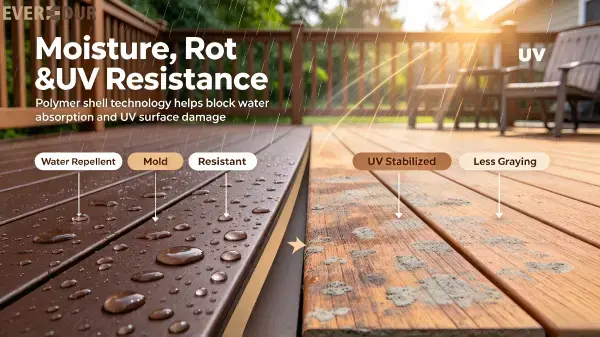
Natural wood can hold water. It takes in water from the air, grows bigger when it's rainy, and shrinks when it's dry. It never fully adjusts to its surroundings. This constant shifting of dimensions puts stress on fasteners, makes gaps in deck boards, and makes the surface ideal for mold and rot. Even though pressure-treated wood is chemically resistant to fungal decay, it still takes in water and changes shape. If you don't fix the surface once a year, it checks and turns gray very fast.
UV damage makes the problem worse. Long-term contact to sunlight breaks down lignin in wood fiber, which makes the surface shiny and increases the number of pores on the surface. This makes it easier for water to absorb. Both processes make each other stronger.
These types of failures can be fixed in the structure of composite materials, especially those made with co-extrusion technology. The polymer shell directly stops liquid water from absorbing it, and HDPE as a base material doesn't let mold or bugs grow like biological material does. The top cap also has UV protectors built in during casting, which makes the surface more resistant to damage from the sun. Independent UV testing after more than 2,000 hours of fast exposure shows that well-formulated co-extruded profiles don't change color much.
It is important to remember that no outdoor building material is completely maintenance-free. For example, trash will collect on and dirty the surface of any walkway. The main difference is that composite materials don't need chemicals to stay physically sound, but wood does..SEND INQUIRY
Which Decking Needs Less Cleaning, Sealing, and Ongoing Maintenance?
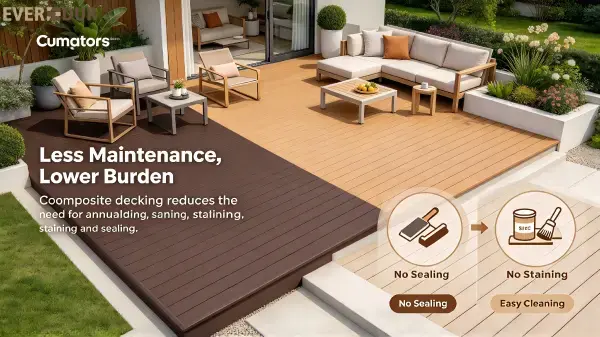
Natural wood decking carries a recurring maintenance schedule that many owners underestimate at the point of purchase. Depending on species and local climate, annual or biennial sanding, re-staining, or sealing is generally required to preserve appearance and slow decay. In humid climates, additional mold treatments may be needed between scheduled maintenance cycles. Over a ten-year period, the labor and material costs associated with wood upkeep are substantial — and often exceed the original material cost differential between wood and composite alternatives.
Composite outdoor boards reduce this burden considerably. Routine cleaning with water and a mild detergent is sufficient for the vast majority of soiling situations. There is no periodic sealing cycle, no need for staining, and no surface sanding requirement. This is particularly relevant for commercial installations or large residential projects where maintenance access is limited or costly.
WPC Decking Lifespan and Dimensional Stability in Changing Outdoor Climates
What a material does in all kinds of weather is directly related to how long it lasts. This includes both normal and extreme weather. Freeze-thaw cycles, heat in the desert, salt air at the coast, and heavy rain all put different kinds of stress on WPC decking materials.
Natural wood can usually be used outside for five to ten years without major repairs to the structure or appearance being needed. Hardwoods can make this range bigger, but they cost a lot more to buy.
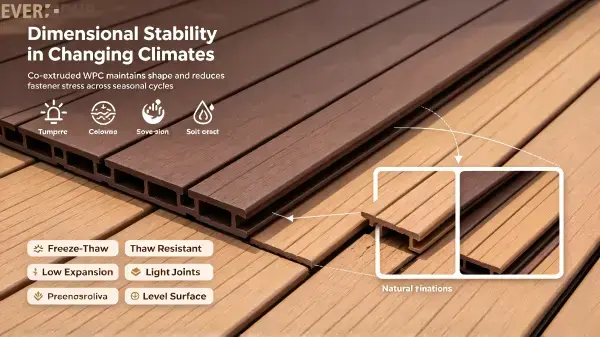
WPC deck boards produced with co-extrusion technology are commonly warranted for fifteen to twenty years, with solid profiles often carrying longer coverage than hollow ones. The polymer-encased core responds to temperature change with lower linear expansion coefficients than untreated timber, which means fewer gaps appear between boards across seasonal cycles and fastener stress is reduced.
It is possible to measure dimensional stability. When installed outside, boards that keep their shape over the seasons make decks that stay level, gap-free, and physically sound without having to be re-fastened every so often.
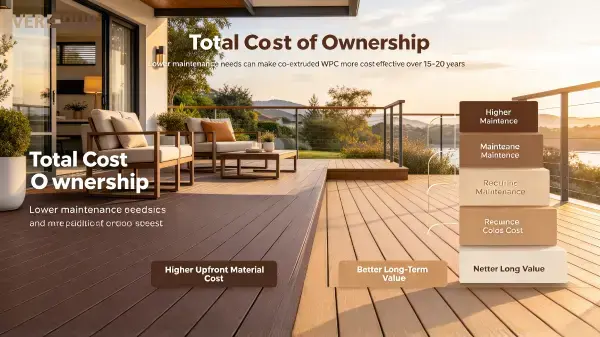
Is WPC Decking More Cost-Effective Over Its Full Outdoor Service Life?
When comparing the upfront costs of materials, it can be confusing to compare composite and natural wood if the full service window costs of upkeep, repair, and work are not taken into account. The lower cost of natural wood as a building material is quickly canceled out by the higher costs of sealing compounds, staining products, and labor, which will continue for the lifetime of the deck.
As a whole, composite decking costs more per square meter, but it doesn't need as much maintenance. After fifteen years of use, a co-extruded composite deck is often cheaper to own than a natural wood deck of the same size when all costs are considered. This includes the cost of at least one full cleaning cycle and the possibility of replacing some boards that are damaged.
The cost of energy and the environment are also taken into account. When compared to new-sawn hardwood decks, composite materials made from recycled HDPE and recovered wood fiber use less new wood and petrochemicals.
Conclusion
Co extrusion WPC decking has a legitimate role in outdoor construction, but the comparison consistently favors composite materials for long-term durability, climate resilience, and total cost across the service life. Co-extrusion technology has addressed the main weaknesses of earlier composite generations — particularly edge exposure and groove moisture ingress — making fully capped profiles a structurally sound choice for a wide range of outdoor applications. For buyers evaluating material options across Europe or North America, the evidence points toward composite outdoor boards as the more practical and cost-effective investment over time..SEND INQUIRY
FAQ
Q: Does WPC decking actually last longer than pressure-treated wood outdoors?
A: Composite deck boards will outlast pressure-treated wood in most outdoor applications. Pressure treatment slows the biological decay process, but it does not stop moisture absorption, UV surface damage or size changes. Co-extruded composites are structurally resistant to all three types of failure, and most manufacturers give fifteen to twenty year warranties.
Q: Can composite decking handle heavy rainfall and freeze-thaw cycles in Northern Europe?
A: Yes. In co-extruded composite profiles the polymer shell prevents water absorption at the board level. This prevents water from swelling inside the material, which is the primary cause of damage during freeze-thaw cycles. In parts of Northern Europe where there are repeated freeze-thaw cycles, composite decking remains more dimensionally stable over time than natural wood solutions.
Q: Is WPC decking genuinely more eco-friendly than natural wood?
A: The environmental image is specific to the product. Composite boards manufactured from salvaged wood fibre and recycled HDPE reduce the requirement for virgin timber and landfill-bound plastic waste. Our products comply with internationally recognized environmental standards such as FSC, REACH and RoHS. Responsibly made composite decking has a lower environmental footprint than newly harvested hardwood decking over the course of its production and service life.
Ready to Source Composite Decking That Meets International Standards?
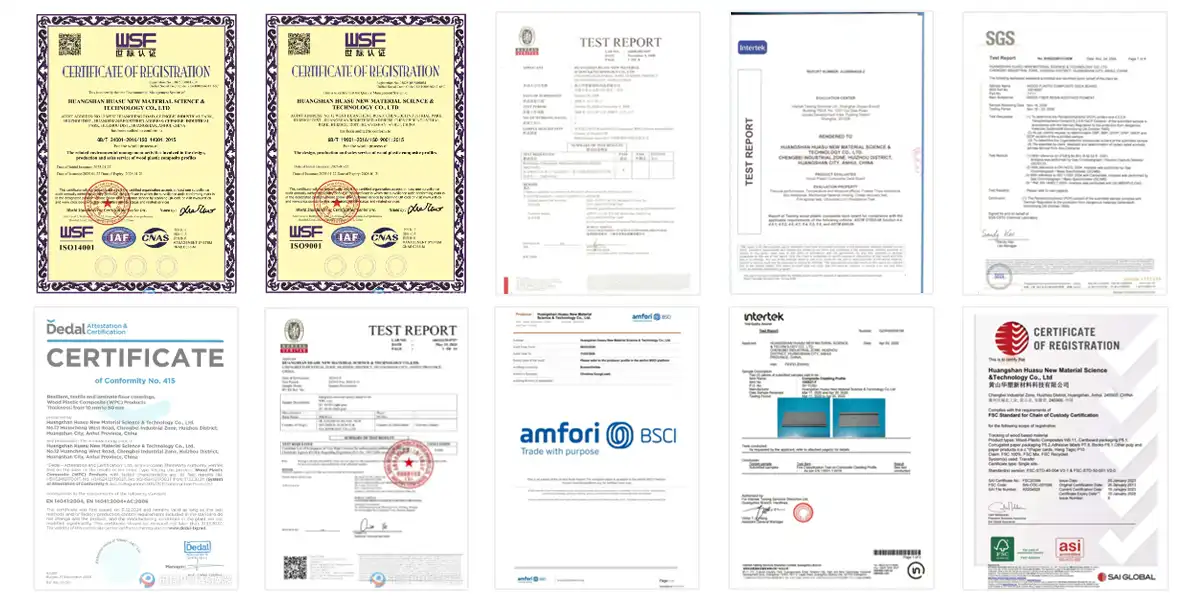
For construction firms and project developers: Everdur offers ODM/OEM project support with custom profiles, color matching, and technical documentation suited to large-scale specifications. Our products comply with EU CE marking requirements, US ASTM D7039 standards, and China GB/T 24137 — with environmental certifications including FSC responsible sourcing, REACH and RoHS compliance, and recycled content verification meeting E0 environmental standards.
For building materials wholesalers and resellers: Inquire about exclusive wholesale pricing structures, sample packs, and volume lead times. With over 50 production lines and an annual output exceeding 30,000 tons, Everdur supports consistent supply for established distribution networks across more than 60 countries.
For fence contractors and end customers: Request free design consultations and installation guidance tailored to your outdoor project. Whether you're specifying a poolside terrace, a garden deck, or a commercial walkway, our team can match profiles, colors, and surface textures to your brief.
As a dedicated WPC decking manufacturer, Everdur works with over 225 clients worldwide and is committed to transparent, professional service at every stage of the supply relationship.
Reach our team directly at violet@wpcsupplier.com to request samples, pricing, or technical data sheets.
References
1. European Chemicals Agency (ECHA). REACH Regulation: Understanding the Requirements for Construction Materials. Helsinki: ECHA Publications, 2022.
2. ASTM International. ASTM D7032: Standard Specification for Establishing Performance Ratings for Wood-Plastic Composite Deck Boards and Guardrail Systems. West Conshohocken: ASTM International, 2021.
3. Forest Stewardship Council. FSC Principles and Criteria for Forest Stewardship. Bonn: FSC International, 2015.
4. Morrell, J.J. Wood Preservation: Past, Present, and Future. Portland: Oregon State University Extension Service, 2020.
5. Stark, N.M., Rowlands, R.E., and Clemons, C.M. Wood-Plastic Composite Lumber vs. Traditional Wood Decking: A Comparison of Performance. Madison: USDA Forest Products Laboratory, Research Paper FPL-RP-659, 2019.
6. British Standards Institution. BS EN 15534: Composites Made from Cellulose-Based Materials and Thermoplastics — Test Methods and Performance Requirements. London: BSI, 2014.
7. Klyosov, A.A. Wood-Plastic Composites. Hoboken: John Wiley & Sons, 2007.
Send Inquiry

Related Industry Knowledge
- Low MOQ Hollow WPC Decking: Perfect for Small Residential Projects
- 2026 Brushed WPC Decking Trends: Stylish & Durable Options
- 3D Composite Decking vs Regular Composite: Which Is More Stylish?
- Top Traditional WPC Decking Manufacturers for Quality Products
- Brushed WPC Decking Installation: Achieve a Sophisticated Look
- Composite Screen Fencing: Privacy & Decorative Screen for 2026
- WPC Decking Maintenance Tips: Keep Your Outdoor Deck Looking New for Years
- WPC Cladding vs Vinyl Cladding: Which Is Better for Outdoor Use?
- Top Hollow WPC Decking Designs for Modern Gardens
- Hollow WPC Decking Maintenance Tips: Keep It New for 10+ Years