
Wholesale Eco-Friendly WPC Decking: Green Supply & Factory Prices
2026-10-27 22:04:56
Buyers, contractors and distributors get factory direct pricing on wood plastic composite (WPC) decking boards made from recycled HDPE and reclaimed wood fibres from wholesale eco-friendly WPC decking. Purchasing directly from a manufacturer at wholesale volume instead of via a trading business may sometimes translate into lower rates per square meter, more consistent batch quality and direct access to custom profiles, colours and lengths. The mature production lines of a manufacturer of green wpc decking for sale may shorten the delivery time and make the cost of the container for international orders predictable. When you're supplying a park or a resort or a residential complex or a series of retail establishments, you remove part of the markup by dealing directly with a manufacturer and make the certification paper trail easier to follow.
In this guide, we'll discuss why composite decking is truly a sustainable building material, how wholesale buyers can plan large outdoor projects around supply capacity, what raw materials are used in a quality board, how to evaluate a supplier before committing to a purchase order, and what customization options a factory can realistically offer. Whether you are the procurement manager of a construction firm, or the owner of a regional distribution business, these fundamentals can help you negotiate better terms and avoid costly sourcing missteps.SEND INQUIRY
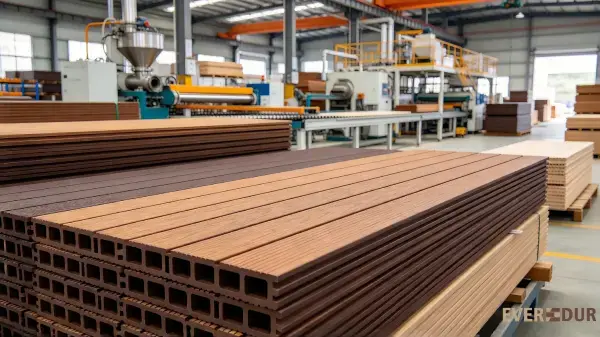

What Makes Eco-Friendly WPC Decking a Sustainable Choice?
Composite decking lives up to the reputation for being sustainable by keeping materials out of landfills and trees standing in forests. The boards are produced from recycled HDPE plastic and reclaimed wood fibres mashed together via co-extrusion, not fresh cut timber. This takes pressure off hardwood supply systems, while giving a valuable second life to post-consumer plastic, instead of being thrown in oceans or cremated.
Pressure treated wood has to be often stained, sealed or chemically treated to prevent rot however eco-friendly wpc decking doesn't. The importance of the absence of maintenance chemicals for the groundwater discharge in the area of gardens, swimming pools and public parks. During co-extrusion the shell is made and this also helps to prevent moisture absorption. This way, boards hold their form during freeze-thaw cycles without cracking or warping as solid wood sometimes does.
Durability has a role to play in the sustainability equation too. A deck that lasts 15-20 years without replacement will create less manufacturing waste during its life than a deck that needs repair after a few seasons. Composite boards may often be re-processed at the end of their life cycle, completing the material loop rather than going to waste.
Buyers who want materials suitable for green building certifications or municipal projects normally seek for recycled content percentages and low-VOC manufacturing records, both of which composite decking can generally provide with lab reports and third-party certificates.

Wholesale Eco-Friendly WPC Decking for Large Outdoor Projects
Large outside constructions – municipal boardwalks, resort terraces, housing complexes – need a regular flow of green wpc flooring, not one powerful batch. Wholesale ordering from a plant with many manufacturing lines allows project managers to prepare for phased installations without fear of colour mismatches between shipments or unexpected stock shortages.
The price is normally negotiated on a volume of container basis, not price per board. So the procurement teams should alter the way they ask for quotations. Flat unit price is good but asking for pricing per square meter + freight to the closest port allows a closer comparison amongst vendors. Minimum order quantities also differ per supplier, thus verifying MOQs early on prevents surprises when a project timeframe is established.
Lead time is as important as pricing for commercial scale decking. A factory with dozens of extrusion lines can normally handle a mid-size order with little disruption to the other customers, whereas a smaller workshop can run into a roadblock when an order goes beyond a few thousands sq. meters. If you are a buyer managing resort or park contract with definite completion deadlines, it is advisable to talk to suppliers about the current production backlog before signing a purchase agreement.
The other side of wholesale planning is consistent batch quality. “Boards produced in different runs should be matched in colour, texture and dimension, and that is a function of a supplier's quality control process, not chance,” he says. With a shipment, requesting batch test results confirms that what is received is what was authorized by Green America during sampling.SEND INQUIRY

Recycled HDPE and Wood Fiber in Eco-Friendly WPC Decking
The end performance of a composite board is determined nearly entirely by the raw material combination that goes into it. A common recipe is a mixture of wood powder, high density polyethylene and a minor amount of additives to promote flexibility and UV resistance. Most quality boards are made from a plastic backbone of Grade A recycled HDPE, plastic that has been previously used, cleaned and reprocessed, rather than virgin resin.
Wood fibre content often originates from waste sawdust, offcuts or other by-products from furniture and building activities, rather than from newly felled wood. The co-extrusion process combines these two streams to generate a board with an exterior protective layer coating an inner core providing the product the resistance to moisture, stains and insect damage without the requirement for a painted or sealed surface.
The ratio of wood fibre to plastic influences weight, flexibility and surface roughness. Boards with a greater plastic ratio perform better in humid or coastal locations whereas boards with more wood content provide a more natural grain look at the expense of somewhat less water resistance. Good providers will tell you this ratio since it impacts warranty terms and estimated service life.
Because the final product is basically a mix of two recyclable materials, a deck made from a recyclable composite can usually be reprocessed into new deck boards or other moulded plastic-wood products at the end of its service life, instead of becoming construction trash. This closed loop potential is one of the clearest sustainability advantages composite decking has over chemically treated timber.

How to Choose an Eco-Friendly WPC Decking Supplier?
There's a lot more to choosing a decking provider than just comparing quotations side by side. Certification documentation is a good place to start—ask for CE marking data for the European market, ASTM test reports for North America, and any recycled content verification the supplier can supply. If a supplier is not ready to release these papers before an order is made, then it is worth re-thinking.
Certification is just as important as the ability to produce almost. Ask how many manufacturing lines the factory has and what their realistic monthly output is so they can commit to your order without holding up other customers. Suppliers are more dependable partners for time-sensitive projects when there is transparency about their present workload.
Test samples are still the most realistic means of gauging quality before placing a big purchase. Request actual samples rather than depending on images or spec sheets, and examine them for consistent colour, surface texture, and board density. For UV stability, a brief outdoor exposure test over a couple of weeks may beat any brochure promise.
How a supplier addresses difficulties after shipping is sometimes foreshadowed in the communication approach during the bidding stage. If a supplier is willing to address technical issues face-to-face and put warranty details in writing, it's usually a sign of a company that's willing to back up long-term customers. A good indicator of ongoing dependability is to look for long-term customers or repeat distributor connections.
Buyers looking for an eco-friendly wpc decking supplier should also verify that the business can make test reports for their desired export market since the standards range considerably for Europe, North America and other areas.SEND INQUIRY

Factory Supply of Eco-Friendly WPC Decking with Custom Options
Standard catalogue colours and sizes will suffice for many projects, but bespoke needs occur frequently enough that a flexible factory makes procurement of recyclable composite deck substantially simpler. Besides the basic swatch card, the ability to customize colours means architects are able to match decking to the palette of a building and not settle for a near approximation.
The choice of surface texture – embossed wood grain, brushed or sanded — can effect both the look and the slide resistance, an important consideration for things like pool decks, public walkways and commercial settings where there may be liability issues. If a manufacturing can change the patterns in the moulds to create texture, then generally they can do it without a huge increase in minimum order.
The dimensional customisation includes width, thickness and length of the board as well as hollow vs solid core construction based on load needs and budget. Hollow boards are less expensive and lighter, while solid boards tend to have stronger load capacity for commercial foot traffic.
Less stated, but very important, is customizing climate to the material. Coastal locations with high humidity or salt exposure need a different plastic-to-wood ratio than a dry inland environment. A supplier who understands the regional construction requirements may generally propose a formulation instead of offering the same board everywhere.
Distributors that develop a private-label line of green wpc flooring frequently start with OEM colour matching before moving into unique profiles. OEM and ODM agreements allow resellers to put their name on decks made to their specification, which is important for enterprises trying to establish a localized product line rather than just reselling a generic import. A facility with continuous material refreshes – about annually, trending toward lighter and more weather-stable formulas – offers long-term partners the opportunity to access incremental improvements without having to renegotiate a new supplier arrangement each time.

Conclusion
Choosing wholesale eco-friendly wpc decking is about balancing pricing, certification and dependability of supply against the unique needs of your project. Buying straight from factories cuts out excessive mark-up and gives customers greater control over customization, lead times and paperwork. Whether you're providing decking for a single resort terrace or decking throughout many distribution areas, the whole procedure is far more predictable when you're dealing with a transparent manufacturer.SEND INQUIRY

FAQ
Q: What is the typical minimum order quantity for wholesale WPC decking?
A: MOQs are determined by the supplier, however many manufacturers have MOQ in the region of 100 square meters for standard profiles, and occasionally lower for sample or trial orders ahead of a full container commitment.
Q: How long does eco-friendly composite decking typically last outdoors?
A: Quality composite decking normally lasts from 10 to 25 years depending on the formulation and co-extrusion technique utilized Proper installation and drainage may push the range toward the upper end.
Q: Can WPC decking be recycled at the end of its service life?
A: Most composite boards (made from HDPE and wood fibre) may be recycled for further decking or other moulded items. A recyclable composite deck is a more circular choice than chemically treated timber, which usually finds its way to a landfill.

Get Wholesale Eco-Friendly WPC Decking Pricing From Everdur
Everdur is an eco-friendly wpc decking producer of wpc decking. Their boards are supported by EU CE, US ASTM D7039 and China GB/T 24137 compliance, Recycled Content certification and E0 environmental grade for minimal formaldehyde emission. We interact with buyers at various points in the supply chain and give bespoke help, not a one size fits all quotation.
For construction companies: bulk pricing with guarantyd lead times and technical drawings.
For decking contractors: Free sample kits and install support supplies.
For construction materials wholesalers: special tiered wholesale prices, plus marketing tools.
Resellers & Distributors: Flexible MOQ Options & Private Labelling Support.
For end customers: free design consulting and layout planning before you purchase.
For a price, certification documentation or physical samples, please contact our team at violet@wpcsupplier.com. We reply with simple answers, not commercial pressure.

References
1. ASTM International. (2023). Standard Specification for Establishing Performance Ratings for Wood-Plastic Composite Decking Boards.
2. European Committee for Standardization. (2022). EN 15534 — Composites Made from Cellulose-Based Materials and Thermoplastics.
3. Forest Stewardship Council. (2023). FSC Standards for Responsible Forest Management and Chain of Custody.
4. U.S. Environmental Protection Agency. (2022). Sustainable Materials Management Program Report.
5. International Organization for Standardization. (2015). ISO 14001 Environmental Management Systems — Requirements with Guidance for Use.
6. Standardization Administration of China. (2018). GB/T 24137 — Determination of Performance Requirements for Wood-Plastic Composite Decking.
Send Inquiry
Related Industry Knowledge
- Traditional vs co-extruded decking: which is better?
- Why Wood Plastic Composite Fence Panels Are Better Than Wood Fencing
- Wood Grain Balcony WPC Decking: Elevate Your Balcony’s Aesthetics
- 2026 Guide to Commercial WPC Decking: Hotels, Malls & Public Areas
- Weather Resistant Swimming Pool WPC Decking: Durable in All Seasons
- Exterior WPC Cladding for Commercial Buildings: Bulk Discounts Available
- Exterior WPC Cladding: Durable & Stylish External Wall Solution 2026
- How to Choose High-Quality Co Extrusion WPC Decking for Your Garden
- Waterproof WPC Cladding: Perfect for Coastal and Rainy Areas
- Hollow WPC Decking Maintenance Tips: Keep It New for 10+ Years