
Why Wood Plastic Composite Fence Panels Are Better Than Wood Fencing
2026-10-28 22:16:39
If you're searching for fence supplies for your next project, you've probably noticed that regular lumber isn't what it used to be. Wood Plastic Composite Fence Panels are manufactured from a blend of recycled HDPE and wood fibres and represent a much more moisture, pest and temperature resistant barrier than solid timber. While cedar or pine boards might split, warp or lose their colour in a few seasons, composite panels need minimal care to retain their shape and colour. This means fewer calls, lower lifetime costs and a product that genuinely works year after year for homeowners, builders and distributors across Europe and North America. Wood has its charms but when you add up the expenses of sealing, staining, restoring rotting boards and insect damage the figures never line up in its favour. This article compares composite panels to wood and discusses the importance of durability and maintenance for outdoor applications and why this material is a smart choice for privacy fences, boundary walls and practically any size decorative screening project.SEND INQUIRY
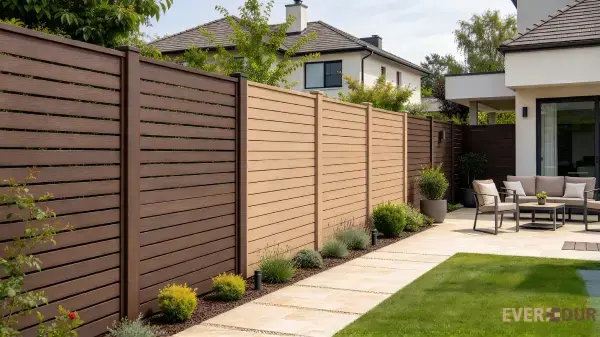

How Do Wood Plastic Composite Fence Panels Compare with Wood Fencing?
Natural wood has been the default choice for fencing for generations, but it has inherent limitations. Wood absorbs water and swells, and then as it dries it splits along the grain. If the boards are untreated, they provide an accessible target for termites and other wood-boring insects. Treated wood also loses its protective coating after a few seasons if exposed to rain and sun. Composite panels have a distinct approach. They are constructed from a mix of wood powder, high density polyethylene and additives and the polymer coating prevents moisture from reaching the core material and they do not give the same food source for bugs.
And visually the distinction between the two has become quite a little smaller as well. Embossed, brushed and wood-grain finishes resemble the texture of cedar or teak so closely that the average homeowner can't tell the difference from a few yards away. Over time, the materials do in fact drift apart. Composite decorative fence panels are dimensionally stable over temperature changes. Solid wood shrinks and expands with humidity, which causes fasteners to loosen and gaps to appear over time. Add in the expense of sealing, new boards and work, and composite panels tend to break even or out-perform wood in five to seven years, for consumers weighing the upfront price against the lifetime cost.

Wood Plastic Composite Fence Panels vs. Wood for Outdoor Durability
And that's where the discussion is decided. Durability. The outside fence is exposed to rain, harsh sun, frost and, in many locations, salt air or considerable amounts of snow during the year. All of these will cause the wood to shrink, swell, grey or decay from the inside. Fungi decay often starts at the points where the fence contacts the ground and here is where most wood fences first fail.
Composite panels are designed to better resist that cycle. UV stabilizers are included into the substance to prevent colour fade. Testing demonstrates little colour change after thousands of hours of direct UV exposure. The polymer shell does not absorb water, but repels it, so no swelling occurs at the base and no soft spots appear around fastenings over time. Structural integrity is able to weather hot summers and frigid winters equally, with little to no warping, cracking or splintering noted over a service life that generally varies between 10 and 25 years depending on the panel type employed.
The manufacturers provide hollow and solid profiles for the panels, and the purchasers may choose the lighter and more economic panels, or denser panels, designed to withstand greater winds or for additional privacy. That trust is reflected in the warranty coverage, with hollow panels typically covered for up to 15 years and solid panels for up to 20 years. natural wood fence has no meaningful guarantee, since rot and insect damage is considered natural wear and not a fault of the product.SEND INQUIRY

Are Wood Plastic Composite Fence Panels Easier to Maintain?
Probably the one thing that keeps customers away from wood fence is maintenance. A wood fence will need to be regularly sanded, stained or painted to keep it looking nice, and missing even one year of sealing will let moisture in that will ultimately cause damage. That adds up to real money and real weekends spent on care, not just enjoying your yard or outside area, over a decade.
Wpc outdoor fence panels take away much of that strain. Regular maintenance often consists of cleaning the panels with a garden hose when dust, pollen or light stains accumulate. Staining, painting or seasonal sealing is not required. The organic food supply that insects are usually looking for is not in the material, so you won't have to look for termite tunnels or soft, decaying areas around the base.
This maintenance-light profile is just as important to fence contractors and property managers juggling several sites as the quality of the first installation. Overall, fewer calls for repairs, less time spent on seasonal touch-ups, and a lesser likelihood of liability from a collapsed or rotten panel all contribute to a better client experience. If you travel a lot, or just don't want to spend your weekends maintaining a fence, composite panels will probably be a more realistic long-term solution for homeowners, particularly in areas with heavy rains or big changes in seasonal humidity that may be hard on bare timber.

Wood Plastic Composite Fence Panels for Long-Lasting Outdoor Privacy
Privacy fence has special requirements beyond durability. Panels have to obstruct sightlines, resist wind load, and yet look decent on both sides of the property boundary for years at a time. Composite panels deal with this using solid and slatted designs, so purchasers may choose for complete privacy covered or a more modern, semi-open slatted aspect depending on the project needs.
Standard widths are usually in the range of 140mm to 220mm, with thicknesses from 20mm to 40mm, so designers may balance weight, cost and wind resistance for a specific location. Available in standard lengths of 1.8m, 2.2m and 2.9m to suit most residential and commercial layouts, more design flexibility is provided with horizontal or vertical installation orientations, without any change to the underlying material performance.
The variety of colours also impacts selections for long-term privacy fences. Finishes including ash grey, cedar, coffee, walnut and teak provide property owners a means to complement existing architectural or landscape themes, but bespoke colour matching is possible for bigger projects requiring a particular brand or building palette. Years after it's installed, the privacy screen still appears near to its original colour because the panels resist fading under UV exposure, which is a big difference from painted wood fence that visibly greys and peels after only a few of seasons outside.SEND INQUIRY

Why Choose Wood Plastic Composite Fence Panels for Outdoor Fencing?
Durability and minimal maintenance aside, there are a few practical reasons customers across all categories keep coming back to composite fence solutions. For many commercial purchasers, sourcing of material matters nowadays, and panels constructed from recycled HDPE and wood fibre have a more circular manufacturing narrative than virgin lumber cut down for fence usage.
Customizability is another difference between composite and normal wood decking. Surface textures can be brushed, sanded or embossed to create a wood grain and projects can be designed to suit a specific aesthetic Special material formulations can be customized to meet regional climate conditions whether it's stronger UV resistance for sun-drenched regions or improved freeze-thaw stability for colder climates. Those with flexible lines of manufacture may frequently respond to these needs without extensive lead times since builders on larger projects sometimes demand dimensions or hues which are not conventional on the basic colour card.
Certifications are especially crucial for business buyers and resellers, who must prove conformity to their own customers. ISO, CE, FSC, REACH and RoHS support provide builders and distributors with something tangible to offer customers worried about safety or environmental impact. Composite decorative fence panels are combined with modular installation, compatible with typical aluminium or steel post systems, therefore they tend to simplify the specification process and actual installation timescale over custom-milled wood fencing.

Conclusion
Wooden fences still have a place in certain rustic or budget-friendly designs, but for most outside applications the upkeep hassle and shorter lifespan are hard to ignore. More predictably, wood plastic composite fence panels have consistent proportions, are rot and insect resistant, and have a surface that stays colorfast long after painted wood would require repainting. Composite fence, whether you require privacy, elegant screening or just a simple border, often delivers a more constant balance of beauty and long-term durability.SEND INQUIRY

FAQ
Q: How long do wood plastic composite fence panels last compared to wood fencing?
A: Composite panels have a life of 10 to 25 years, depending on the kind of panel, but untreated wood fence often requires partial replacement in 5 to 10 years because of decay or insect damage.
Q: Do composite fence panels fade in direct sunlight?
A: Quality composite panels include UV stabilizers to help prevent colour change, and testing shows very little fading even after long-term exposure to UV rays. But, over many years outside, some gradual mellowing of colour is natural.
Q: Can wood plastic composite fence panels be installed with standard fence posts?
A: Most composite panel systems are intended to be compatible with ordinary aluminium or steel posts, making installation easy for contractors acquainted with traditional fence hardware.

Switch to Wood Plastic Composite Fence Panels: For Construction Firms, Fence Contractors, Resellers, and End Customers
The help needed will range from project to project. For construction companies and fence contractors: Bulk pricing and technical drawings to accelerate specification and quotation. Wholesale prices to construction materials wholesalers and re-sellers only. Free samples to test quality first hand before you commit to a container purchase. For the end customer: Free design consultation and installation support to keep the project on track from planning to the final rinse-down. Everdur is a wood plastic composite fence panels manufacturer. Our panels are manufactured to fulfill the EU CE regulations, the US ASTM D7039 standards and the China GB/T 24137 standards. Our panels are also certified with Recycled Content and E0 environmental compliance. Samples, price lists or technical data, contact violet@wpcsupplier.com for your next fence project.

References
1. ASTM International. Standard Test Method for Evaluating Deflection and Load Capacity of Wood-Plastic Composite Deck Boards, Stair Treads, and Guards.
2. Forest Stewardship Council. FSC Certification Standards for Wood and Composite Building Products.
3. European Committee for Standardization. EN 15534 Series: Composite Products Made from Cellulose-Based Materials and Thermoplastics.
4. United States Department of Agriculture Forest Products Laboratory. Wood Handbook: Wood as an Engineering Material.
5. International Organization for Standardization. ISO 9001 Quality Management Systems Requirements.
6. National Association of Home Builders Research Center. Durability Assessment of Alternative Decking and Fencing Materials.
Send Inquiry
Related Industry Knowledge
- Weather Resistant Decorative Composite Fencing: Durable & Stylish
- Is WPC composite fencing stronger than wood?
- 2026 Guide to Waterproof WPC Decking: Sizes, Styles & Prices
- How to Choose the Right Residential WPC Decking for Your Budget
- Wood Grain Grooved WPC Decking: Stylish & Functional Outdoor Flooring
- WPC Villa Fence: Luxury Fencing for Villas & High-End Properties
- Top WPC Composite Fencing Manufacturers in 2026
- 3D Composite Decking vs Regular Composite: Which Is More Stylish?
- Top Composite Screen Fencing Manufacturers in 2026
- Top Hollow WPC Decking Designs for Modern Gardens