
2026 Guide to Commercial WPC Decking: Hotels, Malls & Public Areas
2026-10-21 16:59:41
Are you planning a hotel terrace, retail mall plaza or public promenade exterior surface renovation in 2026? You probably have to balance durability, maintenance costs, appearance and code compliance all at once. Commercial WPC decking (wood-plastic composite decking for high-traffic outdoor application) has shown to be a viable solution to that multi-variable problem all across Europe and North America. It’s made from a blend of wood fiber and recycled HDPE that resists moisture, UV deterioration and heavy foot traffic and doesn’t require the annual sealing cycles characteristic of timber. This handbook supports procurement managers, landscape architects and project developers in all phases of the procurement process from the selection of the correct application and structural profile to sample approval and container logistics. You'll also receive direct answers to most of the questions buyers ask before committing to a large transaction. Whether it’s a pool deck for a 500-room resort or a pedestrian promenade in a city center, the information you get is based on genuine manufacturing parameters and proven performance data so you can proceed with confidence.SEND INQUIRY

Which Hotel, Mall and Public Areas Suit Commercial WPC Decking Best?
Not all composite decking is created equal for all outdoor surfaces, so the best place to start is with material that matches the surroundings.
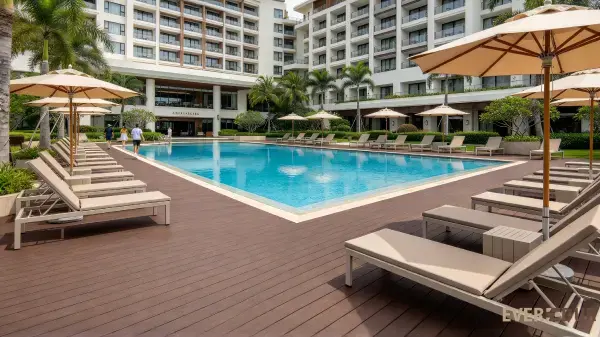
Hotel and resort environments are among the most demanding situations. Pool decks, rooftop dining terraces, spa walks and coastal promenades all present the challenge of high guest numbers with constant dampness. after such conditions timber warps and bleaches and splinters after a few seasons. A co-extruded composite board, however, is encased in a polymer shell that inhibits water intrusion at core level — so it’s structurally stable even if hosing down is a daily ritual. Slip resistance is a must here, and textured surface finishes such as brushed or deep-embossed wood grain profiles give the friction coefficient health-and-safety teams need around water.
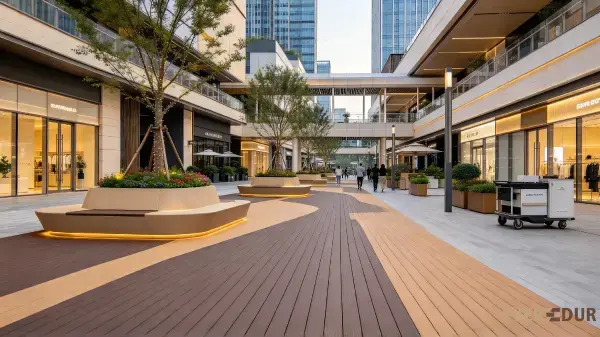
The exterior of shopping malls and open-air retail corridors exhibit a varied set of settings. Foot counts can be in the several thousands each day, trolleys and service vehicles increase point-load stress and the surface has to be presentable under intensive inspection from brand aware tenants. Composite boards with solid or reinforced hollow profiles can withstand numerous load cycles without developing the soft patches that hollow timber boards inevitably do. Consistency of color across hundreds of square meters is also important – UV-stable pigment compositions maintain their appearance after over 2,000 hours of accelerated weathering testing, which means years of kerb appeal without repainting.
Procurement rules could apply to public sector projects such as municipal boardwalks, seaside promenades, park pavilion decks, and transit station platforms that private developers might not have to contend with. Many European public tenders today include EN 15534 composite performance benchmarks, or require FSC chain-of-custody documentation for the wood-fibre component. Structural performance criteria of the ASTM D7032 standard may be applicable to projects in the United States. Compliance paperwork is dramatically reduced when you use certified composite decking.
Of course, there are instances where composite decking isn't as practical. Indoor enclosed flooring, places exposed to harsh chemical spills or surfaces that require load ratings outside of the profile's engineering standard. The material guaranties predictable long-term performance when used within its demonstrated range.
Traffic Loads and Cleaning Cycles Commercial WPC Decking Must Handle
Commercial grade composite profiles are designed to perform structurally under continuous pedestrian and equipment load, unlike residential profiles.
On a hotel pool deck during high season you can have 300 to 500 guests a day, each of which might cause repeated flexural stress across the breadth of the deck. Public boardwalks near seaside attractions may have similar numbers every day of the year. The essential engineering parameter is the permissible span of the board between joists under a given distributed load – generally stated in kilonewtons per square meter. The profile selection discussion in the next section is very important for commercial standards because solid co-extrusion profiles usually allow shorter joist spacings with better load ratings than hollow profiles of comparable width.
Another commonly underestimated stress vector during the procurement of commercial composite deck is the cleaning frequency. Hotel maintenance crews often pressure wash pool decks two to four times a week throughout the operating season. Nightly rotary scrubbers may be used by the mall management. Composite boards must stand up to mechanical abrasion from brushes, and the chemical effects of alkaline degreasers and chlorine-based sanitizers. The HDPE outer shell in co-extruded profiles offers a mostly non-porous surface that does not absorb cleaning chemicals or harbor colonies of mold – a real operational benefit vs untreated timber, which needs to be retreated annually in spring to discourage mold.
Another unappreciated aspect is thermal cycling, particularly in climates with significant seasonal change. In a southern European or southwestern US environment a dark-colored composite surface can attain surface temperatures of 55–65 °C in direct summer heat, then plummet to near-freezing overnight in autumn. Dimensional stability is how well the board stands up to cumulative expansion and contraction to govern whether fastener holes get elongated, gaps close unevenly, or boards crown with time. Quality composite compositions use chemical stabilizers that keep this movement within tolerable tolerances. Always ask a manufacturer for measured linear thermal expansion data, rather than just a generic statement of stability.SEND INQUIRY
Hollow or Co-Extruded: Which Profile Fits Your Commercial WPC Decking?
Two variables that most directly affect how a board functions after a decade of commercial usage are the geometry of the profile and the process of manufacture.
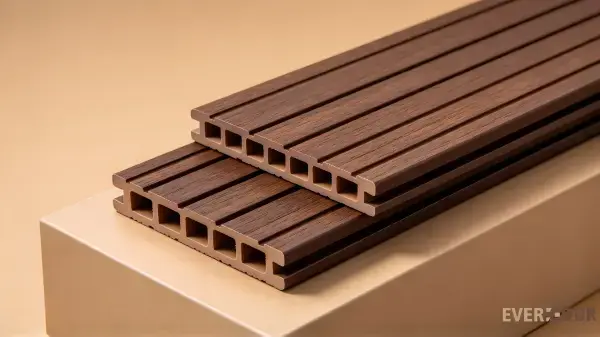
In hollow profiles extrusion, internal chambers decrease the weight of the board and the cost of the material per linear meter. They are suitable for reduced traffic uses – terrace margins in boutique hotels with fewer guest numbers, balcony edges in retail or decorative walks in low-footfall park settings. The weight advantage also reduces transportation costs and makes installation easier for smaller contractor crews. The trade-off is that the resistance to concentrated point loads is lower and the tendency for the internal chambers to hold moisture is greater if the end-grain cuts are not sealed prior to installation.
Profiles co-extruded with a polymer protective layer fused to the composite core during extrusion, rather than as a post-process coating, exhibit considerably higher resistance to surface abrasion, staining and moisture penetration. The bond between the cap layer and the core is continuous and not an adhesive bond, and so will not peel or delaminate under thermal stress. Solid co-extrusion is the most recommended specification by project engineers for hotel pool surrounds, public boardwalks and retail plazas where the surface must last 15 to 25 years with minimal board replacement.
There is a middle ground: hollow co-extruded profiles that offer the weight reduction of a chambered core and the cap-layer protection of co-extrusion. These are a reasonable compromise for roof-top applications where structural dead-load limitations govern material selection, or for large-area projects where budget constraints preclude totally solid profiles. To avoid costly modifications to the specification mid-project, load calculations and the design of the subframe should be discussed with the manufacturer before the profile selection is finalized.

Joist Spacing, Expansion Gaps and Drainage for Commercial WPC Decking
Subframe design is as critical as board selection, but is the last minute feature that procurement teams most often leave until the last minute.
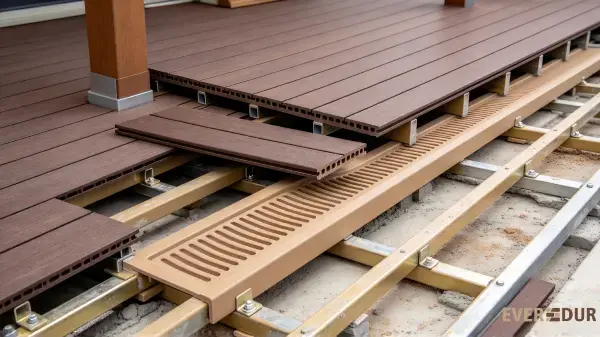
The spacing of the joists should be chosen by the proven spanning ability of the board, not by convention. A solid 25 mm thick co-extrusion board rated for a given distributed load will often require joists at 300-400 mm centers for commercial pedestrian use. One of the most typical mistakes is to increase the joist spacing to save material expense without re-calculating the load rating of the board, leading to board deformation and fastener pull-out over time. Always get the manufacturer’s load-span chart for the exact profile specified. Have the subframe design checked against local structural codes.
Expansion gaps between ends of commercial wood grain WPC boards and around immovable objects such as columns, drains, and walls must accommodate the linear expansion coefficient of the board over the projected temperature range of the installation site. The identical composite board in a Nordic climate with an annual temperature variation of 60 °C performs differently than on a Mediterranean rooftop. Too narrow gaps cause buckling, too large gaps cause trip hazard and debris collection. The manufacturer should calculate the site specific gap based on the thermal expansion data of the board and the climate zone of the project.
The third subframe variable that directly influences long-term performance is drainage. Water that collects under a composite deck will foster mold development on the subframe and speed up corrosion of metal joists, and in freeze-thaw situations it can cause the whole structure to heave. A minimum subframe slope of 1-2% toward drainage channels and sufficient ventilation spaces between the deck surface and the substrate provide a dry underside. Co-extruded boards are naturally more tolerant to wet subframe conditions than hollow profiles but proper drainage design reduces maintenance intervention for any system.SEND INQUIRY
From Sample Approval to Container Loading: Buying Commercial WPC Decking
For a large commercial project, the procurement process usually takes eight to fourteen weeks from initial inquiry to products arriving at port, and understanding each step minimizes the possibility of delays.
So where do you start? Logically, with sample approval. A good manufacturer will send you physical color and profile samples and third-party test reports on slip resistance, flexural strength, UV stability and chemical composition. By reviewing these documents, along with specification sheets, you may verify that the product satisfies the performance criteria of the project, and that it meets any applicable regulatory standards as well. European projects are benchmarked against CE certification to EN 15534-4 and chemical content compliance with REACH. ASTM D7032 and ASTM D7039 are the most widely used structural and compositional benchmarks in commercial requirements for North American projects.
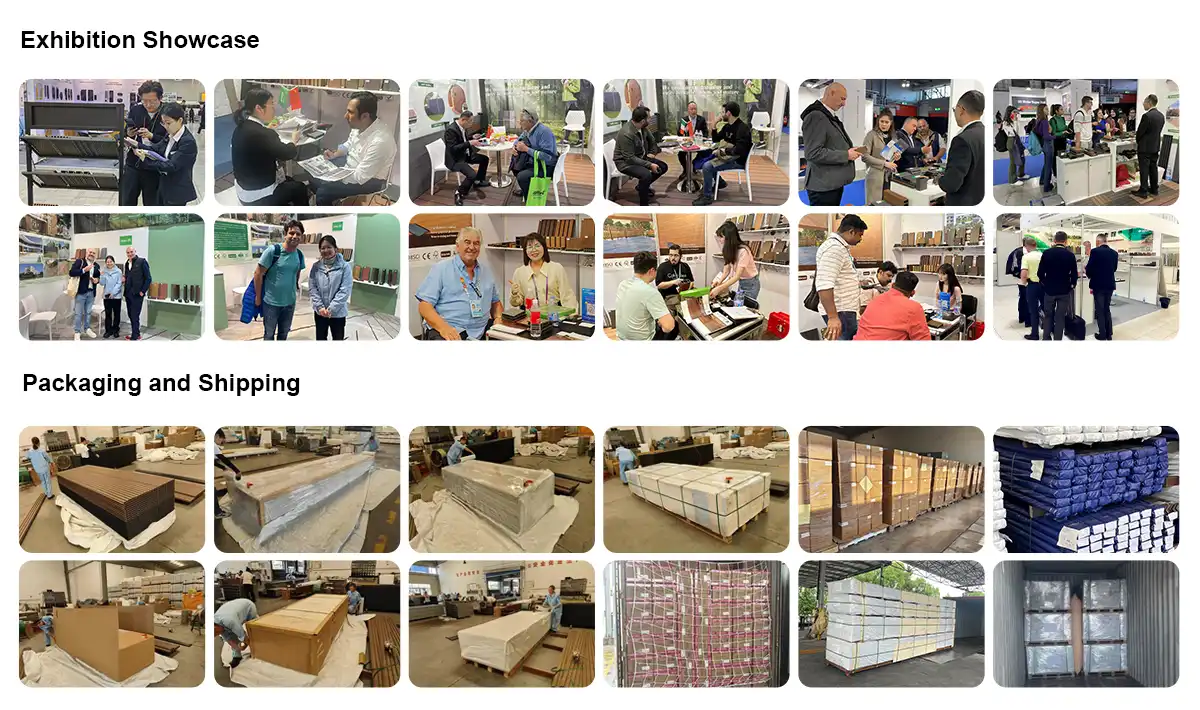
Once the samples are approved, a purchase order agreement should be created that details the board dimensions, color, surface texture, quantity, packing method, lead time and the certificates needed for import clearance. Packaging is more important than it seems: boards shipped on wooden pallets with PE film wrapping arrive in better condition than loose-loaded boards, and pallet dimensions have an influence on container utilization. An exporter with export experience will supply you with a packing list that makes maximum load and minimum paperwork for customs.
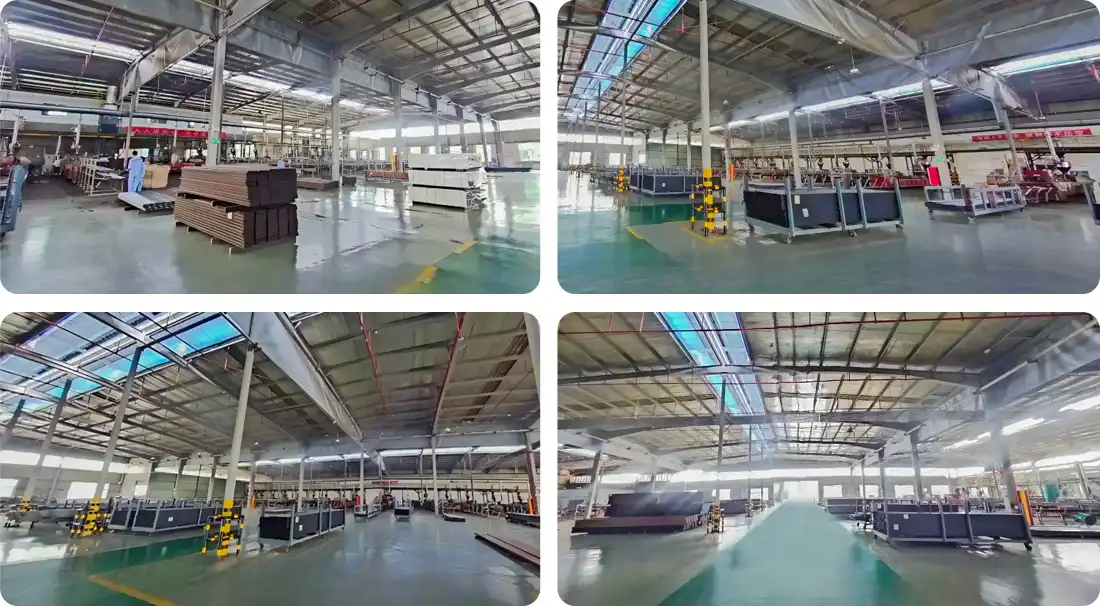
Supply continuity is a matter of container loading and lead time management. A business with many manufacturing lines and an annual output capacity of thousands of tons can handle rush orders and phased deliveries which a smaller operation cannot. At the point of deposit, confirm the factory’s production schedule and book a production slot to secure your project timeline. The FOB prices from Shanghai or Ningbo, the two main export ports for composite decking, are a good landed-cost basis for your budget, as well as current freight rates from a forwarder.
Conclusion
In 2026, choosing the correct commercial WPC decking for a hotel, retail, or public infrastructure project is a systematic decision, not a single product choice. There is an interaction between profile type, subframe engineering, cleaning compatibility, regulatory compliance and procurement logistics. If you have a co-extruded board accurately designed for its load environment, put on a properly drained subframe with accurate expansion gaps, and purchased from a manufacturer whose certificates fulfill the import requirements of your market, you will get the service life the specification guarantees. The purpose of the information in this handbook is to provide procurement teams with a practical framework for those decisions, limiting the amount of surprises between design intent and long-term performance.SEND INQUIRY
FAQ
Q: What is the realistic service life of composite decking in a high-traffic commercial setting?
A: Service life depends on profile type, installation quality, and maintenance frequency. Solid co-extruded profiles in well-drained, correctly specified subframes typically deliver 15 to 25 years of structural performance in commercial environments. Hollow profiles in lighter-traffic applications generally fall in the 10 to 15-year range. Both figures assume routine cleaning and periodic fastener checks rather than any structural maintenance.
Q: Does composite outdoor decking comply with European and North American slip-resistance requirements for public spaces?
A: Brushed and embossed surface textures on composite boards are specifically engineered to meet slip-resistance thresholds required for wet commercial surfaces. In Europe, EN 13893 and the DIN 51130 R-value classifications are the most commonly cited references. In North America, the ADA (Americans with Disabilities Act) sets minimum static coefficient of friction values for accessible surfaces. Always request the manufacturer's documented slip-resistance test data for the specific surface finish being specified, as values vary between profiles.
Q: Can composite decking boards be cut and drilled on-site without voiding performance warranties?
A: Yes. Composite boards can be cut with standard carbide-tipped circular saw blades and drilled with conventional woodworking bits. End-grain cuts on co-extruded boards should be sealed with a compatible end-cap or sealant to prevent moisture ingress at the exposed core. Most manufacturers provide end-cap accessories for this purpose. On-site modification does not void structural warranties provided the installation follows the manufacturer's published guidelines.
Ready to Source Composite Decking for Your Next Commercial Project? Contact Everdur
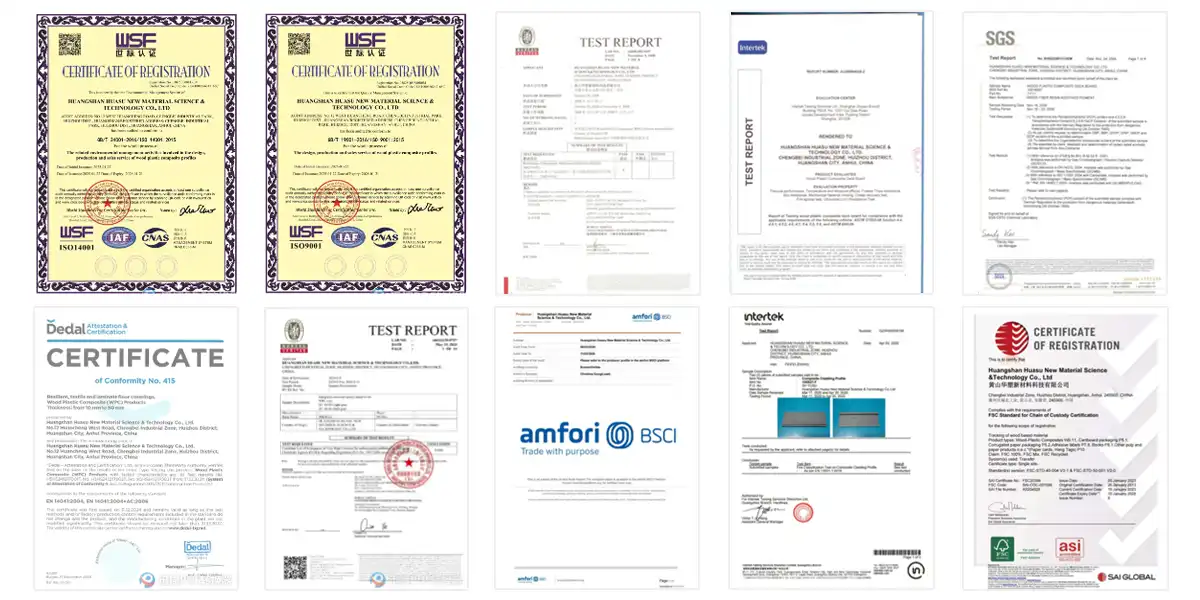
For construction firms and landscape architects: Everdur provides detailed technical documentation — including load-span tables, certified test reports, and BIM-compatible product data — to support specification and tender submissions. Our composite outdoor decking complies with EU CE marking (EN 15534), US ASTM D7039, and China GB/T 24137, and carries FSC, ISO 9001, ISO 14001, SGS, INTERTEK, and ROHS certifications. Recycled-content documentation is available for green building submissions.
For building materials wholesalers and resellers: We offer structured wholesale pricing tiers, container-load programmes, and free physical samples to support your product range expansion. With over 1,500 containers shipped annually, we maintain the production capacity and export documentation experience to keep your supply chain consistent.
For end customers and project developers: Share your project drawings or area measurements with us and we will provide colour samples, a preliminary material estimate, and installation guidance at no charge.
Everdur is a commercial WPC decking manufacturer with 16 years of production experience and active customers across more than 60 countries. Reach out to our export team directly at violet@wpcsupplier.com to request samples, certifications, or a project quotation. We respond to all commercial inquiries within one business day.
References
1. CEN (European Committee for Standardization). EN 15534-1: Composites Made from Cellulose-Based Materials and Thermoplastics — Test Methods for Characterization of Compounds and Products. Brussels: CEN, 2014.
2. ASTM International. ASTM D7032: Standard Specification for Establishing Performance Ratings for Wood-Plastic Composite Deck Boards and Guardrail Systems. West Conshohocken, PA: ASTM International, 2021.
3. ASTM International. ASTM D7039: Standard Test Method for Sulfur in Gasoline, Diesel Fuel, Jet Fuel, Kerosene, and Other Distillate Fuels by Monochromatic Wavelength Dispersive X-Ray Fluorescence Spectrometry. West Conshohocken, PA: ASTM International, 2015.
4. Forest Stewardship Council. FSC Chain of Custody Certification: Requirements for Organizations Buying and Selling FSC-Certified Products. Bonn: FSC International, 2022.
5. European Chemicals Agency (ECHA). REACH Regulation (EC) No 1907/2006: Understanding REACH. Helsinki: ECHA, 2023.
6. DIN Deutsches Institut für Normung. DIN 51130: Testing of Floor Coverings — Determination of the Anti-Slip Property — Workrooms and Fields of Activities with Slip Danger. Berlin: DIN, 2014.
Send Inquiry

Related Industry Knowledge
- Can hollow WPC decking be used for balconies?
- Weather Resistant Brushed WPC Decking: Perfect for All Climates
- How to Choose the Right Residential WPC Decking for Your Budget
- How to Choose WPC Landscape Walls for Your Garden or Park
- WPC Decking vs Wood Decking: Which Is More Durable and Cost-Effective?
- 3D Composite Decking: Elevate Your Outdoor Space with Textured Flooring
- Composite Screen Fencing for Patios & Gardens: Privacy & Aesthetics
- Composite Screen Fencing: Privacy & Decorative Screen for 2026
- How to Choose High-Quality Co Extrusion WPC Decking for Your Garden
- Hollow WPC Decking Maintenance Tips: Keep It New for 10+ Years