
Can WPC decking tiles be used in coastal areas?
2026-11-18 19:25:25
Yes, WPC deck tiles may be utilized in coastal locations if you choose a co-extruded (capped) tile, a light to mid hue, and corrosion resistant hardware. Salt does not damage the wood-fiber and polyethylene body of a tile. The actual threats are on the surface, heat, moisture at the cut edges and rusting metal parts beneath. This guide describes each danger based on data from USDA studies and ASTM standards. It also has a buying checklist. It may be used by online sellers, retail purchasers and rooftop contractors that send WPC decking tiles to seashore clients to reduce returns and one-star ratings.
Need some samples for a coastal test? Everdur is a WPC decking tiles manufacturer with 50+ manufacturing lines and 100 SQM MOQ. Email us your target market, tile size (300x300 mm or 400x400 mm) and color at violet@wpcsupplier.com. We'll send you some example alternatives and a coastal spec sheet. Then you may have your own salt-air trial before you decide on an order.SEND INQUIRY
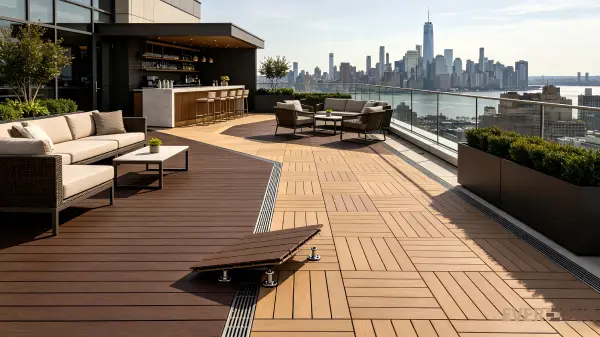
What Makes WPC Decking Tiles Suitable for Coastal Areas?
There are several recurring reasons why coastal decks collapse. Wood rots, finishes flake, inexpensive metal rusts. A good composite tile takes away most of the pathways for failure. This part tells you why the material is holding up and where it still needs aid from you.
What are WPC decking tiles made of?
Wood-plastic composite (WPC) is a mixture of wood fiber and plastic resin. These composites are usually made up of 50 to 60 percent wood by weight and 40 percent or more thermoplastic, according to the USDA Forest Products Laboratory. Our WPC decking tiles are made from recycled HDPE (high density polyethylene, a sturdy plastic used in pipes and bottles), wood fiber and useful additives. Each tile is co-extruded, meaning that one pass creates an outer polymer shell around the core.
The tiles are 300×300 mm or 400×400 mm and 23 mm thick. These WPC decking tiles connect using an interlocking click technology. The owner of a balcony requires no contractor and no special equipment. That's important to renters and DIY purchasers, who account for most of the beachfront apartment market.
Why do coastal conditions change the buying rules?
Four stress elements hit at the same time at the sea: salt, humidity, bright sun, wind-blown sand. Timber has problems with all four. Most of these are handled successfully by plastic-rich composites such as WPC decking tiles. Salt is mostly chloride, and chloride is far more corrosive to metal than it is to polyethylene.
Thus a tile body may be sound, but a cheap screw under it rusts away. Remember that place. It guides all the recommendations in this guide from the kind of tile to the support layer you put beneath the tiles.SEND INQUIRY

Can Saltwater and Sea Spray Damage WPC Decking Tiles?
WPC deck tiles will not be killed by salt alone. Damage often comes in via the side doors: dampness in exposed edges, sun-weakened surfaces and corroding hardware. Once you know what the side doors are, you may recognize a poor product before you sell it or place it on a retail shelf.
Does salt corrode the tile body?
No. Steel reacts with chloride. Polyethylene does not. Inside click deck tiles, the wood fiber is the weak link. In early outdoor exposure, wood particles expand with moisture, the USDA says. This swelling causes microcracks in the plastic matrix and enables decay fungus to access the wood. For much of the route, the co-extruded shell remains intact. Shell quality is our main test of every coastal tile.
Which parts rust earliest near the ocean?
First the metal rusts. Simpson Strong-Tie's 2025 advice shows the scale using Australia's AS 4312 corrosivity zones. In zone C4 the steel loses 50-80 µm/year while in zone C5 the steel loses 80-200 µm/year. In the extreme CX zone the loss exceeds 200 µm. The same recommendation is recommended for the maritime and coastal zones C4 to CX, 316 stainless steel. Also, installers are instructed to use the same metals for fasteners and connectors to prevent galvanic corrosion.
The danger of corrosion in WPC deck tiles is in the support layer: joists, clips, screws and pedestals. Specify that layer as carefully as the tile. A corroded clip is as bad as a damaged tile for a 1 star rating.SEND INQUIRY

How Do WPC Decking Tiles Compare with Wood in Coastal Climates?
One of the most common questions we get from buyers is do WPC decking tiles beat wood at the beach. It is contingent upon the work. Below is a comparison of the two documents on the concerns that push returns and reviews.
| Issue near the sea | Wood deck tiles | WPC decking tiles |
|---|---|---|
| Surface finish | Needs regular staining or sealing in salt air | No staining or sealing required |
| Rot and decay | Decays when it stays wet | Resists rot while the outer shell stays intact |
| Splinters | Splinters as the surface weathers | No splintering from weathering |
| Size consistency | Varies by board and moisture level | Extruded to uniform 300 mm or 400 mm sizes |
| Installation | Screws, tools, and often a contractor | Click-together, tool-free |
There's a pattern to the table. Wood requires continual effort, but WPC decking tiles need a proper specification up front. That transaction is good for sellers, since the labor moves from the customer's weekend to your product choice.
Where does WPC win for seaside sellers?
Fewer maintenance complaints are an internet seller's best gain. A buyer of WPC deck tiles will seldom post a comment on staining if the consumer never stains a deck. Uniform tile size also reduces the uneven-seam concerns that affect listings. Our tiles are produced from 50+ manufacturing lines which are organized using 5S methodology. For a trial order of 100 SQM and replenishment of 1,000 SQM, the same method will be used.
Where does wood still hold an edge?
Honesty fosters trust so here is the other side. Some purchasers like the inherent grain and texture of real wood. Brushed, embossed and wood-grain surfaces in hues like Teak, Walnut and Cedar help bridge much of that gap with WPC. Wood is still a good option if your consumer wants genuine timber and is willing to maintain it regularly.SEND INQUIRY

Are WPC Decking Tiles Resistant to Moisture and High Humidity?
Moisture is the key factor for testing durability of any wood-based composite. WPC decking tiles have minimal water absorption, however they are not waterproof. The amount of water entering is determined by the shell, the edges, and the age of the surface.
How much water can a tile absorb?
Segerholm et al. (2012) said that the surface layer of a WPC snap-together decking may be degraded by light and water. This makes it less resistant to moisture and enables water get to the core. The same investigation indicated the maximum moisture absorption for samples affected by the white-rot fungus. Decay fungus require around 25% to 30% moisture to flourish. A tile that remains dry never attains this status. A tile with a fractured shell and a foundation that does not drain well may.
Why are cut edges the weak spot?
Mankowski et al., 2015) refer to reports of deformation at cut ends due to moisture absorption. Cutting shows the core and a balcony always means cut tiles along the walls. Press the edges against a wall or trim, keep them clear of standing water, and cover them with an edge strip when possible. Ask your provider about edge trims that will match each color of your WPC decking tiles.
Will mold and mildew grow in humid air?
Surface mildew eats dirt, pollen, and leaf litter, not the plastic. Dirty surfaces accelerate it up in humid coastal air. A monthly washing will eliminate the food supply. Your customer care staff may include a one-page cleaning card in the language of the buyer with each retail package to stave off "mold" concerns.SEND INQUIRY

Do WPC Decking Tiles Fade or Crack Under Coastal UV Exposure?
The sun is harsh on the coast because water and light sand reflect more light on the deck. All WPC decking tiles will change color over time. The issue is how much, how quickly and how evenly.
How does coastal sun change the color?
This was researched by Matuana, Jin and Stark (2011) in the USDA. Oxidation of the wood by sunlight darkens uncapped composites, which then lighten when colored wood components are washed off and the surface becomes rougher. A clean cut of the HDPE top layer that discolors considerably. It absorbed UV radiation and reduced oxygen supply at the wood-plastic contact.
Our lab data indicates the same. Our WPC deck tiles are rated for little fading after 2,000+ hours of UV exposure. That's around 83 days of continuous light operation, so consider it a comparative, not a calendar guarantee. Real coastal sun, spray and heat may vary site to site.
Color choice helps, too. The Dark Gray and Coffee absorb more heat and display the salt coating more vividly. Ash Gray, Ivory and Stone Gray conceal dust better and are cooler. For lead SKUs in sunny beach marketplaces, we propose mid tone grays and teak hues.
Do tiles crack from heat and expansion?
Plastic-rich boards expand and contract with temperature changes. If the WPC deck tiles are tightly installed to a wall with no spacing, then cracks and buckling will occur. Leave the space for perimeter expansion your setup instructions says to.
ASTM D7032 standard for WPC deck boards include requirements for UV resistance, freeze-thaw resistance and slip resistance. You may ask any provider, including us, for test results that meet it. Certification papers (ISO, FSC, CE, SGS, RoHS, REACH, Intertek, ASTM) are available upon request for our range.SEND INQUIRY

Which WPC Decking Tile Features Matter Most Near the Sea?
Not all WPC deck tiles are suitable for a deck at the beach. A small screening list will save you the cost of a container of the incorrect goods. The following characteristics address the most prevalent coastal issues like color drift, broken clips, slick surfaces and damaged edges.
What should you test on a sample set?
Order samples and check out these four things before you scale up:
- Outer shell: Coextruded Please provide a cross-section shot of a tile from the batch you will be getting. A continuous casing surrounding the core limits water intrusion and UV damage. We co-extrude that shell at the same time we make the tile. If you see a flat, even line of shell in the shot, that's a positive indication. Gaps or thin places are a caution.
- UV reliable color system: Check how the vendor checks color. Our WPC decking tiles exhibit very little fading after more than 2,000 hours of UV exposure. Ask for the report, the test procedure and the color-difference reading, not just the pass line. Then put a sample out in the external environment for a month. A new tile adjacent to a picture illustrates shade drift that a data sheet may obscure.
- Wet-grip finish: Brushed, embossed and wood-grain finishes provide better traction for feet than a smooth face. Coastal decks become wet from rain, mist and spray, therefore test wet traction with your own sample. ASTM D7032 contains a test for slip resistance of WPC deck boards. Inquire about performance on the particular surface you expect to sell on.
- Solid click edges and secure packaging: Broken clips and chipped edges are the reason for numerous 1-star evaluations. "Take two tiles, snap them together and pull them apart by hand five times. Finally, inspect the margins for white stress marks. Tiles are packed in PE film on wooden pallets with panel protection against edge damages during maritime freight.
These four criteria eliminate most weak tiles before you pay for a container. Your customer care personnel will have information to address queries buyers may have with confidence.
How can private-label sellers reduce returns?
Material is important, but so is packaging and instructions. Retail packaging must include installation guides in each target language, a cleaning card and a notation on cut-edge maintenance. We provide ODM and OEM service like custom colors, surface textures and dimensions so your box and your tile may fit your brand.SEND INQUIRY

Are Capped WPC Decking Tiles Better for Coastal Environments?
Tiles with a cap (co-extrusion) have a protective polymer coating on a core of wood-plastic. Research has shown that this layer helps WPC deck tiles withstand coastal environments. It also has limitations that every customer should be aware of.
What does a cap actually do?
Capped decking was introduced in around 2010. They said the cap keeps the core dry, keeps water out, and shields it from weathering and biological deterioration. Mankowski and colleagues examined the claims in lab and field experiments, reporting early findings in 2015. Separately, the Matuana team found that a transparent HDPE lid reduced UV discolouration compared with uncapped composites. Both results prefer capped WPC decking tiles near the water.
Where can a cap still fail?
The value of a cap lies on the area it covers. Sand can scratch. No limit on cut-ends. If the bonding is poor the layer may lift. Ask your provider how thick the shell is, and what covers cut edges. If the response is ambiguous, consider it as a caution.
Retail buyers of snap-together decking are more exposed. Weak cap = higher return rates. Returns decrease next season's order. This is why category purchasers seek for factory audits, for verification of quality system. Our factory is ISO 9001 and ISO 14001 certified and the factory floor is managed using 5S. We created that method for purchasers that anticipate 5 to 40 containers every season and can't afford to miss a delivery window.SEND INQUIRY

How Should WPC Decking Tiles Be Installed in Coastal Areas?
Installation decides whether good WPC decking tiles last. The table below is Everdur's buying guide, adapted from the AS 4312 distance bands. Local wind and surf can stretch these distances, so adjust for your site.
| Exposure zone | Distance from surf | What to specify |
|---|---|---|
| Surf zone (C5) | Within about 200 m | Co-extruded tiles, light or mid colors, 316 stainless steel or aluminum supports, monthly fresh-water rinse |
| Near-shore (C4) | About 200 m to 1 km | Co-extruded tiles, 316 stainless steel hardware, rinse every one to two months |
| Coastal inland (C3) | About 1 km to 10 km | Co-extruded tiles, galvanized or stainless hardware, rinse each season and after storms |
Use the table as a starting point, not a guarantee. A balcony on the eighth floor of a seafront tower sees more salt spray than a ground-level patio 500 m inland.
What base and drainage does a seaside deck need?
Water must leave the deck. Build on a firm base with a slight slope, and keep airflow under the tiles so the surface dries after rain. On rooftops, protect the waterproof membrane and use adjustable pedestals instead of fixing into the slab. Standing water feeds mildew and speeds edge swelling, so clear debris from drainage paths each season.
Which fasteners and supports work best?
Choose 316 stainless steel, aluminum, or polymer supports in the surf and near-shore zones. Do not mix metals in the same assembly. A galvanized screw touching a stainless bracket corrodes faster in wet salt air. Order extra clips with every shipment. A spare clip costs pennies, while a missing clip causes an uneven seam and a complaint.
How do real projects use WPC decking tiles near the sea?
Three buyer types use our tiles in different ways. Each one has its own pressure points.
An online seller serving apartment renters wants speed and low returns. A 12 SQM balcony needs about 134 tiles at 300×300 mm (12 ÷ 0.09). The tiles click together in a day, and a renter can lift them when moving out. This is the "no construction, done today" format that sells well on Amazon, Wayfair, and independent stores.
A home-improvement retailer wants shelf-ready stock before spring. Our export mix reaches more than 60 countries, and our customers include building-material chains such as Lidl, Hagebau, Hornbach, Hellweg, and Globus. Buyers in that channel need boxes, installation sheets, and delivery before the Q1 window closes.
A property manager renovating a rooftop terrace needs a fast job with no damage to the waterproofing. A 500 SQM terrace needs about 3,125 tiles at 400×400 mm (500 ÷ 0.16). Because tiles lift out one at a time, a crew can swap a damaged piece without lifting the whole deck.SEND INQUIRY

How Can You Maintain WPC Decking Tiles in Salt-Air Conditions?
Maintenance is light but not zero. Salt crystals, sand, and dirt build up on any outdoor surface, including WPC decking tiles. A short routine keeps the finish clean and protects the shell from abrasion.
What is a simple coastal care routine?
Rinse the deck with fresh water once a month, and again after storms. Add mild soap and a soft brush for stubborn spots. Sweep sand away, because sand scratches the surface like fine sandpaper. Inspect clips and edge trims twice a year. A monthly rinse takes minutes, while a wood deck demands sanding and sealing every year.
In salt-heavy zones, we suggest a tighter schedule. Rinse every two weeks during peak summer, when salt spray and dust combine with heat. Put this schedule on the cleaning card in your retail box.
What should you avoid?
Avoid wire brushes and steel scrapers, which scratch the shell of click deck tiles. Skip paints and sealers, which tiles do not need and which can peel. Keep pressure-washer pressure low and use a wide fan nozzle. Wipe grease or oil spills quickly. If a stain resists soap, ask your supplier before trying a stronger cleaner.SEND INQUIRY

How Long Can WPC Decking Tiles Last in Coastal Environments?
Our tiles carry a 5-year warranty and a design service life of 10 to 25 years. Where a coastal deck lands in that range depends on four things: shell quality, color, hardware, and care. Plan for the shorter end in surf-zone sites and the longer end inland.
What decides the real lifespan at the beach?
The USDA's 20-year research summary shows that durability depends on moisture control. Keep the shell intact, keep edges covered, and keep water moving off the deck. Add corrosion-resistant hardware and a simple rinse routine. With those pieces in place, the body of your it is rarely the part that fails.
Check warranty terms in writing before you order. Ask what the warranty covers, how replacement tiles and clips work, and how long the supplier stocks matching colors. Color matching matters because a replacement tile from a different batch can look off beside old ones.
How does Everdur support coastal sellers and buyers?
Everdur brings 16 years of manufacturing experience to the job. We run 50+ production lines with a yearly capacity of 30,000 tons, and about 80% of our output goes abroad. Our 225 customers include more than 100 active partners across Europe, America, Asia, Africa, and Oceania. That scale supports snap-together decking seasonal peaks, so a Q2 sales spike does not leave your listing out of stock.
Orders start at 100 SQM, with FOB Shanghai or Ningbo. We release upgraded product lines about every 12 months, with lighter boards, higher strength, and lower thermal expansion. If you need a color, texture, or size beyond the standard range, our ODM and OEM team can build it.SEND INQUIRY

Conclusion
WPC decking tiles work well near the sea when you specify them with care. Salt does not rot the polyethylene body. Sun, moisture at cut edges, and corroding hardware are the real threats, and each one has a clear fix. Choose a co-extruded shell, a mid-tone color, and a wet-grip surface. Pair the tiles with 316 stainless steel or aluminum supports in high-salt zones. Rinse monthly. Ask for written test reports and warranty terms before you order. These steps cut the complaints that hurt online ratings and retail return rates. They also help you plan stock for the Q2 and Q3 peak with confidence.SEND INQUIRY

FAQ
Q: Can WPC decking tiles be installed right on the beach?
A: Yes, but install WPC decking tiles on a stable, drained base and not directly on loose sand. Sand shifts, holds water, and scratches the surface. In surf-zone sites, use co-extruded tiles, light or mid colors, and 316 stainless steel or aluminum supports, as outlined in our exposure table above.
Q: Do WPC decking tiles get too hot in coastal sun?
A: Dark WPC decking tiles get hot. Plastic-rich surfaces absorb heat, and open coastal sites have little shade. Light and mid-tone colors such as Ash Grey, Ivory, and Stone Grey run cooler. Test a sample in direct afternoon sun before you choose your lead color.
Q: Are WPC decking tiles slippery when wet?
A: Surface texture decides grip. Brushed, embossed, and wood-grain finishes grip better than smooth faces. ASTM D7032 includes a slip resistance test for WPC deck boards. Request the result for the exact finish you plan to sell, and test a wet sample yourself.
Q: Do I need to seal or stain WPC decking tiles near the ocean?
A: No. WPC decking tiles do not need staining or sealing. A fresh-water rinse removes salt and dirt. Sealers and paints can peel and create a mess, so skip them. Keep a short care card in each retail box to guide your customers.
Q: Which hardware works best under WPC decking tiles near salt water?
A: Use 316 stainless steel, aluminum, or polymer supports in surf and near-shore zones. Simpson Strong-Tie's 2025 guidance recommends 316 stainless steel for coastal zones C4 to CX and warns against mixing metals. Order spare clips with every shipment.
Q: What is the minimum order for coastal-ready WPC decking tiles?
A: Our minimum order starts at 100 SQM, with FOB Shanghai or Ningbo. At 300×300 mm that is about 1,111 tiles, and at 400×400 mm it is about 625 tiles.

Ready to Run a Coastal Trial With Everdur WPC Decking Tiles?
Everdur ships WPC decking tiles to more than 60 countries, and our team can quote a coastal trial order from 100 SQM. Send violet@wpcsupplier.com your target market, tile size, color, and packaging needs. As your WPC decking tiles supplier, we will reply with sample options, a coastal spec sheet, and test reports on request.SEND INQUIRY

References
1. USDA Forest Products Laboratory (Ibach, R.E. and Clemons, C.M.), 2024. "Fungal and Moisture Durability of Wood-Plastic Composites: Summarizing 20 Years of Forest Products Laboratory Research," General Technical Report FPL-GTR-303.
2. BioResources (Segerholm, B.K., Ibach, R.E., and Wålinder, M.E.P.), 2012. "Moisture Sorption in Artificially Aged Wood-Plastic Composites," 7(1), 1283-1293.
3. Polymer Degradation and Stability (Matuana, L.M., Jin, S., and Stark, N.M.), 2011. "Ultraviolet Weathering of HDPE/Wood-Flour Composites Coextruded with a Clear HDPE Cap Layer," 96(1), 97-106.
4. American Wood Protection Association Proceedings (Mankowski, M.E., Manning, M.J., and Slowik, D.P.), 2015. "Durability of Capped Wood Plastic Composites," pp. 124-132.
5. ASTM International, 2021. "ASTM D7032-21: Standard Specification for Establishing Performance Ratings for Wood-Plastic Composite and Plastic Lumber Deck Boards, Stair Treads, Guards, and Handrails."
6. Simpson Strong-Tie Australia, 2025. "Corrosion Protection for Metal Connectors in Australia: An Engineer's Perspective."
About the author:Violet, manage, Everdur New Material Technology Co., Ltd. Violet works with overseas sellers, retail buyers, and contractors who specify WPC decking tiles for outdoor projects. Everdur brings 16 years of manufacturing experience, 50+ production lines, and ISO 9001 and ISO 14001 certification to those projects.
Send Inquiry
Related Industry Knowledge
- Top 5 WPC Cladding Benefits for Commercial Buildings in 2026
- Wholesale 3D Composite Decking: Custom Patterns & Low MOQ
- Wholesale Balcony WPC Decking: Low MOQ for Home Balcony Projects
- Custom WPC Decking: Tailored Flooring for Your Unique Outdoor Space
- 2026 Guide to Commercial WPC Decking: Hotels, Malls & Public Areas
- Weather Resistant Brushed WPC Decking: Perfect for All Climates
- Anti-Slip Traditional WPC Decking: Safe for Families & Pets
- Anti-Slip Residential WPC Decking: Safe for Kids & Pets at Home
- WPC Cladding vs Vinyl Cladding: Which Is Better for Outdoor Use?
- Privacy WPC Fence: Perfect for Residential and Villa Outdoor Spaces