
Co-extruded vs regular WPC decking: what's the difference?
2026-11-03 18:24:20
Regular WPC decking exposes the wood-plastic core. Co-extruded WPC decking has a polymer shell connected to the surface, wrapping the core. That one design decision affects moisture absorption, colourfastness, warranty duration and lifetime cost. co-extrusion composite decking is the baseline standard for companies that provide 15- and 20-year guarantees. This article covers the differences between the two boards, the tests that confirm it and what to check before you purchase containers. I developed it for importers, distributors and project purchasers who want figures, not brochure jargon.SEND INQUIRY
Get a Six-Face Cross Section Before Requesting a Quote:
Everdur has 50 co-extrusion composite decking manufacturing lines and delivers to 225 clients in over 60 countries. Want a producer of co-extrusion composite decking that shares cross sections and colour cards before you commit? Email violet@wpcsupplier.com with your target market and colour list. We respond with samples, specifications and an estimate for a 100 SQM trial order.
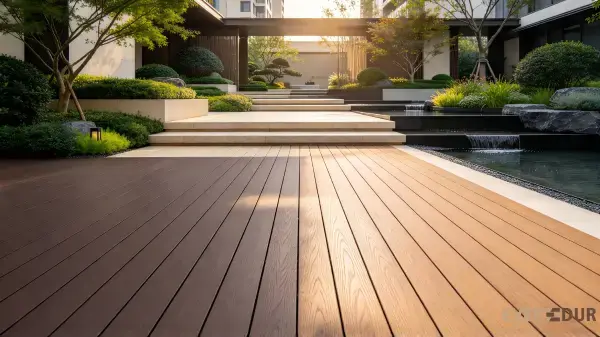
How Does Co-Extruded WPC Differ from Regular WPC Decking?
WPC decking or uncapped or Gen 1 composite is made from one homogenous mix from top to bottom. A single extruder is fed with wood flour, HDPE (high-density polyethylene) and additives. It appears like wood, however it is wood fibre in every surface. Co-extruded WPC decking has a separate extruder for the outer shell. That extruder is laying down a pure polymer coating around the core as the profile is formed. The two layers are bonded in one pass, with no adhesive and no subsequent coating.
The market has already moved. Capped boards launched around 2010. A 2015 American Wood Protection Association paper reports they held over 80% of the WPC decking market by 2014. Mold staining on uncapped boards drove that shift. Today, smart buyers stop asking whether a board has a cap. They ask how much of the board the cap actually covers.
What Exactly Is Co-Extrusion in Decking Manufacturing?
Co-extrusion means two molten streams leave one die together. In co-extrusion composite flooring manufacturing, the core stream contains wood fibre and Grade A HDPE, while the cap stream contains polymer, pigment and UV stabilisers. The cap stream wraps around the core as both materials pass through the die. Cooling bonds the two layers into a single profile. When heated, the layers fuse and act as one board rather than a board with a painted skin. This fusion is the fundamental reason a cap layer will not peel like a surface coating may.
Why Do Brand Owners Call It Gen 2 Composite?
The cap covers the top 3 Gen 1 complaints: mould, fading and staining. Gen 1 boards are cheaper up front, and therefore they remain on the shelf. Because the cap adds polymer and requires a tighter die, Gen 2 boards are more expensive. If you are selling under your own brand, that amount gets you something you can put on a warranty card. A warranty is only as good as the board behind it, thus your whole focus will need to be on cap design.SEND INQUIRY
What Are the Key Differences in Surface Structure and Core Composition?
Two boards may seem similar on a showroom display and act substantially differently outside. The distinction is in the profile. So you need to grasp what each layer accomplishes . You can not assess it from the top surface just.
How Does a Cap Layer Change the Surface?
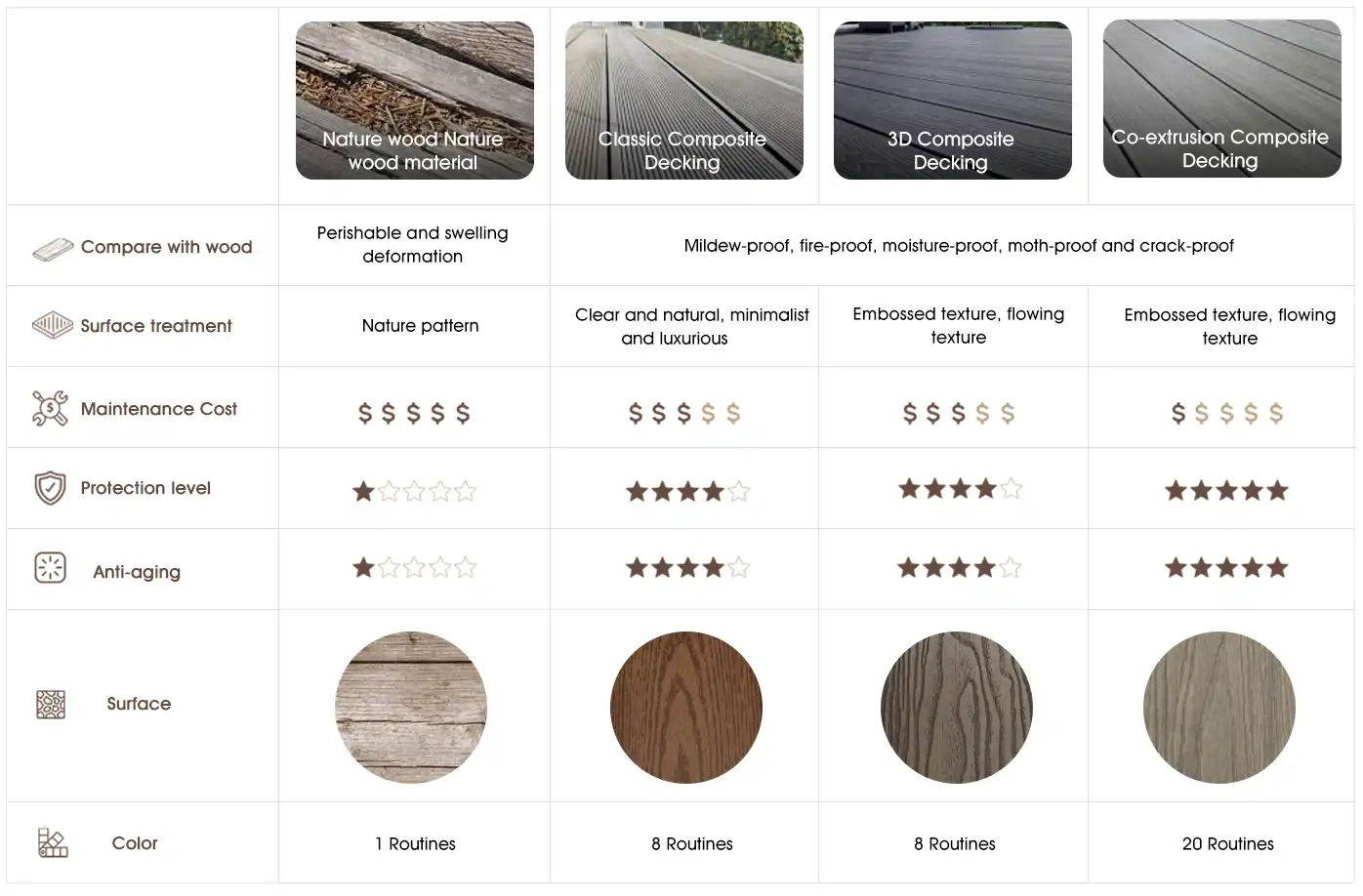
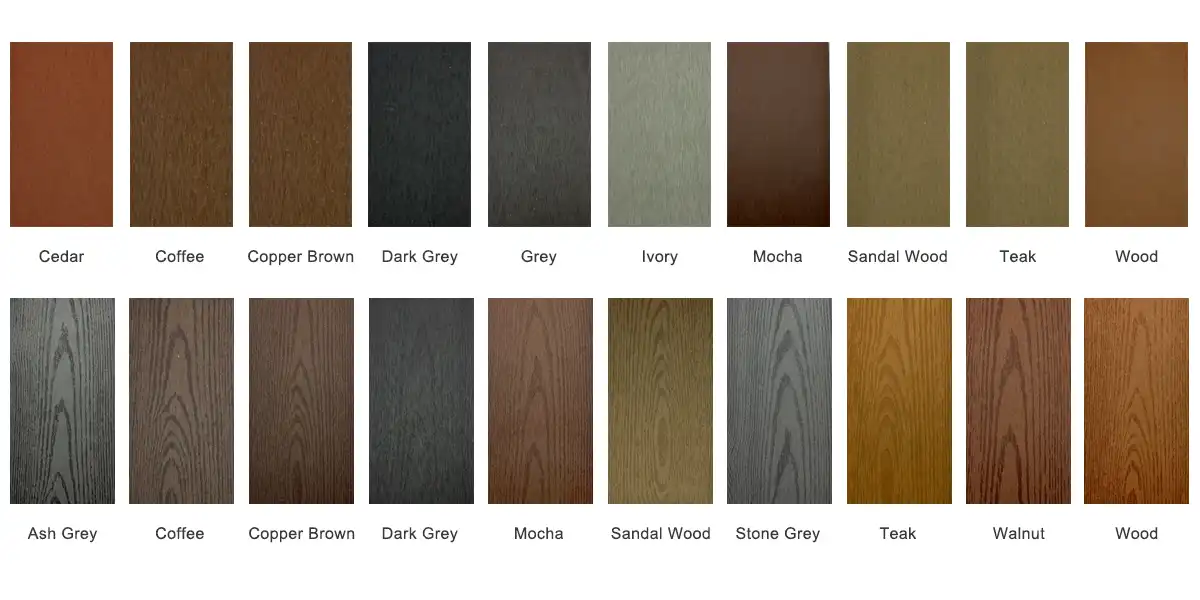
A cap layer provides a thick, smooth outer shell to the board. That skin becomes embossed, brushed, sanded, or wood-grain designs are pressed into it. Uncapped boards absorb texture as well, but the raw wood fibre is there underneath it. UV light and moisture destroy that fibre over time, so that's why co-extrusion composite decking holds its colour longer. The colour is also on the hat. Everdur has twelve regular tones from Ash Grey to Walnut and two-tone effects with cap and core in distinct colours for depth.
What Do the Six Faces of a Board Tell You?
Every board of co-extrusion composite decking has six faces: the top, the underside, two edges, and two groove sides. Many single-sided capped boards protect only the top and sometimes the edges. Everdur's 360° Shield Technology caps all six faces, including the underside and the inside of the grooves. This matters because ground moisture and installation points are where water enters a deck. The table below sums up the differences.
| Feature | Regular WPC (Gen 1) | Partial cap (top/edges) | Full 360° co-extruded |
|---|---|---|---|
| Faces covered by polymer | None | Top, sometimes edges | All six faces |
| Water entry points | Every surface | Grooves, underside, cut ends | Cut ends only |
| Joint and groove protection | Exposed wood fiber | Often uncapped | Cap covers the grooves |
| Warranty range | 8–12 years | Varies by brand | 15–20 years (Everdur) |
| Custom color and texture | Standard profiles | Varies by brand | Full ODM/OEM |
Warranty ranges for regular boards reflect Everdur's internal product comparison, not independent testing.
What Sits Under the Cap?
The core of both (behind the cap) is the same: wood fibre and HDPE. The standard profile of Everdur is 138 mm broad by 23 mm thick, in 2,200 mm and 2,900 mm lengths. Other sizes 140×20 mm, 150×25 mm, etc. available. Obtain a cut cross section from a source. Partial caps are normally designed just to the point of covering the groove, therefore be careful to measure the cap thickness at the groove, not simply at the top face.SEND INQUIRY
Why Does Co-Extruded WPC Offer Better Moisture and Stain Resistance?
Wood fibre is hygroscopic. HDPE hardly does. The cap places the weather-shedding polymer between the weather and the fibre. Manufacturers developed capped decking with a clear promise: the polymer top keeps the core dry and protects it from weathering and biological decay. The USDA Forest Service report tested that claim under laboratory and field conditions.
The same paper also shows a limit. The researchers end-sealed the cut edges of selected capped samples with dissolved ABS plastic. That detail matters to you, because a cap protects only where it covers the board. Edge exposure is the part of the design that separates a good co-extrusion composite decking profile from a weak one.
Where Does Water Enter a Capped Board?
Where the cap misses a surface water enters. On a one-sided capped board that is to say grooves, underside and cut ends. ''The contact of the ground forces moisture upward from below. Rain looks down and finds the grooves. Both paths lead to full encapsulation. Each board has visible cut ends, including co-extrusion composite decking. Discuss with your supplier how they suggest handling them on site and obtain the response in writing.
How Does the Cap Handle Chlorine, Salt, and Stains?
This is asked primarily by pool and coastal customers. The 360° cover protects the core free of saltwater and chlorine, Everdur says. This way, boards will not bloat, discolour or mould in humid conditions. Think of it as an assertion to check, not a commitment to take. "Provide immersion test data including technique, time and measured swelling. The cap's thick surface is cleanable with soap and water for stains. Spills get to the fibre. So uncapped boards have to be cleaned up quicker.SEND INQUIRY
How Do Co-Extruded and Regular WPC Decking Compare in Durability?
Durability claims are simple to publish, hard to confirm. There are three types of proof by which you may differentiate reality from marketing: field surveys, laboratory weathering testing and product standards. I weigh them in that order.
What Does Long-Term Weathering Data Show?
Field data trumps brochure claims. A 2022 research in the European Journal of Wood and Wood Products looked at decking with and without a co-extruded cover. The setting was Hilo, Hawaii, subtropical climate, and exposure was 8 to 14 years. Co-extruded boards did perform better than uncapped boards in above ground weathering. The cap likely decreases oxygen at the core-cap contact, the scientists conclude, and the wood within the cap weathers less since it's surrounded by plastic.
That's the strongest independent signal I know of for co-extruded boards. Still, the study covers one climate and specific products. It supports the concept of co-extrusion composite decking, not any single brand.
Why Does Cap Chemistry Matter as Much as Cap Coverage?
A cap isn't automatically durable. A 2009 paper by Stark and Matuana describes an earlier clear-cap design. It improved water behavior at the start, but weathering later cracked the cap and caused delamination. Their follow-up used a stabilized HDPE cap. Adding nano-TiO2 or a photostabilizer package prevented cracking and helped color retention after 1,000 hours of xenon-arc weathering. Using both together showed a negative interaction. Ask every supplier what stabilizers sit in the cap and who tested them.
How Should You Read a 2,000-Hour UV Result?
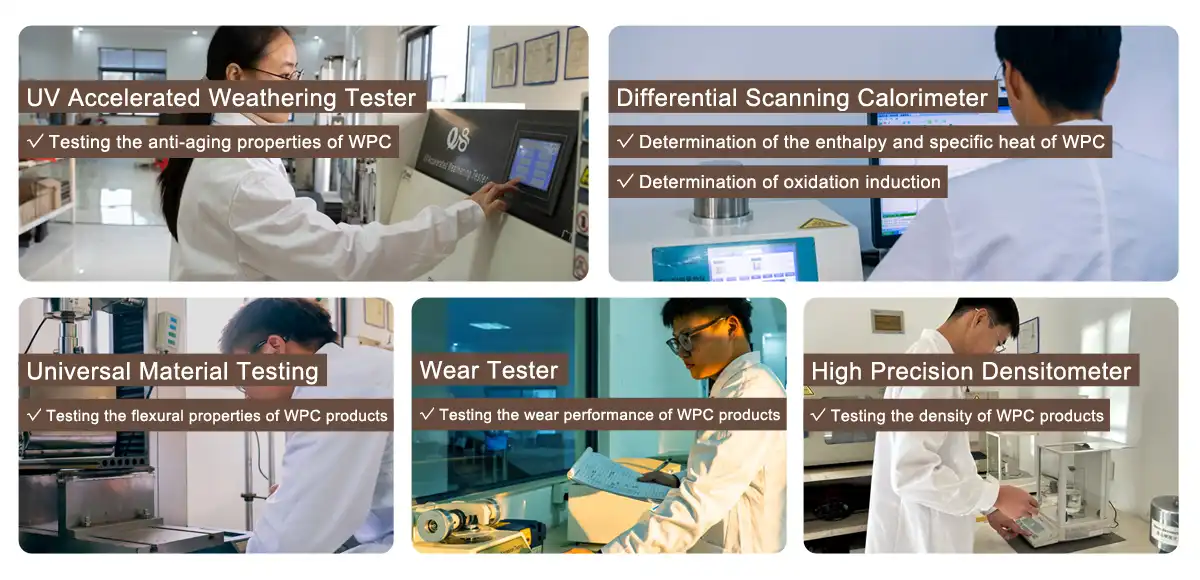
Everdur shows very little fading after 2,000 hours of enhanced UV exposure. A figure like that requires context. Ask what test technique the lab used, what colour they tested, and how they assessed colour change. Darker colours will show the colour shift more, therefore test your true colours. That construction may be a standard for any report . One of the tests needed is a UV resistance test in ASTM D7032 . Please ask for the actual lab report, not the summary page.
Which WPC Decking Performs Better in Different Outdoor Climates?
Climate determines how a board fails. Moisture, heat, and freeze cycles each stress decking differently. So I evaluate each climate zone on its own terms, particularly when selecting co-extrusion composite flooring for different outdoor environments.
How Do Humid and Coastal Climates Treat Decking?
Humidity and salt air encourage mould and fungus on exposed fibre. A 2013 research in the Forest Products Journal exposed composite boards at two locations. In Hilo the Scheffer climate index was approximately 350 and in Vancouver about 50. That gap indicates how strongly tropical humidity presses on composites. This is the zone where purchasers of resorts in the Maldives, South East Asia and the Caribbean dwell. A complete six face capping and immersion data set is above any other criterion for them.
How Do Hot, Dry Climates Affect Boards?
Strong sun and heat stress surface and colour. The Stark and Matuana findings illustrate that the cap stabilisers perform the hard job here. Darker boards are hotter underfoot thus light colours are good for bare foot regions. For cooler surfaces for purchasers, Everdur's selection comprises Ivory, Sandal Wood and Stone Grey.
How Do Cold Climates and Freeze-Thaw Cycles Affect Boards?
Cold regions add freeze-thaw cycles. Water that enters a core can freeze, expand, and crack the board. ASTM D7032 lists a freeze-thaw resistance test among its required evaluations. Fully capped boards cut off the water supply that freeze damage needs. Northern European and Nordic importers should ask for freeze-thaw results next to the UV report.SEND INQUIRY

Which Application Scenarios Benefit Most from Co-Extruded WPC Decking?
Three scenarios show where the cap pays off. Each has a different buyer, a different risk, and a different set of documents.
Residential Retail Programs and Private-Label Brands
Consider a German or UK brand owner who makes 20 to 100 containers a year, all in one design. The customer wants a guarantee he can publish under his name and a colour no rival can replicate. We customise the colour, surface texture, profile size and material grade per location with our ODM service. You own the style. The colour and embossing pattern of the cap is unique. Get pattern and formula ownership in writing, under an NDA, before sharing artwork.
Resort Pool Decks and Hospitality Projects
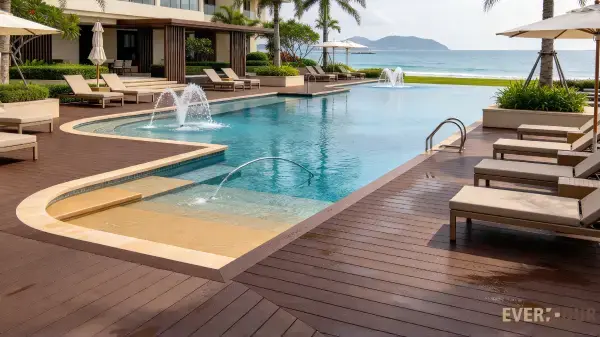
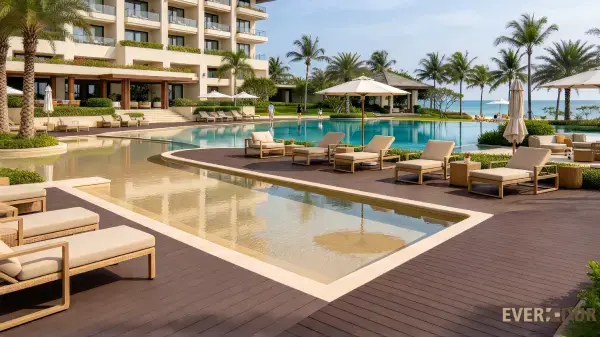
Hotels and resorts need co-extrusion composite decking that survives chlorine, salt, and constant wetting. Everdur's decking appears on resort pool decks in Southeast Asia, and we share reference projects on request, with client permission. Project buyers should also ask for wet-slip and fire documents. EN 13501-1 is the European fire-reaction classification system, and inspectors often request it. Match every document to the legal entity on your contract.
Regional Distribution and Commercial Plazas
Regional distributors buy 5 to 30 containers a year and mix colors in each one. They care about batch consistency, because one color mismatch can trigger a full-container return. A stable cap color helps, but only batch records prove it. Everdur's MOQ starts at 100 SQM, so you can test a mixed-color trial before you commit to a container. Commercial plazas in North America use the same boards, and they need the same repeatable supply.SEND INQUIRY
How Do Co-Extruded and Regular WPC Decking Compare in Maintenance Needs?
Maintenance is where your end customer feels the difference. It also decides how many complaints reach your service desk.
What Does Cleaning Look Like?
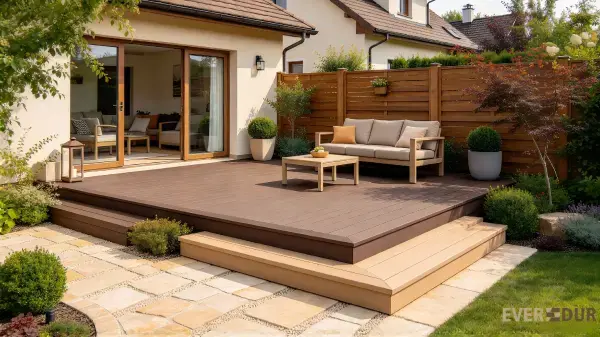
Capped co-extrusion composite decking needs soap, water, and a soft brush. Skip sealing, staining, and painting. Mold staining on uncapped boards is the exact issue that pushed manufacturers toward caps. Regular WPC isn't maintenance-free. It needs prompt cleanup of spills, sap, and algae because the surface holds fiber. Over ten years, those small chores add up for the homeowner, then for your retailer, then for you.
How Does Installation Differ?
Installation is nearly identical for both types. Boards sit on joists and lock with hidden clips. On a 360° board, fully capped grooves keep the clip area protected. Installers cut and drill with standard woodworking tools. Ask your supplier for written guidance on treating cut ends, because the cap stops at every cut.SEND INQUIRY
When Is Co-Extruded WPC Worth the Higher Initial Cost?
Boards of co-extrusion composite decking cost more per square meter. The better question is cost per year of service. I use a simple model, and you can rerun it with your own quotes.
How Do You Calculate Cost Per Year of Service?
Assume an index price of 100 for a normal board with a life of 10 years. Assume a co-extruded board costs 25 percent more, or $125, and lasts 17.5 years, the midpoint of a 15- to 20-year guarantee. The ordinary board costs 10.0 a year. The board that is co-extruded costs 7.1 per year. That is $29% less every year. Break even is 12.5 years, therefore the capped board only has to survive 2.5 years longer than the normal board.
Consider this an example. Warranty term is not the same as service life and the inputs are assumptions. Please replace your true quotations, your warranty conditions and your climate data.
What Hidden Costs Does Cheaper Decking Carry?
The unit pricing masks downstream expenses. Colour complaints and warranty claims and returned containers erode margin and brand image. A single mismatched container might nullify months of decreased cost for a distributor. A consumer photographs deck that fails, goes quickly online for a brand owner. My advice to purchasers is to price a claim, not a board.
When Should You Stay With Regular WPC?
Sometimes regular WPC is still a good choice. It may be justified by budget driven initiatives, covered regions and short life installations. If your market is a low-price-warranty-only for a few years one, an uncapped board may suit. Make the choice deliberately, with the trade-offs on the table. But even then, ask for the same cross-section and test results. Because there are quality discrepancies within every category.SEND INQUIRY
How to Choose Between Co-Extruded and Regular WPC Decking?
Four questions drive the choice. What warranty will you offer? What climate will the boards face? How much brand risk can you carry? What cost per year do you need to hit? Your answers point to one board type fast.
Which Buyer Profile Fits Which Board?
If you are a brand owner looking for a 15 or 20 year guarantee, you need full-capped co-extrusion composite decking. The warranty requires a board that can sustain it. Distributors that compete on price could hold onto a Gen 1 line and introduce co-extruded boards at the top of the price range. Full capping should be the minimum requirement for hotel project teams and their effort should be spent on slip, fire and immersion papers.
How Long Does a Typical Sourcing Process Take?
Three to six months with a new plant, in my experience. Samples and colour cards take two to four weeks. A sample order of 100 to 300 SQM would be produced in 4-6 weeks. Then there's a factory audit, in person or by video. The first order of one to three containers takes 8 to 12 weeks. Start early and notify your supplier the date you are going for.
How Do ODM Colors and Embossing Protect Your Brand?
Your board is difficult to imitate with exclusive colours and embossing rollers. Get a formal agreement that the pattern and formula are yours, or the manufacturer will not sell to anybody else in your market. Customises surface textures, profiles and material grades by environment. Everdur colour matches from your samples for co-extrusion composite decking. And maintain a dated record of every file. Discuss NDA conditions before sending your artwork.SEND INQUIRY
What Should Buyers Check Before Purchasing Co-Extrusion Composite Decking?
A good purchase starts with evidence. Before you pay a deposit on co-extrusion composite decking, run through the checks below.
Which Five Checks Protect You Before You Buy?
Here are the checks I use with every new buyer:
- Full encapsulation proof. Request a cut cross-section from the exact profile you plan to buy. Look for polymer on the top, underside, both edges, and inside the grooves. Measure the cap thickness at each face and photograph it. Add the image to your purchase file so any later dispute starts from evidence.
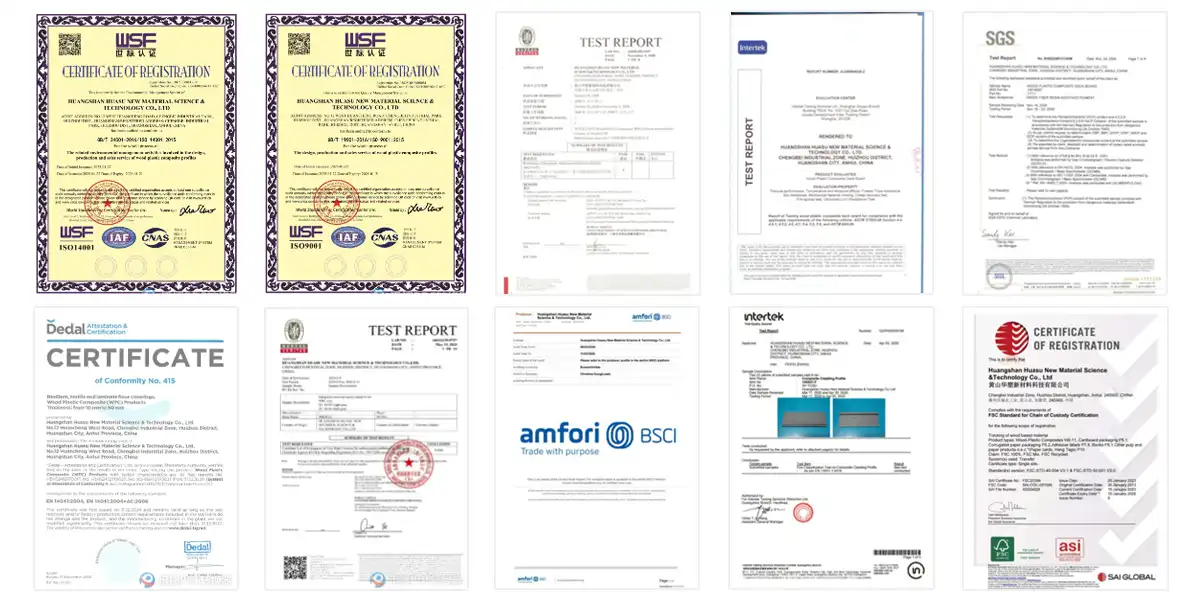
- Certificate holder match. Check that the company named on every certificate matches the company named on your contract. Everdur lists ISO, FSC, CE, SGS, RoHS, REACH, Intertek, and ASTM credentials, and we share documents on request. Review each document, confirm the holder, and confirm the scope. A mismatch can stall a retailer's compliance review or a large customer's factory audit.
- UV and color data. Ask for accelerated UV reports at 2,000 hours or more, with the method, the color tested, and the measured color change. Request batch-to-batch color tolerance and profile tolerance in writing. Small differences between lots can lead a retailer to reject an entire container, so agree on limits and a sampling plan before production starts.
- Warranty wording. Read the warranty text itself. Everdur states 15 years for hollow profiles and 20 years for solid profiles against material defects, cracking, and structural failure. Ask whether you can restate that coverage in your own warranty card, and who handles claims. A warranty you can't pass on to your customers has little brand value.
- Production priority. Small trial orders can slip behind large customers during peak season. Ask for a confirmed production slot and a written lead time before you pay the deposit. Also ask about mixed-color containers, packaging, and private-label options. Clear answers up front can save weeks later, especially during the busy spring season.
These five checks turn a sales promise into a document trail. Most supplier problems start when a buyer skips one of them, and most can be solved in writing before the deposit. Keep the file, because retailers and auditors will ask for it.
What Should the Paperwork Show?
Standards provide you a common language. EN 15534-4 defines the specifications of profiles and tiles for decking, constructed from wood-polymer composites, for exterior use. ASTM D7032 is a standard for developing performance ratings for WPC deck boards and includes testing for flexural, UV, freeze-thaw, biodeterioration, fire, slip and fastening properties. Ask about the standard each report was done to and whose certified lab signed it off on.
How Do You Verify Factory Capacity?
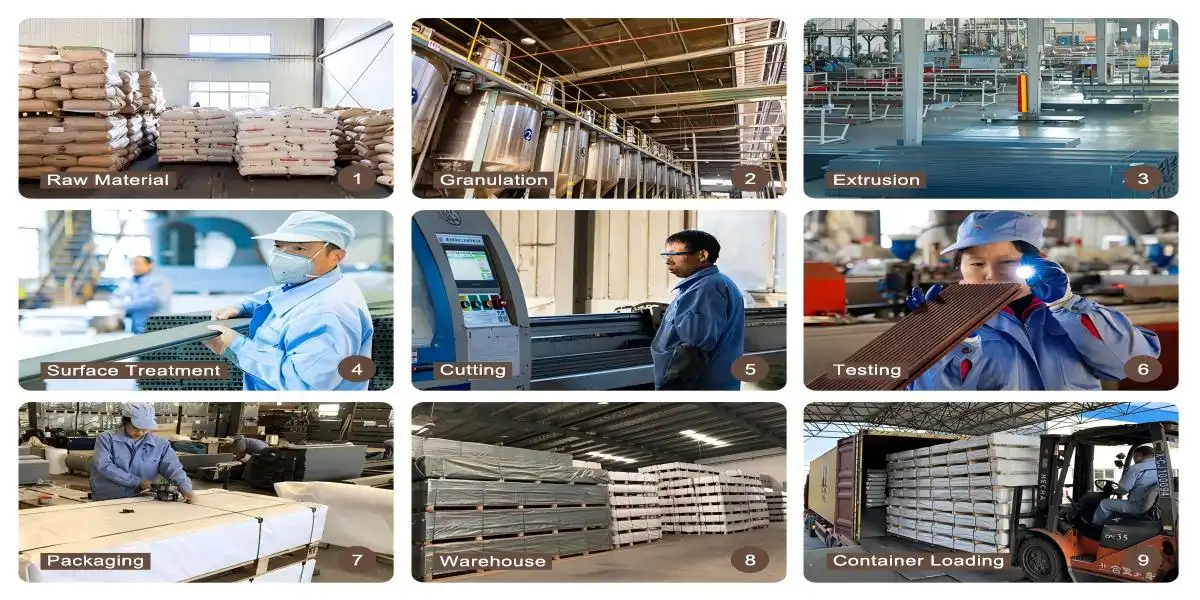
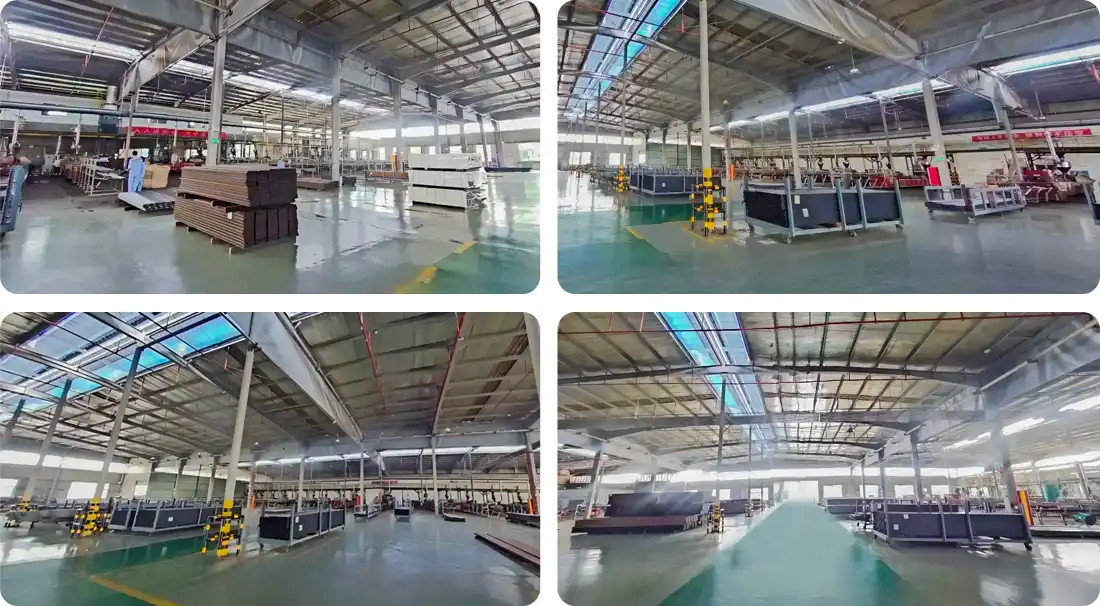
The capacity statistics are what you see. Everdur has 50 WPC manufacturing lines with an annual capacity of 30,000 tonnes. We use 5S on-site management with quality monitoring on every batch. We export over 80% of our production to over 60 countries and more than 100 of our 225 clients are active buyers. Among our clients are chains such as Lidl, Hagebau, Hornbach, Hellweg and Globus. Get a video tour or on-site audit to verify any supplier's data, including ours.
How Can You Lower Trial-Order Risk?
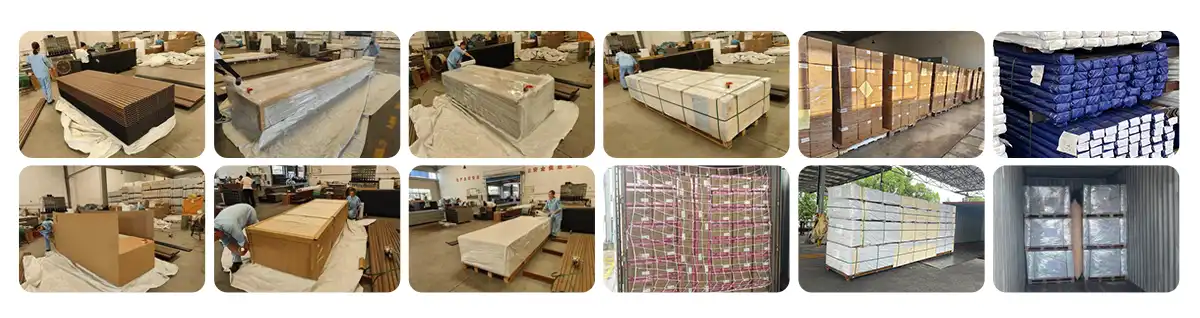
Split your co-extrusion composite decking order into 2 or 3 colours, starting at 100 SQM (Everdur's MOQ). Shipping terms are FOB Shanghai or FOB Ningbo. Check delivery for cap coverage, colour match to authorised sample, and profile tolerance. Saw some boards open and took some pictures of everything. Scale to 1 or 2 containers with the same approval criteria. This tiered approach protects your cash and your relationships with your retailers, and provides a clear record for both parties.SEND INQUIRY
Conclusion
Co-extruded and regular WPC decking share a core, but they don't share a risk profile. A bonded polymer cap that covers all six faces keeps water, UV, and stains away from the fiber, and independent research supports that design. Cap chemistry, cut-end handling, and paperwork decide whether a specific board delivers. Regular WPC still serves budget projects. If you sell a 15- or 20-year warranty, a hotel specification, or a private-label line, co-extrusion composite decking gives you a board to stand behind. Verify with cross-sections, test reports, and a staged trial order.SEND INQUIRY
FAQ
Q: What is the difference between co-extruded and regular WPC decking?
A: Co-extruded decking has a polymer cap fused around the wood-plastic core during manufacturing. Regular WPC decking has no cap, so wood fiber sits at the surface. The cap improves moisture, stain, and fade resistance, and full 360° capping also protects the underside and grooves.
Q: Is co-extruded decking suitable for poolside and coastal use?
A: Yes, when co-extrusion composite decking has a cap on all six faces. Everdur's 360° capping aims to keep chlorine and seawater out of the core. Before you specify boards for a hotel project, ask any supplier for immersion test data, wet-slip results, and a fire classification such as EN 13501-1.
Q: How long does the color last on co-extruded decking?
A: Everdur reports minimal color change on its co-extrusion composite decking after 2,000 hours of accelerated UV testing. Real-world color life depends on climate, shade, and cap stabilizers. Request the full lab report, with the method and the measured color difference for your chosen color.
Q: Can I order custom colors, sizes, and textures?
A: Yes. Everdur's ODM and OEM service covers color matching from your samples, embossed, brushed, sanded, and wood-grain textures, and custom widths, thicknesses, and lengths. The standard profile is 138×23 mm in 2,200 mm and 2,900 mm lengths. Sign an NDA before you share artwork.
Q: What does the warranty cover?
A: Everdur states 15 years for hollow profiles and 20 years for solid profiles against material defects, cracking, and structural failure. Ask for the full warranty text and check whether you can restate it in your own warranty documents.
Q: What is the MOQ, and which port do you ship from?
A: The MOQ is 100 SQM, and boards ship FOB Shanghai or Ningbo.
Request Co-Extruded Samples and a Six-Face Cross-Section From Everdur
Everdur supplies co-extrusion composite decking to importers, distributors, and hotel project teams worldwide. If you want a co-extrusion composite decking supplier that shares cross-sections, color cards, and test documents upfront, send us your target market, colors, and volume. We reply with a sample plan and a quote for a 100 SQM trial order.SEND INQUIRY
Email: violet@wpcsupplier.com
Website: wpcsupplier.com
References
1. American Wood Protection Association Proceedings, 2015. Mankowski, Manning & Slowik, ''Durability of Capped Wood Plastic Composites.'' USDA Forest Service Treesearch.
2. European Journal of Wood and Wood Products, 2022 (Vol. 80, pp. 23–34). ''Long-term outdoor weathering evaluation of wood plastic composites.''
3. Forest Products Journal, 2013. Ibach, Gnatowski & Sun, ''Field and Laboratory Decay Evaluations of Wood–Plastic Composites.'' USDA Forest Service Treesearch.
4. ASTM International, 2021. ASTM D7032-21, ''Standard Specification for Establishing Performance Ratings for Wood-Plastic Composite and Plastic Lumber Deck Boards, Stair Treads, Guards, and Handrails.''
5. CEN via ILNAS, 2014. EN 15534-4, ''Composites made from cellulose-based materials and thermoplastics: Specifications for decking profiles and tiles.''
6. USDA Forest Service Treesearch, 2009. Stark & Matuana, ''Co-Extrusion of WPCs with a Clear Cap Layer to Improve Color Stability.''
About the Author
Violet is manage at Everdur, where she advises importers, distributors, and hotel project teams on co-extrusion composite decking specifications. Violet reviews cross-sections, test reports, and warranty terms with buyers in Europe, North America, and Australia, and has 10 years of experience in wood-plastic composites.
Send Inquiry
Related Industry Knowledge
- Custom WPC Decking: Tailored Flooring for Your Unique Outdoor Space
- Garden WPC Decking Installation: Create a Beautiful Garden Patio
- Anti-Fade Decorative Composite Fencing: Long-Lasting Beauty
- Wood Grain Grooved WPC Decking: Stylish & Functional Outdoor Flooring
- Grooved WPC Decking: Anti-Slip Flooring for Poolside & Walkways
- Traditional Cladding for Residential Buildings: Classic & Reliable
- Low MOQ Traditional Cladding: Ideal for Small Traditional Projects
- Low MOQ Grooved WPC Decking: Ideal for Residential & Commercial
- Top Benefits of WPC Decking for Residential and Commercial Use in 2026
- High-Quality WPC Decking for Poolside: Waterproof and Anti-Slip Solutions