
Low MOQ Commercial WPC Decking: Perfect for Small Commercial Projects
2026-10-21 17:00:01
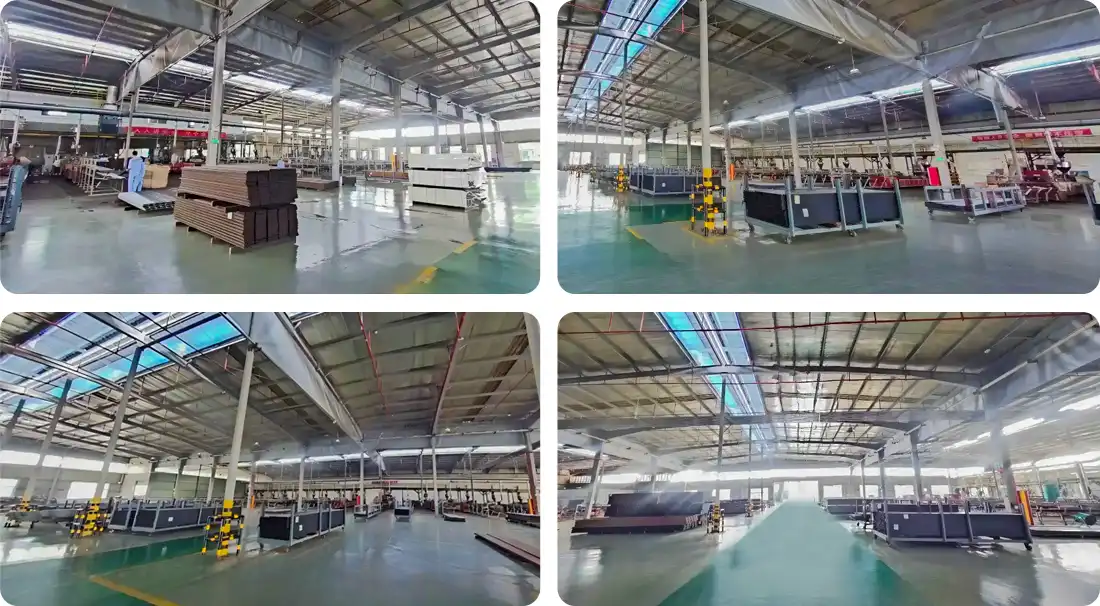
Not all outdoor projects need to be large in footprint or expenditure. Café courtyard. Wellness studio patio. Boutique hotel terrace. These are real business areas that need tough, good-looking decking without the headache of buying way too much material for the job. Commercial WPC decking minimum purchase quantity 100 SQM. This is reasonable. That means a landscape contractor may place a targeted, affordable order without filling a warehouse with surplus boards and a 120 square meter rooftop bar. Everdur’s co-extrusion composite decking is manufactured on 50+ specialized lines, shipped from Shanghai and Ningbo and is certified to CE, ASTM, ISO, FSC, SGS, ROHS, REACH and INTERTEK. So even a small order passes the compliance criteria demanded by European and American project managers. In this video we explore the components of a modest commercial project, how to take that 100 SQM figure with an honest grain of salt, what accessories and wastage to budget for, how to appraise samples before committing to them, and how phased re-ordering safeguards you when a project grows.SEND INQUIRY
What Counts as a Small Commercial Project for Commercial WPC Decking?
The distinction between “residential” and “commercial” is less a distinction of project scale than of use pattern and accountability. An 80 SQM deck used by one family is in a distinct category to an 80 SQM deck used by rotating visitors, staff and the public.
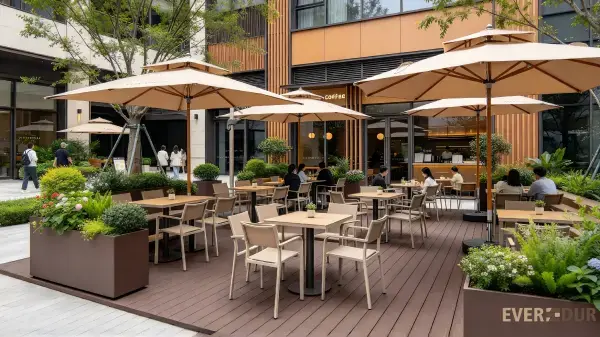
But there are usually just a few noticeable clusters of small business operations. Outdoor spaces for hospitality, such as a guesthouse terrace, a poolside lounge for a boutique property or an outdoor dining area for a café or wine bar, often range between 80 SQM and 250 SQM. Wellness facilities – yoga studios with outdoor platforms, spa gardens, urban rooftop getaways — are generally in a similar price range. Similar in scale are retail forecourts, show-home display gardens and co-working space terraces. Public-realm micro-projects such as a park sitting node, a marina walkway segment or a covered market entry ramp have a net area that may be even smaller but they have high slip-resistance and load-bearing criteria that rule out lighter residential-grade boards.
The common factor is the necessity for a product that can withstand constant foot traffic, retain color in full sun exposure, and requires minimal on-site maintenance – because the operator usually does not have the staff or funds to sand, seal, or replace boards every year. WPC composite decking's second generation co-extrusion technology meets those needs head on. The protective outer shell protects the wood-fiber core from moisture ingress, UV deterioration and biological attack without the need for annual treatment.
Small commercial projects present a procurement difficulty rarely seen with large projects: ordering too small a quantity risks a production batch color mismatch on a reorder, while ordering too large a quantity ties up cash in stored material. A reasonable MOQ — one commensurate with the real scale of these projects — diffuses that tension before it starts.
Reading the 100 SQM MOQ on Commercial WPC Decking Orders
A minimum order quantity of 100 SQM sounds simple enough but there are a number of layers worth unpacking before you put in a buy order.
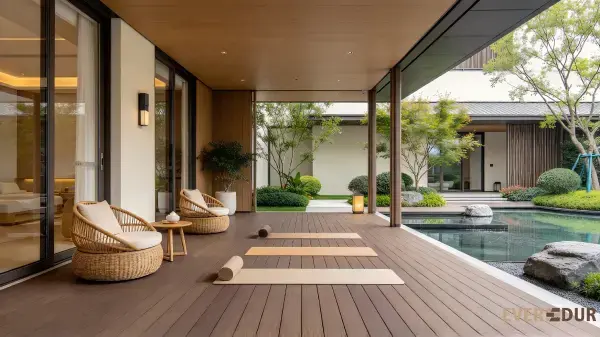
The 100 SQM is the net commercial anti-slip WPC surface area according to the nominal face width of the board. Everdur's typical commercial profiles are available in widths of 135 mm to 150 mm, with popular cross sections being 140×25 mm and 145×25 mm. If you are installing the boards with a drainage gap of typically 5-8 mm between the boards the actual linear meters of board needed to cover 100 SQM will be a bit more than the simple area calculation. If you have a 140 mm board and a 6 mm gap that indicates you need about 4.5% more board length to cover the same space. So, factor in that little boost before hitting send on your order.
The length selection also factor in on how effectively you meet the MOQ. Standard lengths offered are 2,200 mm, 2,900 mm and 3,600 mm. Selecting a length that fits your joist spacing and deck dimension eliminates cut-off waste, and helps make your real material cost per covered square meter predictable. The same 4,200 mm deck run cut from 2,900 mm boards creates more off-cut waste than the same run cut from boards available in a better-matched length.
The selection of colors and surfaces is connected to the MOQ in a practical manner. If your project is single color - for example, Stone Gray with a brushed finish - then 100 SQM in one production batch is clean and straightforward. You are combining two colors for a design pattern. Each color may need to meet the MOQ individually or you negotiate a combined run with your manufacturer. Everdur provides color customisation beyond the basic palette; the manufacturing staff can also advise on batch viability for mixed-color orders at the small commercial scale.
Another variable to read carefully is lead time with MOQ. A 100 SQM order does not get stuck in the queue after big volume contracts for eternity. With 50+ manufacturing lines running at an annual capacity of 30,000 tons, modest orders can be arranged without the delays that frequently plague manufacturers with fewer lines. To remove any confusion from your project plan, clarify your desired ship date at the inquiry stage and ask for a written confirmation of the production schedule.SEND INQUIRY
Clips, Joists, Edge Trims and Wastage in Commercial WPC Decking
They are a structural and esthetic commitment that effect both installation labor and long-term performance, and under-budgeting them is a common cost surprise on small commercial projects.
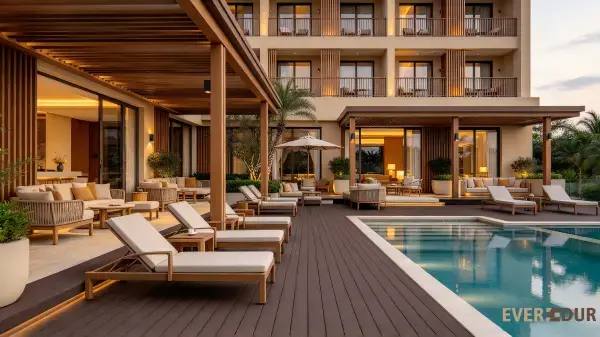
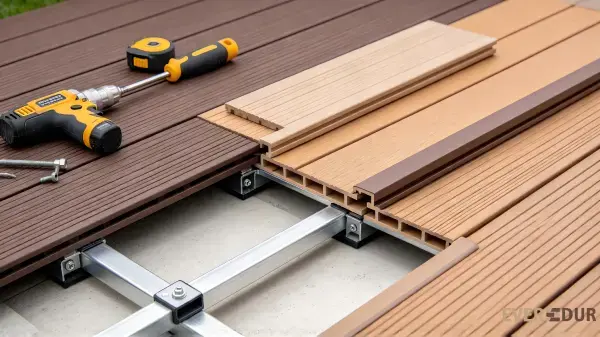
Everdur composite decking spacing boards evenly, allows for little thermal movement and leaves the surface free of visible fastener heads with the hidden-clip fixing system. The number of clips is determined by the board length, joist distance and the fixing pattern determined by the installation. A conservative planning number is one clip per board end and one per intermediate joist crossing, but your installer will need to check this against the precise profile and joist spacing being utilized.
Joists are often aluminum or steel for commercial use and are specified at 300-400 mm spacing for solid profiles and 300 mm or less for hollow profiles in heavy traffic. Getting the joist spacing wrong at the design stage and having to repair it on site is an expensive error; check with the manufacturer for the required spacing for your chosen profile before acquiring structural subframe components.
Edge trims are used to finish exposed board ends and perimeter lines. They are available in matching colors and should be ordered with the first shipment. If ordered separately later they may be a different color batch. Add the perimeter of your deck space, any step nosings or fascia boards, and you have the linear meters of trim you will need.
For a small commercial project, the wastage tolerance should be 8 - 12% above net area. Diagonal laying patterns, uneven plan forms and cut-outs for columns or drainage ditches are likely to result in a higher amount of waste. Phased reordering strategy suggests that you order with a sufficient buffer for wastage, that is, you keep a small number of spare boards from the same production batch.
How to Approve a Sample Before Committing to Commercial WPC Decking?
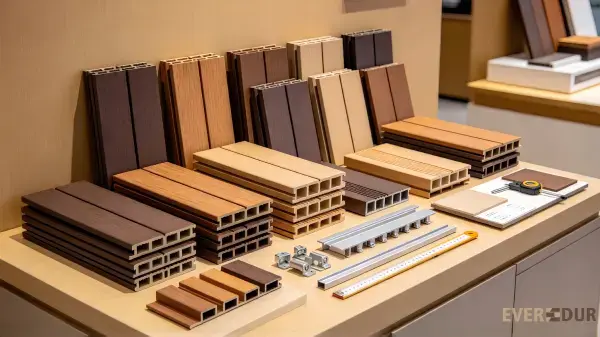
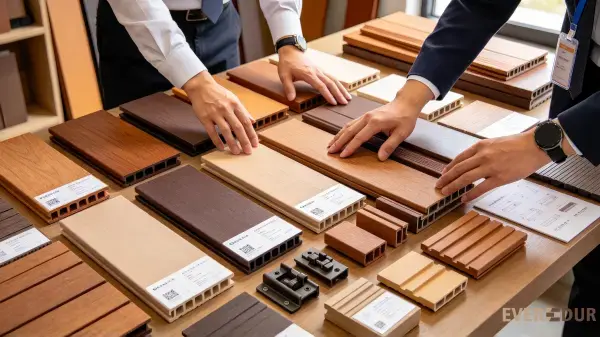
Choosing from a color card displayed on a screen is a reasonable place to start, but insufficient to make a commercial commitment. Physical samples address the variables that digital photos are unable to communicate: the true surface texture to the touch, color depth under varied lighting circumstances, the dimensional accuracy of the cross-section, and the tactile quality of the co-extrusion shell.
Order a sample pack with a minimum of two boards of your preferred color and surface combination, a clip and a short joist piece if available. Place the boards outside (not on a desk) and view them in the morning light, in the sun at noon, and in gloomy weather. The color perception changes dramatically in those situations, and a color that appears like warm cedar inside may read as orange-brown in direct European summer sun.
Ensure the cross-section dimensions are correct per the specification document for commercial WPC board. The 140×25 mm board must always be within an acceptable manufacturing tolerance. Dimensional consistency is important since it can alter the uniformity of clip engagement across a long run of deck, boards of varying widths create unequal gaps.
Check texture with damp hands or towel. “But in a commercial outdoor setting, slip resistance isn’t a preference — it’s a safety requirement. Everdur’s brushed and embossed surfaces are formulated to retain grip when wet, however it is good practice to physically validate this on a sample before specifying for a poolside or waterfront application.
If you are modifying color or surface texture, ask for a pre-production sample (often termed a golden sample) and formally sign off on it before full production begins. This sample is the reference standard against which the production batch is verified. Having a copy at your end of the supply chain protects you against any disagreement about color or finish compliance.SEND INQUIRY
Phased Reordering and Spare Boards for Commercial WPC Decking
Little commercial ventures do sometimes arise. A café patio joins onto an adjoining area. Following favorable guest comments during its first season, the hotel built a second swimming deck. The operator is growing into more floor space and adding a co-working deck. When such happens, the ability to perfectly match the color on the extension depends on how thoroughly the initial order was arranged.
WPC decking color consistency is maintained within a production batch, but can vary somewhat between batches manufactured months apart, even with identical formula inputs – this is a manufacturing reality across the composite decking industry, not a flaw exclusive to any one producer. The pragmatic answer is to order a determined spare quantity in the first batch of usually 5-8% over your expected final area stored in dry covered storage on site. Those boards are repair stock for any broken boards, and color-match insurance for a little expansion.
If you already know that you will need a longer extension, please notify the manufacturer at the time you make your inquiry. Everdur can take note of the project need and in many cases keep a manufacturing record to enable a closely matched reorder to be manufactured when the extension phase is confirmed. It is recommended questioning any supplier you choose for any project with a phased delivery about this form of project continuity on the manufacturer side.
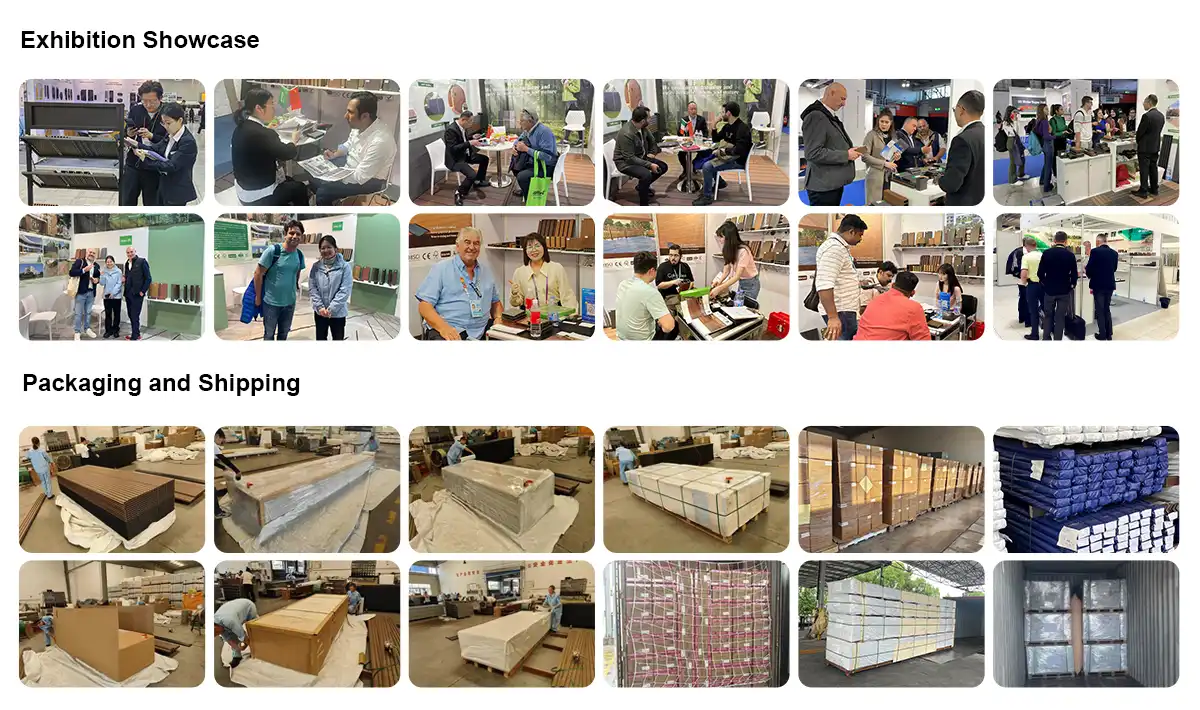
And also worth planning for re-ordering logistics on a 100 SQM-scale top-up order. Check in advance whether the manufacturer can accommodate a minor supplemental order, what the lead time will be and whether the FOB port and shipping route can accommodate your project schedule. Everdur is shipped from Shanghai and Ningbo, on regular schedules to major European and American ports, therefore minor extra shipments are practically possible.
Conclusion
Small business projects have real performance needs and real financial limitations. A well-judged MOQ, honest accessory planning, physical sample approval and staged reordering approach make commercial WPC decking a viable, cost-effective specification at the 100-300 SQM level. Composite decking offers the ideal mix of co-extrusion durability, minimal maintenance and available certification coverage and is a sensible alternative for the expanding number of modest outdoor commercial spaces across Europe and America.SEND INQUIRY
FAQ
Q: Can I order two different colors in a single 100 SQM minimum order?
A: This depends on how the MOQ is structured for each color. In many cases, each color variant needs to reach a production-viable quantity. Contact Everdur directly at the inquiry stage to confirm whether a split-color order can be accommodated within your total volume, and to get guidance on the most efficient way to structure the request.
Q: How long does it take to receive a physical sample before placing an order?
A: Sample dispatch timelines vary based on your location and available stock. Standard sample packs for shortlisted profiles and colors can typically be arranged within a week of a confirmed request. Pre-production custom samples for color or texture customization take longer, as they require a small production run — factor this into your project schedule when working to a fixed installation date.
Q: What maintenance does commercial WPC decking require in a high-traffic outdoor setting?
A: Routine maintenance is limited to periodic cleaning with water and a mild detergent to remove surface dirt, organic matter, or pooled residue. No annual sealing, sanding, or board replacement treatment is required under normal use conditions. The co-extrusion shell protects the core from moisture and biological degradation, which is the primary driver of maintenance burden on untreated timber decking.
Get in Touch with Everdur — Commercial WPC Decking Manufacturer for Small and Mid-Scale Projects
Whether you are a landscape contractor pricing a 120 SQM hotel terrace, a building materials wholesaler looking to carry a certified composite line, or a project manager sourcing for a phased public-space rollout, Everdur offers structured support matched to your role.
For construction firms and contractors: Project-specific technical support, accessory specification guidance, and sample packs for client approval presentations. Our decking complies with EU CE, US ASTM D7039, and China GB/T 24137 standards, and carries Recycled Content certification alongside E0 environmental standard compliance — documentation packages available on request.
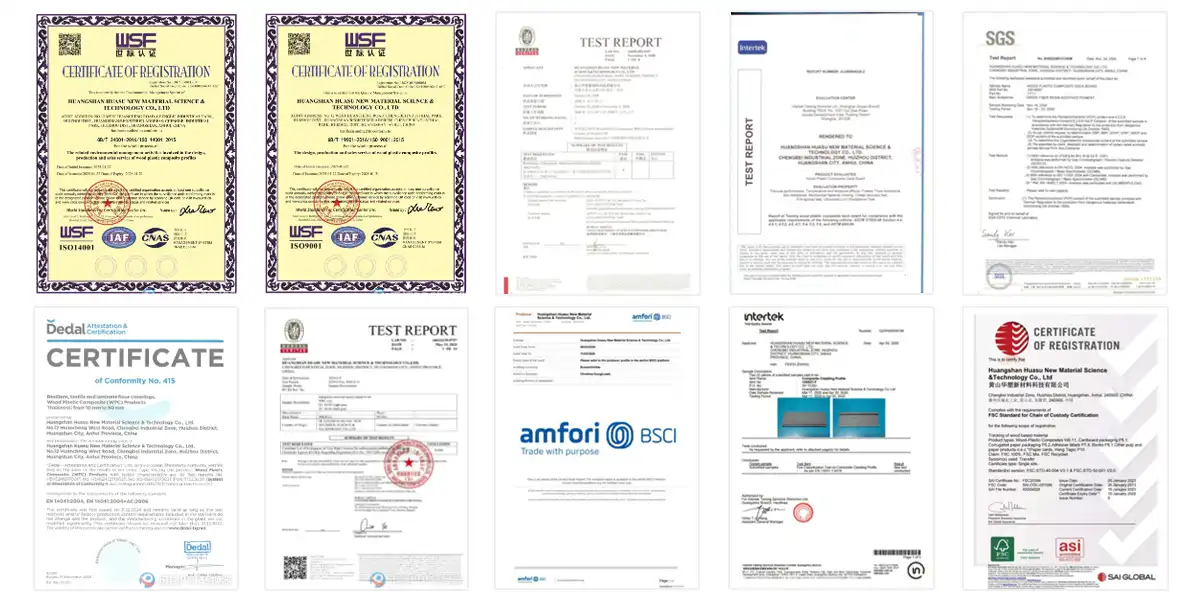
For building materials wholesalers and resellers: Wholesale pricing structures, consistent supply from 50+ production lines, and co-branded or white-label options for established distributors operating in European and American markets.
For end customers and small operators: Free design consultation, color sampling, and installation guidance to help you move from concept to a completed outdoor space with confidence.
Reach the Everdur commercial WPC decking manufacturer team directly at violet@wpcsupplier.com to discuss your project scope, request samples, or get a quotation for your next outdoor commercial installation.
References
1. European Committee for Standardization. EN 15534: Composites Made from Cellulose-Based Materials and Thermoplastics (Wood-Polymer Composites). CEN, Brussels.
2. ASTM International. ASTM D7032: Standard Specification for Establishing Performance Ratings for Wood-Plastic Composite Deck Boards and Guardrail Systems. ASTM International, West Conshohocken, PA.
3. Forest Stewardship Council. FSC Standard for Chain of Custody Certification. FSC International, Bonn.
4. International Organization for Standardization. ISO 9001: Quality Management Systems — Requirements. ISO, Geneva.
5. International Organization for Standardization. ISO 14001: Environmental Management Systems — Requirements with Guidance for Use. ISO, Geneva.
6. Building Research Establishment (BRE). Guidance on the Specification of Composite Decking for External Commercial Applications. BRE Press, Watford.
Send Inquiry
Related Industry Knowledge
- Low MOQ Hollow WPC Decking: Perfect for Small Residential Projects
- How to Choose the Right Residential WPC Decking for Your Budget
- Traditional WPC Decking Maintenance: Easy Tips to Extend Its Life
- Wholesale Traditional WPC Decking: Affordable & Reliable Supply 2026
- How to Choose Exterior WPC Cladding for Your Building
- How to Choose WPC Landscape Walls for Your Garden or Park
- 3D Composite Decking vs Regular Composite: Which Is More Stylish?
- How to Choose High-Quality Co Extrusion WPC Decking for Your Garden
- Waterproof WPC Fence: Ideal for Coastal and Humid Areas
- How to Install WPC Decking Easily: A Step-by-Step Tutorial for Beginners