
Wood Grain Swimming Pool WPC Decking: Enhance Your Pool Area
2026-11-18 19:25:48
There's something quietly compelling about a pool surrounded by warm, wood-toned decking — it feels natural, grounded, and welcoming. But anyone who has maintained real timber around water knows the reality: swelling, warping, splintering, and the relentless cycle of sanding and sealing. Swimming pool WPC decking offers a practical path away from that cycle. By combining recycled wood fiber with high-density polyethylene (HDPE) and functional additives, WPC boards replicate the visual warmth of timber while resisting the moisture, UV exposure, and foot traffic that poolside environments demand. The result is a surface that holds its appearance across seasons without the upkeep burden of natural wood. For homeowners redesigning a backyard pool, resort developers specifying materials for wet leisure zones, or contractors sourcing durable outdoor surfaces, WPC composite decking has become a credible and widely adopted choice. This article walks through how the wood grain aesthetic is achieved, what texture and color options exist, how WPC integrates with poolside landscaping, and what customization paths are available — so you can make a genuinely informed decision.SEND INQUIRY
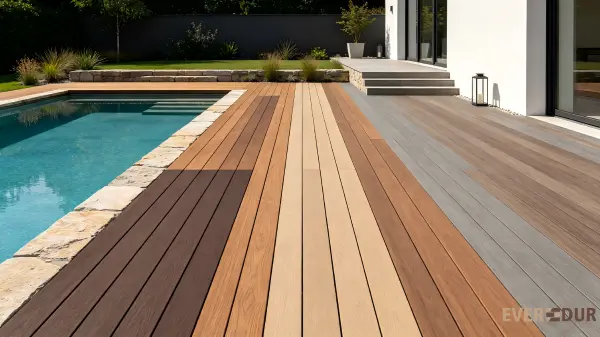
How Does Swimming Pool WPC Decking Create a Natural Wood Look?
As you can see, the wood grain look in composite decking is not a mistake; it is the result of choices made during the extrusion stage. To make it, wood powder and HDPE are mixed together and then heated and pressed through a shaped die. The surface roughness is then added using either rollers that press down on the wood or brushes that make the lines, knots, and small changes in depth that you see in woods like teak, walnut, or cedar look like real wood.
Co-extrusion technology is what makes modern WPC boards look a lot like wood. An extra layer of protection, sometimes known as a cap layer, is fused to the core board during the same extrusion run in a co-extrusion process. This top layer can have surface patterns with a lot of small details, color gradients that are deeper, and the slight difference in sheen that makes real wood look three-dimensional. This cap layer is molecularly linked to the core, so the look doesn't peel, flake, or break down when it comes in contact with water like paint or coating that is added after the fact.
Having different colors on the same board is another thing that makes it seem more real. Along the grain, natural wood has changes in tone: darker streaks, lighter spots, and small differences in tone. Manufacturers of WPC can do the same thing by carefully mixing pigments before extrusion, which makes boards where no two pieces look the same. In a strange way, this unevenness is what makes composite decks feel natural instead of man-made.
Light is also important. Light is scattered differently on a brushed surface than on a smooth one. The eye is used to seeing light bounce off of smooth surfaces in familiar ways. This texture makes a mood instead of just a floor when put down around a pool and light bounces off the water and hits the deck.SEND INQUIRY

Wood Grain Textures and Finishes in Swimming Pool WPC Decking
Texture isn't just for looks; around a pool, it's important for safety. When it gets wet, a smooth surface can be dangerous, which is why the finish you choose is important for more than just how it looks.
Brushed, embossed, sanded, and wood grain finishing are the most popular ways to finish the surface of pool-area pool WPC board products. For a brushed finish, the surface is worn down very slightly, making tiny lines that make it easier to grip without feeling rough. This is great for private pools where comfort and safety while barefoot can live together.
When heated, an embossed finish presses a pattern into the surface, giving it a deeper texture relief. This makes the wood grain look more noticeable and also makes the grip stronger. The 3D embossed wood grain version goes even further by changing the depth and angle of the texture impression. This makes a surface that reflects light in different ways and looks like real wood at first glance.
Grooved surface designs, in which lines run along the length of the board, do two things: they improve drainage by moving water away from the walking surface, and they add a straight visual rhythm that goes well with modern pool architecture.
Sanded finishes are in the middle. They have a matte finish that makes them less reflective in bright outdoor light and a softer texture than deep embossing. If you want a quieter, more understated look, this finish is perfect for you.
Co-extruded boards with a covered top layer protect the wood grain pattern from UV light for a long time, which is an added benefit. If you don't cover the surface, the sun can make the colors flatten out over time. For a much longer time, the cap layer keeps the finish's look and feel without changing them.SEND INQUIRY

Swimming Pool WPC Decking Colors for Modern Outdoor Pool Design
The mood of an outdoor pool area is set by the colors that are used. Cooler tones, like stone gray, ash gray, and dark gray, give pools a modern, architectural look that works well in modern home or business landscaping. Also, these shades are more useful because they show less coloring from sunscreen or chemicals splashed in the pool.
Warmer colors like teak, cedar, walnut, sandalwood, and copper brown make the pool look like it's made of real wood and look great in places where there is natural stone, plants, or yard structures around the pool. These colors make you feel calm and welcome, which makes them perfect for gardens in homes, courtyards of small hotels, and wellness retreats.
Neutrals in the middle range, like mocha, white, and coffee, can be used in many ways. You can use them with both warm and cool color schemes because they don't lean too far in one way. This is helpful when other materials in the room, like tiles, copings, and garden walls, are already very colorful.
Eco-friendly pool deck materials have UV-stable coloring that stops the color from changing over time like it does with lower-quality plastic boards. Well-formulated WPC products don't fade much after being exposed to UV light for more than 2,000 hours. This is important in North America and Europe, where the summer sun is very strong and outdoor furniture and surfaces are in the sun for months on end.
For project-specific needs, color customization beyond standard palettes is available, allowing designers and specifiers to match decking to building color schemes or brand palettes in hotel settings.SEND INQUIRY

How Can Swimming Pool WPC Decking Complement Poolside Landscapes?
A pool deck is connected to things like flower beds, fences, water features, outdoor furniture, and the building's architecture that it is next to. How the decking material fits in with these other parts determines whether the space as a whole feels like it was put together from random pieces.
WPC decking boards are good for structured garden designs where geometry and alignment are important because they come in standard sizes and shapes that can be used again and again. When installed along a straight line, the boards move the eye in different directions. When installed parallel to the edge of the pool, the boards draw the eye along the water, and when installed perpendicular, they draw the eye from the garden around the pool toward the pool. This directionality can be used on purpose by designers who work with WPC composite boards.
You can choose the color and texture of the decking so that it goes with or stands out against the hard landscaping around it. A warm teak board next to a limestone curb makes a natural difference that you can feel. When you put a dark gray board next to white finish or pale concrete, you get a sharp architectural design that looks purposely modern.
Another thing to think about is planting unity. On-site cutting of WPC boards is possible to make room for built-in planters, tree surrounds, or stepped changes between levels. Because they are all the same size, they are easy to cut on-site. This isn't possible with natural wood, which has different densities and grain directions.
At deck level, recessed step lights and surrounding LED strips work with the rough WPC surfaces to make the atmosphere feel like evening. A brushed finish spreads out low-angle light equally with its micro-grooves, while deeper etched textures make shadow patterns that are more striking. Because of this, WPC decking is a surface that looks good at all times of the day and in all kinds of lighting.SEND INQUIRY

Custom Swimming Pool WPC Decking for Distinctive Outdoor Spaces
Most pool floor needs can be met by standard product lines, but some projects have unique needs that aren't met by those lines. This can be fixed with custom WPC decking, which lets you change the material, size, color, and structure.
Customizing materials is useful for projects that will be done in harsh environments. For example, pools near wet coastlines might benefit from formulas that make it harder for bleach and saltwater to get in. For projects in places where temperatures change a lot from season to season, boards that are made to expand and contract less may be needed. This affects both how comfortable the deck is to walk on and how stable it will be in the long term. Long-term results are better when you work with a maker that can change the mix of raw materials to fit these conditions than when you just pick a stock board and hope it works.
Dimensional customization lets boards be made in widths, thicknesses, and lengths that are specific to a project. This cuts down on waste on-site, makes installation easier, and can improve the look in places where normal sizes would require odd cuts or joins that can be seen.
Specificators working on hotel, vacation, or high-end home projects can get a finish that is exactly what the designer had in mind by changing the surface roughness and color. Custom coloring can be used when normal color cards don't match the project's color scheme. If normal textures don't give the grip or look you want, you can ask for different surface treatments.
OEM and ODM services go even further, letting developers, contractors, and resellers add project- or custom-branded WPC decking to what they have to offer. This is especially important for companies that sell building materials and work in construction that work in markets where differentiating their products is important for business.SEND INQUIRY

Conclusion
It looks like real wood and is strong enough to be used around pools. Wood grain WPC decking combines these two qualities. Composite pool decking gives you real design and performance options with swimming pool WPC decking. The different textures, colors, and customization choices are made using manufacturing methods that create realistic grain patterns. For anyone choosing outdoor areas near water, whether for a home, a hotel, or a business health center, this is a well-thought-out, long-lasting, and attractive option.SEND INQUIRY

FAQ
Q: Is wood grain WPC decking genuinely slip-resistant when wet around a pool?
A: Yes. WPC pool decking doesn't slip because of the way its surface is finished. Brushed and etched finishes make tiny lines that stick to the surface even when it's wet. Products that have been tried and approved by the right authorities show that they have enough grip for walking barefoot in wet circumstances. The level of grip depends on the finish. Surfaces with grooves or deep embossed patterns have better grip than surfaces that have been sanded smooth.
Q: How does WPC pool decking hold up against chlorine and saltwater exposure?
A: Pool WPC board products made with grade HDPE that has been recovered is naturally resistant to chemical absorption. It's not possible for chlorine from treated pools or saltwater or seaside pools to get into the board structure. This stops the internal breakdown that softens and decays wood. The co-extrusion cap layer acts as an extra wall to keep chemicals from staying on the core material.
Q: Can WPC pool decking be installed over an existing concrete pool surround?
A: Most of the time, yes, WPC pool decking can be put down on top of a concrete pool surround. While WPC decking is usually put down on a joist framework, it can be put down on top of a concrete or paved surface as long as the base is stable and level. Depending on the board thickness and shape chosen, the joist spacing and way of fixing them may need to be changed. For installation advice that is special to your job, you should talk to the maker or a trained installer.

Get in Touch with Everdur: Swimming Pool WPC Decking Manufacturer
For Construction Firms and Contractors: Get access to technical specs, project prices, and sample boards that are made to fit the needs of your installation. Everdur can handle large orders and keep to the delivery times they promise. They do this with structured quality management that meets ISO 9001 and ISO 14001 standards.
For Building Materials Wholesalers and Resellers: Find out how wholesale pricing works and ask for free samples to see how good the product is before you decide to buy a lot of it. With our OEM and ODM services, you can make products that are unique for your local market.
For End Customers and Homeowners: Get free design help and installation tips to help you choose the right board shape, texture, and color for your pool area.
All of Everdur's swimming pool WPC decking products meet the testing requirements of the EU (CE), the US (ASTM D7039), and China (GB/T 24137). Our products are certified as having Recycled Content and meet E0 environmental guidelines, which proves that they are made from recycled HDPE.
Contact our team at violet@wpcsupplier.com to talk about your project needs with a skilled swimming pool WPC decking manufacturer.

References
1. Clemons, C. M. (2002). Wood-plastic composites in the United States: The interfacing of two industries. Forest Products Journal, 52(6), 10–18.
2. Stark, N. M., & Rowlands, R. E. (2003). Effects of wood fiber characteristics on mechanical properties of wood/polypropylene composites. Wood and Fiber Science, 35(2), 167–174.
3. European Committee for Standardization. (2012). EN 15534: Composites made from cellulose-based materials and thermoplastics (usually called wood-polymer composites (WPC) or natural fibre composites (NFC)). CEN.
4. American Society for Testing and Materials. (2011). ASTM D7032: Standard specification for establishing performance ratings for wood-plastic composite deck boards and guardrail systems. ASTM International.
5. Klyosov, A. A. (2007). Wood-Plastic Composites. John Wiley & Sons.
6. Verhey, S., Laks, P., & Richter, D. (2001). Laboratory decay resistance of woodfiber/thermoplastic composites. Forest Products Journal, 51(9), 44–49.
7. Forest Stewardship Council. (2023). FSC Certification and Recycled Content Standards: A Guide for Manufacturers and Specifiers. FSC International.
Send Inquiry

Related Industry Knowledge
- Low MOQ Hollow WPC Decking: Perfect for Small Residential Projects
- Affordable WPC Decking Wholesale: Direct from Factory to Your Project
- WPC Composite Fencing: The Low-Maintenance Choice for Property Owners
- What is deep embossed composite decking?
- Landscape WPC Decking: Elevate Your Outdoor Landscape Design 2026
- WPC Commercial Building Facades Installation: Guide for Large Projects
- Anti-Fade Decorative Composite Fencing: Long-Lasting Beauty
- Hollow WPC Decking Installation Cost: How to Save Big in 2026
- Waterproof WPC Cladding: Perfect for Coastal and Rainy Areas
- How to Install WPC Decking Easily: A Step-by-Step Tutorial for Beginners