
WPC Composite Fencing: The Low-Maintenance Choice for Property Owners
2026-11-17 20:28:39
A WPC fence is a fence constructed from wood plastic composite planks. It will endure 10 to 25 years outside without painting, staining or sealing. That's why a WPC fence is the low-maintenance alternative for homeowners, developers and property managers. In this article we will cover how the material works, how it stacks up against wood & vinyl and what to look for before ordering a container. It also provides distributors and installers with a system checklist so that posts, panels and gates fit properly on day one.
Need a WPC fence maker with complete system support? Everdur makes WPC fence panels that slide into aluminum or steel posts. Send your fence height, board size, color and target market to violet@wpcsupplier.com We will provide you the panel alternatives and installation specifications so your staff may test one full bay before you buy a container.SEND INQUIRY
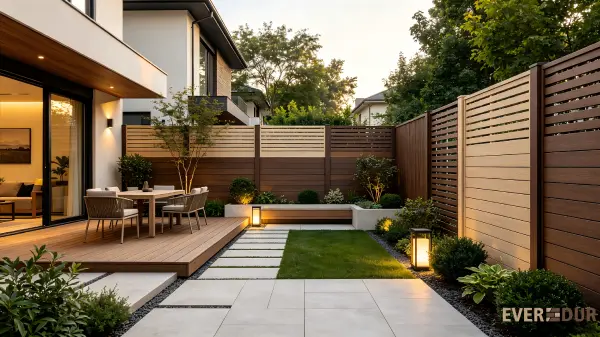
Why Are Property Owners Switching to WPC Composite Fencing?
Wood fences need constant maintenance and a WPC fence does not. They are painted, stained, sealed and repaired by owners season after season. The question many owners now ask is simple: why pay for maintenance when a WPC fence doesn't need it? Time, cost and danger is the answer and the figures are simple to verify.
What maintenance burden pushes owners away from wood?
Purdue University Extension says one layer of penetrating stain on fresh wood will last roughly 2 to 4 years. That indicates 2.5 to 5 coating jobs during a 10-year ownership (10 ÷ 4 and 10 ÷ 2). A fence has two sides , and several meters in length . Every coating project for a landlord or homeowners association is labor, paint and scheduling. If coatings are skipped, boards gray and crack and owners complain.
What do owners get from a WPC fence instead?
Wood-plastic composite (WPC) is a mix of wood fiber and plastic. These composites are generally 50% to 60% wood by weight and 40% or more thermoplastic, according to the USDA Forest Products Laboratory. Our WPC fence boards are composed of wood fiber and Grade A recycled HDPE (high-density polyethylene, a stable material used in pipes). We co-extrude every board and so have a protective outer layer surrounding the core. The outcome is a fence with a design life of 10 to 25 years and a routine that requires simply water.SEND INQUIRY

What Makes WPC Fencing Different from Wood-Plastic Composite Panels?
It is not clear why WPC is referred to as wood-plastic composite. WPC fence is made of WPC panels. The distinction is in what each product does. Generic WPC products such as wall cladding or decking boards are sold by region. WPC fence is sold as a system that has to be resistant to wind, fit its posts and hold up.
What does a WPC fence system include?
A full WPC fencing system comprises five components: boards or panels, posts, rails or connections, post caps and gates. Our panels fit into aluminum or steel posts and don't need complicated tools or professional abilities. Board dimensions range from 140 mm to 220 mm in width and 20 mm to 40 mm in thickness. Usual lengths are 1.8 m, 2.2 m and 2.9 m. Full privacy and slatted designs both function in horizontal or vertical layouts.
Why does system fit matter more than panel price?
A fence is done as soon as it is erected. If one piece doesn't fit, the staff stops working, and the customer waits. Tolerance mistakes also accumulate. For example, a 2 mm inaccuracy on each slot on 13 boards adds 26 mm to a 1.8 m fence. That space is wide enough to jam a gate or create a noticeable seam. Getting panels and posts from one supply system takes much of the risk out of the equation. Full systems quoting installers and distributors also increase the value of each purchase and lock in parts sales later on.SEND INQUIRY

Can WPC Composite Fencing Eliminate the Need for Regular Painting?
That's correct. A WPC fence will not need paint, stain or sealant. The color is inherent to the board, not a coating placed on site, therefore there is no peeling or flaking. Owners bypass the coating work wood needs every several years. There is still some care, and it is light.
What care does a WPC fence still need?
Flush the fence with water a couple of times a year. For tough places, use mild soap and a delicate brush. Clear leaves and dirt from the base. Standing moisture fosters mildew on any surface. Inspect post caps and gate hardware annually. A rinse takes minutes. A wood fence requires scraping, sanding and new coats. Include a one page care card with every purchase to tell your consumers what steps to take.
Will a WPC fence fade or turn chalky?
The first concern for developers who pass up a project is the dread of getting complaints two years later about fading. USDA researched this. Matuana, Jin and Stark (2011) showed that uncapped composites darken in sunshine and lighten when colored wood components wash out. Discoloration was greatly reduced by a transparent HDPE top layer. That's why we co-extrude our boards and grade them at low fading after 2,000+ hours of UV exposure. That's around 83 days of continuous bulb time, so use that as a comparative number. Put a sample in your own sun and observe it. Always.
Moisture also has to be cared for. The Forest Products Laboratory says wood particles in a composite may swell early in outdoor exposure. The swelling creates microcracks through which the decay fungus may enter. Keep board ends off the soil and cover the cut ends. Deformation at cut ends has been linked to moisture absorption (Mankowski et al., 2015).SEND INQUIRY

How Does WPC Fencing Perform in High-Traffic Outdoor Spaces?
A fence will take a hard usage in parks, schools, parking lots and community entrances. Kids lean on it, balls bang it, carts knock it. All day wind blows on it. With the correct profile selection and good support design, a WPC fence can take these loads.
How does a WPC fence handle impact and daily contact?
Thicker, substantial boards will help a WPC fence withstand dents and flex better than thin, hollow ones. That is mirrored in our own warranty levels. Solid co-extrusion panels are guarantyd for 20 years, hollow co-extrusion panels for 15 years. Classic hollow panels carry 5 years. Classic solid panels carry 10 years. Match traffic to the tier. A domestic back yard may fit hollow panels, whilst a school border may call for solid ones.
How does wind affect a WPC fence in open areas?
A sturdy fence is a bulwark against the wind. The ASCE 7 technique for the wind force for solid freestanding walls is F = q × G × Cf × A. where A is the area of the wall. The Caltrans handbook (September 2025) has a practical example showing the formula in action. Two lessons aid buyers. Force increases with area, and the overturning moment at the footing increases with area times height.
Take a fence of the same width of bay. Increasing it from 1.8 m to 2.4 m increases the footing moment by around 78% as (2.4 ÷ 1.8)2 = 1.78. Slatted designs allow wind to move through and reduce the burden. Always ask for engineer verified wind data for your design speed, height and post spacing before you offer a job.SEND INQUIRY

WPC Fencing vs. Vinyl Fencing: Which Offers Better Long-Term Value?
No material wins every task. Vinyl fence is made from PVC compounds and contains no wood fiber. Composite fencing utilizes wood fiber and HDPE that offers a wood-like appearance and feel. The table compares each on the factors buyers care about.
| Factor | WPC fence | Vinyl (PVC) fence |
|---|---|---|
| Material makeup | Wood fiber (50% to 60% by weight) plus plastic | PVC compounds, single or co-extruded layers |
| Product standard | Ask for SGS or Intertek test reports per project | ASTM F964 covers PVC fence profiles |
| Moisture risk | Needs an intact shell and covered cut ends | No wood fiber to absorb water |
| Appearance | Wood grain, brushed, embossed, or sanded surfaces | Often smooth profiles |
| Maintenance | Rinse with water; no painting | Rinse with water; no painting |
| Everdur warranty | 5 to 20 years, by panel type | Varies by maker |
This table is a transaction. Vinyl has a simpler road to standards. WPC provides additional texture possibilities and a deeper appearance.
Where does vinyl hold an edge?
Honesty begets trust. PVC has no wood fiber, therefore no degradation route and no moisture risk at cut ends. ASTM F964 is a known product standard for PVC fence purchasers, including dimensions, extrusion quality and weatherability. Vinyl is a reasonable option if the customer wants a smooth, simple white fence and nothing else.
Where does a WPC fence deliver more value?
WPC comes in wood grain, brushed, embossed and sanded finishes in hues such as Teak, Walnut, Cedar and Ash Gray. We have the same colors on our decking, so a distributor can match a fence to a deck or wall panel from one supply line. A lengthier guarantee – like the 20-year solid co-extrusion panel – also provides developers a definitive figure to use in a handover agreement.SEND INQUIRY

What Design Options Are Available for Modern WPC Fencing?
Design sells. Owners purchase the WPC fence they image in their mind. A WPC fence gives consumers more options than many imagine. Layout, color and texture modify the appearance and the wind stress.
Should you choose privacy panels or slatted designs?
WPC fences with full privacy panels provide total screening for pool areas and back gardens. Slatted patterns provide a contemporary semi-private aspect and allow wind to flow through. They operate horizontally or vertically . Horizontal layouts are great for modern dwellings and lengthy border runs. Vertical layouts fit typical streets. Show both solutions on a sample board to your consumers . Note the wind trade off in your estimate .
Which colors and surfaces can you match to other products?
We provide Ash Gray, Cedar, Coffee, Copper Brown, Dark Gray, Gray, Ivory, Mocha, Sandal Wood, Stone Gray, Teak, Walnut and Wood tones as well as bespoke colors for WPC fencing. Finishes include embossed, brushed, sanded and wood grain finishes. Our ODM & OEM team produces bespoke profiles as well. Specialized varieties include Adamas WPC, Soft WPC and Curved WPC. A matching fence, deck and wall covering for a villa project makes the entire yard appear planned.SEND INQUIRY

How Do Fence Thickness and Profile Affect WPC Fencing Strength?
Shape and span are as important as material in the strength of a WPC fence. The three most important decisions are thickness, solid or hollow profile and the board length between posts. Basic beam guidelines provide important recommendations even before test data is available.
How does thickness change stiffness?
For a solid rectangular piece, stiffness increases with the cube of thickness. A board of 25 mm is roughly 1.95 times as rigid as a board of 20 mm of the same width (25 ÷ 20)³. A 40 mm board is 8 times stiffer than a 20 mm board . Hollow profiles different math Ask for flexural test data Popular sizes include 90x25, 120x20, 135x25, 138x23, 140x20, 140x25, 145x25 and 150x25 mm.
Should you choose solid or hollow profiles?
Hollow profiles are lighter and need less material, which is a benefit for freight and handling . Within our range solid profiles provide greater resistance to impact and longer warranties. Hollow for light residential fencing. Solid for public or high-wind areas. Whichever you select, ask your supplier for the wall thickness and cap thickness and check on a sample cross section.
How do board lengths relate to post spacing?
Lengths standard are 1.8m, 2.2m, 2.9m. A board between posts bends in the wind. For the same section and load, the textbook deflection increases with the span to the fourth power. A 2.9 m span will deflect around 6.7 times more than a 1.8 m span ((2.9 ÷ 1.8)⁴). Use longer boards only if they have a thicker portion or extra support rails.SEND INQUIRY

Is WPC Composite Fencing Suitable for Residential and Commercial Properties?
Yes, provided the location meets the criteria. A WPC fence will do either. WPC fence is perfect for villa gardens, rental residences, projects and public parks. Every situation has its pressure points. Below you can see how purchasers utilize the material and what each of them should examine.
How do homeowners and property managers use it?
The villa owner wants seclusion and a fence that complements the terrace. Landlord wants to cease painting in-between renters. Both may specify a mid tone solid panel and close the maintenance issue for years. Our line is for private yards and villa gardens and a detailed care label in each box helps owners maintain the fence clean.
How do developers and community projects use it?
Developers purchase fence by the meter, not the board. A 2,000 m fence at 1.8 m high covers 3,600 SQM each side. The table below displays scaling of project lengths versus our minimum order of 100 SQM.
| Project length | Area per face at 1.8 m high | Multiple of 100 SQM minimum order |
|---|---|---|
| 2,000 m | 3,600 SQM | 36 times |
| 10,000 m | 18,000 SQM | 180 times |
| 30,000 m | 54,000 SQM | 540 times |
For a 3,600 SQM face, wood requires 2.5 to 5 cycles of coating in 10 years, i.e. 9,000 to 18,000 SQM of coating work. Instead of that a WPC fence replaces rinsing. They also seek for batch deliveries to coincide with construction stages, color uniformity across all phases and a manufacturer to hold responsible. We operate more than 50 manufacturing lines with an annual capacity of 30,000 tons, so volume and color uniformity is from a single source.
How do distributors and traders use it?
Full system distributors gain subsequent parts orders. Traders shipping mixed containers of decking, fence and railings want one supply line and clear documentation. Our export company serves over 60 countries, with 225 clients and more than 100 active partners. Ask about mixed loads and combination volumes and get the terms in writing before you purchase.SEND INQUIRY

What Installation Mistakes Can Shorten the Life of WPC Fencing?
Most WPC fencing complaints trace back to installation, not the material. The four mistakes below appear again and again on sites. Each one is easy to avoid with a short briefing for your crew.
- Mixing posts and panels from different suppliers: Panels and posts that come from different makers often carry different tolerances. A slot that is 2 mm too tight or too loose causes rattling, gaps, or stress on the board. Always trial-fit one complete bay before you commit to a full order. Our panels slot into aluminum or steel posts, and we can review your post drawing before samples ship.
- Skipping expansion gaps: Composite boards expand and shrink with temperature, mostly along their length. Locking boards tight into rigid posts leaves them nowhere to move, so they buckle or crack in summer heat. Follow the gap guidance in the installation drawing, and leave the gap at the slot ends. Test the fit on a warm day, not a cold morning.
- Burying boards or leaving them in soil contact: Wet soil keeps the base of any board damp. The Forest Products Laboratory links sustained moisture to decay risk in wood composites. Keep boards clear of soil, use a base rail or gravel strip, and cover cut ends. This simple step protects the lowest boards on most fences.
- Under-designing the footing: Wind pushes on a solid fence like a sail, and the overturning moment grows with height. Footings that suit a 1.5 m fence may fail under a 2.4 m one. Use engineer-reviewed footing details for your wind speed, soil, and height. Check them again whenever the design, the board profile, or the post spacing changes.
These four mistakes cost crews time and cost owners trust. A short pre-start briefing, a trial bay, and a parts check close most of the gaps before the posts go in.SEND INQUIRY

What Should Buyers Check Before Ordering WPC Composite Fencing?
Good buying habits save a season of problems on any WPC fence order. The checklist below follows the way our distributor and developer customers evaluate suppliers. Use it on every quote, ours included.
What should be on the system checklist?
Run these five checks before you sign a purchase order:
- Complete parts list and node drawings: Ask for a written list of every part in one fence bay: boards, posts, rails, caps, and gate hardware. Ask for drawings that show how each part connects. A missing clip or cap stops a crew on site. Compare the list against your own bill of materials, line by line, and ask which parts the supplier ships and which parts you source locally.
- Wind and structural data: Ask for wind data at your design speed, height, and post spacing. Request that it follow the ASCE 7 method or your local code. Developers should request a calculation sheet from the supplier or a local engineer. Do not accept a general claim of strong wind resistance without numbers that match your project conditions.
- A trial bay and tolerance check: Order samples for a complete bay and install it. Check slot fit, seam alignment, gate swing, and board flatness. Photograph the result next to the drawing. A trial bay costs little and reveals most of the tolerance problems that would otherwise appear on the whole job.
- Color batch and matching: Ask which color batches the order will draw from, and request retained samples for each. If you plan to match decking or wall panels, test the match in daylight. Our range includes the same color families across fence and decking, which makes matching easier. Record the batch numbers on your delivery paperwork, so you can trace any later complaint about shade.
- Warranty, certificates, and manufacturer proof: Request the warranty terms in writing for the exact panel type. Ask for ISO, CE, SGS, RoHS, REACH, Intertek, and FSC documents, which we provide on request. Confirm that the seller runs its own production lines. We hold ISO 9001 and ISO 14001 certification and run 5S management on the floor.
Together, these checks turn a price comparison into a risk comparison. They also give your sales team clear answers when a customer asks how the fence will last.SEND INQUIRY
How should you stage your opening order?
Start with samples, then a trial bay, then a pilot order, then rolling replenishment of composite fencing. Our minimum order starts at 100 SQM, with FOB Shanghai or Ningbo. We pack boards in PE film on wood pallets with panel protection for sea freight. Our capacity of 1,500+ containers a year supports seasonal peaks. We update product lines about every 12 months, with lighter boards, higher strength, and lower thermal expansion.

Conclusion
A WPC fence delivers what wood cannot: a fence that needs only water for 10 to 25 years. The material works best when you match the profile to the job. Pick solid boards for public or high-wind sites, choose co-extruded boards for color stability, and keep cut ends off the soil. Treat the fence as a system, with posts, panels, and gates from one supply line. Ask for wind data, test one complete bay, and compare warranty terms in writing. Vinyl remains a fair choice for plain white fences, but a WPC fence gives more texture, color, and matching options. These steps protect your margins and your reputation.SEND INQUIRY

FAQ
Q: Is a WPC fence really maintenance-free?
A: It is low-maintenance, not zero-maintenance. A WPC fence needs no painting, staining, or sealing. You still rinse it a few times a year, clear soil from the base, and check caps and hardware once a year. That routine takes minutes compared with wood.
Q: How long does a WPC fence last?
A: Our WPC fence range has a design life of 10 to 25 years. Warranty length depends on the panel type. Hollow co-extrusion carries 15 years, solid co-extrusion 20 years, classic hollow 5 years, and classic solid 10 years. Site conditions and installation quality affect actual life.
Q: Can a WPC fence handle strong wind?
A: It can, if you design for it. Wind force on a solid fence rises with area, and the footing moment rises with height. Raising a fence from 1.8 m to 2.4 m adds about 78% to that moment. Use slatted designs, thicker boards, shorter spans, and engineered footings in windy sites.
Q: Is a WPC fence better than a vinyl fence?
A: It depends on the job. Vinyl has no wood fiber and follows ASTM F964 for its profiles. A WPC fence offers wood grain, brushed, and embossed surfaces, plus color matching with decking. Compare warranty terms, test data, and the look your customer wants before you decide.
Q: Can I match a WPC fence to my deck or wall panels?
A: Yes, in most cases. We offer the same color families across our fence and decking ranges, including Teak, Walnut, Cedar, Ash Grey, and Stone Grey, plus custom colors. Request retained samples and compare them outdoors in daylight before you order.
Q: What is the minimum order for a WPC fence?
A: Our minimum order starts at 100 SQM, with FOB Shanghai or Ningbo. At 1.8 m high and 140 mm wide, 100 SQM equals about 397 boards (100 ÷ (1.8 × 0.14)).

Ready to Test a Complete WPC Fence Bay From Everdur?
Everdur ships to more than 60 countries and can quote a trial order from 100 SQM. Send violet@wpcsupplier.com your fence height, board size, color, and project type. As your WPC fence supplier, we will reply with panel options, installation details for aluminum or steel posts, and certificate documents on request.SEND INQUIRY

References
1. USDA Forest Products Laboratory (Ibach, R.E. and Clemons, C.M.), 2024. "Fungal and Moisture Durability of Wood-Plastic Composites: Summarizing 20 Years of Forest Products Laboratory Research," General Technical Report FPL-GTR-303.
2. Polymer Degradation and Stability (Matuana, L.M., Jin, S., and Stark, N.M.), 2011. "Ultraviolet Weathering of HDPE/Wood-Flour Composites Coextruded with a Clear HDPE Cap Layer," 96(1), 97-106.
3. American Wood Protection Association Proceedings (Mankowski, M.E., Manning, M.J., and Slowik, D.P.), 2015. "Durability of Capped Wood Plastic Composites," pp. 124-132.
4. ASTM International, 2024. "ASTM F964-13(2024): Standard Specification for Rigid Poly (Vinyl Chloride) (PVC) Exterior Profiles Used for Fencing and Railing."
5. Caltrans, Temporary Structures Manual, Appendix A-1 "Wind Loads," September 2025 (worked example of ASCE 7-16 Chapter 29, solid freestanding walls).
6. Purdue University Extension, "Selection and Application of Exterior Finishes for Wood" (NCR-132, undated web publication).
About the author: Violet, manage, Everdur New Material Technology Co., Ltd. Violet works with fence distributors, installers, developers, and trading companies who specify WPC fence systems for residential and commercial projects. Everdur brings 16 years of manufacturing experience, 50+ production lines, and ISO 9001 and ISO 14001 certification to those projects.
Send Inquiry

Related Industry Knowledge
- Eco-Friendly WPC Decking Installation: Green Tips for Your Project
- Traditional vs co-extruded decking: which is better?
- Wholesale Co-Extrusion WPC Cladding: Factory Price & Bulk Supply
- Weather Resistant Brushed WPC Decking: Perfect for All Climates
- Traditional WPC Decking Maintenance: Easy Tips to Extend Its Life
- WPC Landscape Walls Installation: Guide for Garden & Park Projects
- Top Composite Screen Fencing Manufacturers in 2026
- Low MOQ Grooved WPC Decking: Ideal for Residential & Commercial
- How to Choose High-Quality Co Extrusion WPC Decking for Your Garden
- Hollow WPC Decking Maintenance Tips: Keep It New for 10+ Years