
Anti-Slip Commercial WPC Decking: Safe for Public Commercial Spaces
2026-10-27 22:06:19
When a guest falls on a wet pool deck or a rain-soaked hotel entrance, the fall is more than just a banged-up knee. Liability lawsuits, reputational loss, and regulatory scrutiny are shortly to follow. That's why specifiers and project managers in Europe and North America are taking a closer look at the slip-resistance qualities of commercial WPC decking before they commit to any outdoor flooring material. Wood-plastic composite decking has earned a great reputation for durability, low maintenance and environmental responsibility, but its safety credentials – particularly in high-traffic, wet-exposure areas – deserve equal attention. The article examines surface texture engineering, standardized slip testing, drainage design and frequent cleaning as the components of the creation of really safe public business areas. Whether you're selecting materials for a hotel pool terrace, municipal boardwalk or high-traffic retail forecourt, understanding these elements allows you to specify with certainty and protect the people who utilize those spaces every day.SEND INQUIRY
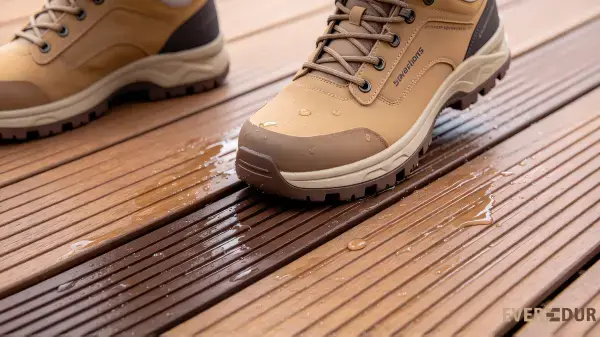

Why Do Wet Entrances and Pool Decks Need Safer Commercial WPC Decking?
Water is the No. 1 culprit in any slip and fall situation. The surface layer between a shoe sole and the deck material reduces the friction to a fraction of what it is when dry. For pool surrounds, spa terraces and building entrances that are exposed to rain, All standard outdoor flooring, be it timber, concrete or ceramic tile, needs to be actively treated to be anti-slip in these situations. The same is true of composite decking and a WPC board that is smooth or has no texture might be a hazard when wet.
The amount of foot traffic makes this concern particularly important for commercial enterprises. In one afternoon, a busy hotel pool deck can host hundreds of visitors in loungers, water features and interior spaces. The risk is increased by wet swimsuits, slippery sunscreen residue and barefoot guests. Wherever retail or hotel entrances are located, wind-driven rain creates a permanently wet zone several meters in. In any case, the flooring material has to be adequately grippy without resorting to expensive add-on treatments that break down over time.
This is something that composite decking engineers into the surface, rather than putting coatings after the fact. Embossed textures, brushed finishes and well sized board gaps all increase friction retention. The composition of the substrate is no less important. The co-extrusion shell included into commercial WPC decking prevents water from being absorbed by the surface, so the board will not become saturated and spongy, a situation that, in some natural timber products, ironically reduces the grip.
Regulatory pressure is a plus in the business case. For buildings that are accessible to the public, flooring must be permanently laid and have proven slip resistance properties according to the EU Construction Products Regulation. The United States Americans with Disabilities Act (ADA) has criteria for accessible routes that implicitly call for a sufficient coefficient of friction. Having a composite deck product with proven slip-resistance data helps shield clients against compliance gaps that may surface at the time of building inspection or worse, at the time of lawsuit.

How Embossed Texture Builds Grip into Commercial WPC Decking
Surface roughness is not merely an esthetic choice, it is a safety feature. The extrusion of a brushed or embossed image into composite decking creates a micro-topography that breaks up the thin layer of water on the board's surface. The water is not a continuous film, but is channeled into the "valleys" of the texture, such that the sole of your shoe (or the bottom of your bare foot) actually meets the peaks of the surface texture. This leads to a detectable increase in wet friction on a surface of the same material composition that is flat or sanded.
Several distinct texturing approaches are regularly utilized. Deep embossed with pronounced ridges, commonly dubbed wood-grain relief, gives good wet-grip performance, although little particles may be trapped between channels if the recesses are too narrow. The brushed surface provides a finer, more equal texture, softer underfoot for barefoot applications like pool surrounds, but still meeting basic slip-resistance standards. It has a grooved or striated pattern running lengthwise along the board. It works well when the main direction of pedestrian traffic is perpendicular to the grooves, but performs less well when traffic approaches at oblique angles.
Co-extrusion process adds further dimension to this painting. This is because a co-extruded board has a separate polymer layer on the outer shell and the texture pushed into the shell is more consistently preserved in its geometry over years of UV exposure and hard use than a texture pressed into a homogeneous composite profile. Mineral additives can be added to the shell material to improve surface hardness, which helps to maintain the emboss depth that contributes to grip retention.
Specifiers who specify WPC composite decking for commercial use should request surface texture depth measurements and slip-resistance test results. A texture that appears beautiful in the laboratory just after it is developed but wears flat in two or three seasons offers poor safety benefit in the long term. “Getting data from boards that have been put through accelerated wear testing gives a more realistic look at how long they will last in service.
Color choice has some subtle overlaps with safety. Darker board colors absorb more solar radiation and are hotter on the surface in full sun, creating thermal discomfort for barefoot users. Light hues reflect more heat, but they also tend to show soil more readily. Most pool and terrace applications call for a mid-range tone with a brushed texture.SEND INQUIRY

R11, Pendulum or COF: Which Slip Test Applies to Commercial WPC Decking?
There are a number of various test methods for slip-resistance and the suitable standard will depend on the location of the decking and the jurisdiction for the project.
The R-rating system (R9 to R13) is based on the German standard DIN 51130 established to ensure occupational safety in barefoot-exposure zones like changing rooms and pool areas. Outdoor business decking is generally specified to be R11 rated in wet situations. This rating is determined by measuring the angle at which a test person begins to slide on an oil lubricated surface. R11 shows that the surface has grip on incline angles between 19° and 27° which is suitable for most pool surrounds and uncovered terraces.
The energy loss of a rubber-tipped pendulum swinging into contact with the surface is measured by the pendulum test (EN 13036-4 in Europe or the equivalent used in UK building regulations). The resulting Pendulum Test Value (PTV) is used in the UK and a number of European markets to classify surfaces as low, moderate or high slip risk . Generally, a PTV of 36 or above is necessary for pedestrian areas that are exposed to moist contamination.
The standard reference for North America is the coefficient of friction (COF) according to ASTM C1028 or the more recently favored DCOF AcuTest (ANSI A137.1). The threshold for wet commercial floor applications is often reported as a dynamic COF of 0.42 or above, but some jurisdictions have more stringent criteria for ramps or inclined surfaces.
These three systems are not directly convertible. R11 certification on a board does not immediately satisfy UK pendulum criteria and neither outcome translates neatly into a COF number. Test data under each applicable standard should be requested by specifiers operating in different markets, rather than presuming equivalency.

Drainage, Slope and Gap Design Under Commercial WPC Decking
Surface texture takes care of the shoe-to-board contact in the moment, but water management at a structural level is also vital. Standing water is always dangerous, because it stops the drainage channels in the texture of the board from working properly. If the recesses are already filled up, they can't drain water away from the contact zone.
The main drainage mechanism in a commercial WPC board surface is board gap spacing. The surface is 5 mm to 8 mm and the spacing between consecutive boards allows rainfall and pool splash to drain to the foundation without accumulating on the surface. If the gaps are too tiny -- less than 3 mm -- drainage is limited and debris might become trapped, eventually creating a slippery biofilm. If the gaps are too big, they become a tripping hazard, especially for people with narrow heels or for those using mobility aids.
The slope of the substructure is as important as the gaps themselves. Industry guidance for outdoor composite decking typically suggests a minimum cross-fall of 1% to 2% to promote water circulation to drainage outlets. That slope has to be included into the joist framework before installation starts, whether it's on a vast pool terrace or a hotel roof deck – it can't be added later. Aluminum or steel joist systems with adjustable pedestals provide perfect slope calibration on flat concrete substrates, a viable solution for retrofit commercial applications.
Also, the region below the decking takes much consideration. Even if the surface of the board is not affected, the moisture trapped in a sealed, poorly ventilated vacuum under the boards encourages biofilm formation on the bottom of boards, and generates conditions that can lead to fastener corrosion and structural instability over time. Co-extruded WPC outdoor decking has water-resistant features and adequate substructure ventilation to greatly limit the dangers.SEND INQUIRY

Which Cleaning Routines Preserve Grip on Commercial WPC Decking?
A lot relies on how the surface is maintained, and how long a grip stays down. Algae, biofilm and organic waste are the main culprits behind slip-related accidents on composite decking that was originally placed with sufficient friction values. These biological layers like to grow in dark, damp spots – just the kind of places you find under pool equipment, under outdoor furniture, and at the base of planters.
Commercial uses usually include routine cleaning program with frequent brushing with a stiff-bristle broom to remove loose material followed by washing with diluted pH neutral detergent solution. To remove better from embossed recesses, brush across the board texture, not along it. Stubborn biofilm can be removed by high-pressure washing, but the lance needs to be held at an angle, not straight down, and the pressure kept below 150 bar, to prevent erosion of the surface texture over time.
Solvent based cleaners and bleach concentrations higher than 3% should be avoided on co-extruded profiles as these can alter the shell polymer and impair the sharpness of the embossed texture with repeated applications. In Europe and North America, proprietary composite deck cleaners developed for WPC surfaces are readily available and are the most reliable alternative for regular maintenance.
Seasonal inspections, particularly toward the end of winter in northern climates, are a valuable complement to any commercial maintenance program. Debris lodged in the spaces between boards can fracture somewhat due to freeze-thaw cycles, and when it is dislodged, it can migrate to the surface of the board and pose a slip hazard when wet. Prompt removal keeps drainage channels free and maintains the friction qualities that keep the deck safe.

Conclusion
Anti-slip performance in public business areas is not a single characteristic – it is the product of a series of decisions taken at the specification, manufacture, installation and maintenance phases. Project teams are in good shape when they choose a commercial WPC decking product that has a proven embossed texture, documented slip-resistance ratings under the right test standard, and a co-extrusion construction that maintains surface geometry for years of service. That product selection, coupled with smart drainage design, proper board spacing and a regular cleaning regimen covers the remaining gaps. For specifiers, builders and building owners working in contexts where wet surfaces are common, these elements are not optional improvements – they are the foundation for responsible behavior.SEND INQUIRY

FAQ
Q: What slip-resistance rating should I specify for a hotel pool deck?
A: For outdoor pool surrounds in Europe, an R11 rating under DIN 51130 is a widely accepted benchmark for barefoot wet-exposure areas. UK projects should additionally request Pendulum Test Value data above 36. North American projects should verify dynamic COF above 0.42 under ANSI A137.1 wet-test conditions. Requesting documentation for all three is reasonable when a project spans multiple regulatory markets.
Q: Does the anti-slip texture on composite decking wear down over time?
A: Co-extruded composite boards, where the textured outer shell is a chemically distinct polymer layer, retain emboss geometry more durably than single-material profiles. Accelerated wear test data — typically measured after equivalent pedestrian cycles — gives the most reliable indication of long-term texture retention. Regular maintenance that avoids high-concentration solvents also extends the service life of the surface texture.
Q: Can anti-slip composite decking be used on sloped ramps in public access areas?
A: Yes, and the combination of adequate surface texture, correct cross-fall, and consistent board gap spacing is particularly important on ramps. Accessibility standards in both the EU and North America set maximum slope gradients for ramp surfaces, and the flooring material must maintain documented friction values across that incline. Specifiers should confirm slip-resistance test results obtained on inclined test rigs rather than flat-surface data alone when the application involves a ramp.

Get Anti-Slip Commercial WPC Decking Samples and Project Support from Everdur
For construction firms and project developers: Request product samples with documented R11 slip-resistance data, technical datasheets for EU CE certification, and project-specific load calculations — no minimum order required for the sample stage.
For building materials wholesalers and resellers: Inquire about wholesale pricing tiers, container-load scheduling, and co-branding options. Everdur's production capacity supports consistent supply across seasonal demand peaks.
For contractors and installers: Access free installation guidance, joist-spacing recommendations, and substructure slope specifications tailored to your project conditions.
All Everdur composite decking products comply with EU CE certification, US ASTM D7039, and China GB/T 24137. Environmental credentials include Recycled Content certification and E0 environmental standard for formaldehyde emissions — relevant to green building assessments under BREEAM and LEED frameworks.
Everdur is an experienced commercial WPC decking manufacturer with over 16 years of production history, supplying customers across more than 60 countries. Reach the team directly at violet@wpcsupplier.com to discuss your project requirements, request samples, or obtain a quotation.

References
1. DIN 51130:2014 — Testing of Floor Coverings: Determination of the Anti-Slip Property, Workrooms and Fields of Activities with Slip Danger, Walking Method, Ramp Test. Deutsches Institut für Normung.
2. EN 13036-4:2011 — Road and Airfield Surface Characteristics: Test Methods, Part 4: Method for Measurement of Slip/Skid Resistance of a Surface, the Pendulum Test. European Committee for Standardization.
3. ANSI A137.1:2017 — American National Standard Specifications for Ceramic Tile, Section on Dynamic Coefficient of Friction. American National Standards Institute.
4. Americans with Disabilities Act Accessibility Guidelines (ADAAG), Chapter 3: Building Blocks, Section 302-303: Floor or Ground Surfaces. U.S. Access Board.
5. BS 7976-2:2002 — Pendulum Testers, Part 2: Method of Operation. British Standards Institution.
6. EU Construction Products Regulation (EU) No 305/2011 — Laying Down Harmonised Conditions for the Marketing of Construction Products. European Parliament and Council.
Send Inquiry
Related Industry Knowledge
- Low MOQ Commercial WPC Decking: Perfect for Small Commercial Projects
- 2026 Guide to Waterproof WPC Decking: Sizes, Styles & Prices
- Weather Resistant Brushed WPC Decking: Perfect for All Climates
- Tips and Tricks for Perfect WPC Solid Decking
- 2026 Guide to Grooved WPC Decking: Sizes, Styles & Prices
- Hollow WPC Decking Installation Cost: How to Save Big in 2026
- Brushed WPC Decking Installation: Achieve a Sophisticated Look
- WPC Composite Fencing Installation: Easy Guide for Beginners
- WPC Villa Fence Installation: Guide for Luxury Villa Projects
- WPC Fence Buying Guide: How to Choose the Right Fence for Your Garden and Villa