_1777451497595.webp)
Composite Screen Fencing Installation: Create Privacy & Style
2026-10-14 22:55:49
Installing composite screen fencing is one of the most practical decisions you can make when shaping an outdoor space. When you use screen fence to circle a garden deck, define a business patio, or add structure to your backyard, it does two things: it gives you real privacy and adds real visual character to your settings. Traditional solid wood fencing needs to be painted, sealed, and eventually replaced. Composite alternatives are made from a mix of recycled wood fiber, HDPE, and stabilizing additives. These materials last through all seasons without needing constant care. The end result is an outdoor screening solution that looks good, holds up well in bad weather, and doesn't need much care. This guide walks homeowners, contractors, and landscape designers in Europe and North America through the whole installation process, from making the first planning decisions to adding the last touches. It gives them the confidence to use composite privacy screen fencing. Along the way, you'll find useful tips, design ideas, and fair comparisons. This is because installing something correctly from the start saves time and money in the long run.SEND INQUIRY
What Should You Plan Before Installing Composite Screen Fencing Outdoors?
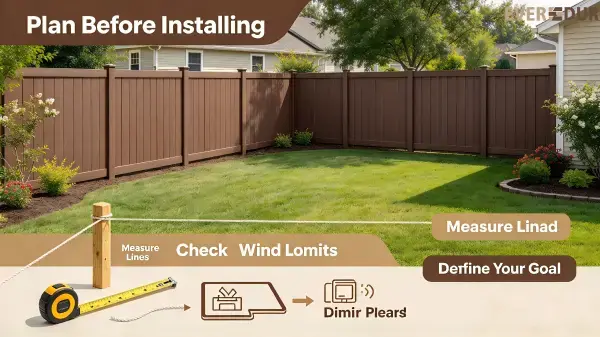
Improvising rarely leads to good outdoor fencing projects that work out. A few basic choices must be made before the first panel is put up. Skipping this step is one of the main reasons installs end up not being lined correctly, being shaky, or not being right for their location.
Carefully measure your lines of separation. Even though it seems clear, the ground outside is rarely perfectly flat or rectangular. Walk along the planned line and make a note of any slopes, drainage ditches, or buildings that might make it hard to place the posts. A small rise across a 10-meter run can make the ends very different in height, which changes how the panels are put up and whether a stepped or sloped design is better.
Understand your local wind load requirements. Outdoor fencing, especially slatted screen panels, catches wind. In coastal or exposed locations across Northern Europe and parts of the American Midwest, wind loading can be considerable. Post depth, concrete footings, and frame gauge should all be specified with this in mind. Many composite outdoor screen fencing failures are structural rather than material-related — the panels hold, but the posts give way.
Check the rules for building permits and boundaries. A fence that is higher than a certain height, usually 2 meters from the ground, may need to be approved ahead of time in many EU member states and parts of the UK. What can and can't be done at property lines in the United States is usually set by homeowner associations and local building rules. Checking with the local government before buying goods can save you a lot of money on repairs.
Think about your main goal. Different combinations are better for privacy, looks, reducing wind, and reducing noise. Panels that face west can block the glare of the western sun in a yard that is mostly used in the afternoon. On the other hand, airflow might be more important on a rooftop patio than privacy. Being clear about the function before choosing the panel spacing and slat width makes it easier to make decisions later on.
Finally, think about the base. What kind of base fitting you use and how long the work needs to cure before the panels go in depend on whether the posts are anchored into concrete, dirt, or earth.
Posts, Frames, and Panels: Building a Stable Composite Screen Fencing System
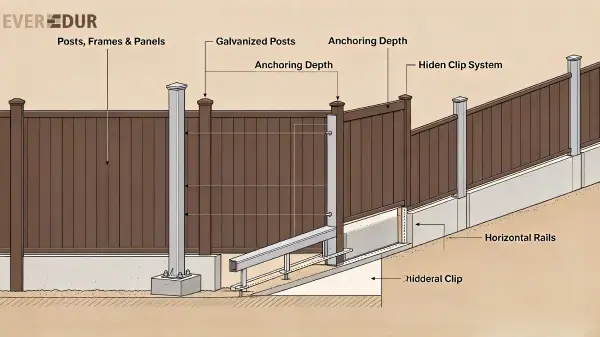
The posts and frames of an outdoor fence are much more important to its stability than the panels themselves. Even though composite panels aren't as heavy as wood, they still need a frame that won't bend, shift, or rust over time.
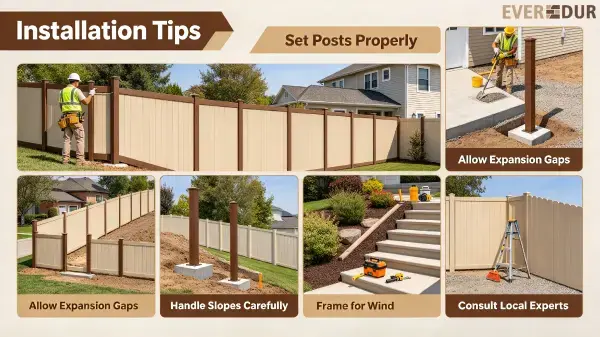
First, choices are made about which posts to use and how far apart they should be. In Europe and North America, galvanized steel or powder-coated metal posts are the most common choice because they can stand up to the weather and keep their shape. Depending on the width of the panel and how much wind it gets, the distance between posts is usually between 1.5 and 2.4 meters. Lateral stiffness goes up when space is closer, which is especially important in places that are uncovered.
Anchoring depth matters more than most assume. Typically, fence posts should be put a third of the way down. A 1.8-meter panel requires at least 600 mm of below-grade stake, preferably concrete and with a tiny cap to drain water from the post base. Even water-soaked steel posts break down where they touch the earth.
Each composite board is held up by horizontal rails or metal channel frames that join the posts. The way the panels are set up will affect the frame style you choose. For simple artistic panel designs, horizontal boards with slats can fit right into channel profiles. But for more complicated designs, each part may need a full frame around it. Make sure that the frame material fits with the composite maker's clip and pin system. Systems made just for one brand usually work better than ones made for all brands.
When you use composite materials, you need to think about thermal growth. Most wood-plastic composites only slightly expand and contract when the temperature changes, especially in places where summers are hot and winters are cold. If you leave the recommended expansion gaps at the ends of the boards and between the slats—usually 3 to 5 mm, but it depends on the product—the boards won't buckle when it's really hot. If you live in continental Europe or a part of North America where the seasons change a lot, you shouldn't skip this step.
Hidden clip fixing systems give the best finish in terms of looks and keep people from getting too close to the composite surface. The groove-and-clip method is used by many systems. Each board locks into the frame with a small clip made of stainless steel or coated steel. This method also makes it easier to change a panel if a piece gets broken in the future.SEND INQUIRY
How Can Composite Screen Fencing Balance Privacy, Airflow, and Natural Light?
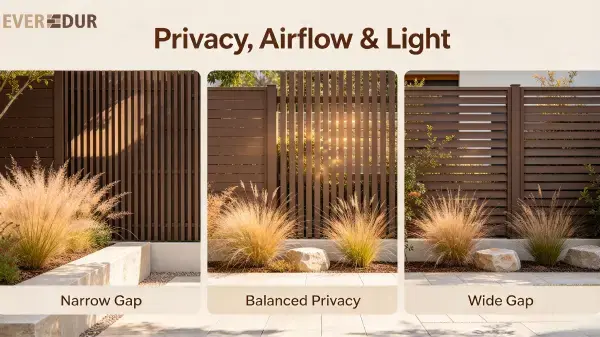
One of the practical strengths of composite privacy screen fencing — compared to solid timber boarding — is the flexibility to adjust opacity. The gap between each slat directly governs how much visual privacy, airflow, and light penetration the finished fence allows.
The narrow gaps of 5mm or less offer near-solid visual screening while allowing some air flow, reducing wind load and preventing the stagnant, trapped sense of complete boarding in smaller areas. Wider gaps of 15 to 25mm enable dappled light and ventilation, making them better for situations where plants grow alongside the fence or where the screen is ornamental.
In practice, many residential installations in Western Europe and along the US Pacific Coast use a gap of around 10 to 12mm — wide enough to soften the visual boundary and maintain air circulation, while still providing functional privacy at standing height.
Horizontal vs. Vertical Slats: Which Composite Screen Fencing Style Fits Your Outdoor Space?
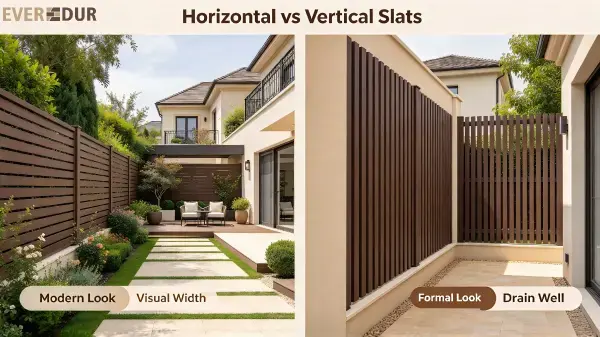
The way the slats are arranged changes both how the fence looks and how well it works. The horizontal slats look modern and laid-back, like the clean lines that are popular in a lot of modern European landscape design. They make a space look wider on the sides, which can make a small garden seem bigger.
Vertical bars look more official and organized. In low-ceilinged terraces, they can make the space feel larger by drawing the eye upward. They also look better in traditional or classic building settings. Vertical configurations also better drain rainwater, which shortens the time that moisture stays on the surface.
When it comes to functionality, horizontal slats tend to collect more dirt and leaves in the gaps, especially in places with lots of trees, while vertical slats drain and clean more easily. Neither direction is always better; the right choice relies on your building needs, how you like to maintain things, and your esthetic goals.SEND INQUIRY
Finishing Your Composite Screen Fencing: Colors, Textures, and Landscape Integration
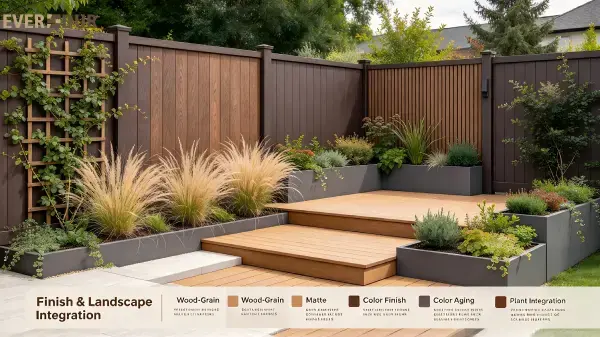
Based on the finish on the surface of composite screening boards, the fence looks different in different settings. Wood-grain-embossed surfaces catch light in a way that makes them look like real wood without the upkeep. Brushed or sanded finishes, on the other hand, give things a more matte, uniform look that works well with modern design styles.
When choosing a color for the fence, you should think about how it will age with the rest of the landscape. Charcoal, deep gray, and rich brown tones make things look farther away, and backgrounds with plants stand out more. There are lighter shades of warm brown that go well with wood decks or dirt surfaces. Most makers offer a basic palette along with ways to make it your own for bigger projects.
Landscape integration works best when the fence is seen as a part of a larger planting plan instead of a separate border feature. Low-growing decorative grasses, climbing wall plants trained along the lower section, or raised containers placed against the base of the fence all help to make the structure part of the garden's visual story instead of just a hard edge that doesn't go with anything else.
Conclusion
Installing composite screen fencing well is less about technical complexity and more about methodical preparation. When posts are properly grounded, frames are the right size for the area, and panels are picked with their real purpose in mind, the end result is an outdoor border that gives you real value over a long period of time through privacy, style, and weather resistance. The main rules are the same whether you're working on a garden in the Netherlands, a commercial terrace in California, or a balcony renovation in the UK: plan the structure before the looks, know your climate, and pick materials that are made to be used outside from the start.SEND INQUIRY
FAQ
Q: How deep should posts be set for composite screen fencing in a windy coastal location?
A: The standard one-third post depth rule should be seen as the very least in coastal areas that are open to the elements. For a panel height of 1.8 meters, putting anchoring posts 700 to 900 mm below grade in reinforced concrete makes wind resistance much better. Before placement, it's a good idea to talk to a local structure expert about places that get a lot of wind.
Q: Do composite screen fence panels need any treatment or sealing after installation?
A: No surface treatment, sealing, or staining is required for standard composite boards. The co-extrusion cap layer provides inherent weather, UV, and moisture resistance. Occasional cleaning with mild soap and water is sufficient to maintain appearance across the product's service life.
Q: Can composite screen fencing be installed on a slope without specialist equipment?
A: Yes, steep areas can be handled with either a stepped configuration, where each panel piece is level but not the same height as the one next to it, or a raked configuration, where the top line of the fencing goes with the slope. Standard tools can be used for both methods, but for sloped setups, extra care needs to be taken to keep the slat gaps even across the slope.
Ready to Source Composite Screen Fencing? Contact Everdur
Whether you're a construction firm planning a large-scale landscape project, a fence contractor looking for a reliable product line, a reseller or building materials wholesaler seeking consistent supply and competitive pricing, or an end customer wanting a tailored solution for your garden or terrace, Everdur offers a product and service framework designed for your specific context.
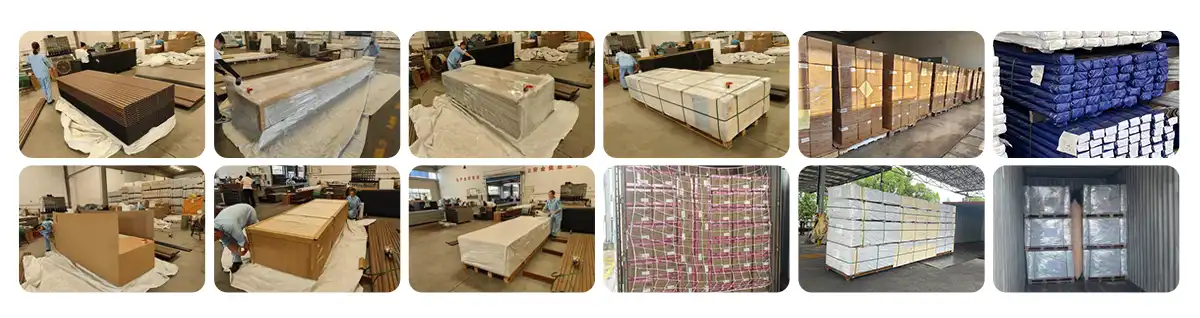
For construction firms and fence contractors: Project-volume pricing, technical specification sheets, and supply continuity backed by 50 WPC production lines and 1,500+ containers shipped annually.
For building materials wholesalers and resellers: Exclusive wholesale pricing structures, free samples, and private-label options available upon request.
For end customers: Free design consultation and installation guidance to help you select the right panel dimensions, slat spacing, and color palette for your outdoor space.
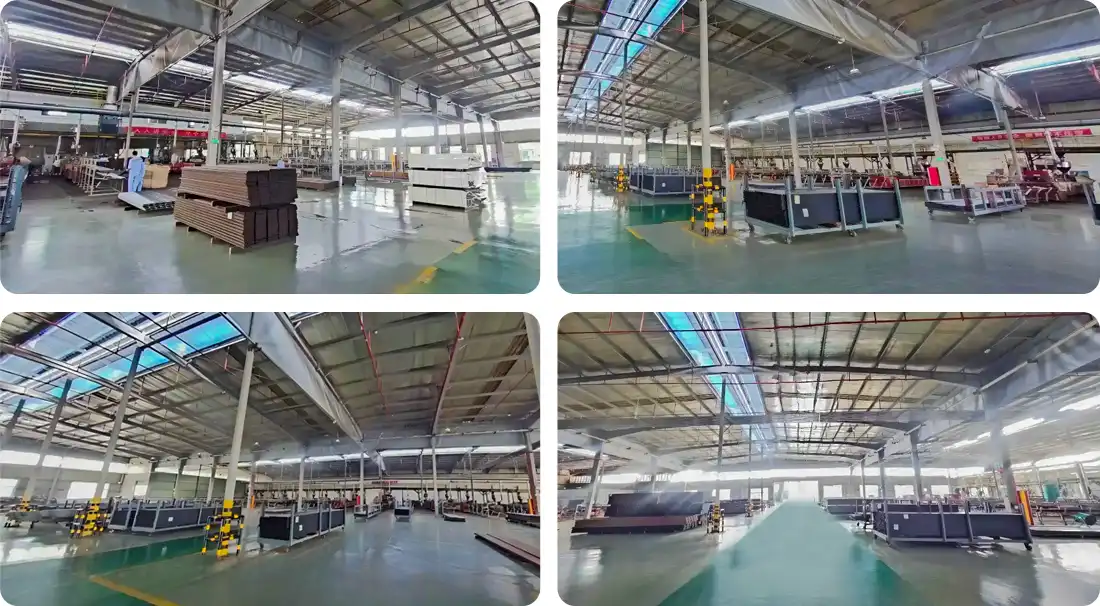
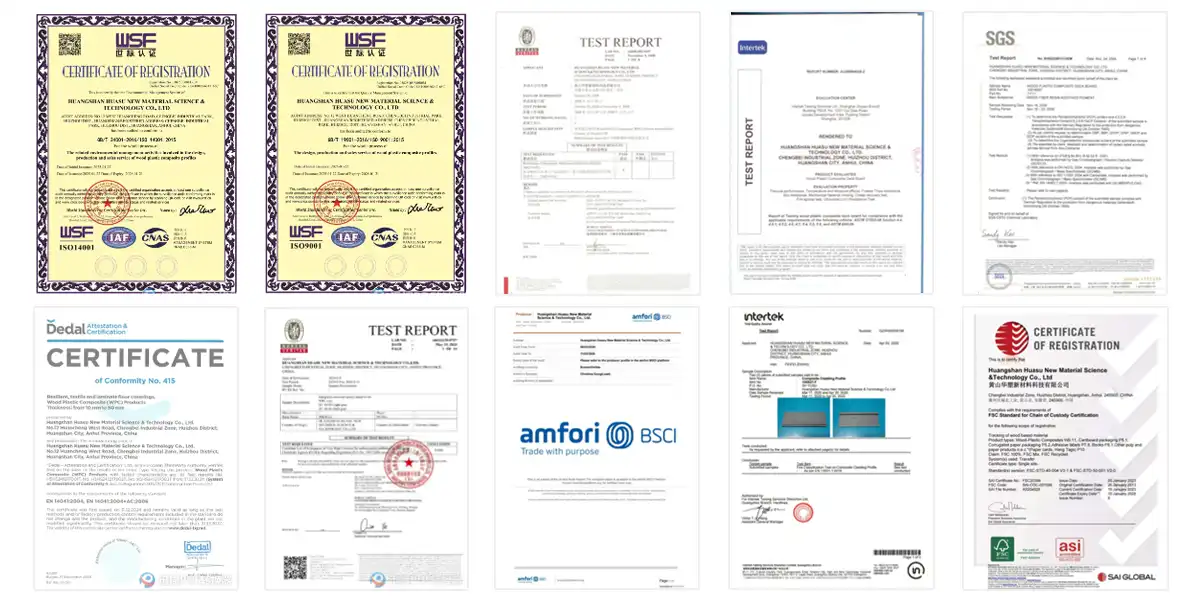
Everdur's composite screen fencing products meet CE (EU), ASTM D7039 (US), and GB/T 24137 (China) standards. Products carry ISO 9001, ISO 14001, FSC, REACH, and RoHS certifications, with Grade A recycled HDPE content and E0 environmental standards. As a dedicated composite screen fencing manufacturer, Everdur ships from FOB ports in Shanghai and Ningbo to customers across Europe, North America, and beyond.
Reach out directly to discuss your project: violet@wpcsupplier.com
References
1. Clemons, C. M. (2002). Wood-Plastic Composites in the United States: The Interfacing of Two Industries. Forest Products Journal, 52(6), 10–18.
2. EN 15534-1:2014. Composites Made from Cellulose-Based Materials and Thermoplastics (Usually Called Wood-Polymer Composites or Natural Fibre Composites) — Part 1: Test Methods for Characterisation of Compounds and Products. European Committee for Standardization (CEN).
3. ASTM International. ASTM D7031: Standard Guide for Evaluating Mechanical and Physical Properties of Wood-Plastic Composite Products. ASTM International, West Conshohocken, PA.
4. Stark, N. M., Rowlands, R. E., & Clemons, C. M. (2004). Effects of Wood Fiber Characteristics on Mechanical Properties of Wood/Polypropylene Composites. Wood and Fiber Science, 36(2), 129–140.
5. Smith, P. M., & Wolcott, M. P. (2006). Opportunities for Wood/Natural Fibre-Plastic Composites in Residential and Industrial Applications. Forest Products Journal, 56(3), 4–11.
6. Forest Stewardship Council (FSC). FSC Principles and Criteria for Forest Stewardship. FSC International, Bonn, Germany.
7. Klyosov, A. A. (2007). Wood-Plastic Composites. John Wiley & Sons, Hoboken, New Jersey.
Send Inquiry
Related Industry Knowledge
- Tips and Tricks for Perfect WPC Solid Decking
- 2026 Guide to Grooved WPC Decking: Sizes, Styles & Prices
- Brushed WPC Decking: Premium Textured Flooring for Luxury Outdoor Spaces
- Why Exterior WPC Cladding Is Better Than Vinyl for External Walls
- Grooved WPC Decking: Anti-Slip Flooring for Poolside & Walkways
- Traditional Cladding for Residential Buildings: Classic & Reliable
- 3D Composite Decking vs Regular Composite: Which Is More Stylish?
- Why Co-extruded WPC Decking Is a Must for Your Outdoor Project
- Top Benefits of WPC Decking for Residential and Commercial Use in 2026
- High-Quality WPC Decking for Poolside: Waterproof and Anti-Slip Solutions