_1777451497595.webp)
Wholesale Swimming Pool WPC Decking: Hotel & Resort Bulk Supply
2026-10-14 22:55:45
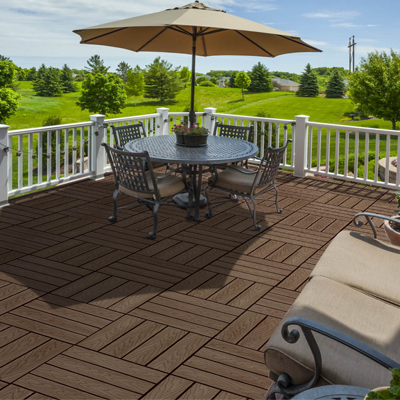
When hotels and resorts evaluate outdoor flooring for their pool environments, swimming pool WPC decking consistently rises to the top of the shortlist. The material — a composite of recycled wood fiber and high-density polyethylene — delivers the warm visual character of timber without the structural vulnerabilities that wet conditions accelerate. For buying teams that are in charge of large supplies for multiple locations, the draw is clear: a single product category that takes care of safety requirements, uniformity in appearance, chemical protection, and the cost of long-term upkeep all at the same time. To get this category on a large scale, though, you need to do more than just place a large order. To do this, you need to know how the material is made, which surface shapes work best in wet areas where bare feet aren't allowed, and how a manufacturer's production capacity turns into reliable delivery dates. This guide helps people who work in the hotel industry, landscaping, and selling building materials figure out if WPC pool decking is the right choice for their next big outdoor job by going over the most important technical and business points.SEND INQUIRY
Why Is Swimming Pool WPC Decking Suitable for Hotel and Resort Pool Areas?
When it comes to flooring, hotel and resort pools are especially hard on any material. The surface is always wet during the work day. Visitors don't wear shoes. Normal things include chlorine-filled water, sunscreen film, and sometimes being in saltwater. Cleaning teams use bleach liquids that have been dampened. When surfaces are in full sunlight, they can get very hot. Over time, traditional hardwood decking, even treated types, absorbs water, which causes the boards to change size, the surface to check, and living things to grow in the grain channels. Maintenance needs to be done more often, and closing for cleaning or finishing hurts the experience of guests.
These types of failure are taken into account at the material level by WPC composite decks. The HDPE part makes the board resistant to moisture all the way through, not just on the surface. Wood fiber gives structures strength and the warm feel that people associate with a high-end outdoor space. Chemical additions control how UV light breaks down things and how living things grow. As a result, the board stays the same size even after going through the wet-dry and hot-cool processes that happen on a busy pool deck.
For hotel owners, it's easy to see how to figure out maintenance costs. A composite pool deck doesn't need to be sealed every year, sanded every so often, or have boards that are rotting replaced. Cleaning is limited to simple tasks like washing. Over a ten- to twenty-five-year working life, the total cost of ownership is lower than that of wood options, even if the price per board is higher. It's more useful for resort groups that manage more than one property to be able to define a uniform product across all of them, with clear wait times from a single manufacturing source. When you buy in bulk, you can also get custom color matching, which means that the decking can match the brand palette of your property instead of a standard catalog finish.
Swimming Pool WPC Decking for Wet, Barefoot, and High-Traffic Outdoor Spaces
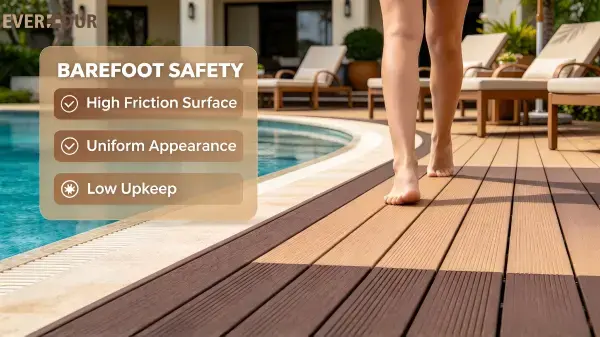
Barefoot surfaces adjacent to water carry a distinct liability profile. The combination of wet feet, smooth flooring, and hurried movement — children running, guests carrying drinks — creates slip-fall risk that operators take seriously from both a guest-safety and insurance-underwriting perspective. A weatherproof pool deck is engineered with this use case as a primary design constraint, not an afterthought.
The shape of the surface of a board meant to be installed by a pool is different from that of a board meant to be installed on a home yard deck. When the surface is wet, it has a higher coefficient of friction because of deeper groove channels, more violent stamping designs, and brushed finishes. These are not just for looks; they have practical effects on how water moves out from under your foot when you put weight on it.
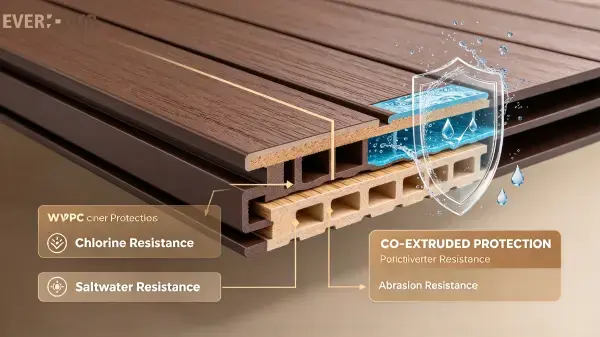
A lot of foot traffic also speeds up surface wear in ways that may not be fully reflected in lab tests. A private terrace doesn't get worn down as quickly as a resort pool deck where several hundred people walk around every day during the summer. Composite boards with a co-extruded outer shell have a better ability to resist surface wear over time. This is because a protective polymer layer is bonded to the core during manufacturing. The shell also doesn't get stained by food-grade oils and sunscreen, so it's easier to clean and the surface looks good even after years of use.
It's important to make sure that the right surface treatment is chosen for the right area in big hotel jobs. For visual continuity, areas that change from covered walkways to open pool surrounds may look better with different surface profiles within the same installation. The board width and color family should stay the same.SEND INQUIRY
How Do Grooved Surfaces Improve Drainage and Slip Resistance in Swimming Pool WPC Decking?
The Hydraulic Logic of Surface Channels
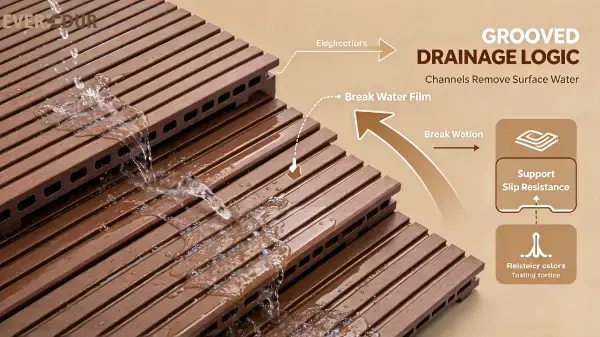
A curving deck is more than simply a gorgeous design. Long lines carved into the board face provide low-resistance channels that carry water away from the surface contact zone. Raised grooves break up water film and provide dry touch patches when bare feet impact a grooved surface. Grooves direct water away from the board edge and toward foundation drainage holes. This technology reduces hydroplaning on smooth, always-wet surfaces.
How effectively drainage works depends on groove width, depth, and spacing. Wider, deeper paths drain water quicker, but they reduce walking surface area, reducing comfort and finish. Pool deck standards prioritise drainage and grip above more beautiful elements for a rooftop patio.
Surface Texture and Friction Coefficients
Measurements of the friction coefficient in wet situations are used to figure out slip resistance. Minimum standards for flooring in public wet areas are set by regulations in a number of European markets. When you brush and sand composite surfaces, you create micro-texture on the surface that raises friction at a level that your eyes can't see. When paired with the coarse roughness of lines or etching, these surfaces achieve friction levels that are good for public places where people walk barefoot.
Embossed wood-grain surfaces spread pressure over a larger area than flat profiles, which makes them easier to hold on to and more comfortable to wear. If the surface has less thermal mass, or is made to reflect solar energy instead of absorbing it, it stays cooler underfoot during the hottest parts of the afternoon. This is an important comfort factor for outdoor pool areas in warm countries.
Maintenance of Drainage Performance Over Time
Drainage channels require periodic cleaning to maintain performance. Debris — leaf matter, sand, and biological film — can partially occlude grooves over time, reducing water evacuation efficiency. The practical advantage of poolside composite deck surfaces over timber is that cleaning is straightforward: low-pressure washing removes most accumulations without chemical treatment. The non-porous HDPE component does not harbor biological growth within the material itself, so surface biofilm does not penetrate and degrade structural integrity the way it does with wood.
Swimming Pool WPC Decking Resistance to Chlorine, Saltwater, UV, and Humidity
Chemical Exposure in Pool Environments
Pool water chemistry is aggressive toward many organic and synthetic materials. Chlorine compounds — used in liquid, granular, and stabilized tablet forms — can degrade surface finishes, bleach colorants, and attack adhesive bonds in layered materials. Saltwater pools, increasingly common in premium resort environments, present a different but equally demanding chemical profile. Weatherproof pool deck composites are formulated with HDPE as the primary polymer matrix specifically because HDPE demonstrates strong resistance to both chlorine compounds and sodium chloride solutions at the concentrations used in pool treatment.
Wood fiber within the composite is encapsulated by the polymer matrix, limiting direct chemical contact. The co-extrusion process adds an outer shell that provides an additional barrier. Over a multi-year period of regular chemical exposure, a well-specified composite board retains color and structural integrity more reliably than unprotected timber or lower-grade composite formulations.
UV Degradation and Color Stability
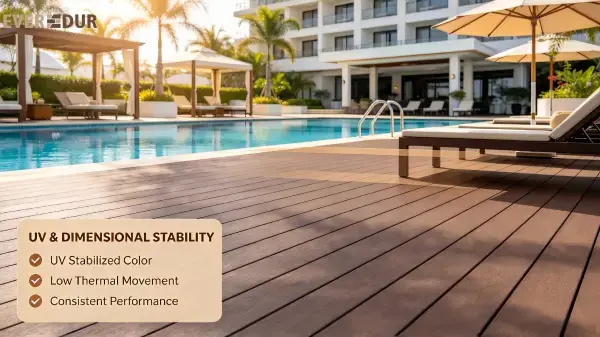
One of the biggest hazards to outdoor flooring is ultraviolet radiation. Reflected sunlight off pool surfaces increases UV burden on deck materials. Colours with UV stabilisers and absorbers prevent bleaching and chalking. Products evaluated to 2,000 or more hours of accelerated UV exposure under ASTM D4329 methods may be specified for colour stability during their estimated service life.
Humidity, Thermal Cycling, and Dimensional Stability
Any material's dimensional stability is tested daily by temperature changes. A board that expands and contracts substantially with temperature has installation gaps, fastener pull-through, and surface unevenness that pose trip hazards. In second-generation co-extruded profiles with complementary core and shell thermal behaviour, HDPE-based composites with adequate chemical additive packages exhibit lower thermal expansion coefficients than solid timber. Dimensional stability affects surface uniformity over time in hundreds-square-meter pool deck constructions.SEND INQUIRY
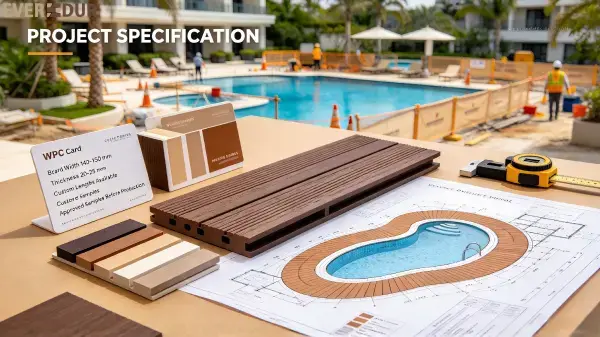
How to Specify Swimming Pool WPC Decking for Large Hotel & Resort Bulk Projects?
Defining Technical Parameters Before Procurement
Bulk project definition begins with a precise material brief, not a list. For pool applications, boards are 140–150 mm broad and 20–25 mm thick. Also crucial are surface treatment category, colour references (or custom match criteria), and installation process. Complex geometry or curved pool surrounds may need custom profile lengths or mitered ends. These criteria should be specified before contracting vendors to prevent mid-project specification changes and cost and schedule disruption.
Before finalising the specification, consult the project architect or engineer about structural load requirements, building regulations, and fire classification standards. CE marking for European projects and ASTM conformity for North American projects should be obtained as evidence, not assumed.
Volume Planning and Lead Time Management
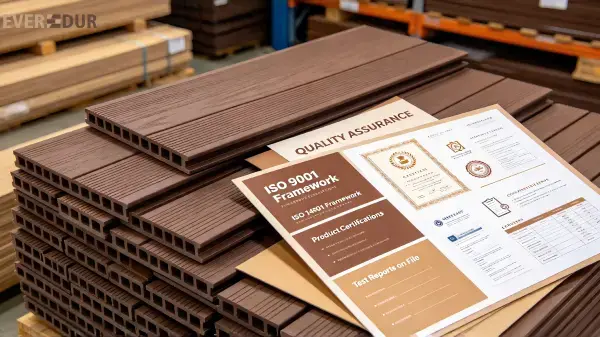
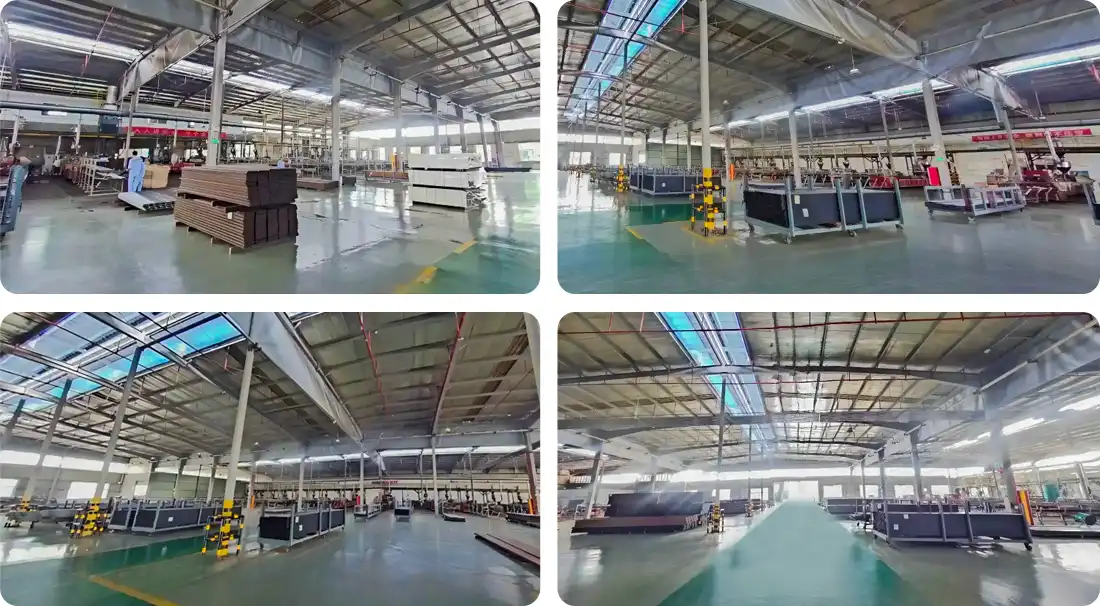
Resort openings and multi-property restorations need accurate volume forecasts and adequate planning. High-volume orders may be fulfilled by a firm with 50 or more manufacturing lines and 30,000 tonnes of annual output, but the procurement team must provide project-specific production and container booking schedules. Production lead time increases when shipping from Shanghai or Ningbo to Europe or North America. FOB pricing lets purchasers handle products directly or via a logistical partner.
Sample colour, texture, and co-extrusion cross-section should be approved before mass production. Many experienced procurement teams request a small trial batch for on-site testing in actual conditions before committing to full project volume.
Quality Assurance and Documentation
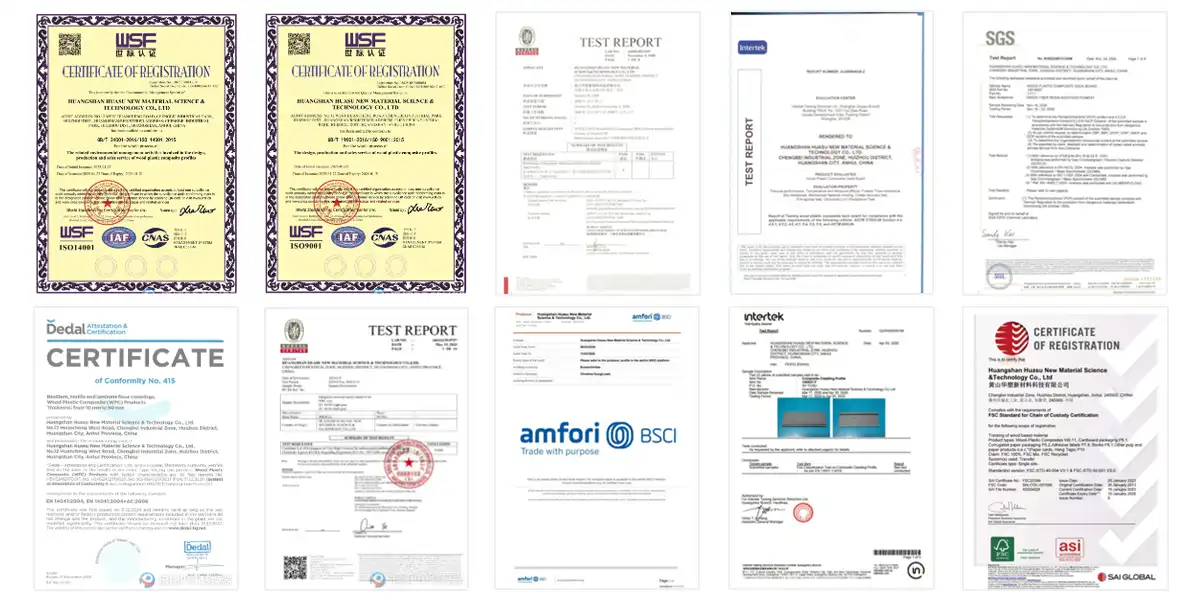
For hospitality construction, documentation is not optional. Procurement contracts for swimming pool WPC decking at hotel or resort scale should specify the quality management framework (ISO 9001), environmental management (ISO 14001), and any product-specific certifications required by the project jurisdiction. FSC certification addresses chain-of-custody concerns for wood fiber content. ROHS and REACH compliance documents confirm that restricted chemical substances are absent from the product. SGS or Intertek test reports provide independent verification of performance claims.
Request full documentation at the time of order confirmation, not at the point of shipment. This allows any compliance gaps to be resolved before production begins rather than at customs clearance.
Conclusion
Hotel and resort pool environments demand outdoor flooring that performs reliably under sustained chemical, UV, and mechanical stress — while maintaining the aesthetic quality that guests associate with a premium property. WPC composite decking, properly specified and sourced from a manufacturer with documented production capacity and quality management systems, meets these demands across a service life measured in decades rather than years. For wholesale procurement teams and hospitality contractors, the combination of technical performance, design flexibility, and bulk supply reliability makes composite pool decking a rational specification choice.SEND INQUIRY
FAQ
Q: What is the minimum order quantity for wholesale supply of WPC pool decking?
A: Standard minimum order quantity is 100m². For bigger volume hotel and resort developments, manufacturing scheduling and phased delivery may be coordinated to project schedules.
Q: Can the decking be customized in color and profile dimensions for a resort-wide specification?
A: Yes. ODM and OEM service may provide colour matching beyond the normal catalogue, unique board widths and special surface textures. Custom orders require sample approval prior to bulk production confirmation.
Q: How does co-extruded WPC decking differ from standard single-layer composite boards in a pool environment?
A: The extrusion technique bonds a polymer shell to the core of co-extruded boards. This shell protects against moisture ingress, chlorine and saltwater chemical interaction, and heavy foot traffic abrasion, which are crucial in continuous wet-zone applications.
For Hospitality Contractors, Building Materials Wholesalers, Resort Developers, and Procurement Teams: Get Bulk Pricing from Everdur
Whether you are a resort developer sourcing decking across multiple properties, a building materials wholesaler seeking a reliable manufacturing partner, or a landscape contractor quoting a large commercial pool installation, Everdur provides direct factory supply with consistent quality documentation.
For building materials wholesalers: Access wholesale pricing tiers, dedicated account support, and free sample sets to support your client presentations.
For hospitality contractors and resort developers: Receive custom color matching, project-specific profile design, and allocated production scheduling to meet your construction timeline.
For resellers and procurement firms: Benefit from OEM/ODM flexibility, full compliance documentation, and stable FOB supply from Shanghai and Ningbo ports.
All products comply with EU CE marking requirements, US ASTM D7039 standards, and China GB/T 24137. Environmental certifications include Recycled Content certification and E0 environmental standards. Our swimming pool WPC decking manufacturer team is available to support specification review and bulk order planning.
Contact Everdur directly: violet@wpcsupplier.com
References
1. American Society for Testing and Materials. Standard Specification for Wood-Plastic Composite Deck Boards and Guardrail Systems (Guards or Handrails) (ASTM D7032). ASTM International.
2. European Committee for Standardization. Thermal and Moisture Behaviour of Building Products and Components — Assessment of Water Absorption by Partial Immersion (EN 1609). CEN.
3. Forest Stewardship Council. FSC Chain of Custody Certification: An Introduction for Businesses. FSC International.
4. International Organization for Standardization. Quality Management Systems — Requirements (ISO 9001:2015). ISO.
5. Clemons, C. M. Wood-Plastic Composites in the United States: The Interfacing of Two Industries. Forest Products Journal, 52(6), 10–18.
6. Stark, N. M., & Rowlands, R. E. Effects of Wood Fiber Characteristics on Mechanical Properties of Wood/Polypropylene Composites. Wood and Fiber Science, 35(2), 167–174.
7. European Chemicals Agency. Understanding REACH. ECHA Publications, Helsinki.
Send Inquiry
Related Industry Knowledge
- How to Choose the Right Residential WPC Decking for Your Budget
- Brushed WPC Decking: Premium Textured Flooring for Luxury Outdoor Spaces
- 2026 Guide to WPC Landscape Walls: Designs & Installation Tips
- Grooved WPC Decking: Anti-Slip Flooring for Poolside & Walkways
- Best WPC Cladding Designs for Villa and Luxury Residential Projects
- 3D Composite Decking: Elevate Your Outdoor Space with Textured Flooring
- Low MOQ Traditional Cladding: Ideal for Small Traditional Projects
- WPC Decking Maintenance Tips: Keep Your Outdoor Deck Looking New for Years
- Top Hollow WPC Decking Designs for Modern Gardens
- Hollow WPC Decking Maintenance Tips: Keep It New for 10+ Years