
Is hollow composite decking waterproof?
2026-11-05 17:17:22
Hollow composite decking is water resistant, not water proof. A capped board sheds water, prevents decay and keeps sturdy as water drains away. But water may still get in via chopped ends, broken caps and standing puddles. In this article we consider how rain, pools and humid transportation are handled by hollow WPC decking and which design aspects make the difference. You will see what research indicates, how to test samples before you make an order and which requirements safeguard your margin. I developed this for distributors, internet merchants, contractors who want straight answers before they purchase.
Require samples tested for water before quoting a project? Everdur is a hollow WPC decking producer. 100 SQM minimum order. 15 year guarantee on co-extrusion. Email violet@wpcsupplier.com your target market and board size. We offer you specs, colour cards and a sample cut which you may soak in your own warehouse. Compare it with your present hollow WPC decking provider and assess the difference yourself.SEND INQUIRY


Is Hollow Composite Decking Completely Waterproof?
The Honest Answer: Water-Resistant, Not Waterproof
No deck board is fully watertight, even hollow WPC decking. Wood plastic composite (WPC) is a combination of wood fibre and plastic. According to the USDA Forest Products Laboratory, these boards usually include 50 to 60 percent wood by weight and 40 percent or more thermoplastic. Wood fibre is hygroscopic while plastic is not. The board is in the middle: it repels water, but it is never a sealed container. Clear labelling protects you when a consumer enquires about warranty conditions.
Surface science supports this. The new boards seem particularly moisture resistant. Segerholm et al. (2012) discovered that the polymer-rich skin retards early moisture absorption . The same research found that artificial weathering broke the polyethylene surface and drew fibre away from the plastic. Then moisture uptake accelerated. The best resistance to water a board can have is when the surface is unbroken.
What Water-Resistant Should Mean in a Quotation
So many postings are lax with the term waterproof. Instead, I suggest purchasers ask for quantifiable terms: what sort of cap, how water absorption will be tested, and exactly what the guarantee says. ASTM D7032 provides a well established foundation. It establishes performance ratings for WPC deck boards and addresses moisture and temperature impacts, freeze-thaw resistance, UV exposure and biological assault. You may put the phrase into a tender file. If the provider can name the test and share the report.
That transparency also safeguards your margin. And with margins tight, one contested container might wipe out the profit on numerous purchases. A precise statement is free to write and saves a lot of dispute later on.SEND INQUIRY

How Does Water Drain Through Hollow Composite Decking?
Surface, Gap, and Underside: The Drainage Path
The rain runs off via the crevices between the boards, not through the boards themselves. Installers use clips to maintain an even space at the edge of each board. The water flows through the opening to the joists and subsequently out from the sub-frame. Everdur hollow WPC decking has internal air tubes and a grooved underside. Moisture and air may get under the surface, instead than resting on top of it. Good drainage prevents the wood fibre from becoming wet for lengthy periods of time. And that is the largest lever you can manage.
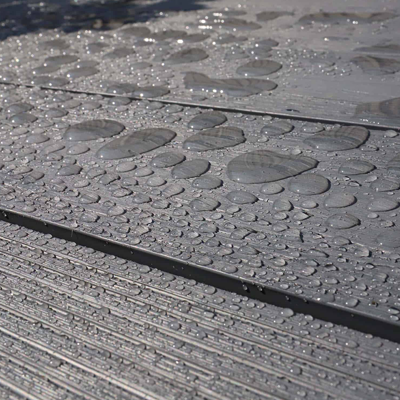
So does surface texture. An embossed or brushed surface breaks up a film of water such that rain beads up and rushes into the gaps. A thin coating lasts longer on a smooth flat surface. The difference is obvious if you do the tap test. Tilt a sample under flowing water and see how soon the surface clears.
Why Slope and Joist Airflow Matter More Than the Board
A board with puddles is better than any hollow core decking. Make a gentle slope away from the walls to let water drain out of the frame. Leave the area beneath the deck open on at least two sides so air may circulate and dry the bottom after a rain. Ibach and Clemons (2024) state that the swelling of wood particles caused by moisture finally results in microcracks in the plastic. Those fractures allow rotting fungus to enter the wood. Often drying that line of events.
Hollow profiles provide one more path: the ends. The sliced end showing the voids and the core. I discuss that danger in the sections following, and also the easy bits that close it.SEND INQUIRY

Is Hollow or Solid Composite Decking More Water-Resistant?
Same Material, Different Geometry
The formula for both hollow and solid boards is identical: wood fibre, high-density polyethylene (HDPE) and additives. The voids are not the reason for water resistance of hollow WPC decking, it is recipe and the cap layer. Smaller wood flour and the increased ratio of plastic to wood minimise the thickness swelling and so decreases water absorption (Machado et al. 2016). These variables appear in the formula. A hollow strong board of formula may absorb less water than a weak solid board of formula.
But geometry matters in other ways. A hollow board has an interior surface area and open ends. You won't find either in a solid board. This means that for hollow profiles the end sealing and cutting process is more crucial. It also makes the cap and the formula the two things to look for when you purchase it.
Side-by-Side Comparison for Buyers
The table below compares the three materials your clients weigh most often. It leverages Everdur's own manufacturing data for hollow and solid composite columns.
| Factor | Traditional wood | Solid WPC | Hollow WPC decking |
|---|---|---|---|
| Weight | Heavy | Heavier | 20–30% lighter than solid boards |
| Installation speed | Labor-intensive | Moderate | Fast and easy |
| Material cost | Variable | Higher | Budget-friendly |
| Maintenance | Painting or staining | Low | No painting or staining |
| Water behavior | Absorbs water, prone to rot | Resists water, absorbs slowly | Resists water through the cap, open ends need care |
| Main water risk | Rot and swelling | Cap damage, standing water | Open cut ends, standing water |
Hollow boards win on weight, freight, and installation speed. Solid boards carry more load and have no cavities to protect. Neither material is waterproof. Pick the one that fits the job, the budget, and the climate.SEND INQUIRY

Can Water Get Inside Hollow Composite Decking Boards?
Where Water Enters a Hollow Board
Yes water does go inside of hollow WPC deck planks. The principal access sites are chopped ends, drilled holes and damaged caps. They each allow the core to absorb moisture. Water forced through an unbroken capped face by rainfall alone is unusual. Water that pools at an open end may seep into the cavity and the wood-rich core.
According to Machado et al. (2016) , the absorption mechanism in hollow core decking is described by: diffusion, capillary flow at the fiber-plastic interface, and transport via microcracks. With ageing of boards, capillary flow and fractures get greater. Hence why a well-functioning board in year one requires the same attention in year eight.
What a Wet Cavity Does and Does Not Do
A moist cavity is no tragedy in itself. A little of moisture dries out via the air tubes and flutes. The problem is when water is left over and the board cannot dry. Then the wood fibre expands, rigidity decreases and mould might form on the surface.
Machado et al. measured the extreme case. In their high-moisture tests, bending stiffness fell 40 to 50 percent from water absorption. Shrinkage and swelling movement accounted for losses of 22 to 29 percent. Those conditions were harsh, and I read them as a ceiling, not an average. They show why drainage and end protection deserve attention.SEND INQUIRY

Does Standing Water Damage Hollow Composite Decking?
Short Puddles Versus Permanent Ponding
A puddle that dries within a day or two rarely harms a capped hollow WPC decking board. Ponding is different. Water that sits for weeks keeps the surface wet and the cap under stress. Ibach and colleagues (2013) built test boards to match the water absorption of commercial decking and exposed them outdoors. Samples under aggressive exposure decayed, fungal fruiting bodies appeared on some surfaces, and decay needed an initiation period before it started.
The message to your consumers is practical. Damage is a long process and site design determines whether it even starts. The wide spaces, moderate fall and free airflow of a deck allows the board to dry each day.
Freeze-Thaw and Heat Cycles
In cold markets, water may freeze within a hollow. For this reason, ASTM D7032 includes freeze-thaw testing. In heated markets, the worry becomes heat. The hollow boards are heated to high temperature for weeks in a locked container during a lengthy maritime journey. Ask each supplier about: pallet height, stacking limitations, packaging technique. Everdur packs boards in PE film on wood pallets with protection for the panels. This protects the edges and profiles during transportation.SEND INQUIRY

How Does Hollow Composite Decking Perform in Heavy Rain?
What Happens During a Storm
A properly designed hollow WPC decking deck drains quicker than it rains in heavy weather. The grooves and gaps drain water off. The cap layer prevents water being absorbed from the surface of the wood core. This is called co-extrusion . The plastic shell develops around the core in the same manufacturing cycle , thus the cap and core are bonded as one board . That's why I encourage purchasers to examine the thickness of the caps and the polish of the edges on every sample.
The true test comes after the storm. Boards dry in hours in the sun and breeze. Boards in shade with sealed gaps remain moist for days. Clear leaves out of the gaps each season with your contractors. It takes minutes and protects your warranty.
Sound, Flex, and the Hollow Drumming Concern
Distributors are frequently asked about the hollow sound underfoot and the pounding sounds in the rain. Hollow core decking is better at amplifying sound than an open frame. The outcome is dependent on rib design, board thickness and joist spacing. Everdur profiles include reinforcing ribs to disperse the load, with thickness ranging from 20 to 25 mm. Ask for the suggested joist spacing for each profile and follow it. The closer joists will limit bending of the boards and reduce drumming.SEND INQUIRY

Is Hollow Composite Decking Suitable for Pools and Wet Areas?
Pool Surrounds, Balconies, and Terraces
Yes, with restrictions. Hollow WPC decking is often used in pool surrounds, balconies and terraces and the top layer manages rain and splashing effectively. First and foremost, these areas need slip resistance. ASTM D7032 [4] deals with slide resistance testing of deck boards. Get an embossed or brushed finish for damp feet. Leave openings for quick drainage of water and do not fasten the deck firmly to a pool wall.
Picture a distributor in a humid seaside city supplying mansion gardens and hotel terraces. Her consumers desire a cheap price band, quick installation, no repainting. But a capped hollow board with an embossed face fits these demands, if her installers seal the cut ends.
Where Hollow Boards Are Not the Right Choice
I stay clear from hollow boards for customers that are always submerged, such docks in the water all the time. I also skip them in high point load areas. Those tasks fit solid boards or something. Honesty limits develop repeat orders. Low returns and loyal clients for a distributor of hollow WPC decking for patios, terraces and pool surrounds.SEND INQUIRY

What Causes Moisture Damage in Hollow Composite Decking?
Four Common Causes
Moisture damage is seldom the result of a single source. Research and field reports indicate a tiny number of repeat offenders. The four that matter most for hollow profiles are:
- Cut ends of exposed wood: Cutting a board exposes the wood-rich core and the cavities. Water gets in there a lot easier than via the capped face. The weakest part is left exposed by installers not using end caps and trim pieces. This is a common and preventable problem on hollow WPC decking profiles and is fixed with a simple cap or trim piece.
- Weathered or damaged cap layers: Segerholm and colleagues (2012) demonstrated that weathering caused cracks on the surface of the HDPE separating wood from plastic. This led to increased moisture absorption. Scratches from tools, sand or heavy furniture might open the same door. This is slowed by a properly bonded cap with a strong UV package protecting the core below.
- Poor drainage and lack of airflow:Blocked gaps and closed-in sub-frames keep boards damp with standing water. With time, moisture expansion generates microcracks that let decay fungus to enter the wood, say Forest Products Laboratory experts. Keep gaps open, and keep joists clean of debris. Debris in the gaps and soil contact beneath the frame speeds up that cycle.
- High wood content and low density cores: Machado et al. (2016) emphasise that finer wood flour and larger plastic share result in swelling decrease. Formulas that increase wood content to lower cost absorb more water. Before you compare pricing per square metre ask any provider for the formula range, the density goal and the test results.
Most moisture issues are caused by these four factors. Everyone has a fix in the factory, on the site or in your conditions of purchase. The next section discusses how to narrow all three gaps.
Warning Signs to Check After Installation
After the first hard rain, walk the deck, and again after the opening season. Look for black mould patches on the surface, fractures in the cap near cut ends and boards that remain wet long after their neighbours dry. If a contractor notices these signals early, he may replace one board rather than a full section. Share this checklist with your consumers and you can nip warranty problems in the bud.SEND INQUIRY

How Can You Prevent Water Ingress in Hollow Composite Decking?
Installation Practices That Keep Water Out
Preventing hollow WPC decking begins at the saw. Seal or cap all cut ends and fill or cover drilling holes. Follow the clip and joist spacing indicated on the manufacturer's installation sheet. Leave necessary expansion spaces at ends and edges of boards. Angle the frame away from the walls. Keep the dirt and debris off of the joists. leave the underside free for air movement. These measures cost relatively little and eliminate the most prevalent water pathways.
Maintenance is light but not nothing. Each season sweep leaves from the gaps and rinse dirt from the surface with clean water. If you detect standing water in low locations, drain it. Don't use scraping instruments that scrape the cap. A deck that receives this basic maintenance offers the cap layer the highest chance of surviving the warranty term.
A Pre-Order Sample Test You Can Run Yourself
Here is the screening test I propose before you sign on a container of hollow core decking. Take a 300 mm cut from a manufacturing board, not a showroom sample. Weigh it and measure the thickness in three places. Soak in clean water for 24 hrs. Then pat dry, weigh and measure again. Note the difference in thickness and mass increase.
Repeat the test with a sealed cut end and an open cut end. The gap between the two results shows how much the end matters on that profile. Laboratory studies use the same logic of soaking samples and tracking mass gain and thickness swelling . Run the same test on boards from each supplier under identical conditions. Treat the result as a purchasing screen, not a certified value. For formal numbers, request reports from an accredited laboratory.SEND INQUIRY

What Should You Check When Buying Waterproof Hollow Composite Decking?
Specification Checklist for Distributors and Sellers
Price per container matters, but the details below decide whether your hollow WPC decking container sells through without complaints. Here are the typical Everdur specifications, all customizable:
| Item | Everdur hollow WPC decking |
|---|---|
| Width | 135–150 mm |
| Thickness | 20–25 mm |
| Standard lengths | 2.2 m, 2.9 m, 3.6 m (custom lengths available) |
| Popular sizes | 90×25, 120×20, 135×25, 138×23, 140×20, 140×25, 145×25, 150×25 mm |
| Materials | Wood powder, HDPE, and additives; co-extrusion capping |
| Surface | Brushed, sanded, embossed, wood grain |
| Service life | 10–25 years |
| Warranty | 15 years on co-extrusion hollow decking |
| MOQ | 100 SQM |
| FOB port | Shanghai, Ningbo |
| Certifications | ISO 9001, ISO 14001, CE, FSC, REACH, RoHS |
| Packaging | PE film on wood pallets with panel protection |
Use this table as a template for any supplier comparison. Ask each one to fill the same rows, and request the test reports behind the water claims. A supplier who answers quickly and in detail usually runs a tidy factory. Slow or vague answers on cap thickness and formula range tell you something too.
Matching the Order to Your Buyer
Distributors want container pricing with tiers, a low trial order, and stable delivery. Everdur accepts orders from 100 SQM of hollow core decking, so you can test a profile before you commit a full container. Our standard production window sits at 20 to 30 days. Online sellers need small runs, custom colors, and retail-ready packaging. Our ODM and OEM service covers custom colors, surface textures, profiles, and private labeling.
Contractors care about weight, cutting, and compatible parts. Hollow boards run 20 to 30 percent lighter than solid boards, so two installers can lay more area per day. Ask for matching clips, trims, and stair treads in the same color so the job finishes without color mismatches. Also request a written installation guide, because clear instructions prevent most callbacks.
Supplier Proof Points That Reduce Your Risk
Scale and consistency lower your risk when you source hollow WPC decking. Everdur runs more than 50 wood-plastic production lines with an annual capacity of 30,000 tons. We export to more than 60 countries across five continents and serve 225 customers, over 100 of them active. Our export customers include building-materials chains such as Lidl, Hagebau, Hornbach, Hellweg, and Globus. Strict 5S site management and quality control back each shipment.
Those numbers matter because water performance depends on repeatable production. A stable formula, steady cap thickness, and tight dimensions come from disciplined lines, not from luck. Ask any supplier, including us, to show the factory and the test records.SEND INQUIRY

Conclusion
Hollow composite decking is water-resistant, and the right board, installed well, performs for years in rain, humidity, and splash zones. It is not waterproof. Water finds three weak points: worn caps, open cut ends, and standing pools. Each one has a simple fix, and you control most of them through supplier choice, installer training, and site design.
Use the research as your guide. Three research groups point to the same rule. Protect the surface, drain the deck, and let the board dry. Run the 24-hour soak test on every new supplier. Then compare results, not promises. Hollow WPC decking can protect your margin and your reputation when you buy on evidence.SEND INQUIRY

FAQ
Q: Can hollow WPC decking sit in standing water?
A: Short exposure is fine, but permanent ponding is not. Water that sits for weeks keeps the cap wet and can speed up surface wear and mold. Build the frame with a gentle slope and clear gaps so water leaves within a day or two.
Q: Does water inside the cavities cause mold?
A: Mold needs moisture that stays. Everdur hollow WPC decking uses air tubes and a grooved underside so moisture and air can move out of the profile. Cap the cut ends and keep airflow open under the deck, and cavities stay dry in normal conditions.
Q: Do hollow composite boards need end caps?
A: Yes. Cut ends expose the core and the cavities, which are the easiest entry points for water. Use end caps or trim pieces on every exposed end, and seal drilled holes. This small step removes one of the most common moisture paths.
Q: Is hollow composite decking safe around swimming pools?
A: It suits pool surrounds when you choose an embossed or brushed finish and keep the gaps clear. ASTM D7032 includes slip resistance testing for deck boards, so ask suppliers for those results. Avoid constant submersion, because solid or other materials handle that better.
Q: How long does hollow WPC decking last in wet climates?
A: Service life for Everdur hollow WPC decking runs 10 to 25 years, depending on finish, drainage, and care. We back co-extrusion hollow decking with a 15-year warranty. Wet climates reward good installation, so follow the joist spacing and cap every cut end.
Q: What minimum order does Everdur accept?
A: Our MOQ is 100 SQM, which lets distributors and online sellers test a profile with a small order. We ship FOB from Shanghai or Ningbo and customize colors, textures, sizes, and labels.

Request Water-Tested Hollow WPC Decking Samples and Container Pricing
Ready to test hollow WPC decking before you commit a container? Everdur ships from Shanghai and Ningbo, accepts orders from 100 SQM, and backs co-extrusion hollow boards with a 15-year warranty. Email violet@wpcsupplier.com with your board size, color, and destination port. As a hollow WPC decking manufacturer, we quote tiered container pricing and send samples you can soak, weigh, and measure yourself.SEND INQUIRY

References
1. Ibach, R.E. and Clemons, C.M. (2024). Fungal and Moisture Durability of Wood–Plastic Composites: Summarizing 20 Years of Forest Products Laboratory Research. USDA Forest Service, General Technical Report FPL-GTR-303.
2. Segerholm, K. et al. (2012). Moisture Sorption in Artificially Aged Wood-Plastic Composites. BioResources, 7(1), 1283–1293.
3. Machado, J.S. et al. (2016). Impact of high moisture conditions on the serviceability performance of wood plastic composite decks. Materials & Design, 103, 122–131.
4. ASTM International (2021). ASTM D7032-21, Standard Specification for Establishing Performance Ratings for Wood-Plastic Composite and Plastic Lumber Deck Boards, Stair Treads, Guards, and Handrails.
5. Ibach, R.E., Gnatowski, M., and Sun, G. (2013). Field and Laboratory Decay Evaluations of Wood–Plastic Composites. Forest Products Journal, 63(3/4), 76–87.
6. Kim, J.W., Harper, D.P., and Taylor, A.M. (2008). Effect of Wood Species on Water Sorption and Durability of Wood–Plastic Composites. Wood and Fiber Science.
About the author: Violet is Export Sales Manager at Everdur, a composite decking manufacturer with more than 50 production lines and customers in over 60 countries. She works with distributors, online sellers, and contractors on hollow and solid WPC decking specifications, sample testing, and container planning for Europe, the Americas, and other markets.
Send Inquiry
Related Industry Knowledge
- Affordable WPC Decking Wholesale: Direct from Factory to Your Project
- Waterproof WPC Decking vs Tile: Which Is Better for Wet Spaces?
- Can hollow WPC decking be used for balconies?
- Wood Grain Grooved WPC Decking: Stylish & Functional Outdoor Flooring
- Hollow WPC Decking Installation Cost: How to Save Big in 2026
- WPC Landscape Walls Installation: Guide for Garden & Park Projects
- WPC Decking vs Wood Decking: Which Is More Durable and Cost-Effective?
- WPC Villa Fence Installation: Guide for Luxury Villa Projects
- WPC Decking Maintenance Tips: Keep Your Outdoor Deck Looking New for Years
- WPC Cladding vs Vinyl Cladding: Which Is Better for Outdoor Use?